How Dubai Heat Affects E-Bike Batteries (And What You Can Do)
Dubai heat can shorten an e-bike battery’s useful life. Avoid hot cars and direct sun, let the battery cool before charging, and follow your manufacturer’s storage limits. This guide explains the precautions that matter without promising a fixed lifespan.
Heat doesn’t just reduce battery life — it kills it
Most people think battery degradation is about charge cycles. How many times you plug it in and unplug it.
Charge cycles matter, and heat exposure adds another source of wear.
Lithium-ion batteries — the kind in almost every e-bike — are sensitive to temperature. Not a little sensitive. Extremely sensitive.
High temperatures accelerate battery ageing. The rate depends on cell chemistry, charge level, time and usage; there is no single percentage loss that applies to every e-bike.
The battery doesn’t fail all at once. It just quietly loses capacity — month by month, ride by ride — until one day you realize it’s not giving you the range it used to.
And by then, the damage is done.
What actually happens inside the battery when it gets hot
I’m not going to hit you with a chemistry lecture. But understanding what’s happening helps you know why the fixes work.
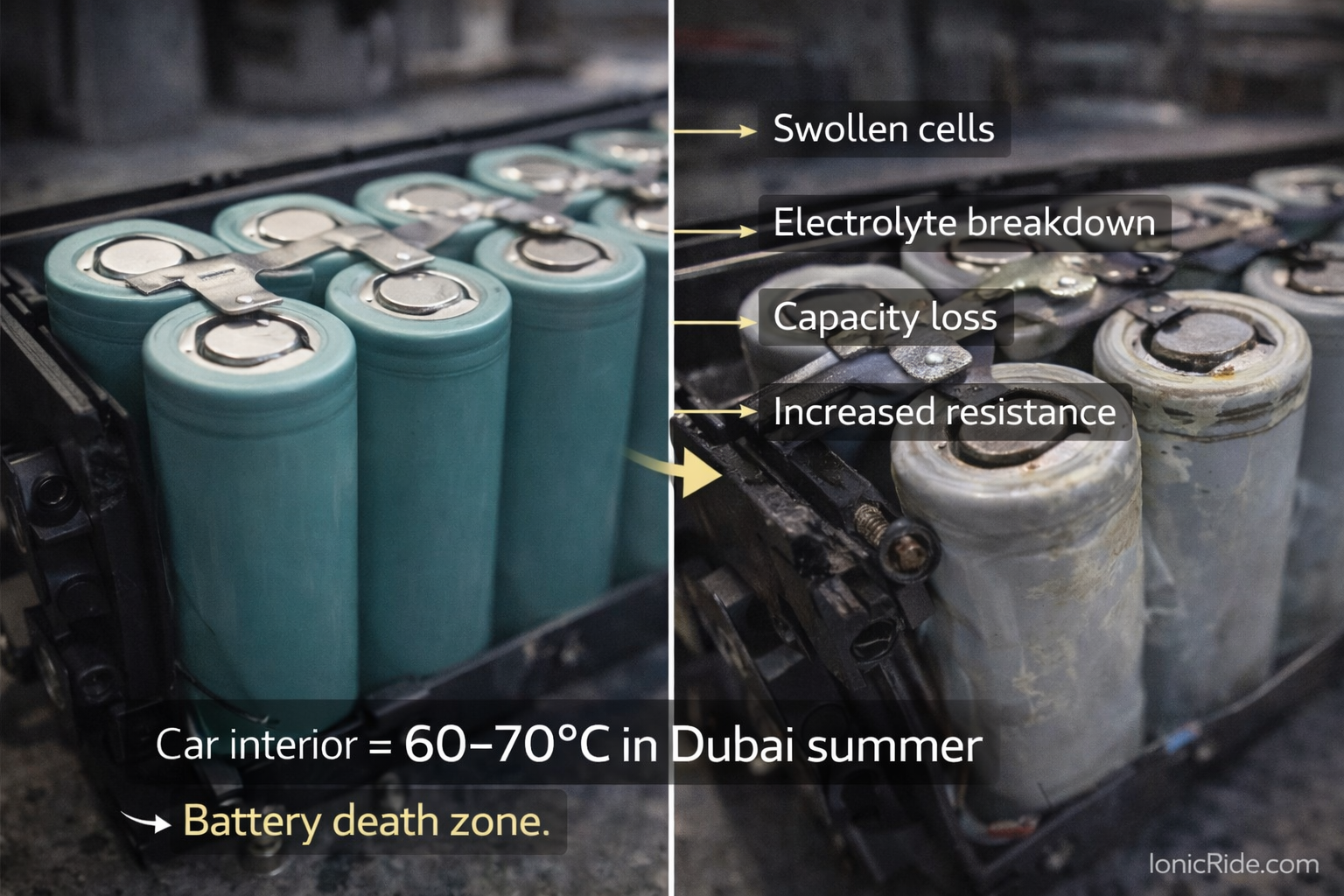
The electrolyte breaks down faster, which is why proper battery care in hot climates is critical.
Inside your battery are lithium-ion cells. Each cell has an electrolyte — basically a liquid that lets ions move between the positive and negative sides.
Heat accelerates chemical reactions. When the electrolyte heats up repeatedly, it breaks down. Think of it like cooking oil that’s been reused too many times — it stops working as well.
Once that starts, the battery can’t hold as much charge. Capacity drops. Range drops.
Internal resistance increases
As the battery degrades, it gets harder for current to flow through it. That’s internal resistance.
Higher resistance means the battery works harder to deliver the same power. It heats up more under load. Which causes more degradation. Which increases resistance further.
It’s a feedback loop. And heat kicks it off.
The BMS gets more protective
Your battery has a BMS — Battery Management System. Its job is to protect the cells from damage.
Depending on the system, temperature protection may reduce power or prevent charging. Do not rely on it as a substitute for proper storage and charging.
A high charge reading does not rule out temperature protection or another fault.
How bad is it in Dubai specifically?
Hot storage conditions can damage a battery even when the bike is not being ridden. A capacity test by a qualified service centre is more useful than guessing remaining battery life from age alone.
Cool, dry indoor storage: helps limit avoidable heat exposure.
Direct sun, balconies and parked cars: can expose the battery to temperatures outside its manufacturer’s limits.
These are practical comparisons, not results from IonicRide testing.
Charging in the heat makes it worse
Here’s what most people don’t realize: charging generates heat.
If you plug in your battery right after a ride in 45°C weather, you’re asking it to handle two heat sources at once — the ambient temperature and the heat from charging.
The BMS will slow the charge to protect the cells. But if you do this repeatedly, you’re still accelerating degradation.
What you can actually do about it
You can’t control the weather. But you can control where and how you store and charge your battery.
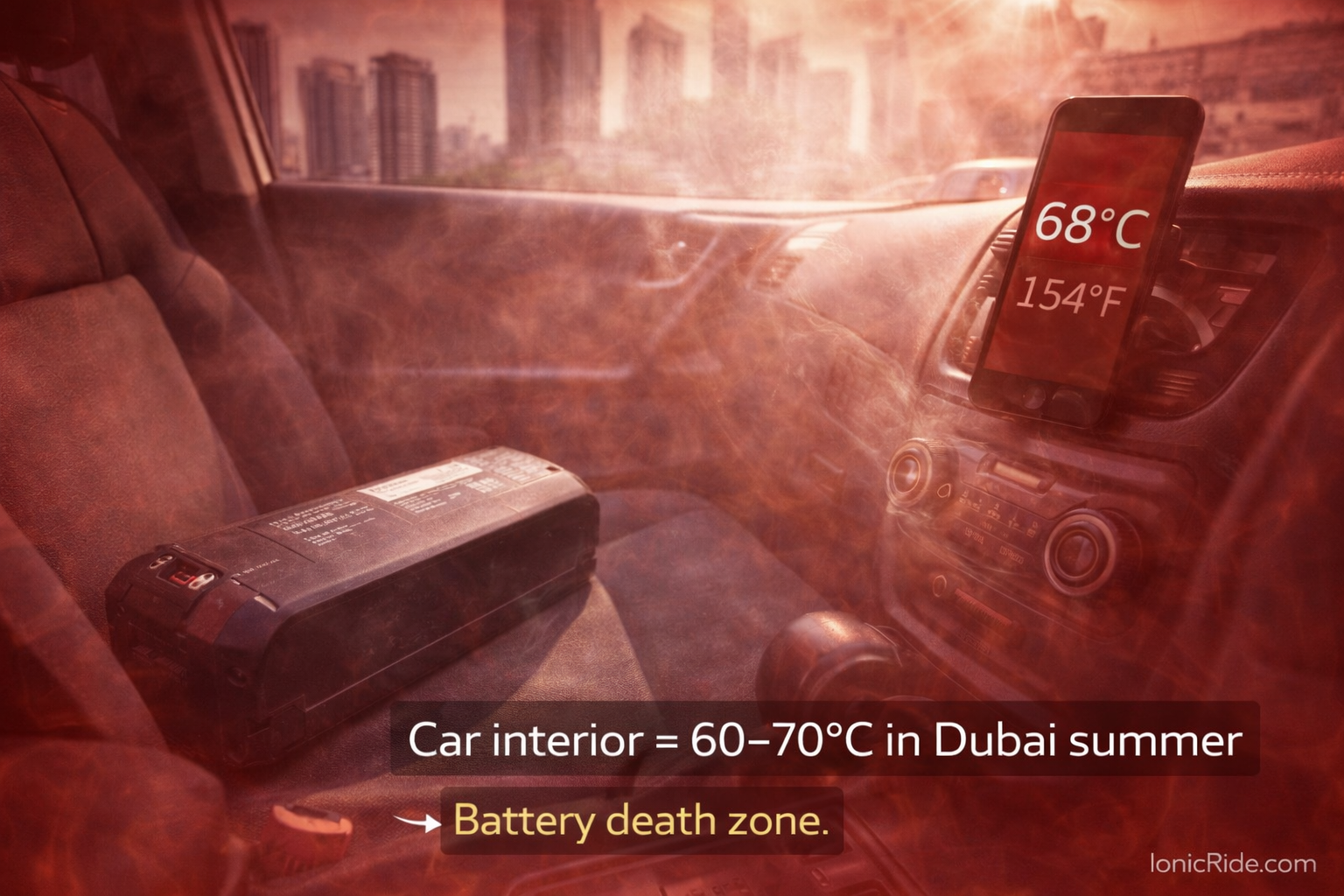
Never leave the battery in your car
A parked car can become much hotter than the outside air. Do not use it as battery storage in hot weather.
If you’re running errands, take the battery inside with you. Yes, it’s annoying. Yes, it’s heavy. But replacing a dead battery is more annoying and more expensive.
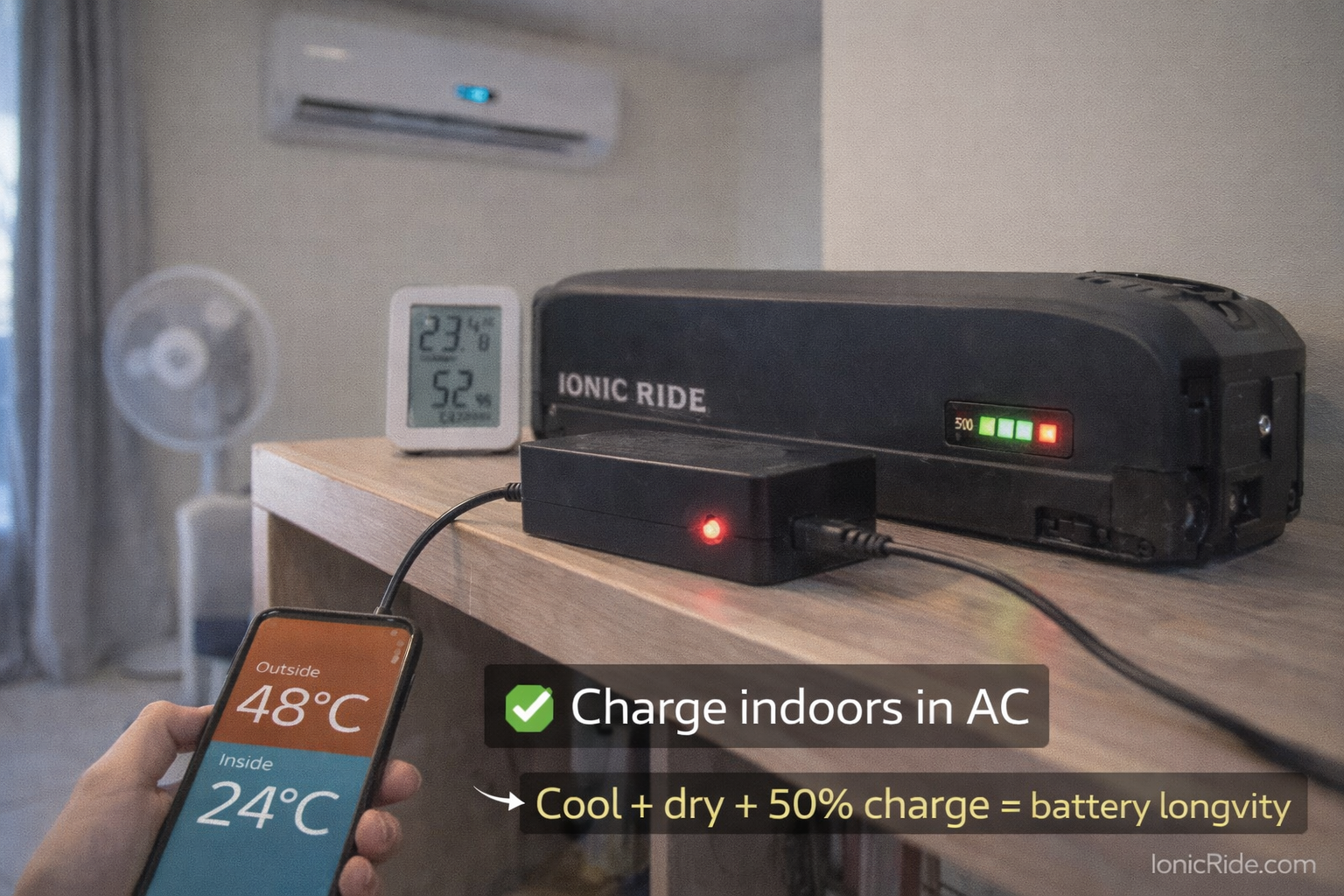
Charge indoors, in AC if possible
If you’ve got air conditioning, charge the battery in a cool room. 20–25°C is ideal.
If you don’t have AC, charge at night when it’s cooler. The difference between 30°C and 40°C is significant for battery health.
Let a hot battery cool naturally before charging. Use the temperature range in its manual; a fixed waiting time or touch test cannot confirm the internal cell temperature.
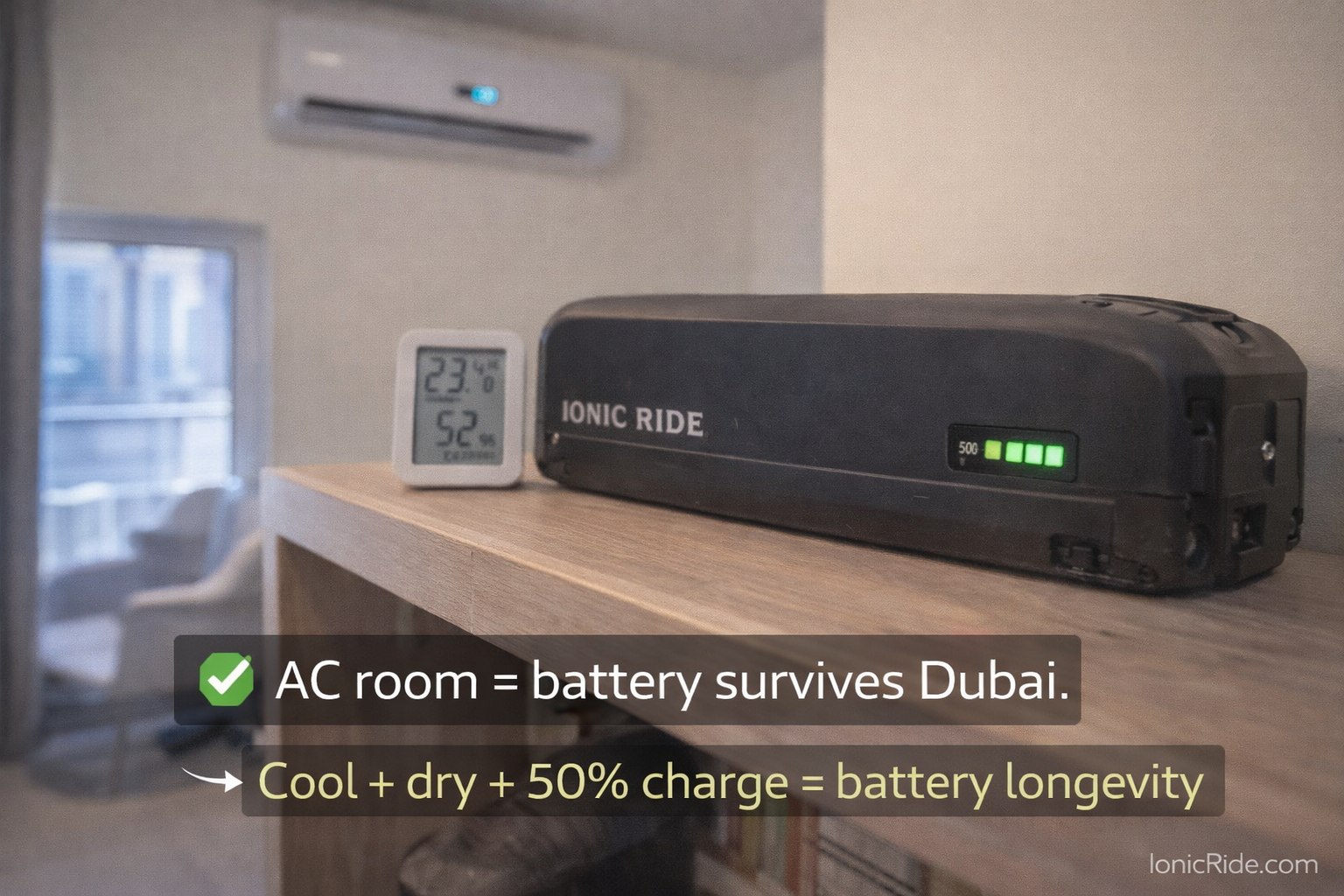
Store the battery indoors when not in use
Don’t leave your e-bike in the garage or on the balcony with the battery attached.
Remove the battery and store it inside. Even if your apartment gets warm, it’s still cooler than outside or in a garage with no ventilation.
Use the recommended charge level for long-term storage
If you’re not using the bike for a few weeks, don’t store the battery fully charged or fully dead.
For Bosch systems, the manufacturer recommends 30–60% for extended storage. Other systems may differ: follow your own manual and check the charge periodically.
A deeply discharged battery may be unsafe or unable to charge. Do not bypass its protection circuit, open the pack or attempt a jump-start. Ask an authorised service centre to assess it.
Avoid fast charging in summer if you can
Fast chargers push more current into the battery, which generates more heat.
If you’ve got time, use the standard charger. It’s slower, but it’s gentler on the cells — especially in hot weather.
Can you reverse heat damage?
No.
Once capacity is lost, it’s gone. You can’t bring it back.
Good care can reduce avoidable wear, but ageing continues. It cannot restore capacity permanently lost through chemical degradation.
That’s why prevention matters. The earlier you start protecting your battery from heat, the longer it’ll last.
How long should an e-bike battery last in Dubai?
There is no reliable Dubai-wide lifespan figure. Battery design, charge cycles, storage conditions and use all matter. Compare your range under similar conditions and seek a diagnostic check if it falls sharply.
Check your battery warranty
Read the specific warranty and care instructions supplied with your bike. Coverage, capacity guarantees and exclusions vary. Keep your receipt and ask the seller to explain the terms before buying.
Manufacturer guidance
Bosch’s battery-care guidance explains cooling before charging, compatible chargers and storage conditions. These Bosch-specific limits do not replace the instructions for another brand.
Bottom line
Heat is one of several factors that can shorten an e-bike battery’s useful life.
You can’t avoid the weather. But you can avoid leaving your battery in a hot car, charging it in direct sun, or storing it on a balcony in summer.
These precautions reduce avoidable heat exposure, but they cannot guarantee a particular lifespan.