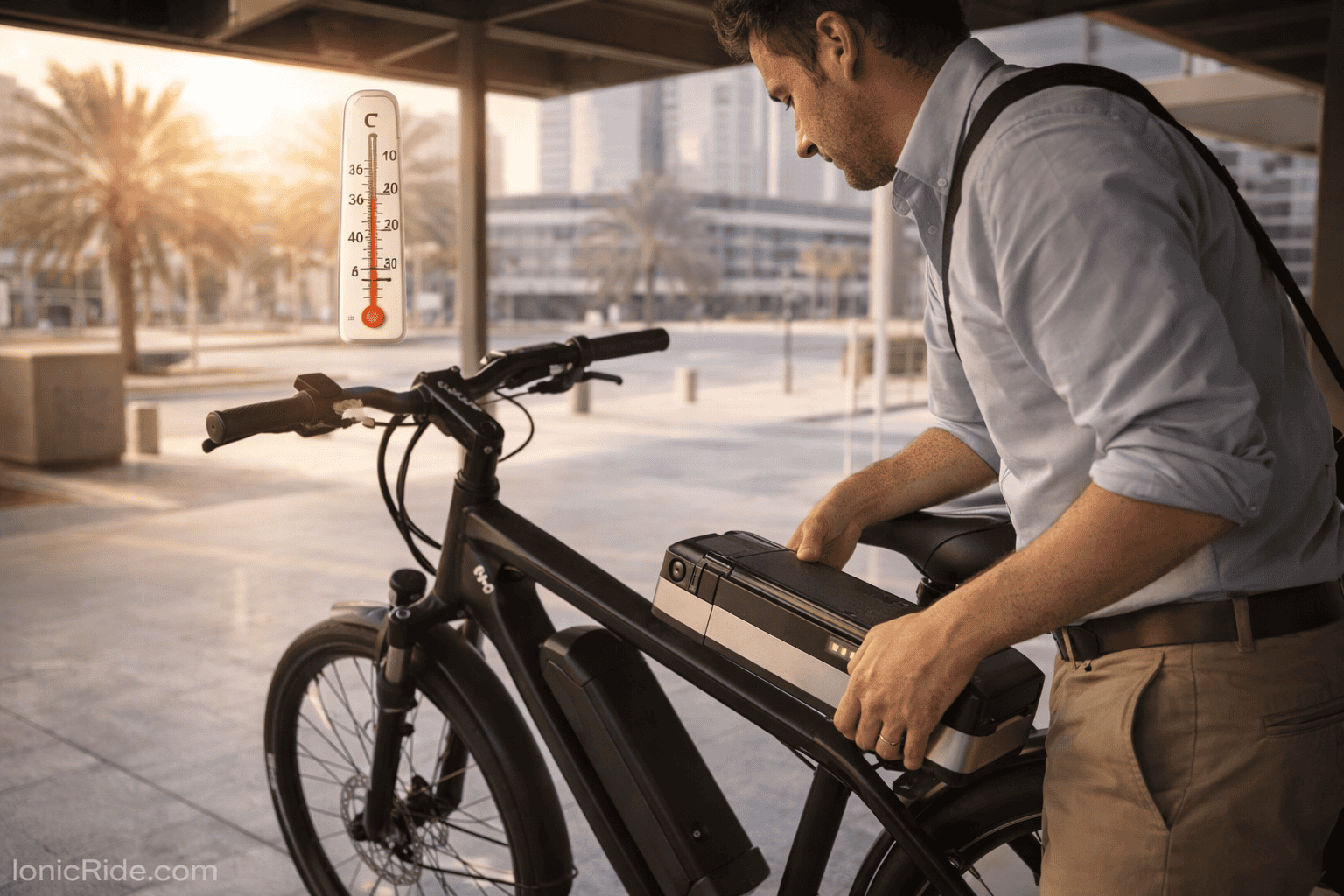
How to Extend Your E-Bike Battery Life in Hot Climates
How to Extend Your E-Bike Battery Life in Hot Climates
I get asked this at least once a day: “How do I make my battery last longer?”
Most people expect some complicated routine. Special chargers. Expensive additives. Magic tricks.
The truth? It’s simpler than that. And most of it comes down to just not doing the things that kill batteries fast.
The two things that age batteries fastest
Before we get into what to do, let’s be clear about what we’re fighting against.
Batteries degrade naturally over time. You can’t stop that completely. But you can slow it way down by avoiding two things:
Heat. We covered this in detail already — if you’re in the UAE, heat is your biggest enemy. This goes deeper here: how Dubai heat affects e-bike batteries.
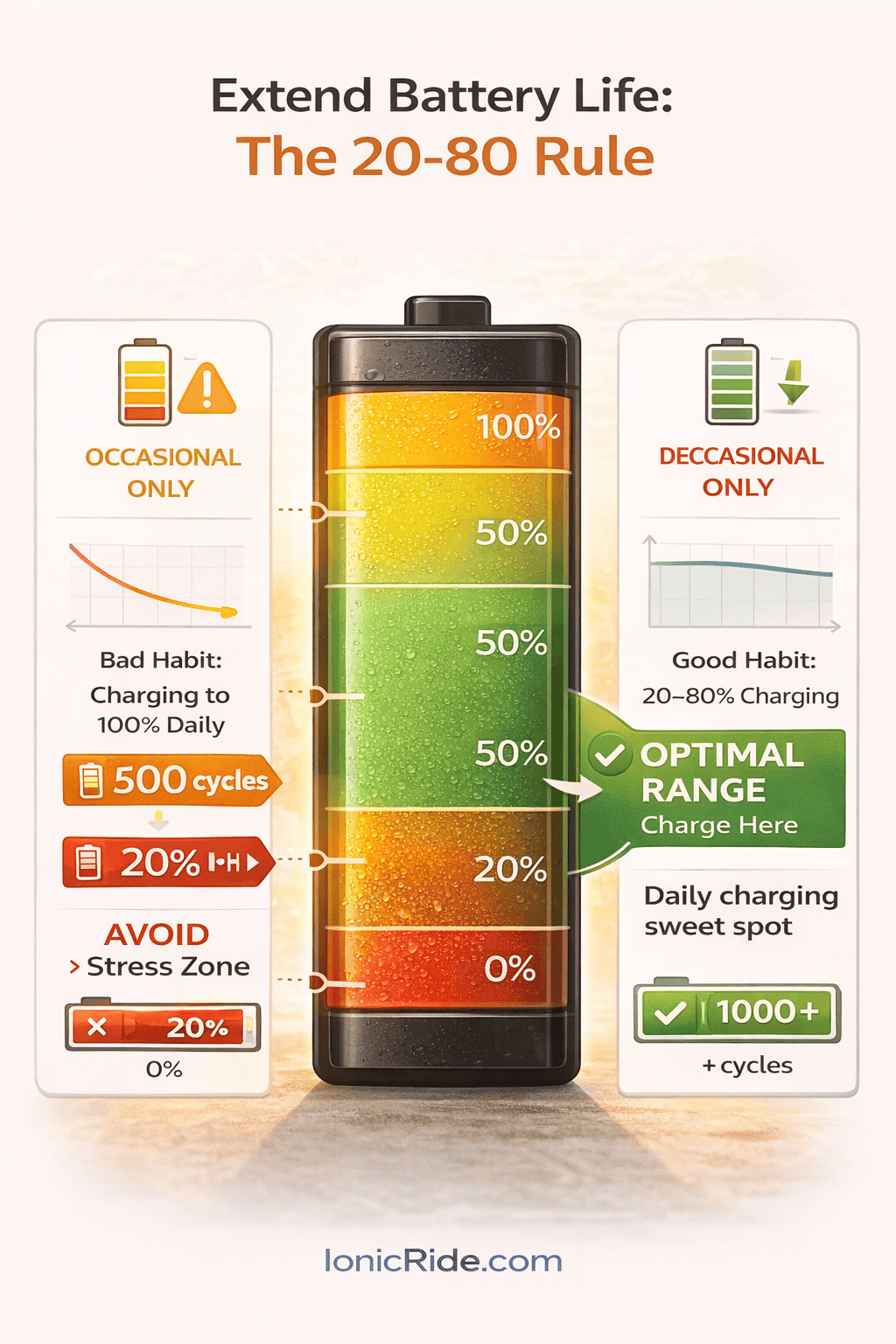
Voltage stress. Keeping a battery at 100% charge or letting it drop to 0% puts stress on the cells. The more time it spends at these extremes, the faster it ages.
Everything else — charge cycles, vibration, age — matters too. But if you manage heat and voltage stress, you’ve handled 80% of the problem.
Stop charging to 100% every time
This one surprises people.
Most of us plug in our phones, laptops, and e-bikes and charge them to full. It’s automatic. But lithium-ion batteries don’t like sitting at 100%.
When a battery is fully charged, it’s under maximum voltage stress. If it stays there for hours — or days — the cells degrade faster.
“I should always charge to 100% to get maximum range.”
Reality: You only need 100% if you’re actually using that range. If you’re just commuting 15km and your battery does 50km, charging to 80% is better for long-term health.
What to do instead
If your e-bike or charger has a charge limit setting, use it. Set it to 80% for daily use. Only charge to 100% when you know you’ll need the full range.
If your charger doesn’t have that option, use a timer plug. Charge for the time it takes to hit 80%, then the plug cuts power automatically.
How do you know when you’re at 80%? Rough math: if it takes 4 hours to charge from empty to full, it takes about 3 hours to hit 80%. Test it once, note the time, and use that as your baseline.
Charging to 80% instead of 100% can extend your battery’s usable lifespan by 30–50%. That’s an extra year or more of capacity before you’re thinking about a replacement. The opposite tends to happen when batteries aren’t treated this way — why e-bikes start feeling sluggish after 6 months.
Don’t let it drop to 0% either
The flip side of the 100% problem is the 0% problem.
Running your battery completely dead — where the bike cuts out and won’t turn on anymore — puts stress on the cells. The BMS shuts everything down to protect them, but the damage is already starting.
If the battery sits dead for days or weeks, the cells can drop below the safe minimum voltage. This is exactly how many “won’t charge” cases start — explained step by step here: e-bike battery won’t charge: step-by-step fix. At that point, the BMS might lock it out permanently. You’ll plug it in and nothing happens. That’s when people bring it to the shop and ask if it’s fixable.
Sometimes it is. Sometimes it’s not.
What to do instead
Recharge when you hit 20–30%. Don’t wait until the display is flashing red and the motor is cutting out.
Think of it like a fuel gauge. You wouldn’t run your car until it sputters and dies on the highway. Same logic applies here.
The 20–80% rule (and why it works)
So if you’re not supposed to charge to 100% or drain to 0%, what’s the ideal range?
20–80%.
Keep your battery between those two numbers for daily use, and you’ll minimize voltage stress on both ends.
Does this mean you lose range? Yes — technically. You’re only using 60% of the battery’s capacity instead of 100%.
But here’s the tradeoff: the battery lasts years longer. Instead of replacing it at 2–3 years, you might get 4–5. That’s worth more than squeezing out an extra 10km per charge.
If you genuinely need the full range — long ride, no charging options along the way — charge to 100%. That’s what the battery is for. Just don’t make it a daily habit.
Store it properly when you’re not riding
If you’re not using your e-bike for a few weeks — travel, injury, off-season — don’t just leave the battery on the bike and forget about it.
Batteries slowly self-discharge even when not in use. If it drops too low and sits there, you’re asking for problems.
Best storage practice
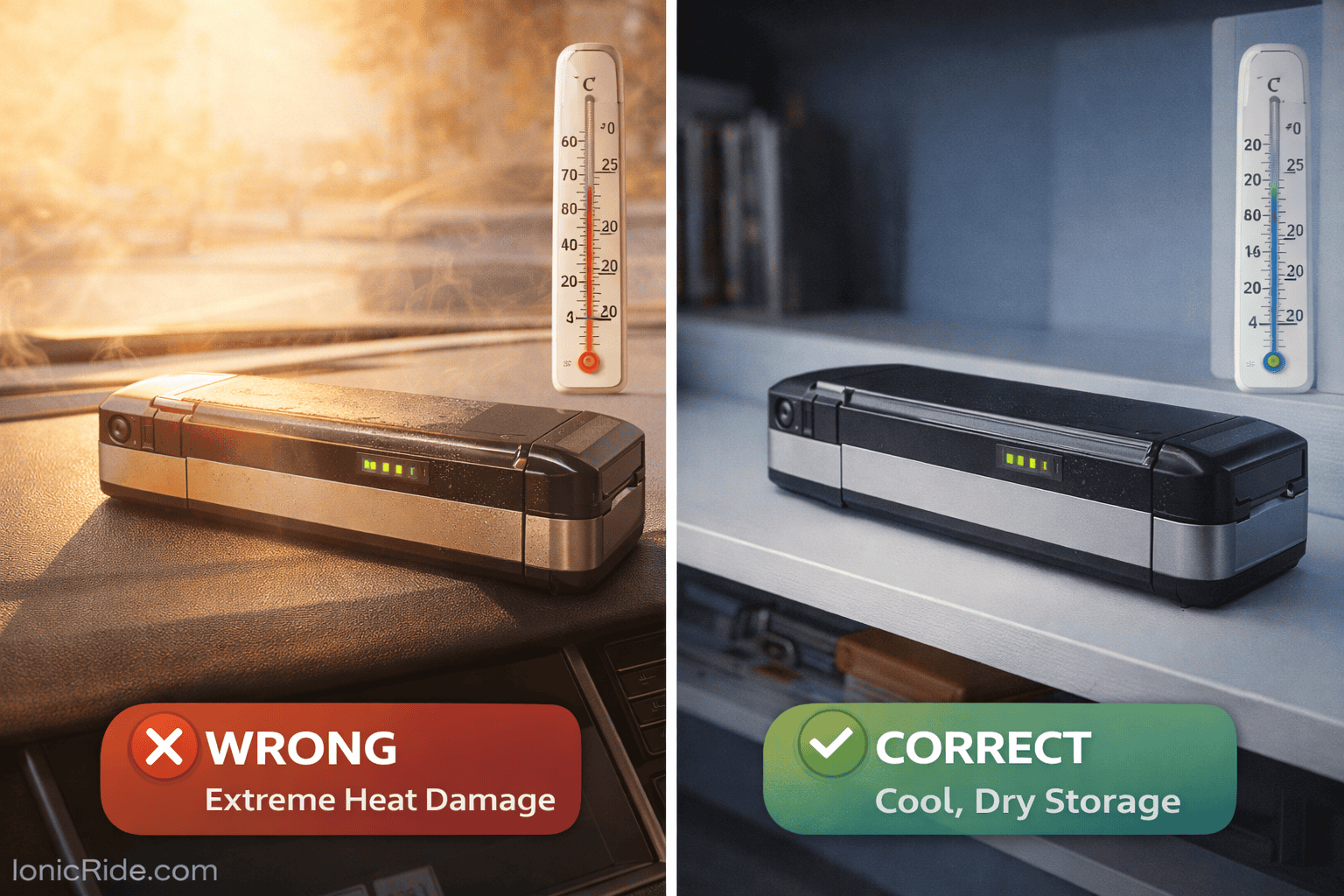
Charge the battery to around 50–60%. Not full, not empty — right in the middle.
Store it somewhere cool and dry. Indoors, away from direct sunlight. If you’ve got AC, even better.
Check it once a month. If it’s dropped below 40%, top it back up to 50–60%.
Leave the battery fully charged in storage. It’ll degrade faster sitting at 100% than it would sitting at 50%.
Avoid extreme heat during charging
We already talked about heat damage in general. But charging in the heat is a specific problem worth repeating.
When you charge a battery, it generates heat internally. If the ambient temperature is already 40°C+, you’re stacking two heat sources.
The BMS will throttle the charge rate to protect the cells, so charging takes longer. But even with that protection, you’re still aging the battery faster than if you charged it in cooler conditions.
What to do
If you can charge indoors with AC, do it. If not, charge at night when temperatures drop.
If your battery feels hot after a ride, let it sit for 20–30 minutes before plugging it in. Touch the casing with your hand — if it’s noticeably warm, wait.
Use the right charger (and don’t cheap out on replacements)
This should be obvious, but I’ve seen it enough times that it’s worth saying: use the charger that came with your bike. Or, if you need a replacement, get one from the manufacturer or a verified compatible option.
Cheap third-party chargers — especially the ones that claim to be “fast chargers” for half the price — often don’t regulate voltage properly. They might overcharge the battery slightly, or deliver inconsistent current, or skip safety checks the BMS expects.
Over time, that adds up. You’re saving $30 on a charger and losing $300 on a battery that dies early.
Contact the manufacturer first. If they don’t sell replacements, ask them for a list of compatible third-party options. Don’t just buy the first thing you find on Amazon.
Fast charging: use it sparingly
Some e-bikes support fast charging. You can go from 20% to 80% in an hour or less instead of 3–4 hours.
Fast charging works by pushing more current into the battery. More current = more heat. More heat = faster degradation.
It’s not going to kill your battery if you use it occasionally. But if you fast-charge every single day because you’re always running late, you’re shortening the battery’s lifespan.
When to use it, when to skip it
Use fast charging when you actually need it — you’re in a hurry, you need the range now, and waiting isn’t an option.
Skip it for overnight charging or anytime you’ve got a few hours. The standard charger is gentler on the cells.
Keep the battery firmware updated (if applicable)
Some newer e-bikes have updatable battery firmware. The manufacturer releases updates that improve BMS logic, optimize charging behavior, or fix bugs that could cause premature degradation.
Most people never check for these updates. If your battery supports it, check once every 6 months. It takes 10 minutes and could add months to your battery’s life.
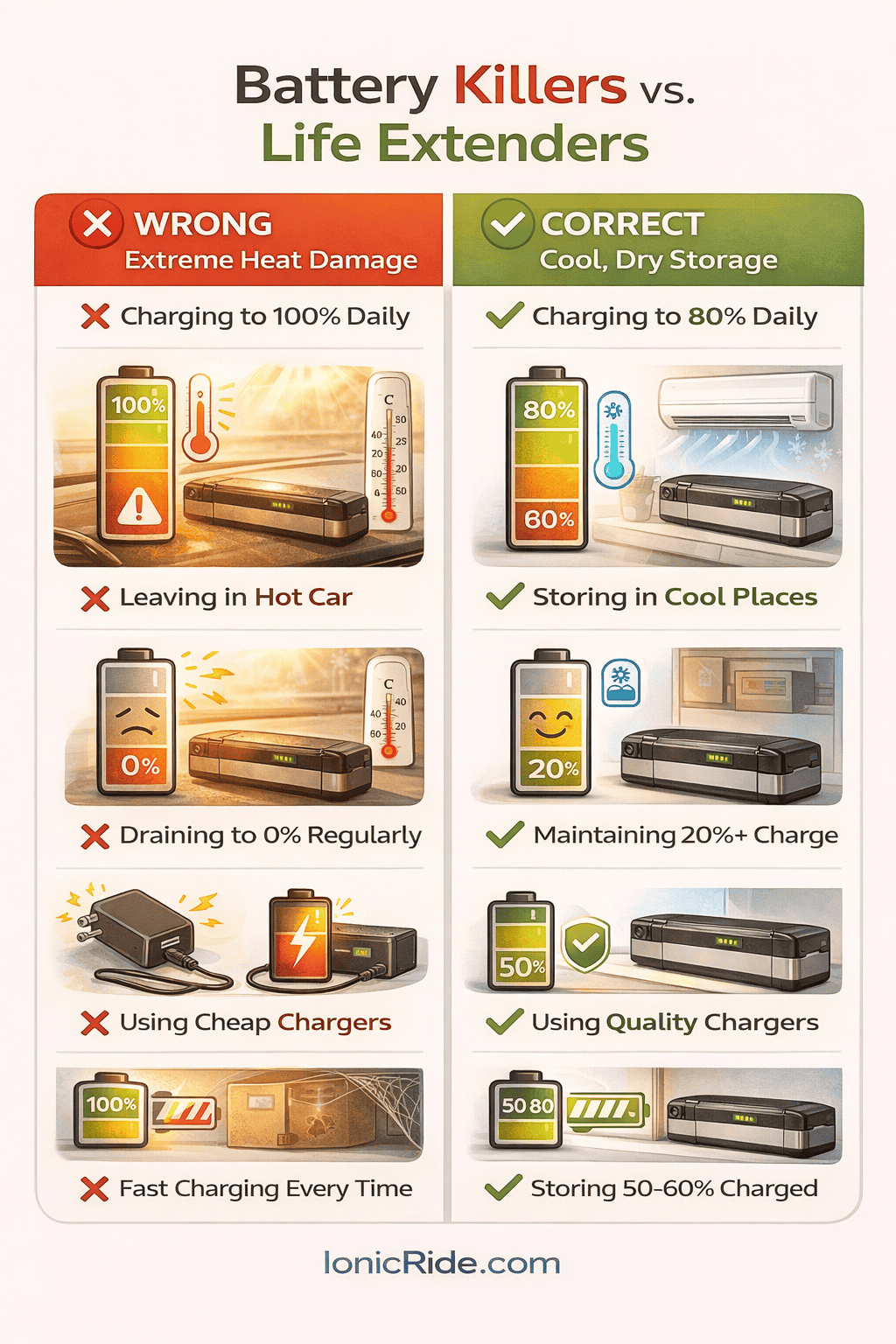
Do’s and Don’ts (quick reference)
✓ DO:
- Charge to 80% for daily use
- Recharge at 20–30%, not 0%
- Store at 50–60% if not using for weeks
- Charge indoors in AC when possible
- Let battery cool after riding before charging
- Use the original or verified compatible charger
- Check battery monthly during long storage
✗ DON’T:
- Charge to 100% every single day
- Let it drain to 0% regularly
- Store fully charged for weeks
- Charge in direct sun or hot garage
- Leave battery in car during summer
- Use cheap knockoff chargers
- Fast-charge every day unless necessary
How much difference does this actually make?
Customer A: Charges to 100% daily, leaves battery in car sometimes, drains it to 0% once a week. After 18 months, battery’s at ~65% of original capacity.
Customer B: Charges to 80% most days, stores indoors, recharges at 30%. After 18 months, battery’s at ~88% of original capacity.
That’s a 23% difference in capacity after the same amount of time. Customer B will get another year or two out of that battery before replacing it. Customer A is already shopping for a new one.
Same bike. Same riding conditions. Different habits.
You don’t have to be perfect
Look — I’m not saying you need to obsess over every charge cycle and check battery voltage with a multimeter before every ride.
You’ll forget sometimes. You’ll need the full 100% for a long ride. You’ll leave it in the car once because you were in a hurry.
That’s fine. Batteries are resilient. One mistake isn’t going to kill it.
What matters is your default behavior. If most of the time you’re charging to 80%, storing it indoors, and not draining it to empty — you’re already ahead of 90% of e-bike owners.
Final thought
Battery replacement costs vary, but figure $300–$800 depending on capacity and brand.
Following these practices costs nothing except a little habit change.
If it buys you an extra year or two before replacement, that’s a pretty good return on effort.