E-Scooter Suddenly Feels Slow – How to Diagnose It
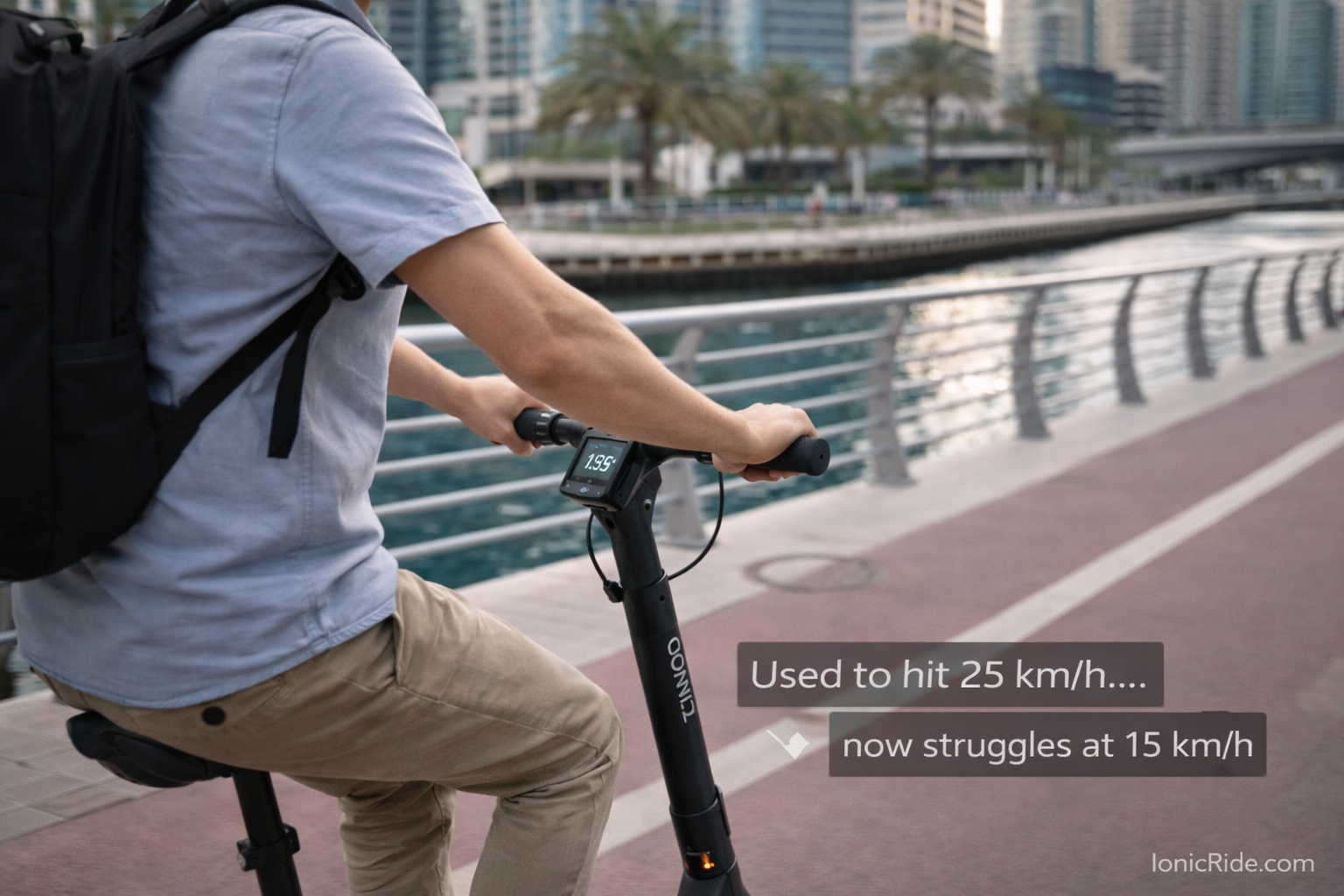
Your e-scooter used to hit 25 km/h no problem. Now it struggles to reach 15 km/h, even on flat ground with a full battery.
You haven’t dropped it. You haven’t changed anything. But something’s off.
Here’s how to figure out what’s actually slowing it down — and whether you can fix it yourself or need a shop.
Five possible causes to check
Start with the simple checks below. These are possible causes, not a statistical ranking or a diagnosis of your scooter.
1. Tire pressure is low
Tire pressure is an easy first check on a scooter with pneumatic tires.
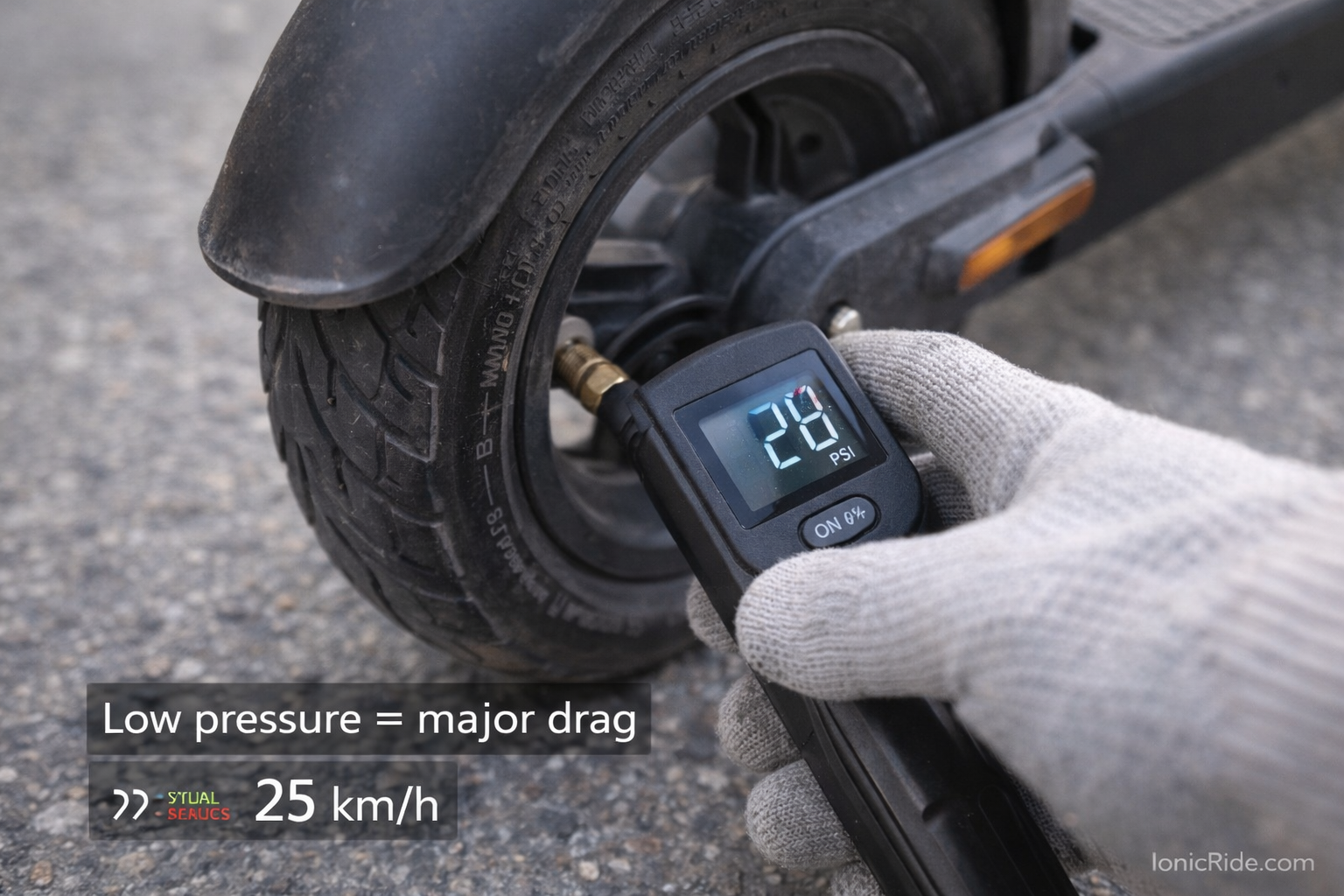
Low tire pressure creates more rolling resistance. The motor has to work harder to move the scooter, so top speed drops. Battery drains faster. Everything feels sluggish.
Most people don’t check tire pressure regularly. The tires lose air slowly over time — especially in hot climates where temperature swings cause air to expand and contract.
How to check
Use a pressure gauge on pneumatic tires. A thumb test is not accurate enough.
Use the cold-tire pressure specified in your scooter manual for your tire and load. A sidewall maximum is not necessarily the recommended operating pressure.
Inflate gradually with a suitable pump and gauge, staying within the manufacturer’s limits. Check for damage or leaks before a short, controlled test ride.
If your scooter has solid (airless) tires, skip this step. Solid tires don’t lose pressure — but they also wear down over time, which can reduce grip and performance.
2. The battery is degraded
The battery gauge might say 100%, but that doesn’t mean the battery is healthy.
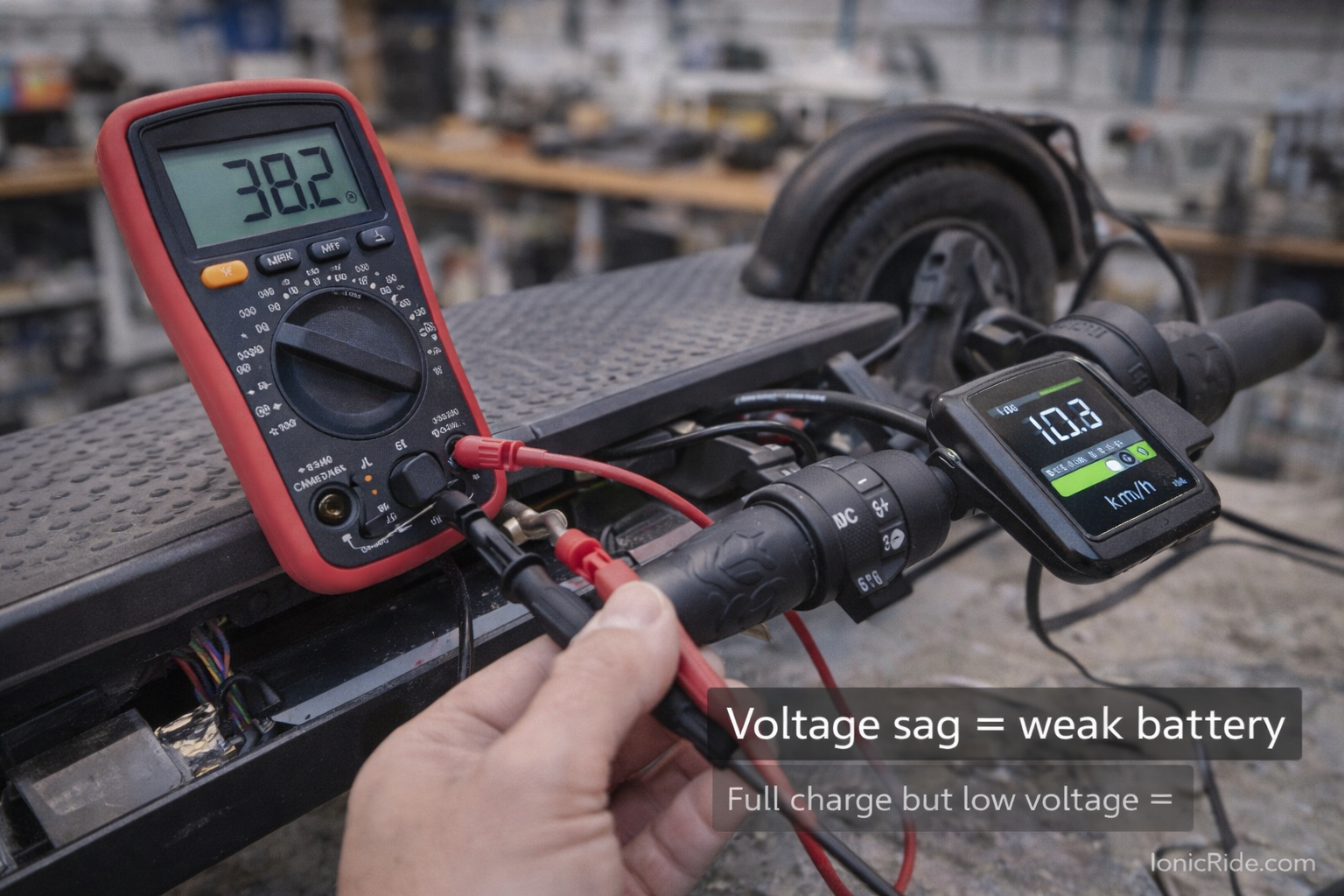
As lithium-ion batteries age, they lose capacity. A battery that used to hold 10 amp-hours might only hold 7 amp-hours now. The voltage it can deliver under load drops. The motor can’t pull as much power, so top speed decreases.
How to tell if it’s the battery
Power loss under acceleration or on hills can be consistent with voltage sag, but it can also have other causes. A technician should confirm the fault.
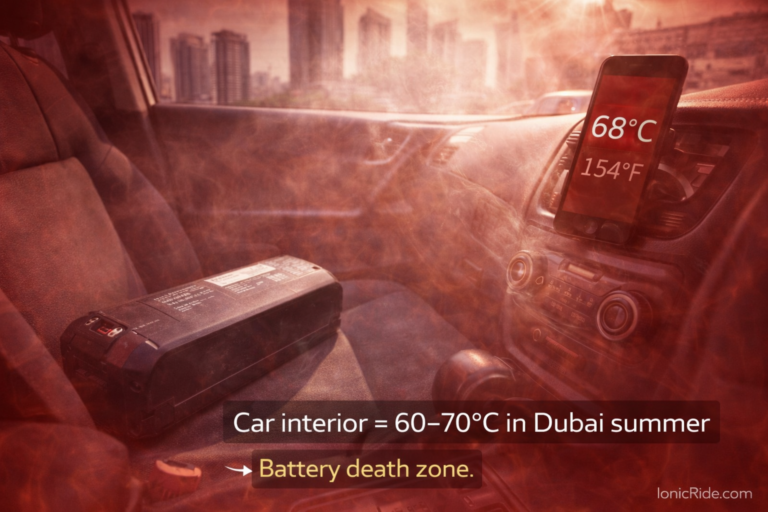
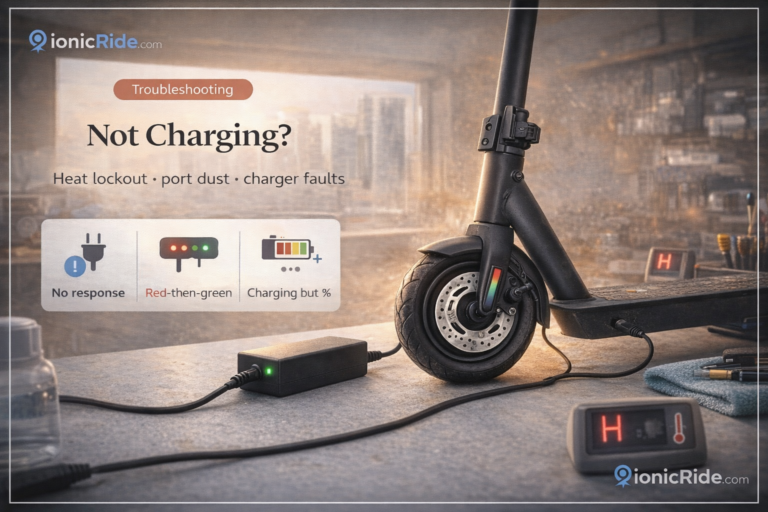
Has the battery been exposed to extreme heat regularly? Stored in a hot car, charged in direct sun, left outside in UAE summer? Heat can accelerate battery ageing – learn more about how Dubai heat affects battery lifespan.
If your scooter is 2+ years old and has been used heavily in hot weather, battery degradation is likely. You’re not getting it back — you’ll need a replacement eventually.
What you can do
Do not open the battery or probe exposed terminals. Nominal voltage and fully charged voltage differ, and a single reading does not prove that cells are defective.
A qualified service centre can check the battery, charger and connections with appropriate diagnostic equipment. IonicRide publishes guidance and does not provide a repair service.
3. The motor is overheating and throttling
E-scooter motors generate heat when they work. If the motor gets too hot, the controller cuts power to protect it. That’s called thermal throttling.
If power falls as the scooter heats up and returns after cooling, temperature protection is one possible explanation. Check the display for warnings and follow the manual before riding again.
Why it happens
Hot weather. If it’s 45°C outside and you’re riding hard, the motor has no way to cool down fast enough.
Heavy load. If you’re over the scooter’s weight limit, or carrying a backpack with 10kg of groceries, the motor works harder and heats up faster.
Continuous uphill riding. Climbing hills generates way more heat than flat-ground riding. The threshold depends on the model, load and conditions.
What you can do
Ride during cooler times of day. Morning or evening instead of midday in summer.
Take breaks on long rides. Stop if a temperature warning appears and let the system cool according to its manual.
Reduce the load. If you’re carrying heavy stuff, lighten it or split it into multiple trips.
If the scooter is throttling constantly even in normal conditions, the motor might be failing. That’s a shop repair – similar to issues covered in our motor cutting out troubleshooting guide.
4. Brake drag
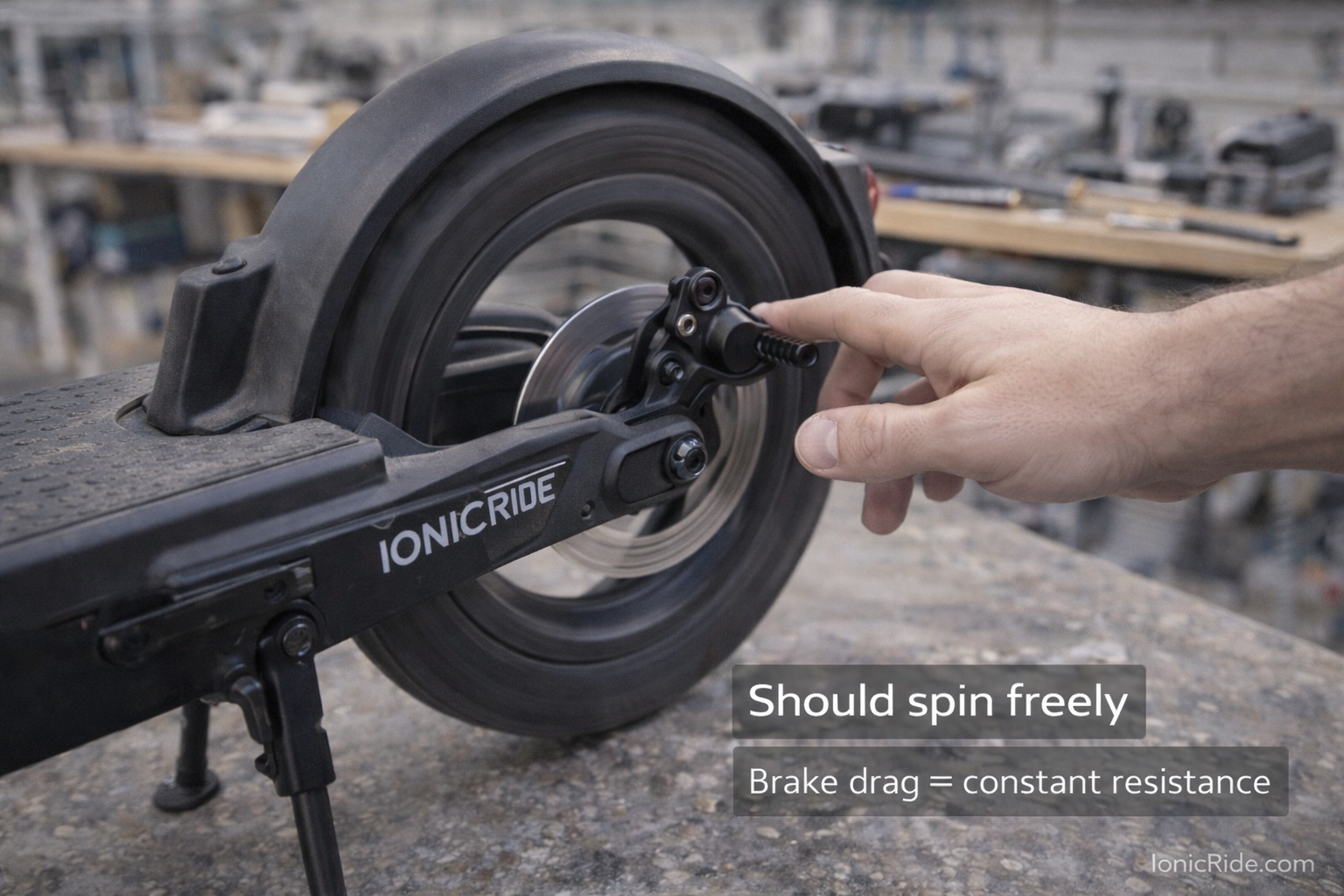
If your brakes are rubbing against the wheel — even slightly — the motor has to fight that resistance constantly. Top speed drops. Battery drains faster. You might not even notice the drag until you check.
How to test
Switch the scooter off and support it securely before turning a wheel by hand. Keep fingers away from discs and moving parts.
Listen for brake rubbing and check for unusual resistance. A motor-driven wheel may resist rotation even with correctly adjusted brakes.
Stopping quickly alone does not prove brake drag. Have persistent rubbing or roughness checked.
For disc brakes:
Check if the brake caliper is properly aligned. If it’s crooked or the pads are worn unevenly, they’ll rub. You can sometimes fix this by loosening the caliper bolts, centering it, and retightening. Or replace the pads if they’re worn.
For drum or electronic brakes:
These are harder to adjust yourself. If you suspect brake drag, take it to a shop. A qualified technician can assess them.
5. The controller is in a limited mode
Most e-scooters have multiple speed modes — eco, normal, sport, etc. If your scooter is stuck in eco mode, it’ll feel slow even with a full battery.
How to check
Look at the display. Does it show which mode you’re in? Cycle through the modes using the button or app (if your scooter has one).
Check the intended riding mode in the manual. Keep any test within the permitted speed for your location; do not remove limiters.
If the mode won’t change, or if the scooter feels slow even in sport mode, the controller might have a fault. That’s usually not a DIY fix.
Less common causes (but still possible)
Bearing failure
The wheel bearings let the wheels spin freely. If they’re worn out or seized, the wheels won’t spin smoothly. You’ll feel resistance, and top speed drops.
To check: Spin the wheels by hand (scooter lifted off the ground). If you hear grinding or feel roughness, the bearings are bad. They’ll need to be replaced.
Motor magnets or wiring damage
If the motor took a hard impact — pothole, curb, crash — internal components might be damaged. Magnets can crack. Wires can come loose. Motor efficiency drops.
This usually comes with other symptoms: weird noises, vibration, or the motor cutting out randomly.
Firmware issue
Some scooters have updatable firmware. A buggy update can limit speed or throttle response. Check the manufacturer’s app or website for firmware updates. Use only manufacturer-approved update and recovery instructions.
Diagnostic checklist
Use this checklist to record symptoms and decide when professional diagnosis is needed:
Step 1: Check tire pressure
Inflate to spec. Test ride. If speed is back to normal, problem solved. If not, move to step 2.
Step 2: Test the battery
Note charge level, range changes and error codes. Have a technician perform electrical tests; do not open or bypass the battery pack.
Step 3: Check for brake drag
Spin the wheels. If there’s resistance, adjust or service the brakes. If wheels spin freely, move to step 4.
Step 4: Check bearings
Spin the wheels and listen. Grinding or roughness = bad bearings. Replace them. If smooth, move to step 5.
Step 5: Test in different speed modes
Make sure it’s not stuck in eco mode. Try all modes. If speed is still limited, the controller or motor is likely the issue.
Step 6: Motor and controller diagnosis
Motor, wiring and controller testing require suitable tools and model-specific procedures. Ask a qualified technician to identify the fault before buying parts.
When it is worth fixing rather than replacing
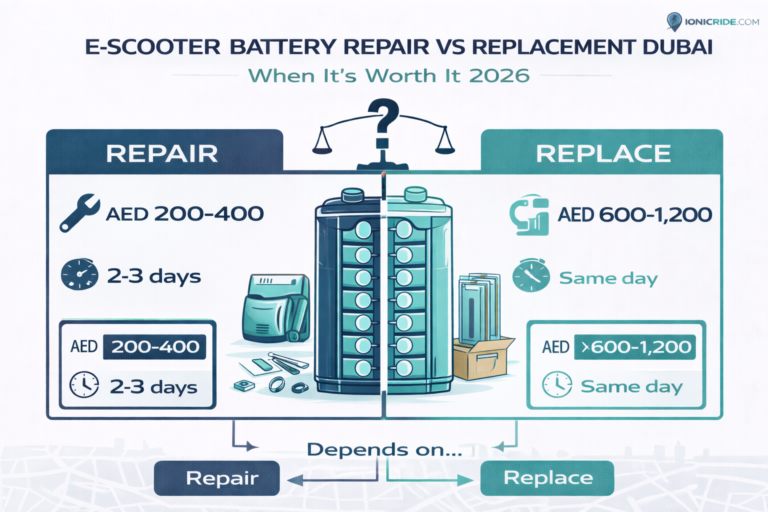
Get a written local quote covering diagnosis, compatible parts and labour. Compare it with the cost of an equivalent scooter and consider the condition of the battery, brakes and frame. Prices vary too much by model to give a reliable universal repair figure.
Do not ignore a new loss of performance
Compare performance under similar load, charge and route conditions. Stop riding if you notice damaged wiring, unusual heat, a battery warning or a braking fault. A change in speed alone is not enough to identify the problem.
For model-specific limits and procedures, use the manufacturer’s support and manuals or the manual supplied with your scooter.