E-Bike Motor Cutting Out? Here’s What to Check First
E-Bike Motor Cutting Out? Here’s What to Check First
You’re riding. Everything’s fine. Then the motor just… stops. No warning. No error message. Just dead.
Wait a few seconds. Try again. It works. For a while. Then it cuts out again.
I see this problem at least once a week. And 90% of the time, it’s one of three things.
First: What kind of cutout are you dealing with?
Before you start checking components, figure out the pattern. How the motor cuts out tells you where to look.
Motor works fine on flat ground, but cuts out when you hit a hill or try to accelerate hard. Usually the battery or a loose connection.
Motor dies at random times — flat ground, uphill, low speed, high speed. Could be several things: loose wire, faulty controller, intermittent sensor issue.
Works fine at first, then starts cutting out repeatedly after you’ve been riding for a while. Usually overheating — motor, controller, or battery.
Motor dies the moment you hit a pothole or rough pavement, then comes back after a few seconds. Almost always a loose connection somewhere.
Knowing the pattern cuts your diagnostic time in half. Now let’s work through the most common causes.
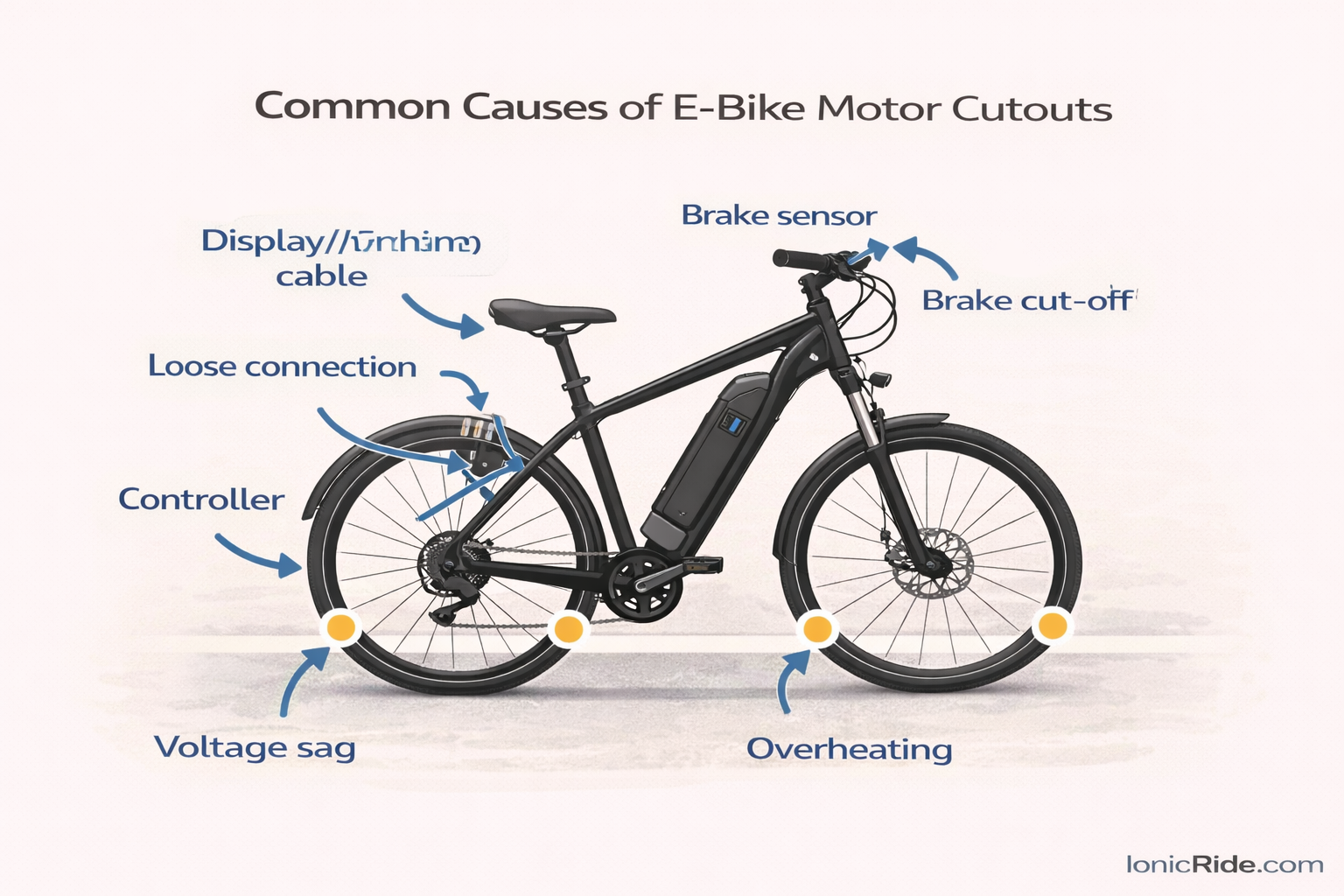
1. Loose or corroded connections
This is the most common cause. And the easiest to fix.
E-bikes have a lot of connectors — battery to controller, controller to motor, display to controller, brake sensors, throttle. Any one of those connections can work loose over time from vibration.
A loose connection might work fine most of the time, but when you hit a bump or the wire flexes, contact breaks for a split second. The motor cuts out. The connection reestablishes itself. Motor comes back.
(It’s like when you had to wiggle the Nintendo cartridge to make it work. Except here it’s your motor, not Mario.)
How to check
Turn off the bike. Open the battery compartment and any access panels you can reach.
Look at every connector you can see. Are they fully seated? Any corrosion on the pins? Any signs of water damage?
Unplug each connector, inspect it, and plug it back in firmly. Make sure you hear or feel it click into place.
Pay special attention to:
- Battery discharge connector (main power connection)
- Motor phase wires (usually three thick wires going to the wheel)
- Controller connections (everything connects here, so it’s a common failure point)
- Display cable (if your display goes blank when the motor cuts out, this is the culprit)
After reseating connections, take the bike for a short test ride. Hit some bumps. If the cutouts stop, you found it. If they continue, move to the next check.
2. Battery voltage sag under load
If the motor cuts out when you’re climbing hills or accelerating hard, the battery might not be able to deliver enough current.
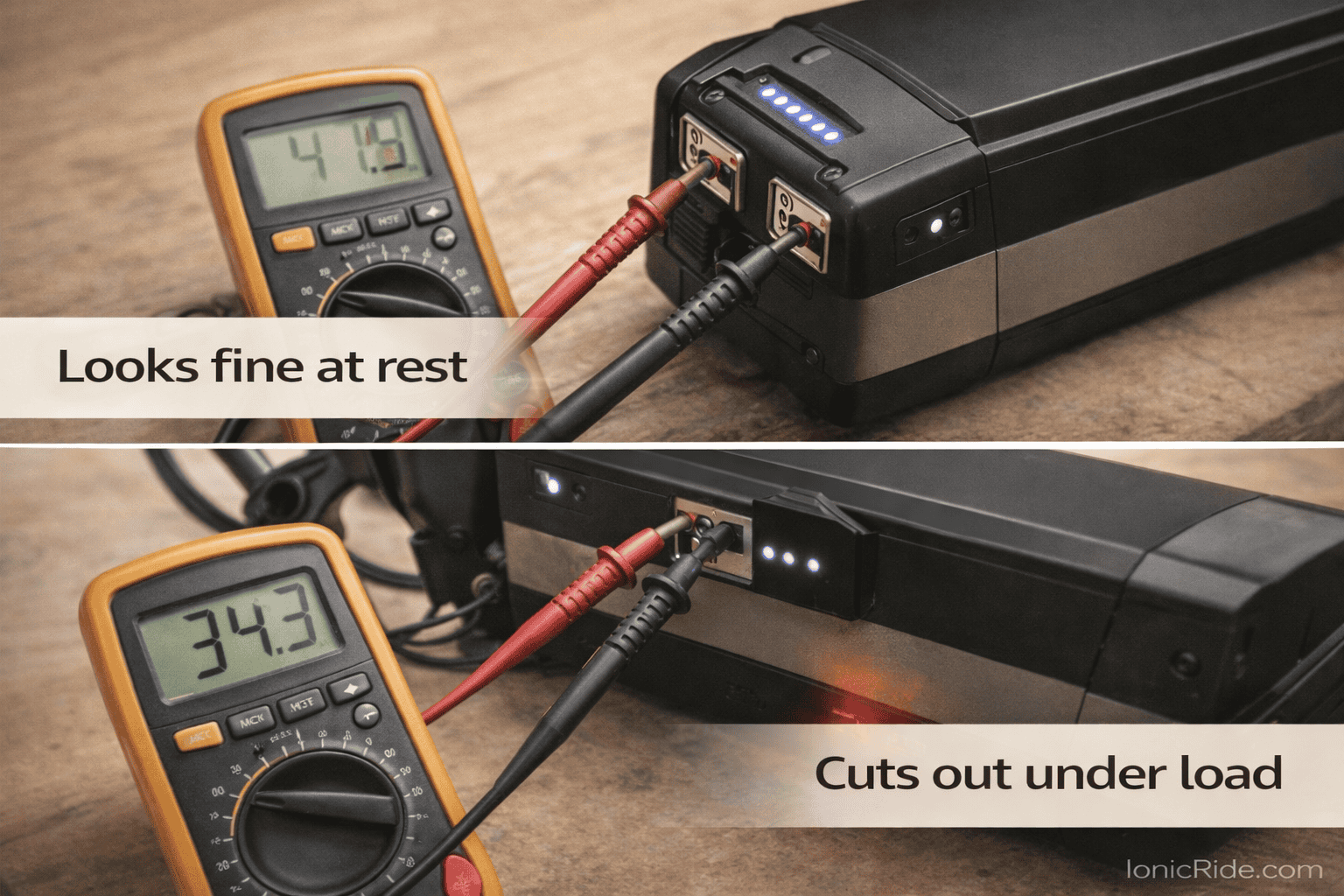
When you demand more power, the battery voltage drops temporarily. If it drops below the controller’s minimum threshold, the controller shuts down to protect itself. Motor cuts out.
A few seconds later, voltage recovers. Motor comes back. Repeat.
Why this happens
Battery is old or degraded. The cells can’t sustain high current draw anymore.
Battery is too cold. Lithium cells lose performance in cold weather. (Not a big problem in the UAE, but if you’re riding early morning in winter, it’s possible.)
Battery connections are weak. If the discharge connector isn’t making good contact, resistance goes up and voltage drops under load.
How to test
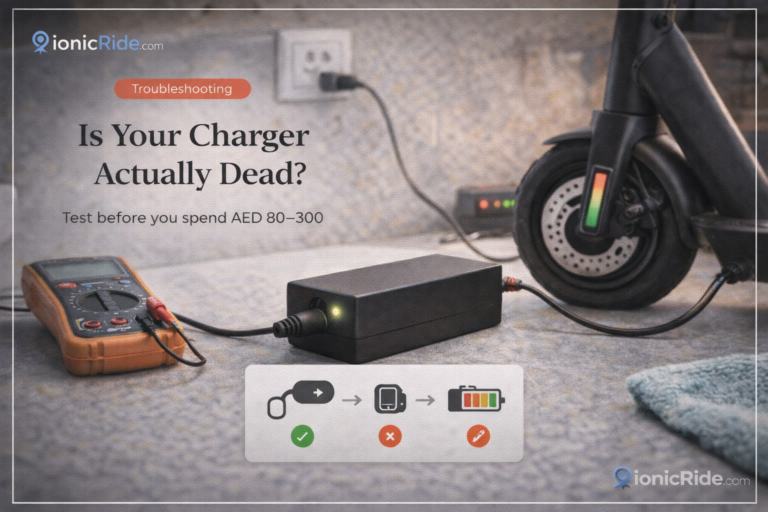
If you have a multimeter, measure battery voltage while riding. You need someone to hold the probes on the battery terminals while you ride (or mount the multimeter somewhere visible).
Watch the voltage when the motor cuts out. If it’s dropping below ~31V on a 36V battery or ~42V on a 48V battery, that’s voltage sag.
If you don’t have a multimeter, pay attention to the battery indicator. Does it drop suddenly when the motor cuts out, then recover after? That’s a sign of voltage sag too.
First, reseat the battery connections and clean the terminals. That might fix it if it’s a contact issue. If the battery itself is weak, you’re looking at a replacement. Batteries aren’t repairable in most cases. This often starts earlier than people expect — explained here: why your e-bike feels sluggish after 6 months.
3. Overheating (motor or controller)
If the motor works fine for 10–15 minutes, then starts cutting out repeatedly, something’s overheating.
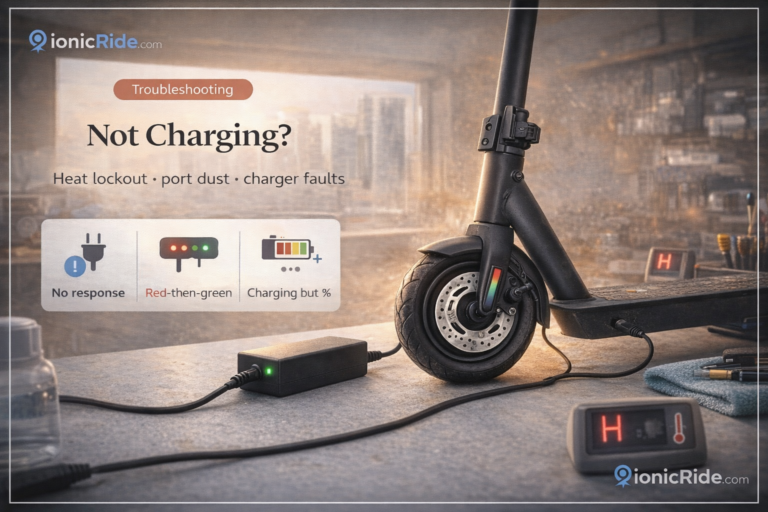
Motors and controllers have thermal protection. When they get too hot, they shut down to prevent damage. Let them cool for 20 minutes, and they work again. Until they heat up again.
Why it overheats
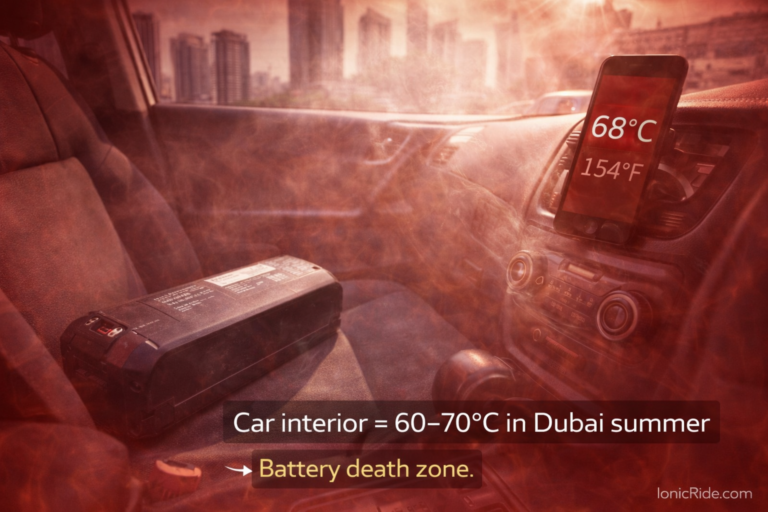
You’re riding in extreme heat. 45°C outside + continuous motor load = thermal limits hit fast. Dubai heat affects batteries and controllers more than most riders realize — see how Dubai heat affects e-bike batteries.
You’re over the weight limit. Heavier load = more current draw = more heat.
The motor or controller has poor ventilation. Some e-bikes have the controller tucked in a sealed compartment with no airflow. Heat builds up.
The motor is failing. If the motor windings are damaged or the magnets are weak, efficiency drops. More energy becomes heat instead of motion.
How to test
After the motor cuts out, immediately touch the motor casing (carefully — it might be hot). If it’s too hot to touch comfortably, that’s your problem.
Same with the controller. If you can access it, check the temperature. Controllers are usually in a box somewhere on the frame. If the box is hot, the controller inside is hotter.
What you can do
Ride during cooler times of day. Early morning or evening instead of midday.
Take breaks. Let the motor cool for 10 minutes every 20–30 minutes of hard riding.
Reduce the load. Lighten your backpack. Avoid steep hills if possible.
Improve ventilation. If the controller compartment has no airflow, you might need to drill small ventilation holes (do this carefully — you don’t want water getting in).
If it overheats even in normal conditions, the motor or controller might be failing. That’s a shop repair.
4. Faulty brake sensor
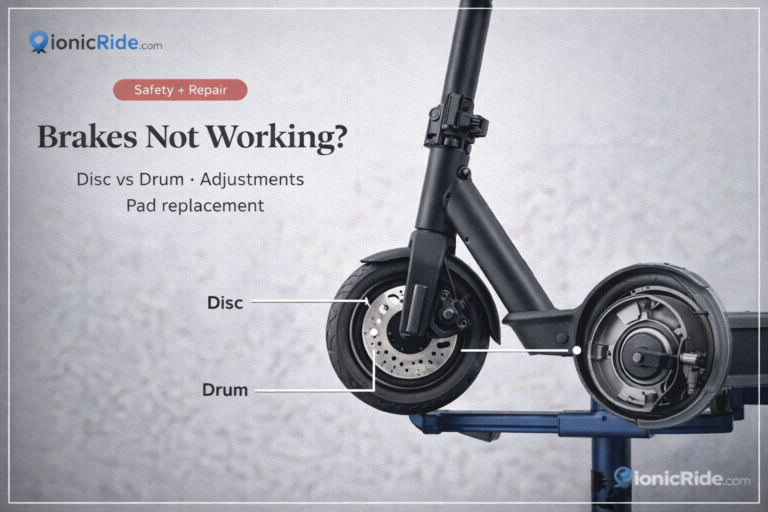
Most e-bikes have brake sensors that cut motor power when you pull the brake lever. Safety feature. Prevents the motor from fighting the brakes.
If the sensor is faulty or misaligned, it can trigger randomly and cut the motor even when you’re not braking.
How to test
While riding (carefully), note whether the motor cuts out when you’re *not* touching the brakes. If it does, disconnect the brake sensor temporarily.
Most brake sensors are simple magnetic switches. Unplug the connector (usually near the brake lever) and test ride without it.
If the cutouts stop, the sensor was the problem. You can either replace it or ride without it (but you lose the safety feature — motor won’t cut when you brake).
If you disconnect the brake sensor, be extra careful. The motor will keep running even if you’re braking. That can be dangerous in traffic. Only ride this way for testing — then replace the sensor.
5. Faulty throttle or pedal assist sensor
If your e-bike has a throttle, the throttle sensor can glitch and send intermittent signals to the controller. The controller gets confused and cuts power.
Same with pedal assist sensors (PAS). If the sensor is dirty, misaligned, or failing, it might send erratic signals. The controller sees conflicting inputs and shuts down the motor.
How to test
If you have a throttle, disconnect it and test ride using only pedal assist (if your bike supports that). If cutouts stop, throttle was the issue.
If you have pedal assist, check the PAS sensor. It’s usually a ring of magnets on the crank or a sensor near the pedals. Make sure it’s clean and properly aligned. If it’s misaligned, the sensor can’t read the magnets correctly.
6. Controller fault
If you’ve checked everything else and the motor still cuts out randomly, the controller might be failing.
Controllers are the brain of the e-bike. They manage power delivery, sensor inputs, speed limits, and safety cutoffs. When they start to fail, symptoms can be unpredictable.
Random cutouts. Delayed throttle response. Motor surging. Error codes on the display (if your bike shows them).
What causes controller failure
Water damage. Controllers are usually sealed, but seals fail. Water gets in. Corrosion starts. Components short out.
Overvoltage or overcurrent. If the battery or motor has a fault that sends too much voltage or current to the controller, it can fry components.
Just age and heat cycles. Controllers have capacitors and MOSFETs that degrade over time, especially if exposed to heat repeatedly.
Can you fix it yourself?
Probably not. Controller repairs require soldering skills, component-level diagnosis, and sometimes firmware reflashing.
If the controller is bad, replacement is the usual fix. Depending on the bike, a new controller costs $50–$200. Labor depends on how hard it is to access.
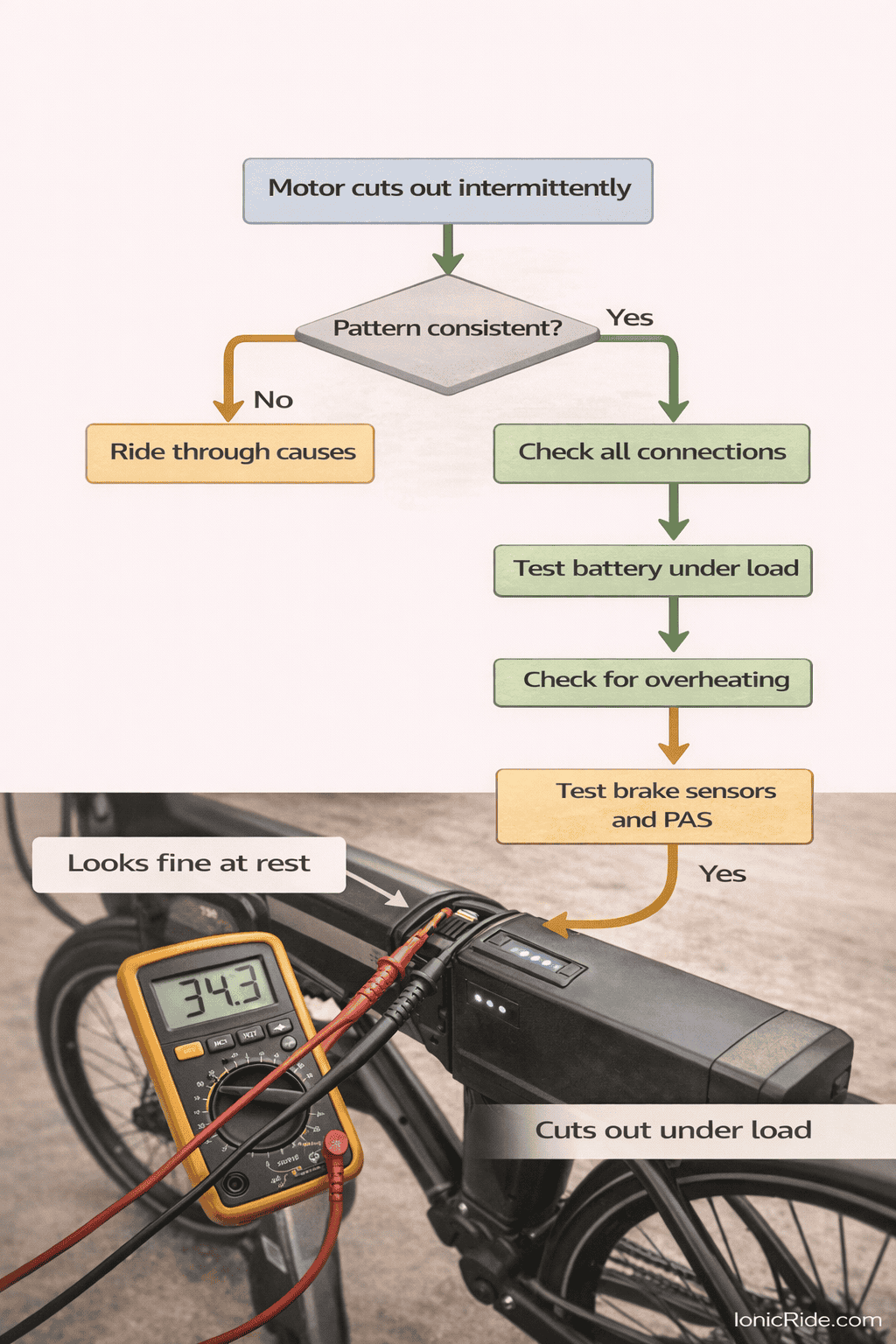
My diagnostic process (step by step)
When someone brings me an e-bike with motor cutouts, here’s what I do:
Step 1: Identify the pattern
Does it cut out under load? Randomly? After riding for a while? On bumps? This tells me where to start.
Step 2: Check all connections
Open every accessible panel. Reseat every connector. Look for corrosion. 50% of the time, this fixes it.
Step 3: Test the battery under load
Measure voltage while riding. If it’s sagging badly, the battery’s weak or the connections are loose.
Step 4: Check for overheating
Ride until the motor cuts out. Immediately check motor and controller temperature. If either is too hot to touch, that’s the problem.
Step 5: Test brake sensors and PAS
Disconnect brake sensors one at a time. Test ride. If cutouts stop, that sensor was bad. Same with throttle and PAS.
Step 6: Controller diagnosis
If everything else checks out, the controller is likely faulty. At this point, replacement is usually the answer.
When to DIY vs when to bring it to a shop
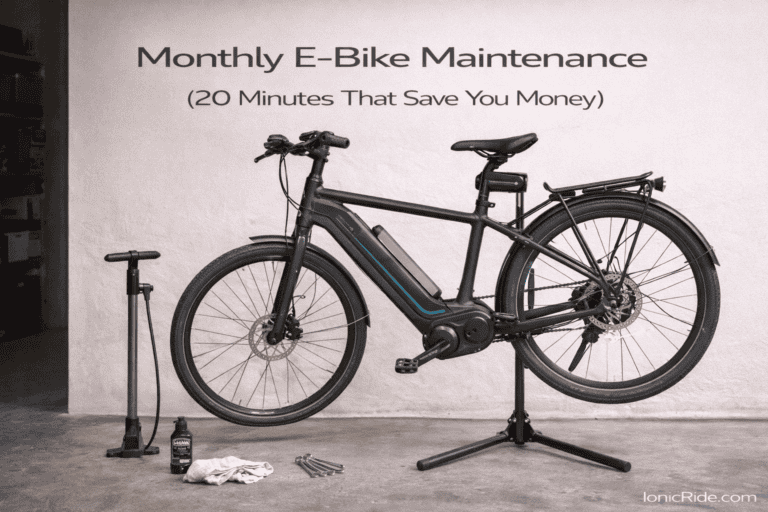
If it’s loose connections, you can fix that yourself. This is exactly why a simple routine like this monthly e-bike maintenance checklist prevents most random cutouts. Reseat everything. Maybe add a bit of dielectric grease to protect against corrosion.
If it’s a brake sensor or throttle issue, those are easy replacements. Parts are cheap ($10–$30). You can do it at home with basic tools.
If it’s battery voltage sag, you might need a new battery. That’s not a DIY repair unless you’re comfortable working with lithium cells (most people shouldn’t).
If it’s overheating due to poor ventilation, you might be able to improve airflow yourself. But if the motor or controller is failing internally, that’s a shop job.
If the controller is fried, replacement requires technical knowledge. Some controllers are plug-and-play. Others need firmware configuration. Bring it to a shop unless you know what you’re doing.
One more thing: Intermittent problems are the worst
I’ll be honest — intermittent electrical faults are frustrating to diagnose. Because they don’t happen on command.
You might bring the bike to a shop, and the motor works perfectly while we’re testing it. Then you take it home and it cuts out again.
If that happens, try to record the conditions when it fails. Time of day. Temperature. How long you’d been riding. What you were doing when it cut out. That helps narrow it down.
(It’s like when you take your car to the mechanic and the weird noise mysteriously stops. Except with e-bikes, at least the motor doesn’t judge you.)