Torque Sensor vs Cadence Sensor: Which Feels Better?
Torque Sensor vs Cadence Sensor: Which Feels Better?
This is the question I get after people have narrowed down their e-bike choice: “Does the sensor type really matter?” If you’re still comparing options, this practical guide to choosing an e-bike in the UAE helps put sensor choice in context.
Short answer: Yes. More than you’d think.
Long answer: It changes how the bike feels to ride. One type feels like you got stronger legs. The other feels like you turned on a motor. Both work. One might be way better for you.
What they actually do
Both sensors tell the motor when to help you. But they measure different things.
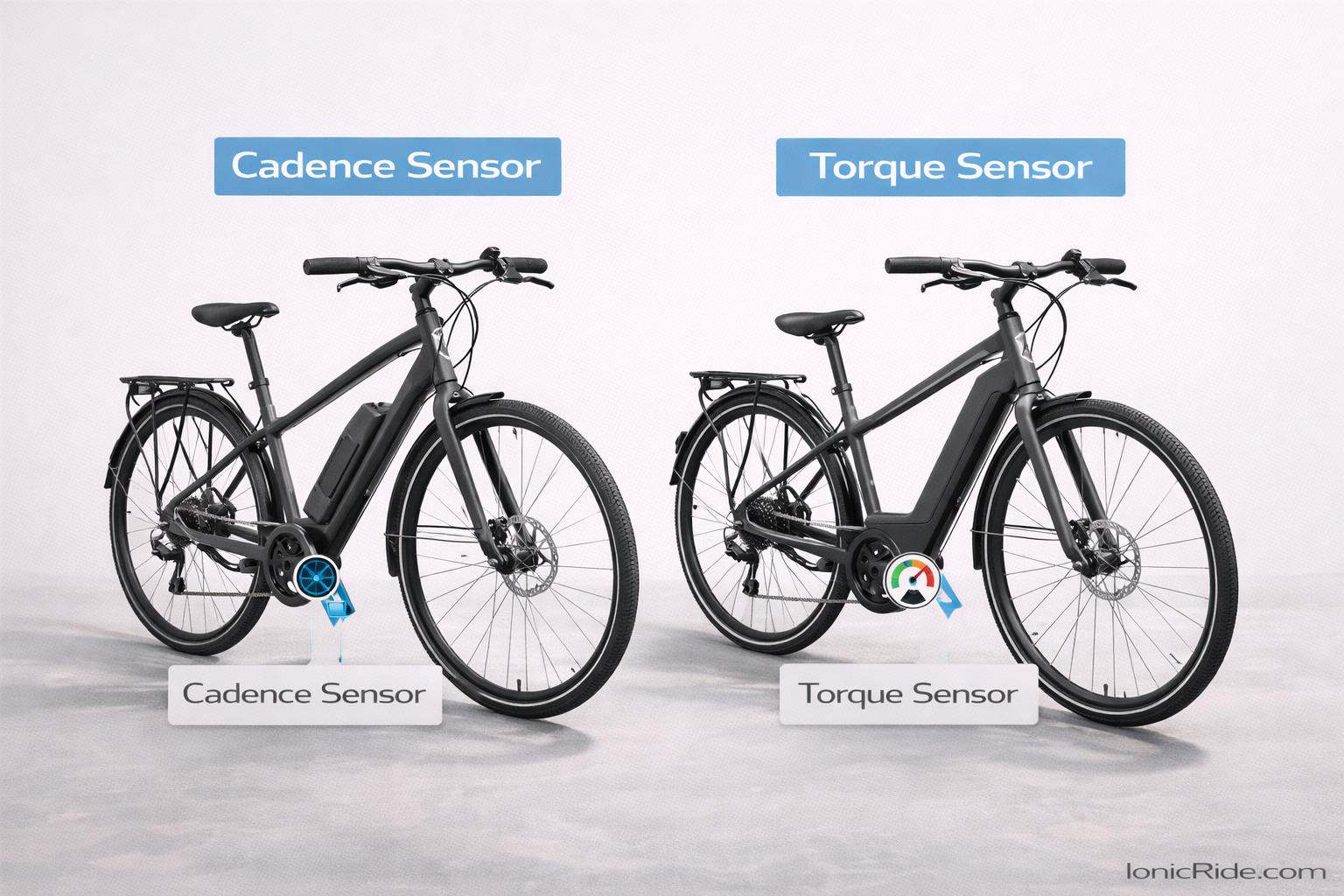
Cadence sensor
Detects that your pedals are moving. Doesn’t care how hard you’re pedaling — just that you are.
When you start pedaling, the sensor sees motion and tells the motor to turn on. Stop pedaling, motor turns off.
It’s binary. On or off. Pedaling or not pedaling.
Torque sensor
Measures how hard you’re pushing on the pedals. The harder you push, the more the motor helps.
Pedal gently, get gentle assist. Hammer down, get strong assist. It’s proportional.
The motor responds to your effort in real-time.
How they feel (the part that matters)
Specs don’t tell you this. You have to ride them to understand the difference. This is also why some bikes feel underwhelming later — explained here: why your e-bike feels sluggish after 6 months.
Cadence sensor: Predictable assist
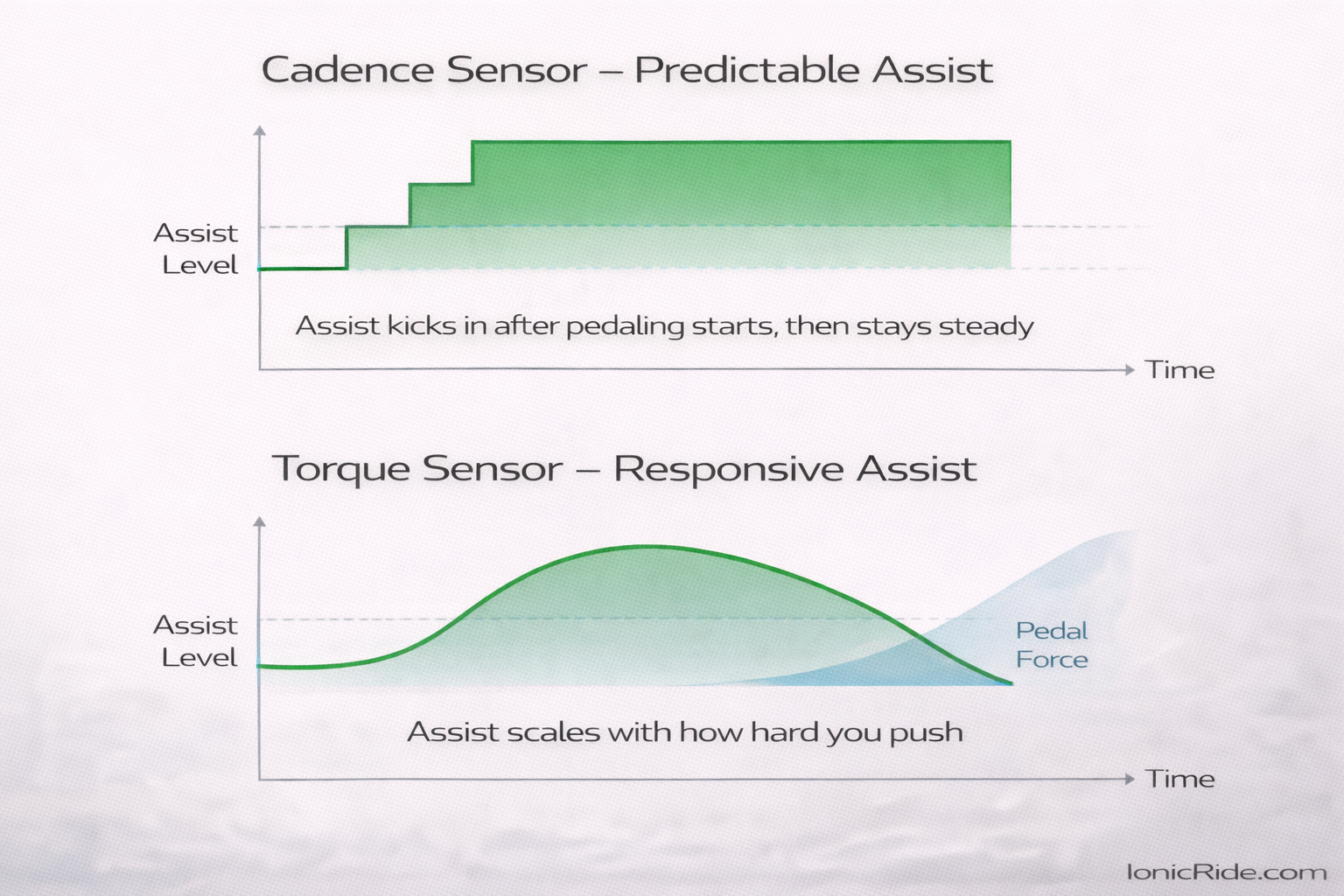
What it feels like: Like someone is pushing you from behind. The motor does its thing. You do your thing. They’re kind of separate.
When it works well: Flat terrain, cruising at steady speed, relaxed riding. You don’t have to think about it.
When it feels weird: Starting from a stop (the motor takes a moment to kick in). Sudden stops (the motor is still pushing for a moment after you stop pedaling). Hills (the motor gives the same push regardless of how hard you’re working).
Torque sensor: Responsive assist
What it feels like: Like riding a regular bike, but you’re superhuman. The motor amplifies your effort instead of replacing it.
When it works well: Everywhere. Starting from stops, climbing hills, accelerating, cruising. It adapts to you.
When it feels weird: If you’re tired and want the bike to do all the work, torque sensors make you pedal with some effort. You can’t just ghost-pedal and let the motor carry you.
The best analogy I’ve got
Cadence sensor: It’s like cruise control in a car. You set the speed (assist level), and the car maintains it. You just have to keep your foot near the pedal.
Torque sensor: It’s like power steering that adjusts to how hard you’re turning. Light turn = light assist. Hard turn = strong assist. You’re still doing the work, but it’s amplified.
Which one is “better”?
Torque sensors feel more natural. That’s not subjective — nearly everyone who’s tried both agrees.
But “more natural” doesn’t always mean “better for you.”
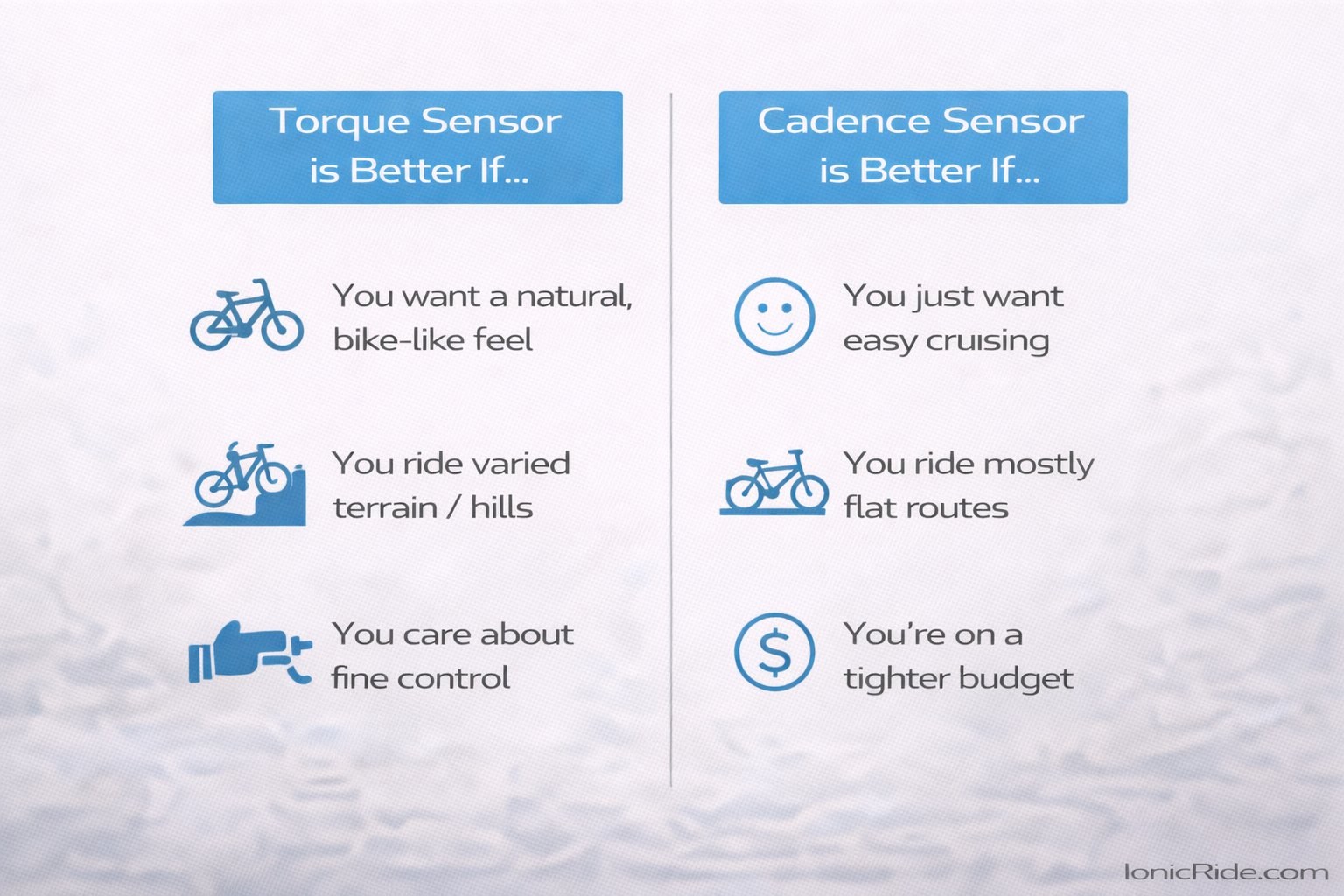
Torque sensors are better if:
- You want the bike to feel like a bike (not a moped with pedals)
- You’re using the e-bike for exercise, not just transportation
- You ride varied terrain (hills, flats, stop-and-go traffic)
- You care about how the bike responds to your input
- You’re willing to pay extra for a better riding experience
Cadence sensors are better if:
- You want simple, predictable assist that doesn’t require thought
- You’re riding mostly flat terrain at steady speeds
- You want the motor to do most of the work (ghost-pedaling is fine)
- You’re on a tight budget (cadence sensor bikes are cheaper)
- You don’t care about the “feel” as long as you get where you’re going
Most of the UAE is flat. If you’re commuting on flat roads at steady speed, a cadence sensor works fine. You won’t miss the torque sensor unless you’ve tried it.
But if you’re riding in areas with varied terrain (Hatta, off-road, or just navigating speed bumps and inclines), torque sensors make a noticeable difference.
The price difference
Torque sensors cost more. Not a little more — significantly more. If you’re weighing value vs specs, this explains where performance actually comes from: why advertised e-bike range rarely matches real-world riding.
A bike with a cadence sensor might cost AED 2,500–3,500. The same bike with a torque sensor? AED 3,500–5,000.
You’re paying AED 1,000–1,500 extra for the sensor and associated electronics.
Is it worth it?
If you ride daily and care about how the bike feels, yes.
If you ride occasionally and just want cheap transportation, probably not.
Can you upgrade a cadence sensor to torque?
Technically, yes. Practically, no.
Torque sensors are integrated into the crankset and communicate with the controller. Retrofitting one requires replacing the crankset, potentially the controller, and recalibrating everything.
By the time you pay for parts and labor, you’ve spent almost as much as the price difference between a cadence and torque sensor bike.
If you want torque sensing, buy a bike that has it from the factory.
What about hybrid systems?
Some newer e-bikes use both sensors. Cadence sensor for basic detection, torque sensor for fine-tuning power delivery.
These systems try to give you the best of both: the simplicity of cadence with the responsiveness of torque.
They work pretty well. But they’re rare and usually only on premium bikes.
The test ride is everything
Reading about the difference doesn’t tell you how it’ll feel for you.
If you’re buying from a shop, test ride both types if possible. Ride them on the same route. Same conditions. Back to back.
Pay attention to:
- How the motor engages when you start pedaling
- How it responds when you accelerate or slow down
- How it feels on a hill
- Whether you can “ghost pedal” (pedal lightly and let the motor do the work) or if the motor demands effort
One of them will feel better to you. That’s the one you should get.
If you’ve never ridden an e-bike before, start on a cadence sensor bike. It’s simpler and less overwhelming. Once you’re comfortable, try a torque sensor bike. You’ll immediately understand the difference.
Maintenance and reliability
Cadence sensors are simpler. Fewer things to go wrong. If the sensor fails, it’s cheap and easy to replace (AED 50–150).
Torque sensors are more complex. They’re built into the crankset, so if they fail, repair is more involved. Replacement cost: AED 300–800 depending on the system.
That said, modern torque sensors are pretty reliable. I don’t see a lot of failures. But when they do fail, it’s more expensive to fix.
My honest take
If budget isn’t tight and you plan to ride regularly, get a torque sensor.
It makes the bike more enjoyable. More intuitive. More fun. That matters if you’re going to be on it every day.
If you’re on a budget or using the e-bike purely for short, practical trips (groceries, errands, simple commute), a cadence sensor is fine. Don’t overthink it.
But if you can swing the extra cost, torque sensing is one of those upgrades that feels worth it every single ride.
If I had to choose one without test riding:
Torque sensor for daily riders who care about the experience.
Cadence sensor for casual riders who just want cheap, reliable transportation.
One more thing: It’s not the only factor
Sensor type matters. But it’s not the only thing that makes a bike feel good.
Motor quality, controller tuning, battery capacity, frame geometry, weight distribution — all of that affects the ride too.
A well-tuned cadence sensor bike can feel better than a badly-tuned torque sensor bike.
So don’t fixate on the sensor type alone. Look at the whole package. Test ride. Choose what feels right.
(It’s like focusing on horsepower in a car. Sure, it matters. But suspension, weight, and handling matter just as much.)