What to Check Before Buying a Used E-Bike in Dubai (Complete Inspection Guide)
What to Check Before Buying a Used E-Bike in Dubai (Complete Inspection Guide)
Got an email from a reader last week: “Found a used e-bike on Dubizzle for 2,000 AED. Original price was 4,500 AED. Seller says it’s in perfect condition. Too good to be true?”
Short answer: Maybe. Depends on the battery.
Long answer: Used e-bikes can be great deals — or expensive mistakes. Here’s how to inspect one properly before you hand over cash.
Why battery health matters more than everything else
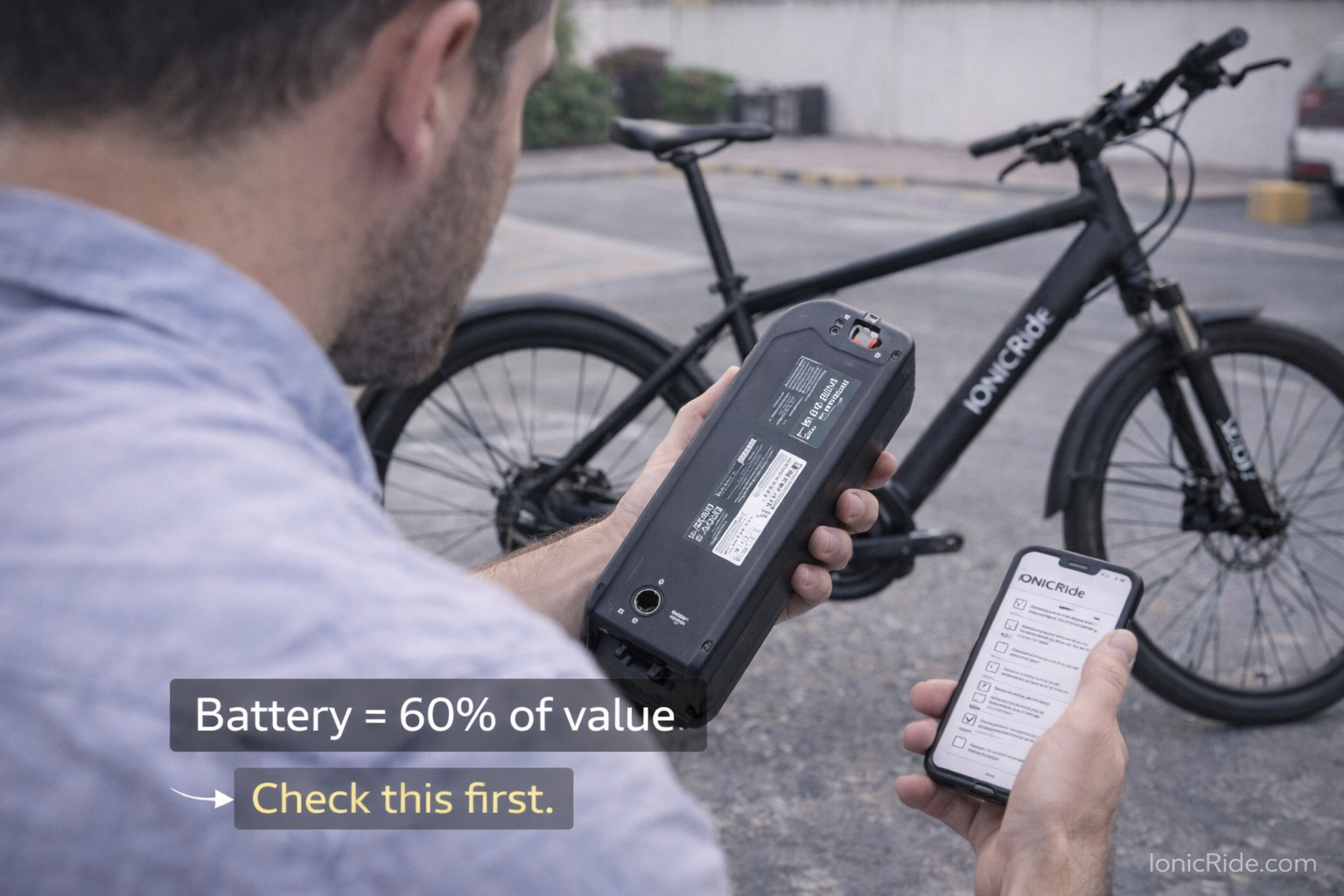
Let’s get this out of the way first: the battery is 50-70% of a used e-bike’s value – and Dubai heat accelerates battery degradation significantly.A 2-year-old e-bike with a healthy battery? Great deal at 50% off original price.
The same bike with a degraded battery? You’re about to spend 600-1,500 AED on battery replacement within 6 months. Suddenly that “deal” isn’t so great.
Battery replacement costs in Dubai:
- Budget e-bike batteries: 600-900 AED
- Mid-range e-bike batteries: 900-1,500 AED
- Premium e-bike batteries: 1,500-2,500 AED
If the used e-bike needs a new battery soon, factor that into your offer price. Or walk away.
How to check battery health (without lab equipment)
You don’t need fancy diagnostic tools. Here’s what actually works.
Step 1: Visual inspection (before you even touch it)
Look for:
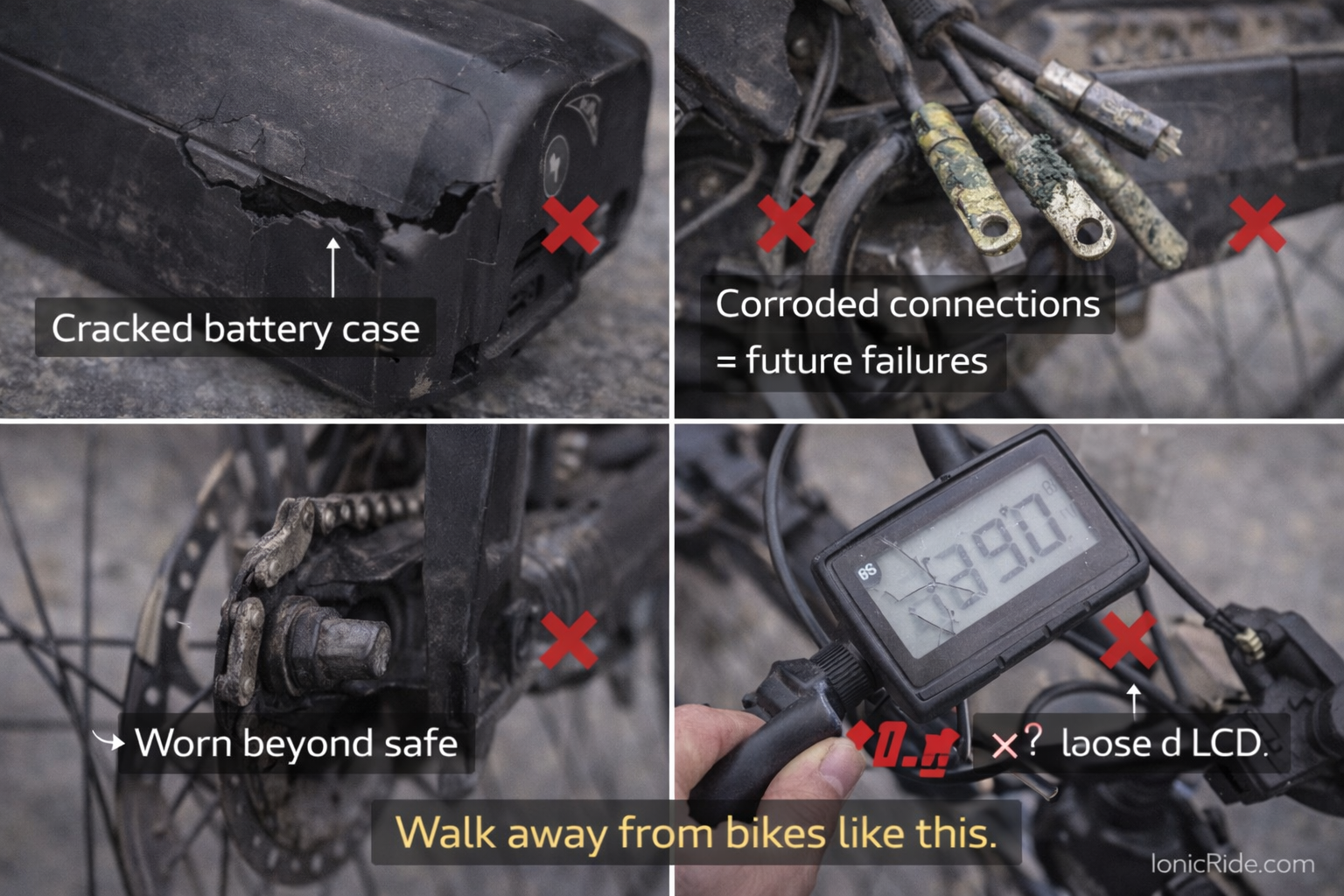
- Swelling: Battery pack bulging or deformed? That’s catastrophic failure. Don’t buy it. Dangerous.
- Cracks or dents: Physical damage to battery casing suggests internal damage.
- Corrosion: Check battery terminals for rust or green/white corrosion.
- Water damage: Look for water ingress marks around battery compartment.
- Burn marks: Any discoloration or burning around connectors = electrical problems.
If you see any of these, stop. Don’t buy the bike.
Step 2: Check display voltage (if bike has voltage readout)
Many e-bikes show battery voltage on the display.
What you’re looking for:
- 36V battery should show 40-42V when fully charged
- 48V battery should show 53-54V when fully charged If voltage is significantly lower (35V on a “fully charged” 36V battery), that’s degradation and the battery likely won’t charge properly
Ask the seller to charge the battery fully before you arrive. Check the voltage immediately.
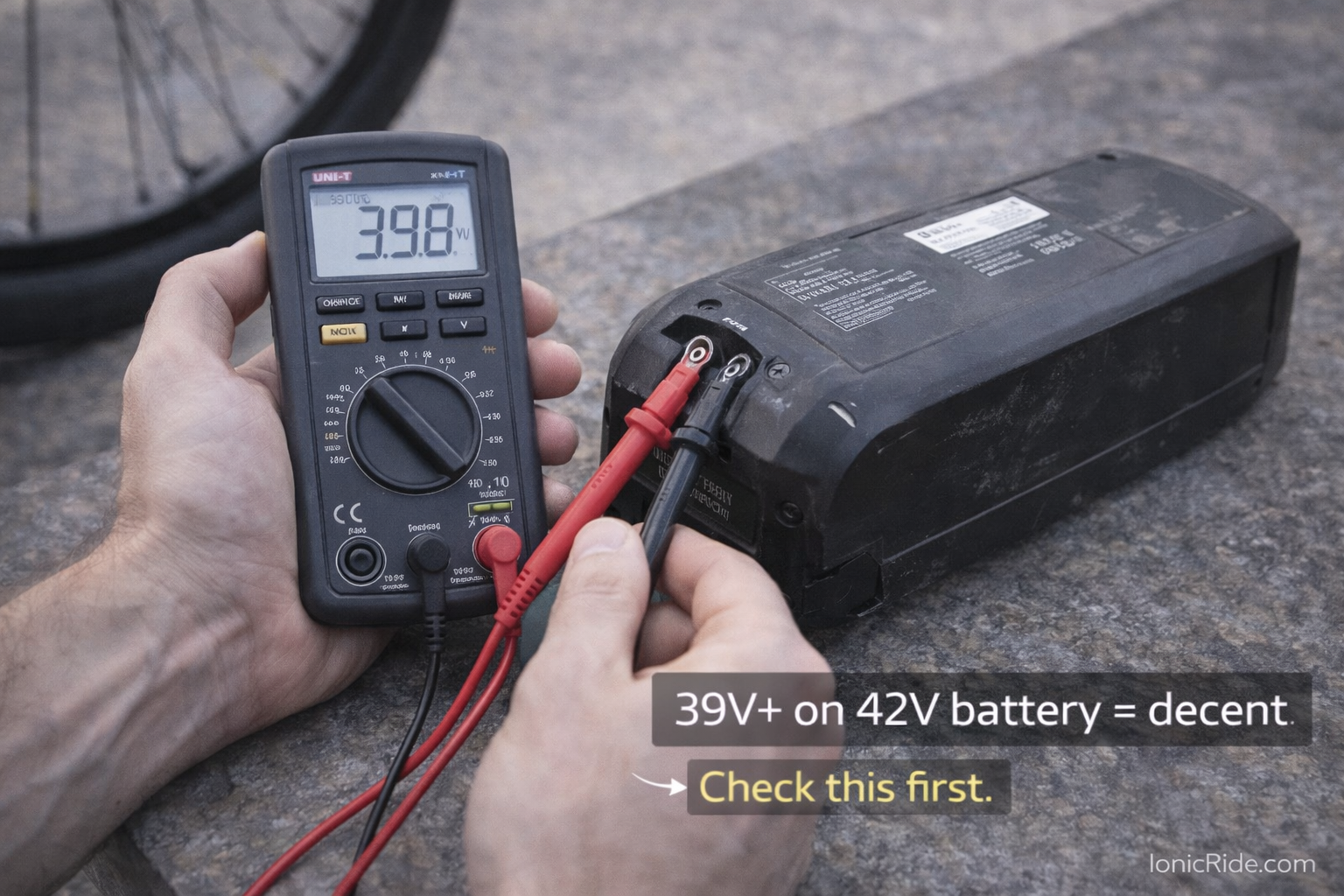
Step 3: Use a multimeter (if you have one)
Multimeters cost 30-50 AED from any hardware store. Worth having if you’re buying used e-bikes.
How to test:
- Set multimeter to DC voltage (20V or 200V range)
- Touch red probe to positive battery terminal, black probe to negative
- Read voltage on display
What the numbers mean:
- 36V battery reading 40-42V = Good (fully charged)
- 36V battery reading 37-39V = Degraded (lost capacity)
- 36V battery reading under 35V = Severely degraded or dead cell
Same principle for 48V batteries (should read 53-54V when charged).
Step 4: Real-world range test (the most important check)
Numbers on a multimeter don’t tell the full story. You need to ride it.
The test:
- Fully charge the battery (ask seller to do this before meeting)
- Reset trip counter (if available) or note starting odometer reading
- Ride at moderate assist level (eco or mid setting)
- Ride until battery shows 20-30% remaining
- Calculate distance covered
Example:
Bike advertises 60 km range. You ride 35 km and battery shows 25% remaining. That’s about 47 km total range — roughly 80% of advertised range. That’s acceptable degradation for a 1-2 year old bike.
If you only get 20 km before hitting 25% battery (27 km total range), that’s only 45% of advertised range. Battery is shot.
Batteries left in Dubai heat degrade faster. Ask seller: Where was the bike stored? Indoors or outdoors? Shaded parking or direct sun? This tells you a lot about likely battery condition.
Step 5: Ask direct questions
Sellers won’t volunteer bad news. You have to ask.
Questions to ask:
- How old is the battery? (Not the bike — the battery specifically)
- How many charge cycles? (Most don’t know, but ask anyway)
- Has range decreased noticeably since new?
- Has the battery ever been replaced?
- Where was the bike stored? (Indoor, outdoor, shaded, direct sun)
- How often was it charged? (Daily, weekly, sits for months uncharged)
If seller can’t answer these or gives vague answers, assume the worst about battery condition.
Motor and electrical system checks
After battery, check the motor and electronics.
Motor sound test
Test procedure:
- Turn on bike
- Lift rear wheel off ground (or ask someone to hold bike)
- Engage motor (pedal or use throttle depending on bike type)
- Listen carefully to motor sound
Good motor sounds: Quiet humming or slight whirring. Smooth, consistent.
Bad motor sounds:
- Grinding or scraping (worn gears inside motor)
- Clicking or rattling (loose components or bearing failure)
- Loud whining (worn motor brushes or controller issue)
- Intermittent cutting in/out (electrical connection problem)
Bad motor sounds = expensive repair (motor replacement is 600-1,500 AED).
Motor power delivery test
During test ride, pay attention to how motor responds.
Good motor behavior:
- Smooth acceleration
- Consistent power delivery
- All assist levels work as expected
- No sudden cutouts or power surges
Bad motor behavior:
- Jerky or inconsistent power
- Motor cuts out randomly
- Some assist levels don’t work
- Motor engages with delay (2-3 second lag)
These suggest controller problems or failing motor – similar to issues that make e-bikes feel sluggish after 6 months..
Display and controls check
Test everything:
- Display turns on and shows all info clearly
- Buttons respond (no dead buttons)
- All assist levels cycle properly
- Battery indicator updates as expected
- Lights work (if integrated with display)
- No error codes displayed
If display is malfunctioning, replacement costs 150-400 AED depending on bike.
Wiring and connections inspection
Look for:
- Frayed wires (especially near joints and moving parts)
- Loose connectors (wiggle them gently — should be secure)
- Taped-up repairs (sign of previous electrical problems)
- Corroded connectors (common if bike was stored outdoors)
- Modified wiring (DIY repairs often create new problems)
Electrical gremlins are annoying and expensive to troubleshoot.
Frame and mechanical components inspection
Don’t skip this. Frame damage can be dangerous.
Frame integrity check
Critical areas to inspect:
1. Welds (where frame tubes join):
- Look for cracks radiating from welds
- Check for rust or paint bubbling near welds
- Tap welds with knuckle — should sound solid, not hollow
2. Folding hinges (if folding bike):
- Check for cracks around hinge area
- Test folding mechanism — should lock securely
- Look for excessive play or wobble when locked
- Cheap folding bikes have hinge failures after 1-2 years
3. Down tube (battery mount area):
- Check for cracks where battery attaches
- Battery mounting points should be solid, not loose
4. Rear triangle (around motor):
- Motor adds stress — check for cracks near motor mount
- Look at dropouts (where rear wheel attaches)
Don’t buy a bike with frame cracks. Period. Even small cracks grow and eventually cause catastrophic failure. Not worth the risk, no matter how cheap the price.
Brakes inspection
E-bikes are heavier and faster than regular bikes. Brakes are critical.
Check:
- Brake pad thickness (should have at least 2-3mm material left)
- Brake rotor condition (no deep grooves or warping)
- Brake cable condition (if mechanical brakes)
- Hydraulic brake lever feel (if hydraulic — should be firm, not spongy)
Test ride brake check:
- Test brakes at 20+ km/h
- Brakes should stop you smoothly and quickly
- No squealing (indicates worn pads or contaminated rotors)
- No rubbing when not braking
Budget 100-200 AED for brake pad replacement, 200-400 AED for rotor replacement if needed.
Drivetrain condition
Check chain:
- Should be clean and lubed (not rusty or dry)
- Check for chain stretch (worn chains skip under power)
- No stiff links (chain should flex smoothly)
Check gears:
- Shift through all gears during test ride
- Shifts should be smooth and quick
- No grinding or skipping
- Check derailleur for damage (easy to bend in crashes)
Check cassette and chainring:
- Teeth should be relatively sharp, not worn to points
- No missing teeth
Chain replacement: 50-80 AED. Cassette: 100-200 AED. Chainring: 80-150 AED.
Tires and wheels
Tire condition:
- Tread depth (should have visible tread, not bald)
- No cracks in sidewalls (indicates age/sun damage)
- No bulges or deformities
Wheel condition:
- Spin wheels — should spin freely without wobbling
- Check for broken spokes
- Look for dents in rims
Tire replacement: 80-150 AED per tire. Wheel truing (fixing wobble): 80-120 AED.
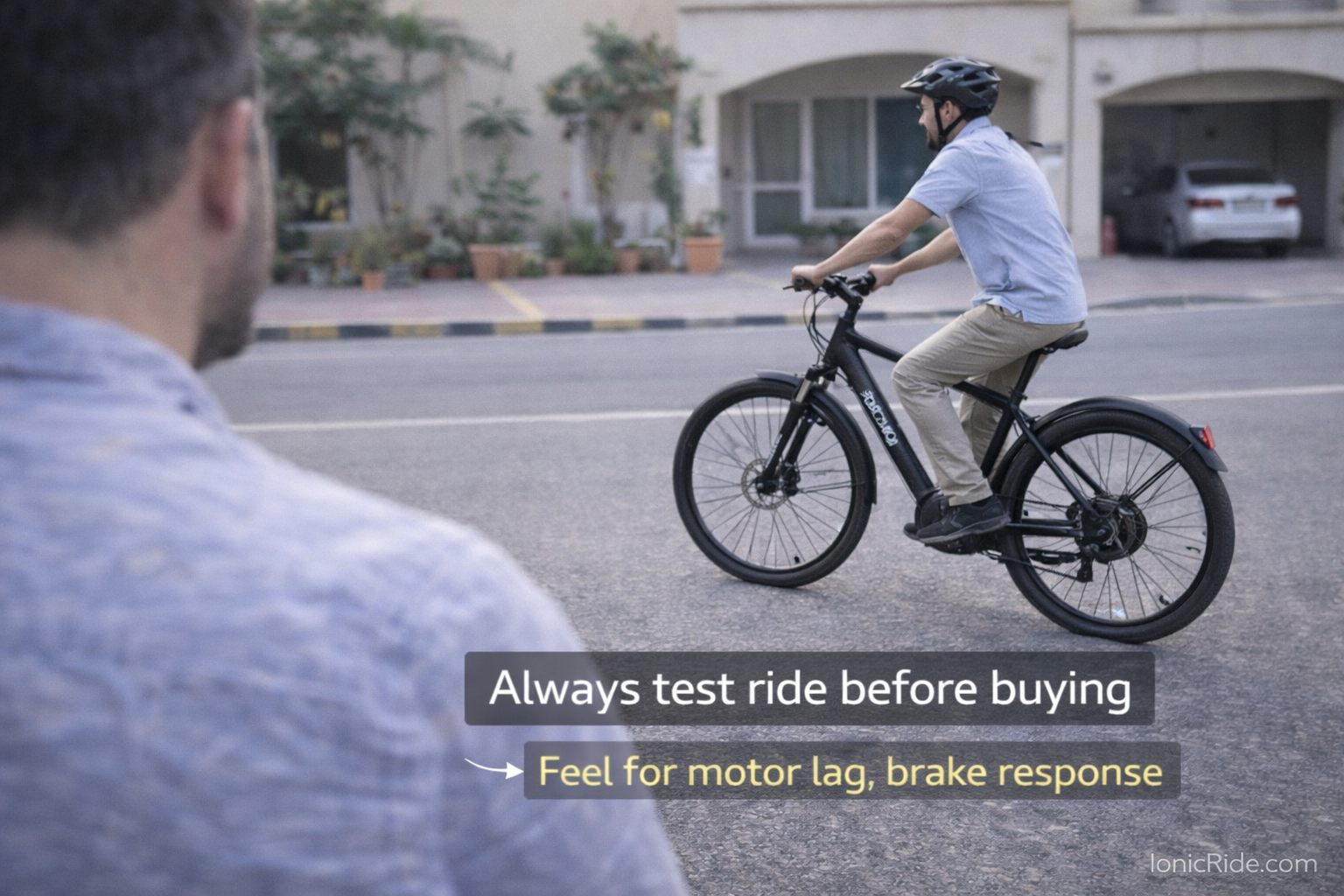
The test ride (most important step)
Don’t buy an e-bike without riding it. Period.
What to test during the ride
1. Motor engagement:
- Start pedaling from stop — motor should engage smoothly within 1-2 pedal strokes
- No delay, no jerking
2. All assist levels:
- Cycle through all assist settings
- Each level should feel noticeably different
3. Hill climbing (if possible):
- Find a gentle incline or speed bump
- Motor should provide smooth assistance uphill
- No struggling or cutouts
4. Braking at speed:
- Get up to 20-25 km/h
- Test both brakes individually
- Should stop smoothly and quickly
5. Handling and comfort:
- Does bike feel stable?
- Any unusual vibrations?
- Seat comfortable?
- Reach to handlebars comfortable?
6. Listen for weird noises:
- Squeaks, rattles, grinding
- Anything that sounds wrong probably is wrong
If seller won’t let you test ride? Walk away. Major red flag.
Red flags that should make you walk away
Absolute deal-breakers (don’t buy):
- Battery is swollen or deformed
- Frame has visible cracks (especially near welds)
- Seller won’t allow test ride
- Motor makes grinding or loud rattling sounds
- Price is suspiciously low (likely stolen)
- Seller can’t provide any proof of purchase
- Multiple components clearly need immediate replacement
Warning signs (proceed with caution):
- Battery range significantly degraded (under 60% of advertised)
- Seller is leaving UAE “tomorrow” (pressure tactic)
- Bike has obvious DIY repairs or modifications
- No service history or maintenance records
- Seller doesn’t know basic info about the bike
- Multiple minor issues (adds up to expensive repairs)
- Bike stored outdoors in direct sun in Dubai
What questions to ask the seller
Get as much information as possible before committing.
About ownership and history:
- Why are you selling? (Leaving UAE, upgrading, not using it?)
- When and where did you buy it?
- Do you have the original receipt?
- Is there any warranty remaining?
- Has it ever been repaired? What was fixed?
About usage:
- How often did you ride it? (Daily, weekly, occasionally?)
- What kind of riding? (Commuting, leisure, off-road?)
- Approximate total distance covered?
- Ever been in an accident or dropped?
About storage and maintenance:
- Where was it stored? (Indoors, outdoor parking, direct sun?)
- When was it last serviced?
- What maintenance have you done? (Chain lube, brake adjust, etc.)
- Any modifications or upgrades?
About battery:
- How old is the battery?
- Has range decreased noticeably?
- Has battery ever been replaced?
- How do you store/charge it?
Honest sellers answer these easily. Dishonest sellers get vague or defensive.
Fair pricing for used e-bikes in Dubai
Use this as rough guidance. Adjust based on condition.
Age and condition:
- Under 6 months, like-new: 70-80% of original price
- 6 months – 1 year, good condition: 60-70% of original
- 1-2 years, good condition: 50-60% of original
- 2-3 years, decent condition: 40-50% of original
- Over 3 years: 30-40% of original (battery replacement likely needed soon)
Deduct from price if:
- Battery degraded noticeably: -500 to -1,000 AED
- Needs brake pads/rotors: -150 to -300 AED
- Needs new tires: -150 to -300 AED
- Needs chain/cassette: -150 to -300 AED
- Cosmetic damage (scratches): -100 to -300 AED
Don’t be afraid to negotiate based on what you find during inspection.
Where to find used e-bikes in Dubai
Dubizzle (most popular)
Pros: Largest selection, easy to filter by price/brand
Cons: Many overpriced listings, some scams, need to meet sellers in person
Tips for Dubizzle:
- Look for sellers with multiple positive reviews
- Check listing history (how long has it been listed?)
- Meet in public place (mall parking, coffee shop)
- Don’t hand over money until inspection is complete
Facebook Marketplace and Groups
Groups to check:
- Dubai Buy and Sell groups
- Expat groups (people leaving UAE often sell quickly)
- Cycling groups in UAE
Often better prices than Dubizzle because sellers want quick sales.
Local bike shops
Some shops accept trade-ins and resell used bikes. Usually more expensive but may offer some warranty.
June-August (summer): Expats leaving UAE. More inventory, better negotiation leverage. Many people willing to accept low offers just to sell before leaving.
The inspection checklist (print this)
Battery checks:
- ☐ Visual inspection (no swelling, cracks, corrosion)
- ☐ Voltage test (within 10% of rated voltage)
- ☐ Range test (actual distance vs advertised)
- ☐ Asked about battery age and usage
Motor and electrical:
- ☐ Motor sound test (quiet, no grinding)
- ☐ Power delivery smooth and consistent
- ☐ All assist levels work
- ☐ Display functions properly
- ☐ Wiring intact, no frayed cables
Frame and components:
- ☐ Frame has no cracks (check welds carefully)
- ☐ Folding hinges secure (if applicable)
- ☐ Brakes work well, pads have life left
- ☐ Gears shift smoothly
- ☐ Chain in good condition
- ☐ Tires have tread, no cracks
- ☐ Wheels spin true, no wobble
Test ride:
- ☐ Motor engagement smooth
- ☐ All assist levels tested
- ☐ Brakes tested at speed
- ☐ Bike handles well, no weird noises
- ☐ Comfortable riding position
Documentation:
- ☐ Asked about ownership history
- ☐ Asked about maintenance/repairs
- ☐ Requested proof of purchase (if available)
- ☐ Confirmed why seller is selling
One more thing: Trust your gut
If something feels off — seller is evasive, bike has multiple issues, price seems too good — walk away.
There are always more used e-bikes for sale in Dubai. Don’t settle for a bad one just because you’ve already spent time on inspection.
The best used e-bike is one from someone who:
- Took care of it (stored indoors, maintained regularly)
- Has low usage (occasional rider, not daily heavy commute)
- Is honest about condition (volunteers issues instead of hiding them)
- Lets you do thorough inspection without pressure
- Has reasonable expectations on price
Those bikes exist. Keep looking until you find one.