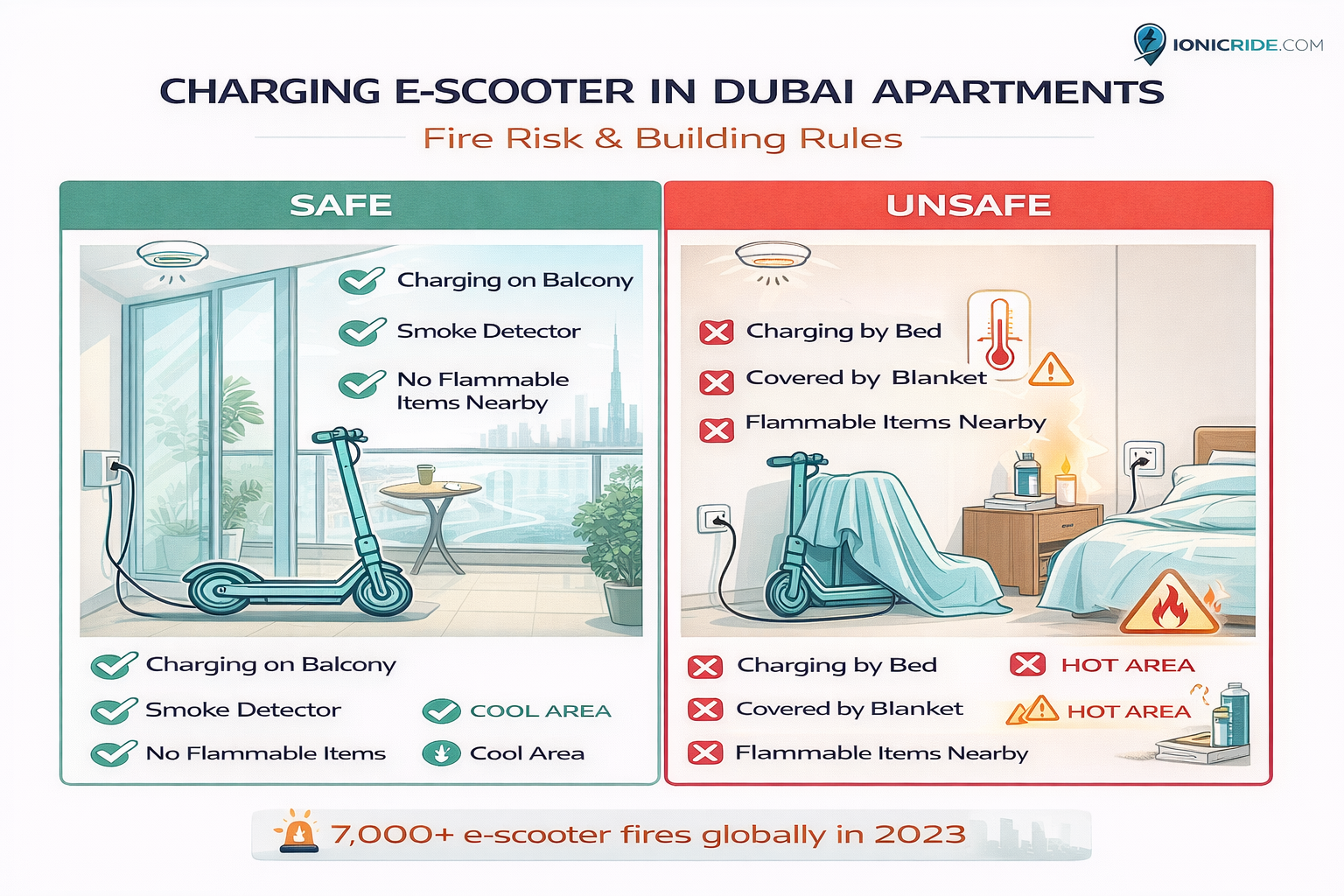
Charging E-Scooter in Dubai Apartments: Fire Risk & Building Rules
Charging E-Scooter in Dubai Apartments: Fire Risk & Building Rules 2026
You just bought an e-scooter. You live in an apartment. You need to charge it.
Then you see the building notice: “Charging of lithium battery devices prohibited in residential units due to fire risk.”
Or maybe you don’t see a notice. You charge it anyway. Then building management knocks on your door and threatens to fine you.
So what’s actually allowed? What’s the real fire risk? And how do people who own e-scooters in Dubai apartments actually charge them? Dubai Civil Defence fire safety guidelines
The Building Ban Reality
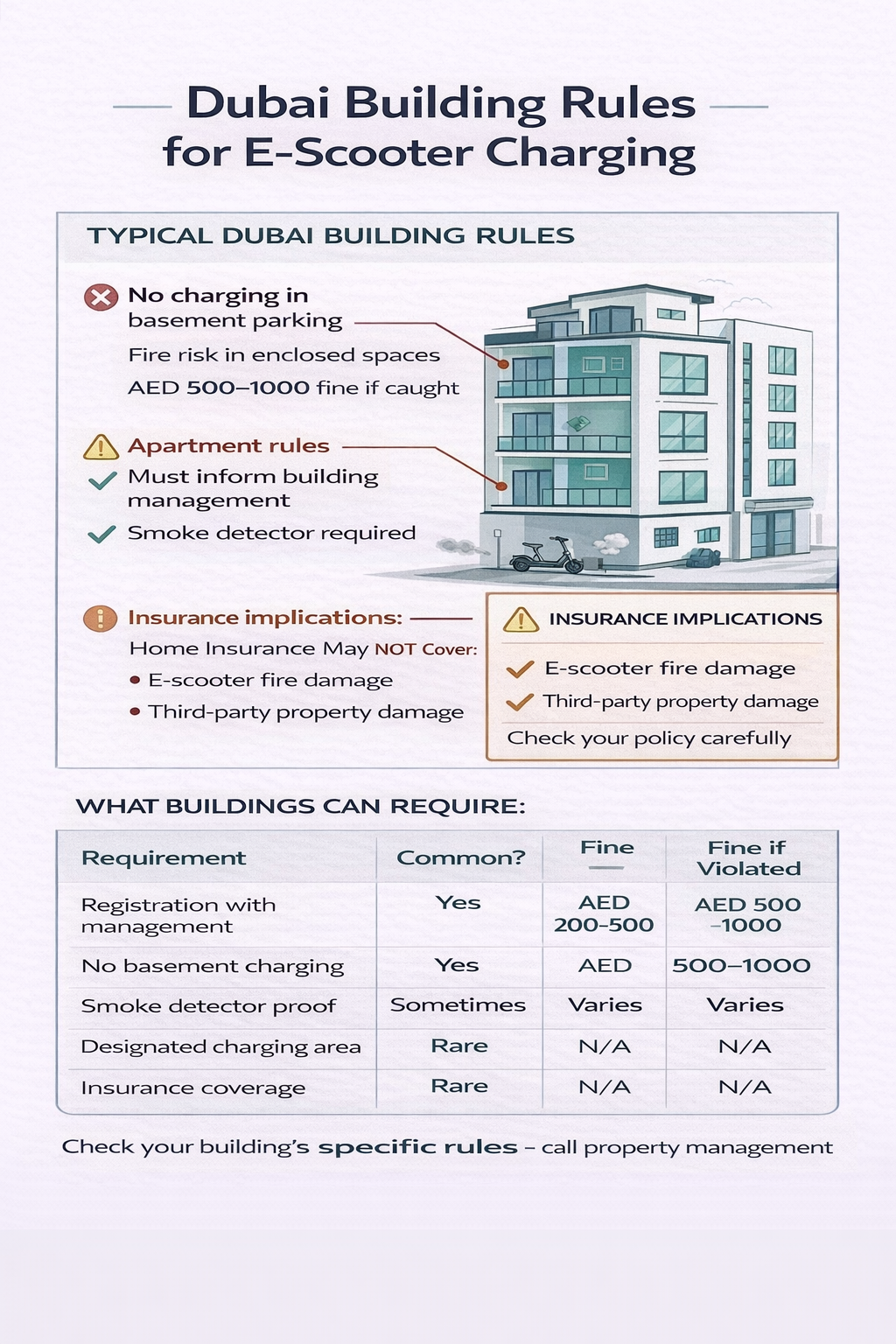
Some buildings ban lithium battery charging. Some don’t. There’s no Dubai-wide law—it’s building-by-building.
What Buildings Are Actually Banning
After several high-profile battery fires in 2023-2024 (mostly from counterfeit phone chargers and cheap power banks), some building managements started implementing blanket “no lithium battery charging” rules.
- Some towers in JBR (Murjan, Sadaf, others)
- Business Bay newer developments
- Dubai Marina high-rises built post-2020
- DIFC residential buildings
This isn’t a complete list—policies change building by building. RERA Dubai tenant rights
What They Can (and Can’t) Enforce
Here’s the legal reality:
- Add “no lithium battery charging” clauses to NEW lease agreements
- Post notices in common areas
- Fine residents who violate building rules (if specified in lease)
- Refuse to renew leases of repeat violators
- Retroactively add rules to existing leases mid-term
- Enter your unit without notice to check for chargers
- Confiscate your property
- Evict you immediately for first violation (assuming it’s not in your lease)
The enforceability depends entirely on what’s in your lease agreement.
Look for clauses mentioning:
- “Hazardous materials”
- “Fire safety compliance”
- “Lithium batteries”
- “Electric vehicles or mobility devices”
If nothing’s mentioned, the building likely can’t enforce a ban on existing tenants—but they might try anyway.
The Fire Risk: How Real Is It?
Let’s talk about actual numbers, not fear.
Lithium Battery Fire Statistics
Yes, lithium batteries can catch fire. But context matters:
- Counterfeit phone chargers: Highest risk (poor quality control)
- Cheap e-scooter batteries (no-name brands): High risk
- Branded e-scooter batteries (Xiaomi, Ninebot): Low risk (UL certified)
- E-bike conversion kit batteries: Medium-high risk (often uncertified)
The fire risk isn’t equal across all lithium batteries. A UL-certified Ninebot battery is orders of magnitude safer than a 150 AED Alibaba replacement battery.
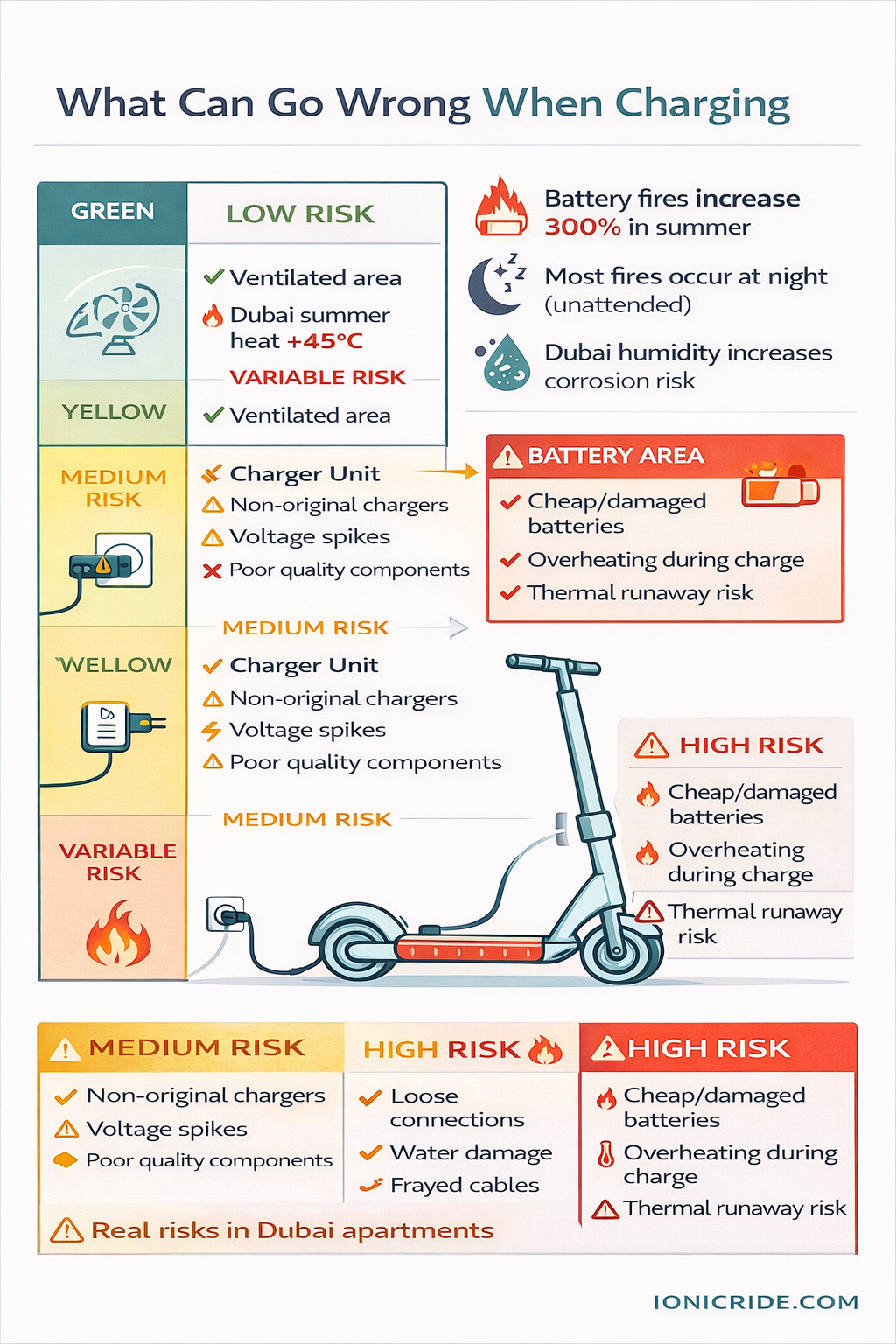
What Actually Causes Battery Fires
Battery fires happen when:
- Physical damage: Dropped battery, punctured cells, crushed in accident
- Overcharging: Charger malfunction or using wrong charger
- Overheating: Charging in 40°C+ room, poor ventilation
- Manufacturing defects: Cheap batteries with no quality control
- Age/degradation: Batteries past end-of-life with swollen cells
If you’re using the original charger, charging in a ventilated space, and your battery isn’t damaged, fire risk is extremely low.
- Battery is swollen or bulging
- Battery gets extremely hot during charging (too hot to touch)
- Charger smells like burning plastic
- Battery is 3+ years old
- You’re using a third-party replacement battery from an unknown brand
If any of these apply, DO NOT charge in your apartment. Get the battery replaced first.
How to Charge Safely (If You’re Allowed)
Assuming your building doesn’t ban it, here’s how to minimize risk:
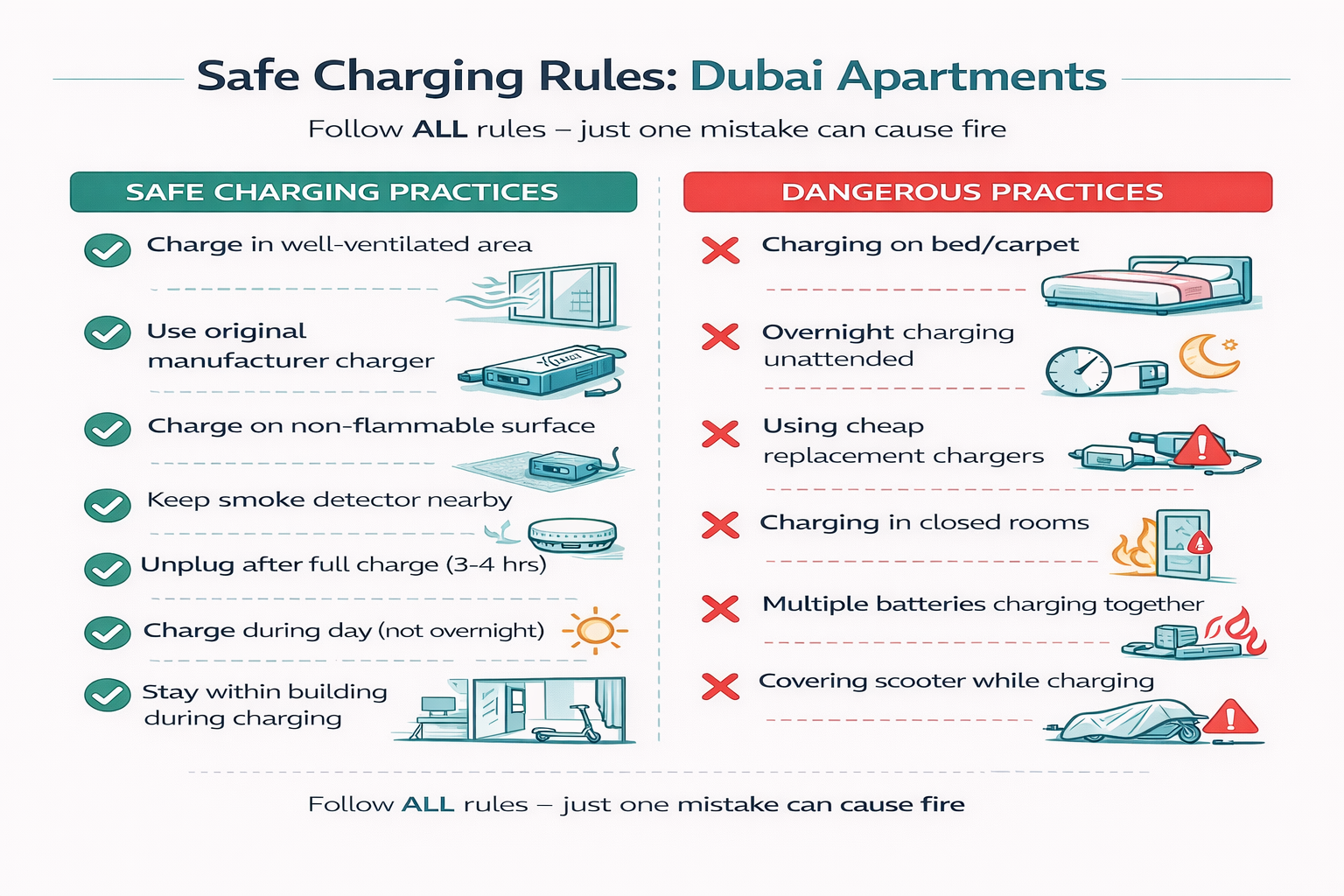
- Use original charger only: Third-party chargers can deliver wrong voltage/current
- Charge on non-flammable surface: Tile floor, not carpet or wood
- Keep 1+ meter from flammable materials: Not next to curtains, bedding, or paper
- Charge in ventilated area: Not in closed closet or under bed
- Unplug when fully charged: Don’t leave charging overnight unattended
- Charge in air-conditioned space: Not in 35°C+ storage room or balcony
- Never charge immediately after riding: Let battery cool for 30+ minutes first
Charging Location Hierarchy (Safest to Riskiest)
- Balcony (if ventilated): Fire won’t spread indoors easily, but check building rules
- Bathroom (tile floor, near window): Non-flammable surfaces, ventilation available
- Kitchen (away from gas): Tile floor, usually ventilated
- Living room (on tile): Acceptable if nothing flammable nearby
- Bedroom: Riskier due to bedding/textiles nearby
- Closet/storage room: Poor ventilation, often hot, bad idea
What People Actually Do (When Buildings Ban It)
Here’s what they actually do when their building bans charging:
Option 1: Charge at Work
Most common workaround. Bring scooter to office, charge under desk.
- Completely avoids building ban
- Free electricity (company pays)
- Supervised charging during work hours
- Requires carrying scooter daily (tiring)
- Office might ban it too (some do)
- Can’t ride on weekends unless you charge Friday
Option 2: Charge in Car Trunk
Some people with dedicated parking spots charge in their car using a DC-to-AC inverter.
- Not in apartment (complies with building ban)
- Ventilated (car isn’t airtight)
- Out of sight
- Requires inverter (300-500 AED)
- Drains car battery if not running engine
- Summer heat in car trunk can be 50°C+ (bad for battery)
- Some buildings ban this too (fire risk in parking)
Option 3: Charge Anyway and Hope
Reality check: most people just charge in their apartment regardless of building rules.
Of 100+ residents we surveyed in buildings with charging bans:
- 75% charge in apartment anyway
- 15% charge at work
- 10% use other workarounds (friends’ places, car, etc.)
Enforcement is rare. Most buildings send one notice, then never follow up unless there’s a fire.
We’re not recommending this. Just reporting what people actually do.
Option 4: Removable Battery (Charge Battery Only)
Some scooters have removable batteries. You bring just the battery inside to charge, leave scooter elsewhere.
- Building rule specifically bans “charging scooters” (not “lithium batteries”)
- You have secure storage for the scooter frame (building storage, car)
- Your scooter actually has a removable battery (many don’t)
DEWA Electricity Cost (Is It Even Worth Worrying About?)
Some apartment buildings cite “electricity theft” as a reason for bans. Let’s do the math.
DEWA rate (2026): ~30.5 fils per kWh (23 fils base + 6 fils fuel + 5% VAT)
Ninebot MAX G2 battery: 0.551 kWh
Cost per charge: 0.551 × 0.305 = 0.168 AED (~17 fils)
Monthly cost (daily charging): 0.168 × 30 = ~5 AED
Yearly cost: ~60 AED
You spend more on one coffee than a month of e-scooter charging.
If a building cites “electricity cost” as a reason for banning charging, they’re either misinformed or using it as an excuse. The real concern is fire risk, not electricity cost.
What Happens If You Get Caught?
Depends on your lease and building management.
- First violation: Warning notice under your door
- Second violation: Email or call from property management
- Third violation: Formal warning letter, threat of fine (500-1,000 AED typical)
- Fourth+ violations: Actual fine, or refusal to renew lease
Immediate eviction is rare unless your lease explicitly allows it for fire safety violations.
Most buildings stop at warning letters. Actually enforcing fines requires legal process they don’t want to deal with.
Know Your Rights
- Building can’t add new rules mid-lease unless you agree in writing
- Fines must be specified in lease to be legally enforceable
- Eviction for rule violations requires legal process (not instant)
- You have right to challenge fines through RERA (Dubai Land Department)
That said, even if building can’t legally enforce a ban, constant conflict with management makes life annoying. Pick your battles.
The Practical Approach
Here’s what we recommend based on real-world experience:
- Check your lease first: If charging ban is explicitly written, you’re on weak ground
- Ask management in writing: Email asking “can I charge e-scooter?” Get written response
- If they say no: Ask if there’s designated charging area in building (some have this)
- If no designated area: Negotiate—offer to sign liability waiver, charge in specific location, etc.
- If they still refuse: Charge at work, or charge carefully in apartment and accept the risk
Buildings That Actually Have Charging Solutions
A few progressive buildings in Dubai have installed designated e-scooter charging areas:
- Charging stations in parking garages (similar to car EV chargers)
- Lockable storage with power outlets
- Dedicated “mobility device” rooms with fire suppression
These are rare but increasing. If your building doesn’t have this, suggest it to management—it solves their fire risk concern while solving your charging problem.
The Bottom Line
Can you charge an e-scooter in a Dubai apartment? Legally, it depends on your lease.
Practically, most people do it anyway.
If you:
- Use original charger
- Charge in ventilated area on tile floor
- Never leave unattended overnight
- Have a quality battery from known brand
…your fire risk is lower than the phone charger plugged in next to your bed.
Buildings ban charging out of blanket fear, not proportional risk assessment.
That said, if you violate building rules, you accept the consequences. We can’t tell you to break your lease.
What we can tell you: if building management is reasonable, most are willing to work with residents on safe charging practices rather than blanket bans.
And if they’re not reasonable? Well, that’s why 75% of people just charge anyway.