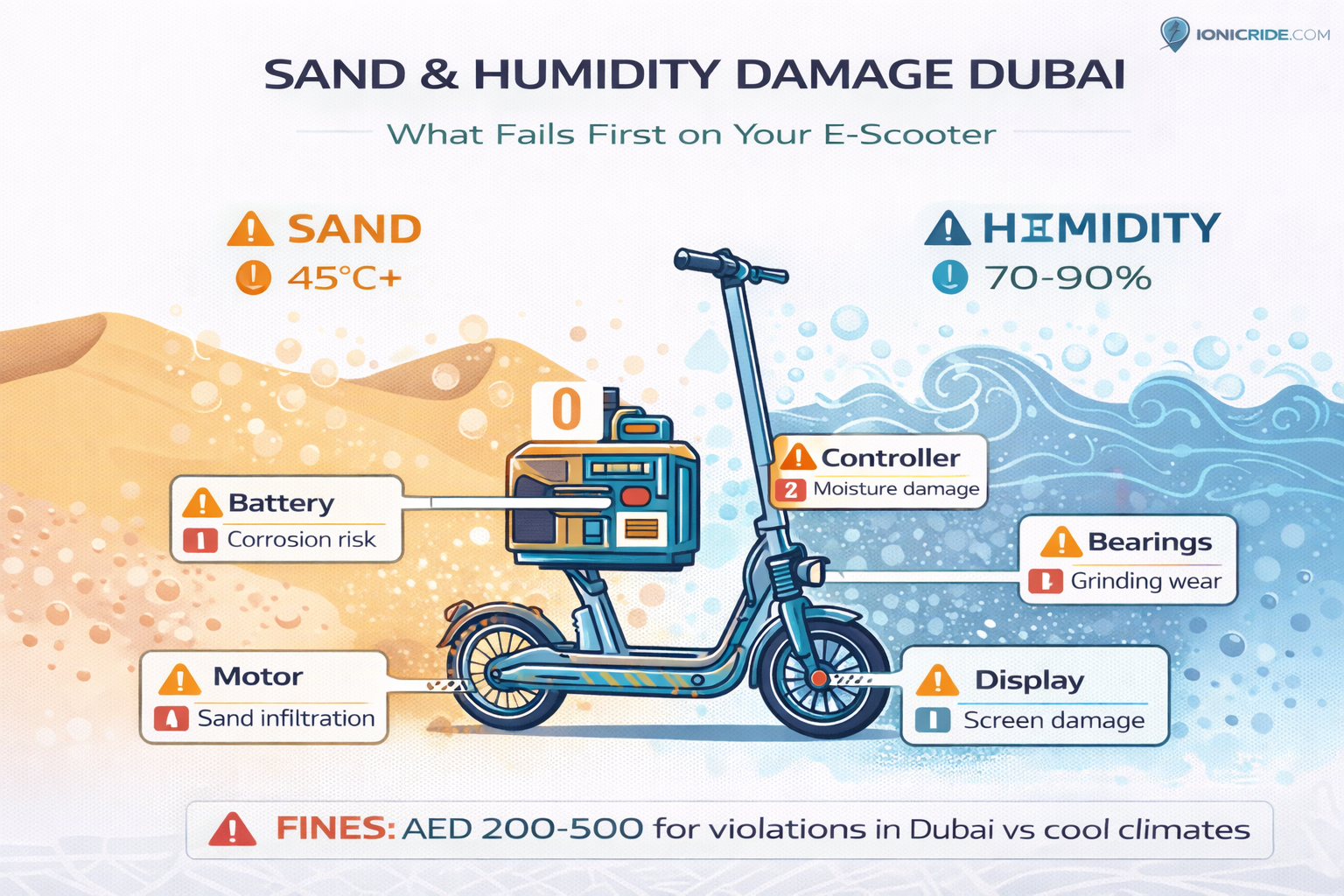
Sand & Humidity Damage Dubai: What Fails First on Your E-Scooter
Sand & Humidity Damage Dubai: What Fails First on Your E-Scooter (2026)
Three months in Dubai. Your scooter starts making grinding noises. Brakes feel gritty. Display randomly cuts out.
You thought you were maintaining it. But Dubai’s sand finds gaps you didn’t know existed. Summer humidity (90%+) corrodes electronics faster than rain ever could.
Here’s what actually breaks first in Dubai conditions, how much it costs to fix, and what prevention methods actually work vs the ones that waste your money.
Why Dubai Climate Destroys E-Scooters Faster
Dubai isn’t just hot. It’s a specific combination of factors that manufacturers in China or Europe never test for:
- Fine desert sand: Smaller than beach sand, penetrates sealed bearings and motor housings
- Extreme temperature swings: 25°C at 6 AM, 45°C at 2 PM (metal expands/contracts, seals fail)
- High humidity + heat combo: 90% humidity at 35°C creates condensation inside sealed electronics
- Salt air near coast: Accelerates corrosion on metal components (JBR, Marina riders know this)
- Year-round riding: No winter break for components to “rest” like in Europe
E-scooters are rated IP54 (dust and water resistant). Dubai sand is finer than the test particles. Dubai humidity condenses inside “sealed” units. The ratings don’t mean what you think they mean.
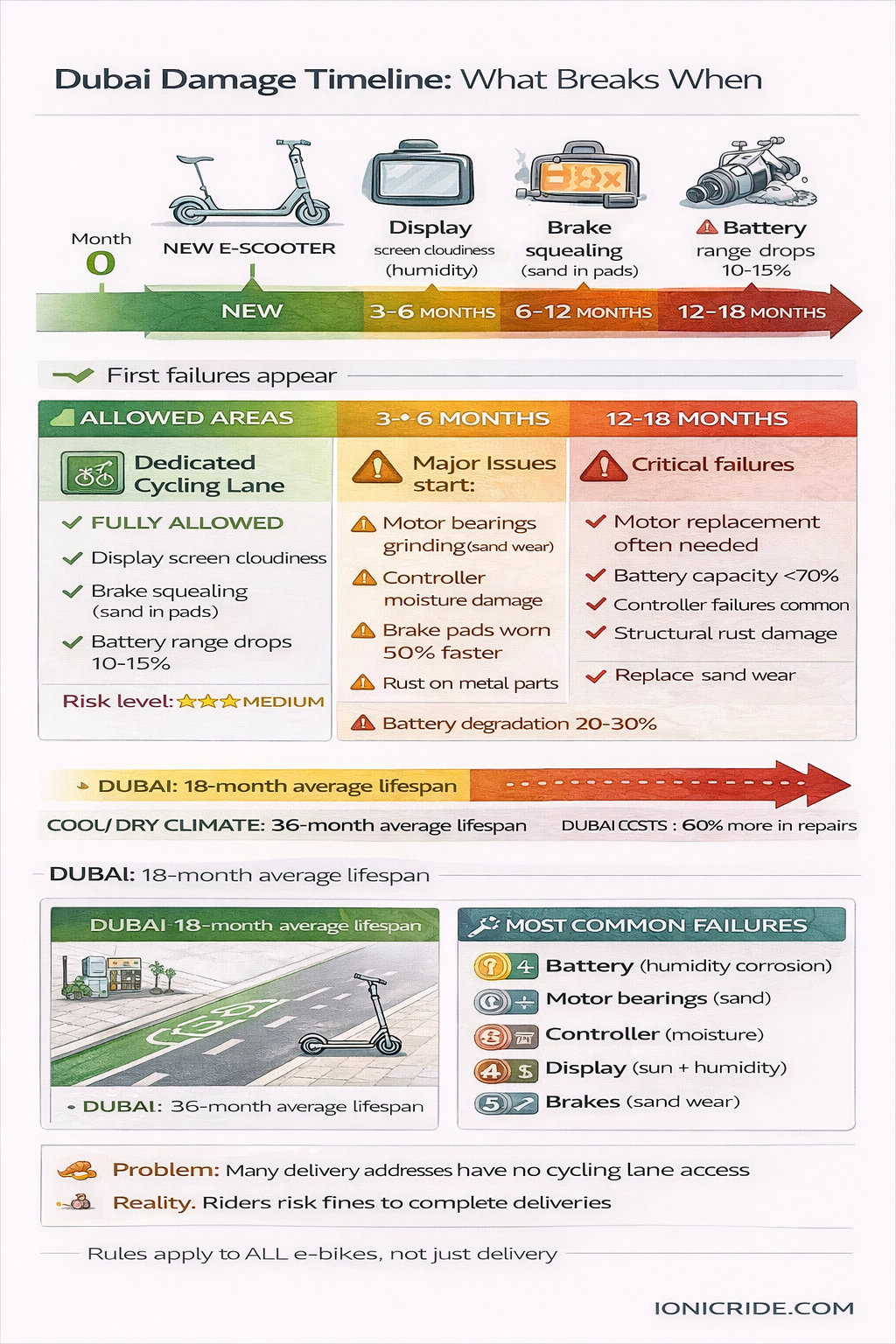
The Failure Timeline: What Breaks When
Based on tracking scooters used daily in Dubai conditions:
| Time Period | What Typically Fails | Symptoms | Repair Cost (AED) |
|---|---|---|---|
| Month 1-3 | Brake pads (sand abrasion) | Squeaking, reduced stopping power | 80-120 |
| Month 3-6 | Bearings (wheels, stem) | Grinding noise, loose feeling in steering | 150-300 |
| Month 6-9 | Display/controller connections | Intermittent display, random power cuts | 200-400 |
| Month 9-12 | Motor bearing seals | Motor noise increases, efficiency drops | 400-800 (motor replacement often needed) |
| Month 12-18 | Battery (humidity corrosion on BMS) | Reduced range, won’t charge fully | 600-900 |
| Month 18-24 | Frame welds/rivets (thermal stress) | Creaking sounds, visible cracks | 300-600 (if repairable) |
The Accelerated Failure Pattern
Same scooter, different locations:
- London usage (wet, cool): First major repair at 18 months (battery degradation from charge cycles)
- Dubai usage (hot, sandy, humid): First major repair at 6-9 months (bearing failure or electrical corrosion)
Dubai conditions accelerate wear by roughly 2-3x compared to manufacturer testing environments.
Component-by-Component Breakdown
1. Brakes: The First Casualty
Brake pads in Dubai last 1,500-2,500 km. Manufacturer claims: 3,000-5,000 km.
- Sand acts like sandpaper: Gets between brake pad and disc/rim, grinds both surfaces
- Heat cycling: Brake disc heats to 60-80°C in use, cools rapidly in AC parking. Metal fatigues.
- Humidity corrosion: Brake discs rust overnight from condensation. Surface rust grinds into pads.
What you’ll notice:
- Month 1: Faint squeaking when braking
- Month 2: Loud squealing, need more lever pressure
- Month 3: Metal-on-metal grinding (you’re out of pad material)
- Clean brake discs weekly: Isopropyl alcohol on cloth, wipe disc surface
- Check pad thickness monthly: Replace when under 2mm (don’t wait for metal-on-metal)
- Avoid riding in sandstorms: One sandstorm ride = 500 km of normal wear on brakes
- Budget: 100-150 AED every 3-4 months for pad replacement
2. Bearings: The Silent Killer
Wheel bearings, stem bearings, suspension bearings—all fail faster in Dubai.
Bearings are sealed with rubber seals. Dubai sand is so fine (0.1-0.3mm particles) it works past the seals over time.
What happens inside:
- Sand particles mix with bearing grease
- Sand grinds against ball bearings and races
- Grease breaks down from heat + abrasion
- Metal-on-metal contact begins
- Bearing seizes or becomes loose
Timeline: Sealed bearings rated for 10,000 km last 3,000-5,000 km in Dubai.
- Grinding noise: Especially when turning or going over bumps
- Loose steering: Stem wobbles more than when new
- Wheel resistance: Push scooter by hand, wheel doesn’t spin freely
- Vibration: New vibration at certain speeds
If you hear grinding, bearings are already damaged. Continuing to ride causes more expensive failures (bent axles, cracked housings).
- Avoid water puddles: Water washes sand INTO bearings. Dry sand stays outside better.
- Don’t pressure wash: Pressure forces water and sand past seals. Use damp cloth only.
- Service bearings every 6 months: Shop opens, cleans, repacks with grease. 150-250 AED prevents 400+ AED replacement.
- Upgrade to ceramic bearings: 300-500 AED upfront, last 2-3x longer than steel in Dubai conditions
3. Electronics: Humidity Corrosion
This is where Dubai’s humidity causes unique damage:
Dubai summer nights: 35°C, 90% humidity. Your scooter is parked outside.
What happens:
- Controller box temperature drops from 45°C (riding) to 35°C (parked)
- Air inside controller contracts slightly
- Humid air gets drawn in through cable ports
- Water condenses on circuit boards overnight
- Salt from humidity deposits on circuits
- Corrosion begins at connection points
This is invisible. You won’t see water damage. But after 6-12 months, connections fail.
| Component | Humidity Damage Pattern | Typical Failure Time | Repair Cost |
|---|---|---|---|
| Display | Condensation inside screen, corrosion on ribbon cables | 6-12 months | 200-350 AED |
| Controller | Corrosion on solder joints, short circuits | 9-15 months | 300-500 AED |
| BMS (battery) | Corrosion on balance wires, protection failure | 12-18 months | 600-900 AED (battery replacement) |
| Wiring harness | Corrosion inside connectors, intermittent connection | 12-24 months | 150-400 AED |
4. Motor: Sand Infiltration
Hub motors are “sealed.” In practice, not sealed enough for Dubai.
- Phase 1 (Months 1-6): Fine sand gets past motor seals into bearing area
- Phase 2 (Months 6-12): Sand grinds away bearing grease. Motor gets louder, slight vibration appears.
- Phase 3 (Months 12-18): Bearing damage allows more sand into motor coils. Efficiency drops, range decreases by 10-15%.
- Phase 4 (Months 18-24): Bearing fails completely or coils short-circuit. Motor replacement needed.
Warning signs:
- Motor louder than when new (grinding/whining sound)
- Vibration through footdeck at certain speeds
- Range dropping without battery degradation
- Motor gets hotter than usual after rides
- Never ride through standing water: Water + sand = paste that gets sucked into motor
- Check motor seals every 3 months: Look for cracks in rubber seal at motor edge
- Silicone spray on seals: Apply silicone lubricant (not oil) to rubber seals every 2 months. Keeps rubber flexible.
- Store indoors if possible: Even unair-conditioned storage is better than outdoor parking for motors
5. Battery: The Expensive One
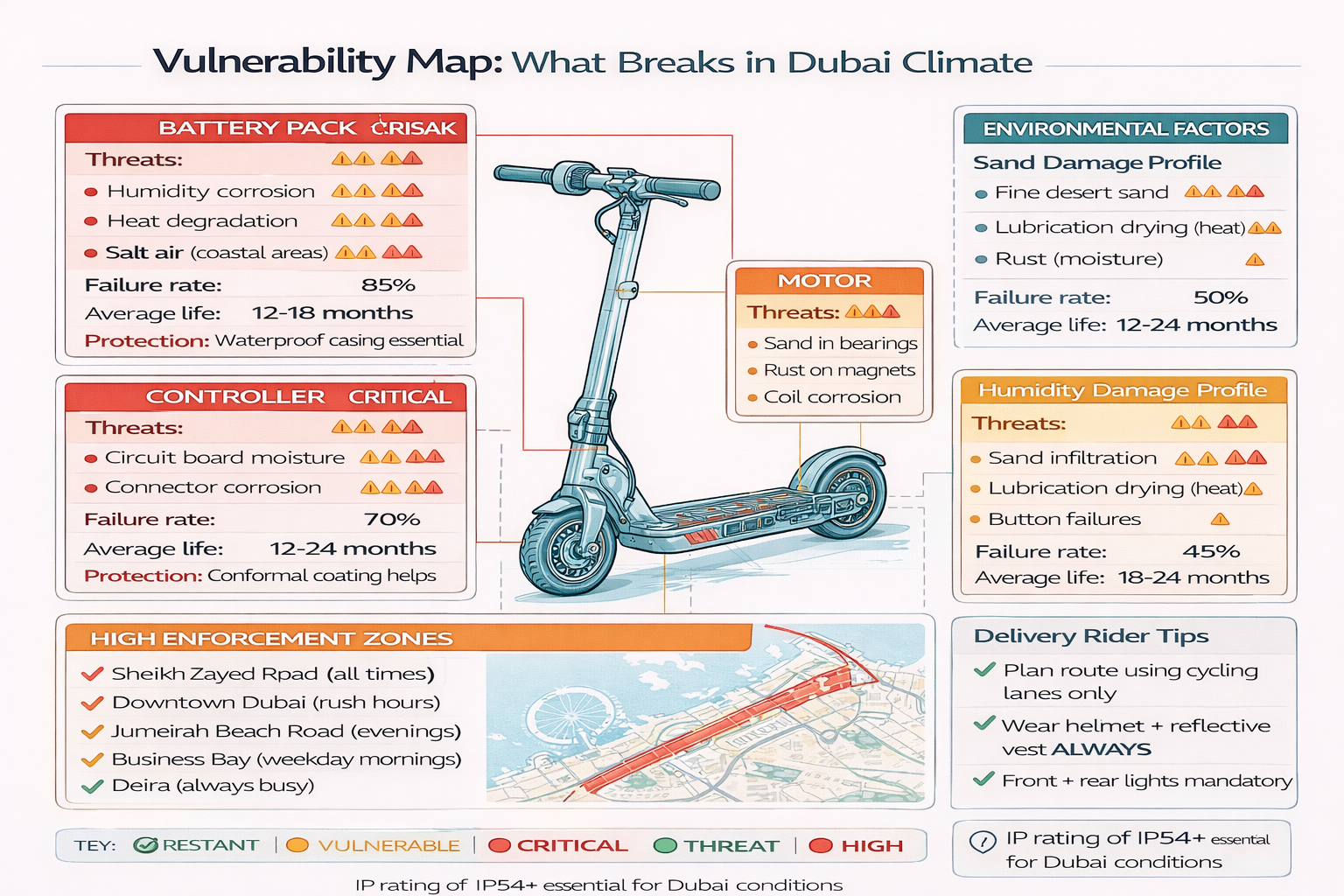
Battery replacement is 600-900 AED. In Dubai, batteries fail faster than manufacturer claims.
- Manufacturer claim: 500-800 charge cycles (3-5 years)
- Dubai reality: 400-600 charge cycles (18-24 months)
Why the difference:
- Heat accelerates degradation: Every 10°C above 25°C doubles degradation rate. Dubai averages 35°C year-round.
- Humidity corrodes BMS: Battery Management System circuit boards corrode, causing premature protection shutdowns
- Thermal cycling stress: Battery expands when hot, contracts when cool. In Dubai, this happens daily for months.
- Don’t charge immediately after riding: Let battery cool 30 minutes before charging. Hot battery + charging = accelerated degradation.
- Charge indoors (AC environment): Charging in 45°C parking lot kills battery 2x faster
- Don’t leave at 100% charge for days: If not using scooter for a week, charge to 60-70% only
- Store at 20-40% if long-term storage: Full charge in Dubai heat degrades battery even when not in use
The Parts That Surprisingly Survive
Not everything fails fast in Dubai. Some components handle the climate well:
- Tires: Heat accelerates wear BUT Dubai’s smooth roads balance it out. Solid tires last indefinitely.
- Frame/deck: Aluminum handles heat well. No rust (unlike steel frames). Can last 3-5+ years.
- LED lights: Solid-state components handle heat better than mechanical parts. Rarely fail from climate.
- Folding mechanism: Metal hinges corrode but usually still functional. Lubrication prevents major issues.
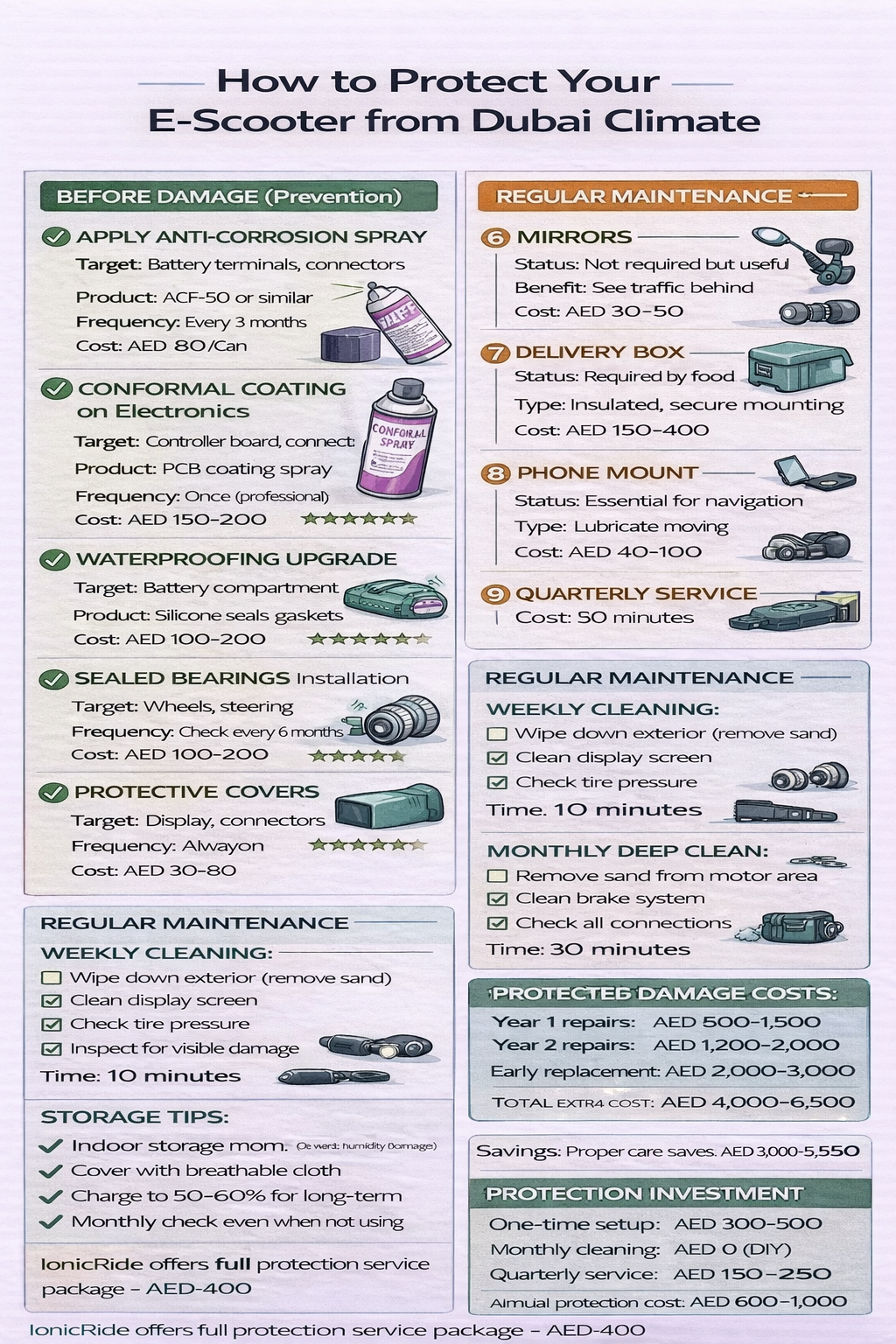
What “Prevention” Actually Works
You’ll see lots of advice online. Here’s what actually works vs what wastes money:
Methods That Work
- Indoor storage (even without AC): Reduces condensation by 70%, extends electronics life by 6-12 months. Worth finding space.
- Monthly cleaning with damp cloth: Removes salt residue before it corrodes. Use cloth, not pressure washer. 10 minutes/month prevents 300+ AED repairs.
- Silicone spray on all rubber seals: 30 AED can, lasts 6 months. Apply to motor seals, stem seals, battery port seals every 2 months.
- Dielectric grease on electrical connections: 40 AED tube, protects connections from humidity. Apply when assembling/disassembling any connectors.
- Skip the sandstorm rides: One 30-minute ride in active sandstorm = 1,000 km of normal wear. Just don’t.
Methods That Don’t Work (Marketing BS)
- “Waterproof covers” for scooter: Trap heat and humidity underneath. Make condensation worse, not better. Waste of 150-300 AED.
- Aftermarket “nano coatings”: Shops charge 200-400 AED for ceramic coating. Doesn’t prevent sand ingress or humidity damage to electronics. Save your money.
- “Climate-specific” lubricants: Marketing fluff. Regular silicone spray (30 AED) works same as “desert formula” spray (120 AED).
- Daily washing: More water exposure = more problems. Weekly damp-cloth wipe is better than daily water rinse.
- Rice in battery compartment: Internet myth for phones. Doesn’t work for scooter battery compartments. Just no.
Repair vs Replace: The Economics
When do you repair vs when do you cut losses and buy new?
Repair vs Replace Decision Tree:
Scooter under 12 months old:
- Brake pads, bearings, display: Repair. Total cost under 500 AED, scooter still has years of life.
- Motor or battery failure: Check warranty first. If no warranty, repair if scooter originally cost 2,500+ AED.
Scooter 12-24 months old:
- Single major component (motor OR battery): Repair if scooter originally cost 3,000+ AED.
- Multiple failures (motor + battery + controller): Repair cost will be 1,200-1,800 AED. Consider buying new for 2,500-3,500 AED instead.
Scooter over 24 months old:
- Minor repairs (brakes, bearings): Worth it.
- Major repairs (motor, battery): Usually not worth it. Scooter has other components near failure too. Replace.
The 50% Rule
If total repair cost exceeds 50% of current replacement cost, replace instead of repair.
Example:
- Your scooter needs: new battery (700 AED) + new motor (600 AED) = 1,300 AED
- Similar new scooter costs: 2,800 AED
- Repair cost is 46% of replacement cost → Worth repairing
But if repair was 1,500+ AED (54%+): Better to buy new, get warranty, start fresh.
Maintenance Schedule for Dubai Conditions
Follow this schedule to maximize scooter lifespan in Dubai:
- Visual inspection: cracks, loose bolts, tire wear
- Brake test: squeeze levers, check for full travel and stopping power
- Quick wipe-down with damp cloth (removes sand and salt)
- Deep clean all accessible surfaces with damp cloth
- Check brake pad thickness (replace if under 2mm)
- Tighten all visible bolts (handlebars, stem, folding mechanism)
- Test all lights and electrical functions
- Check tire pressure (if pneumatic tires)
- Apply silicone spray to all rubber seals
- Check wheel bearing play (spin wheels, listen for grinding)
- Clean brake discs with isopropyl alcohol
- Lubricate folding mechanism
- Inspect all cable connections for corrosion
- Full bearing inspection and repack (150-250 AED)
- Electrical system check for corrosion
- Motor seal inspection and replacement if needed
- Battery health test (capacity check)
The Coast vs Inland Difference
Where you ride in Dubai affects failure rates:
Coastal (salt air exposure):
- Metal corrosion 2-3x faster
- Brake discs rust overnight, need more frequent replacement
- Electrical connectors corrode faster (salt conducts electricity)
- Expected major failure: 6-9 months (vs 9-12 months inland)
Inland (less salt, more sand):
- Bearing wear faster (more desert sand in air)
- Corrosion slower than coastal
- Still hot and humid, but slightly less aggressive overall
If you live coastal, budget 20-30% more for maintenance than inland riders.
Insurance and Warranty Reality
- “Normal wear and tear”: Brake pads, tires, bearings. You pay even if under warranty.
- “Environmental damage”: Sand ingress, humidity corrosion labeled “misuse.” Warranty denied.
- “Modified scooter”: If you opened motor or battery for any reason, warranty void.
Realistically, Dubai climate damage is almost never covered by warranty. Shops blame user, manufacturer blames “extreme conditions.”
The Bottom Line
Dubai will destroy your e-scooter faster than manufacturer testing predicts. Accept this upfront.
Realistic Dubai e-scooter economics:
- Budget scooter (1,500-2,500 AED): 12-18 months before major failure. Maintenance: 300-500 AED/year.
- Mid-range scooter (2,500-4,000 AED): 18-24 months before major failure. Maintenance: 400-600 AED/year.
- Premium scooter (4,000+ AED): 24-36 months before major failure. Maintenance: 500-800 AED/year.
Total cost of ownership (2 years): Purchase price + 800-1,200 AED maintenance/repairs
The riders who get longest lifespan follow two rules:
- Indoor storage whenever possible: Single biggest factor. Prevents 50%+ of humidity damage.
- Proactive maintenance: Monthly cleaning + 6-month shop service. Costs 400 AED/year, prevents 1,000+ AED in repairs.
You can’t stop Dubai from damaging your scooter. But you can slow it down enough to get 2-3 years instead of 12-18 months.
That’s the honest truth nobody else will tell you.