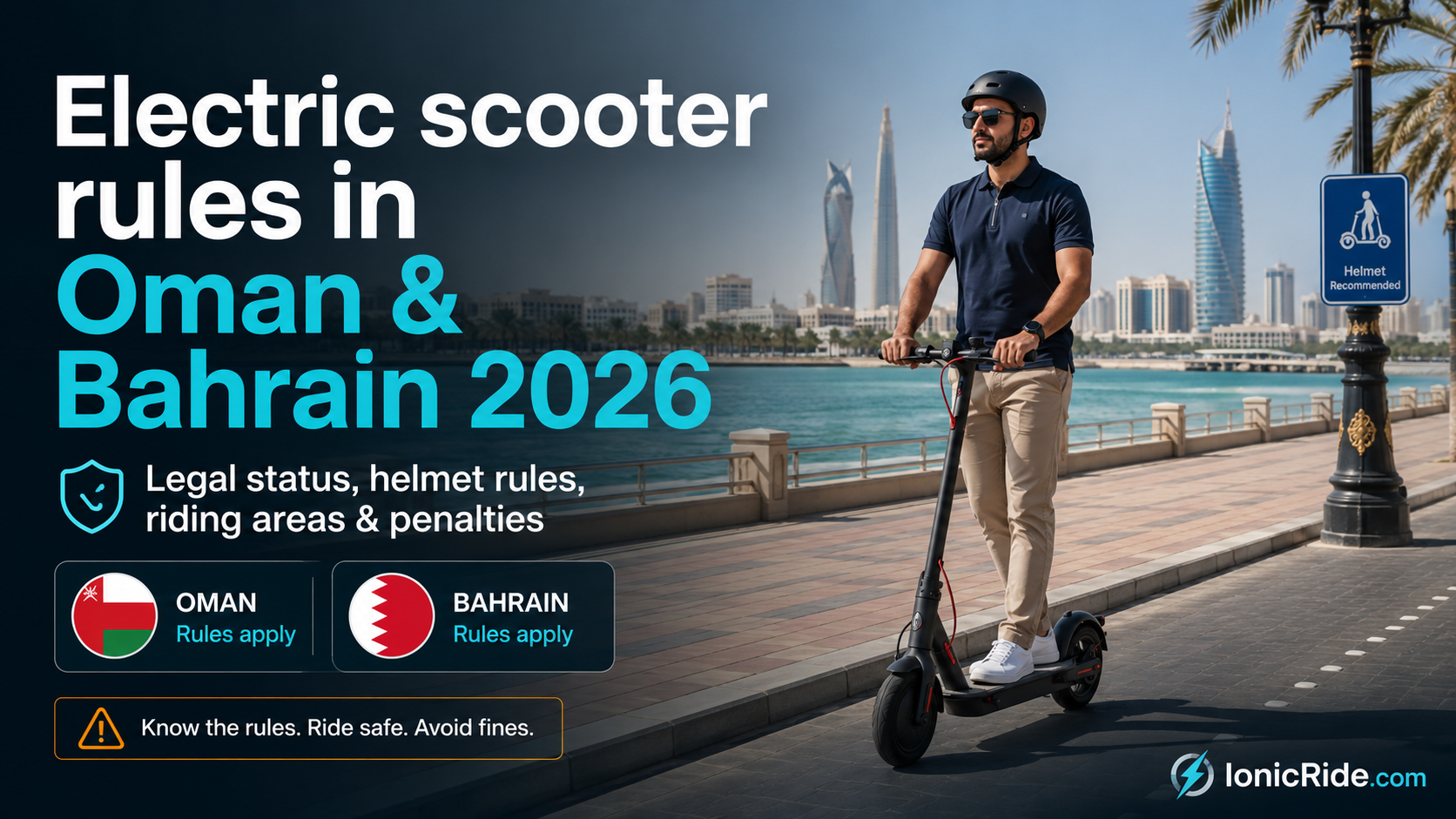
Electric Scooter Rules in Oman & Bahrain
Electric Scooter Rules in Oman & Bahrain 2026: Fines, Helmets & Where You Can Ride
Oman and Bahrain are two small Gulf neighbours that have taken almost opposite routes on electric scooters — which is exactly why it’s worth covering them together.
Bahrain just did what most of the Gulf hasn’t: in 2026 it passed a clear, formal e-scooter law. Scooters are now allowed on internal roads at up to 25 km/h, with defined areas, age rules and penalties. Oman went the stricter way — the Royal Oman Police keeps e-scooters off main roads entirely, limits them to private or quiet areas, and has been ramping up enforcement with AI cameras.
This guide covers both, side by side: what’s actually legal, where you can ride, the penalties, and how the two compare — with the bits that genuinely aren’t published yet flagged honestly rather than guessed.
🇴🇲 Oman: E-Scooters Are Off the Main Roads
Let’s be clear about Oman’s position, because it surprises people who assume the Gulf is uniformly scooter-friendly. The Royal Oman Police (ROP) — which runs all traffic regulation through its Traffic Department — does not allow e-scooters and e-bikes on main roads.
The ROP’s repeated message: these vehicles “should be limited to private properties or less populated areas,” because riding them on main roads endangers the rider and others and disrupts traffic. A rule has existed since 2024, but as one official put it, it “was not fully operational” — until a rise in accidents pushed the ROP to start strictly implementing it in 2025.
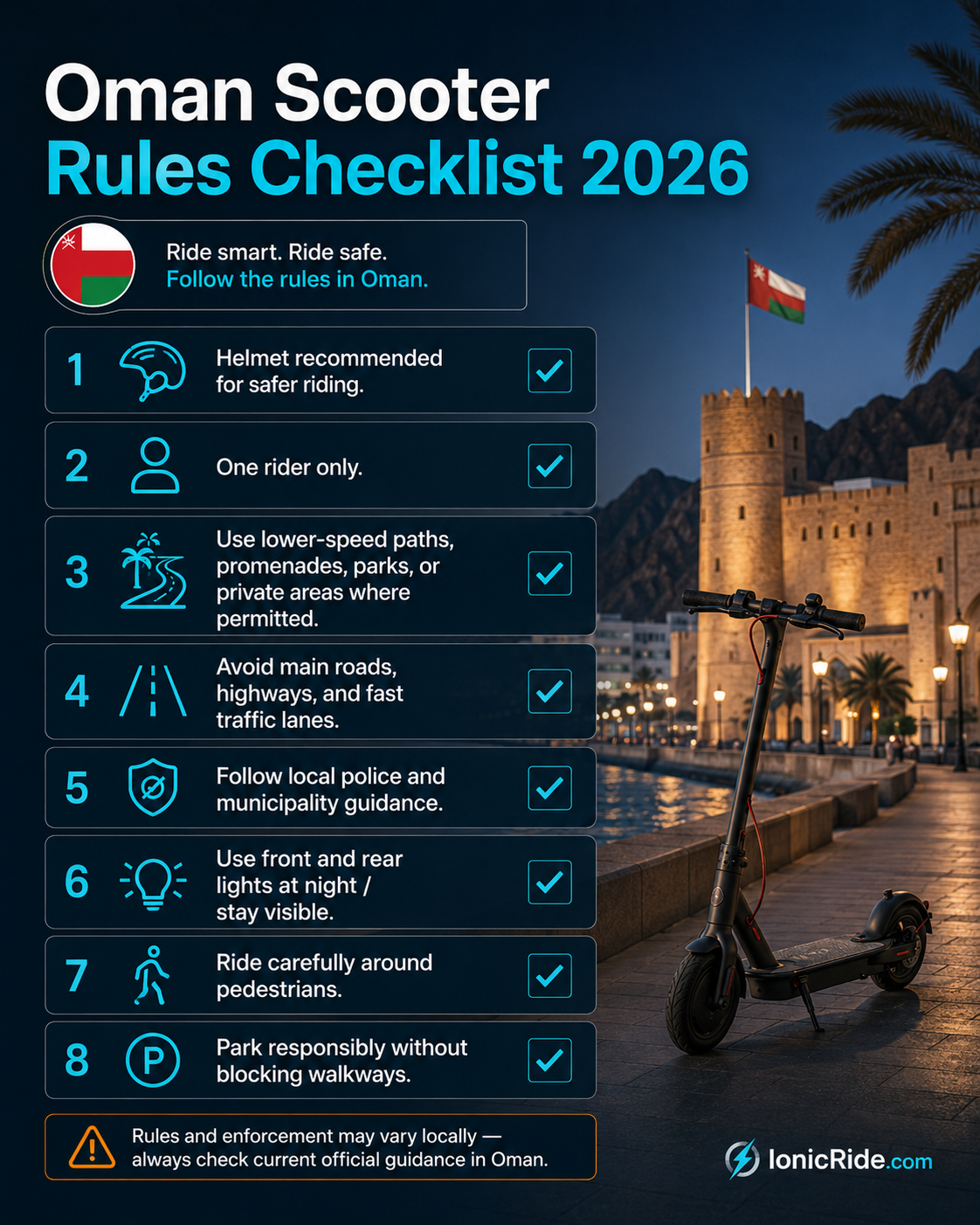
- Main roads — prohibited; the ROP has been explicit and repeated about this.
- Public parks, gardens and beaches — Muscat Municipality bans all bikes, including electric ones.
- School grounds — banned by the Ministry of Education.
- Private property — the clearly safe option.
- Less-populated areas — the ROP’s stated tolerance, away from main-road traffic.
Enforcement is increasing — AI cameras and confiscation
This isn’t a paper rule any more. In 2025 the ROP confirmed its newly activated AI-powered traffic cameras will monitor e-scooter riders if they operate on main roads. The ROP has also been confiscating unregistered and heavily modified e-bikes. Oman runs a strict black-point system on top of fines, so getting swept up in traffic enforcement carries real consequences.
Because Oman’s stance is to keep e-scooters off main roads rather than to license road use, there’s no published e-scooter-specific speed limit or minimum age to quote. A helmet isn’t formally mandated for e-scooters either — but the ROP and doctors warn strongly about head-injury risk, and Oman fines riding a bicycle without a helmet (a small RO fine), so wear one regardless.
🇧🇭 Bahrain: A Clear New 2026 Framework
Bahrain is the more interesting story, because it just did what the rest of the Gulf has mostly avoided — it wrote e-scooters into the law properly. In 2026, Interior Minister Shaikh Rashid bin Abdulla Al Khalifa issued Decision No. 58 of 2026, published in the Official Gazette, formally bringing electric scooters, electric bicycles, off-road motorcycles, ATVs and small electric toy vehicles under the 2014 Traffic Law.
For ordinary e-scooter riders, the headline rules are refreshingly concrete:
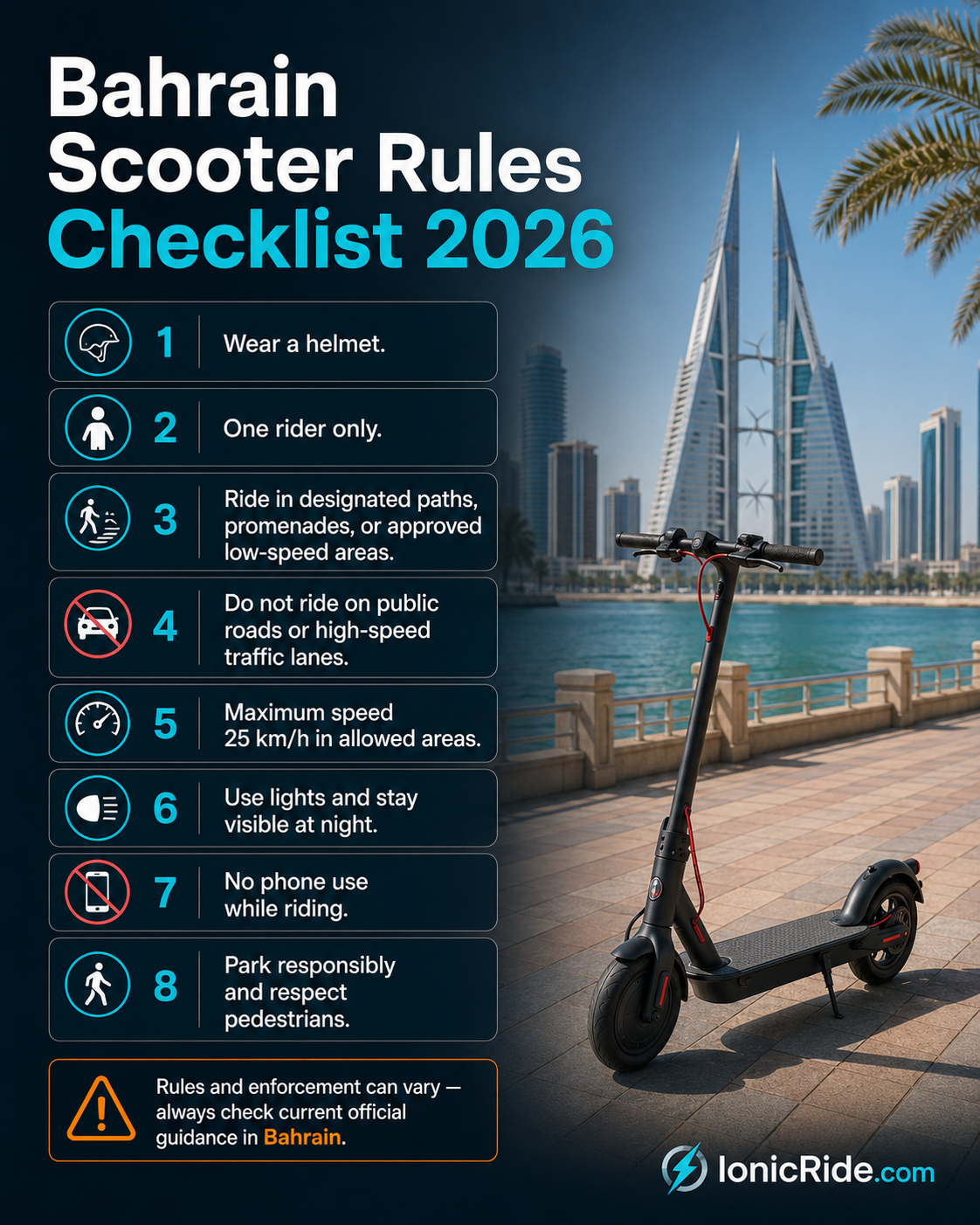
- Internal roads only — e-scooters and e-bikes may be used on internal roads, not highways.
- Maximum speed 25 km/h — one of the clearest published e-scooter speed caps in the Gulf.
- Designated areas and times — authorities can set where and when scooters may operate.
- Age-linked use — tied to appropriate age groups, with parental or guardian supervision required for younger riders.
- Owner / guardian responsibility — you can’t hand a scooter to someone outside the permitted age group.
This framework replaced a messier situation. Through 2025, Bahrain’s General Directorate of Traffic had been banning unlicensed e-scooters from public roads, lanes, shoulders and emergency lanes after a run of accidents — and repeatedly reminding riders that scooters don’t belong on main roads or vehicle lanes. Decision 58/2026 turned that enforcement posture into a structured, legal framework with clear limits.
Penalties in Bahrain
The decision has teeth. Violations can bring fines, vehicle impoundment for up to 60 days, and imprisonment for certain offences. The General Directorate of Traffic can also inspect rental outlets and event organisers to check they meet safety standards and age restrictions, and abandoned impounded vehicles can ultimately be auctioned or destroyed.
Initial reporting on Decision 58/2026 confirmed the 25 km/h limit, internal-roads rule and age-linked supervision, but did not publish the exact minimum-age number or specific BHD fine amounts for e-scooters. The explicit helmet-goggles-full-gear requirement that was reported applies to off-road motorcycles and desert vehicles, not e-scooters specifically — so wear a helmet on a scooter as basic safety, but don’t assume a precise e-scooter helmet fine until the detail is confirmed. Check the General Directorate of Traffic for specifics.
Oman vs Bahrain — Side by Side
Here’s the clearest way to see how differently these two neighbours treat the same machine.
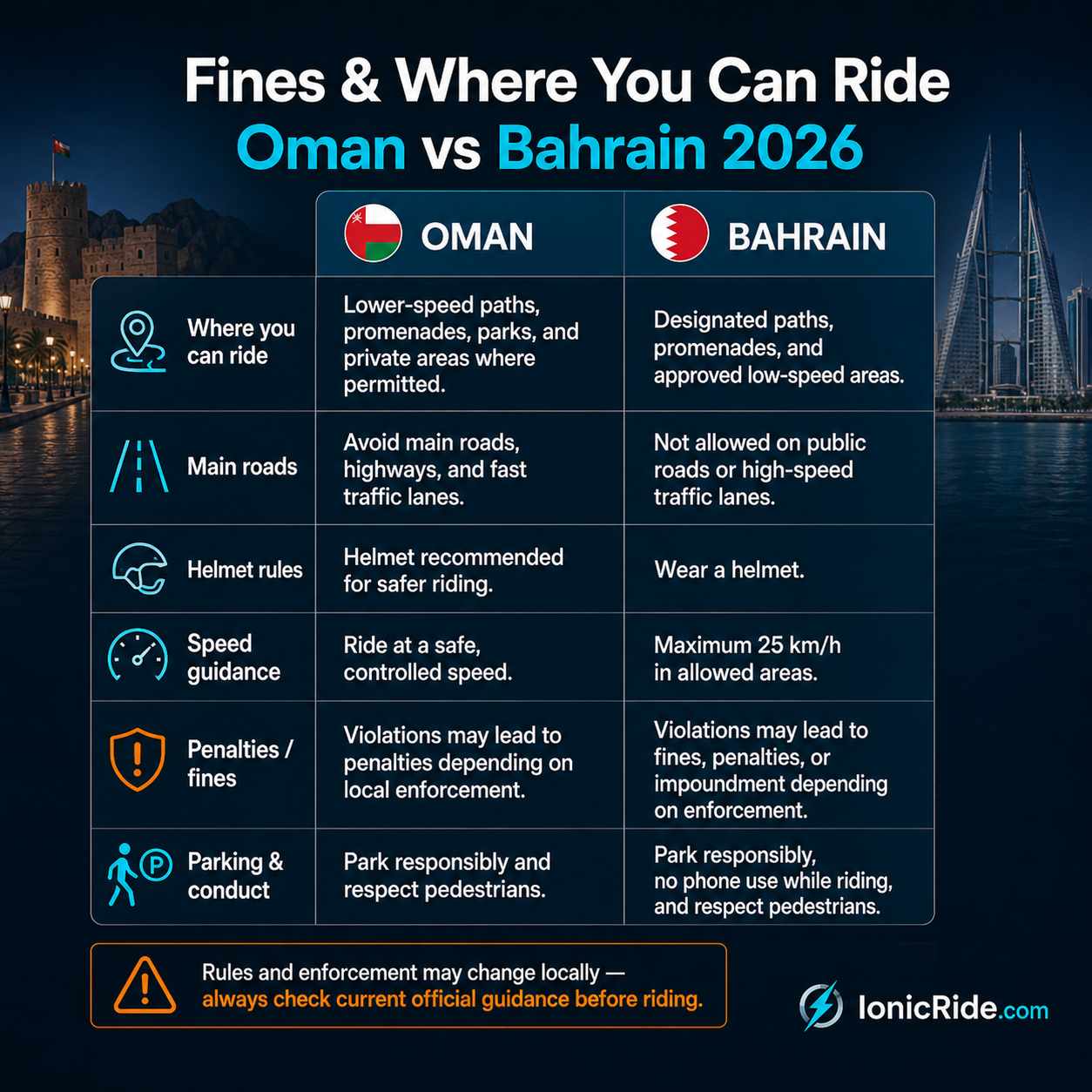
E-Scooter Rules — Oman vs Bahrain (2026)
| Rule | 🇴🇲 Oman | 🇧🇭 Bahrain |
|---|---|---|
| Legal to own? | Yes | Yes |
| Formal e-scooter law? | Restriction, not a framework | Yes — Decision 58/2026 |
| Allowed on roads? | No main roads | Internal roads only |
| Highways | No | No |
| Speed limit | Not published | 25 km/h |
| Age rules | Not published | Age-linked + guardian |
| Helmet | Advised | Advised (gear rules apply) |
| Main penalty | Confiscation | Fines · impound ≤60 days · jail |
| Enforcement trend | Tightening (AI cameras) | Newly formalised |
Comparing the rest of the Gulf? See Saudi Arabia, Qatar and Kuwait e-scooter laws.
The Factor No Law Covers: Gulf Heat
Whether you’re on a quiet road in Muscat or an internal street in Manama, the heat is the same enemy. Both countries hit well above 40°C in summer, and that punishes scooters as much as riders.
- Range drops in extreme heat, and sustained high temperatures shorten battery life — expect less than the range printed on the box.
- Never charge a hot battery or leave a scooter charging in direct sun or a parked car. Heat is the number-one killer of scooter batteries in the Gulf.
- Ride early or late — keep summer rides to the cooler morning or evening windows and stay hydrated.
Full hot-climate riding and battery-care guide: Gulf Summer Survival Guide for E-Scooters
Common Mistakes & Things People Forget
- Assuming a quiet main road is fine — it isn’t; the ROP prohibits main-road use, full stop.
- Riding in a public park, garden or on a beach — banned by Muscat Municipality.
- Thinking the rule isn’t enforced — AI cameras now monitor main roads and the ROP confiscates modified e-bikes.
- Skipping a helmet — not formally required for scooters, but the head-injury risk is real.
- Getting onto a highway — banned; e-scooters are for internal roads only.
- Going over 25 km/h — that’s the legal cap under Decision 58/2026.
- Letting an under-age child ride unsupervised — use is age-linked and guardians are responsible.
- Ignoring designated areas/times — authorities can set them, and impoundment up to 60 days is on the table.
🇴🇲 Oman: Legal to own, but keep it off main roads. Ride on private property or quiet, less-populated areas only — parks, beaches and schools are off-limits, and enforcement is tightening with AI cameras and confiscations.
🇧🇭 Bahrain: Now properly regulated under Decision 58/2026 — ride on internal roads only, at up to 25 km/h, never on highways, within any designated areas and times, and mind the age rules. Penalties run to fines, 60-day impoundment and possible jail for serious violations.
Both are still moving. Oman may yet introduce a permissive framework, and Bahrain’s detail (exact ages, fines) will firm up as the new law beds in. Check the ROP (Oman) or the General Directorate of Traffic (Bahrain) before relying on any specific figure.
Oman & Bahrain E-Scooter Law — Full FAQ
Legal to own — yes. But the Royal Oman Police does not allow them on main roads; its position is that e-scooters and e-bikes belong on private property or in less-populated areas. A rule has existed since 2024 and has been strictly enforced since 2025, including AI camera monitoring of main roads. Muscat Municipality bans them from parks, gardens and beaches, and the Ministry of Education bans them from school grounds.
Yes, and clearly regulated. Decision No. 58 of 2026 brings e-scooters under the Traffic Law: internal roads only, maximum 25 km/h, no highways, with designated areas and times, age-linked use with guardian supervision for younger riders, and penalties including fines, impoundment up to 60 days, and imprisonment for certain offences.
Not on main roads. The ROP has repeatedly warned that e-scooters and e-bikes must stay off main roads, and enforcement increased in 2025 with AI cameras and the confiscation of unregistered or modified e-bikes. The ROP says to use them on private property or in less-populated areas instead.
25 km/h, under Decision No. 58 of 2026, and only on internal roads — highways are off-limits. Authorities can also set designated areas and times for use. It’s one of the clearest published e-scooter speed limits in the Gulf.
In Bahrain: fines, vehicle impoundment up to 60 days, and imprisonment for certain offences, with owners and guardians held responsible. In Oman: confiscation for main-road use, plus seizure of unregistered or modified e-bikes and general traffic penalties under the black-point system. Neither publishes a single simple e-scooter fine, so confirm amounts with the authorities.
On private property or in less-populated areas, per the ROP — not main roads. Parks, gardens and beaches are banned by Muscat Municipality, and school grounds by the Ministry of Education. In practice, private compounds and quiet private land are the clearly safe options.
Wear one in both, regardless of the fine print. Oman strongly advises it (and fines riding a bicycle without a helmet). Bahrain’s 2026 framework adds safety conditions and explicit gear rules for off-road vehicles; for e-scooters specifically, a helmet is basic safety. It’s the cheapest protection you can buy.
Different stages. Bahrain has a clear 2026 framework that permits e-scooters within limits (internal roads, 25 km/h, age rules, penalties). For compliant models, compare the best legal electric scooters in Bahrain. Oman is more restrictive — it keeps e-scooters off main roads and is tightening enforcement rather than opening a permissive framework. Bahrain regulates and permits; Oman restricts and enforces.