Scooty in Dubai 2026: Prices, Best Models & 3-Wheel Options
Scooty in Dubai 2026: Prices, Best Models & 3-Wheel Options
“Scooty” in Dubai usually means a small, seated scooter — and the word covers more than one thing. It can mean a petrol gearless scooter, a seated electric scooty, or a stable three-wheel model.
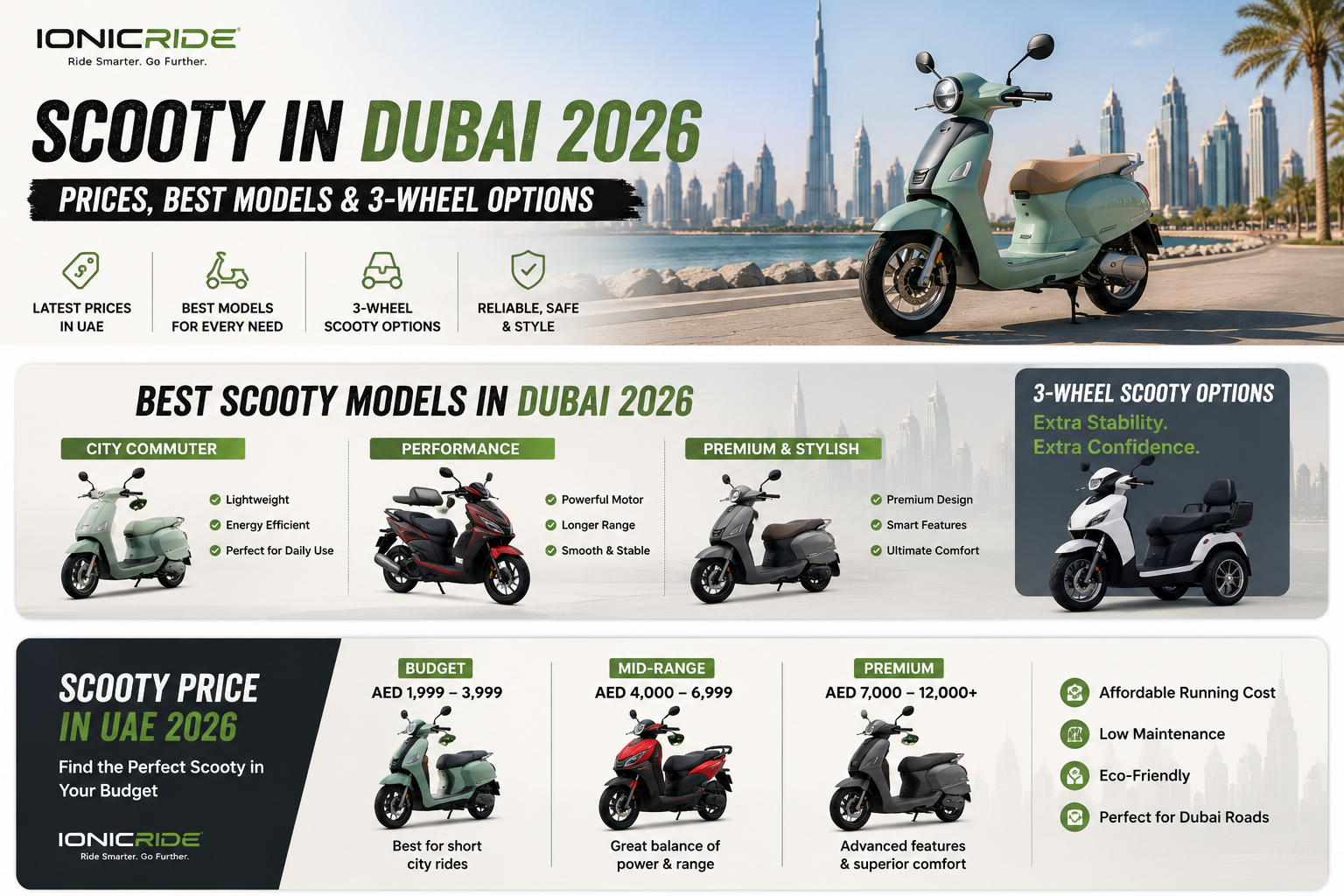
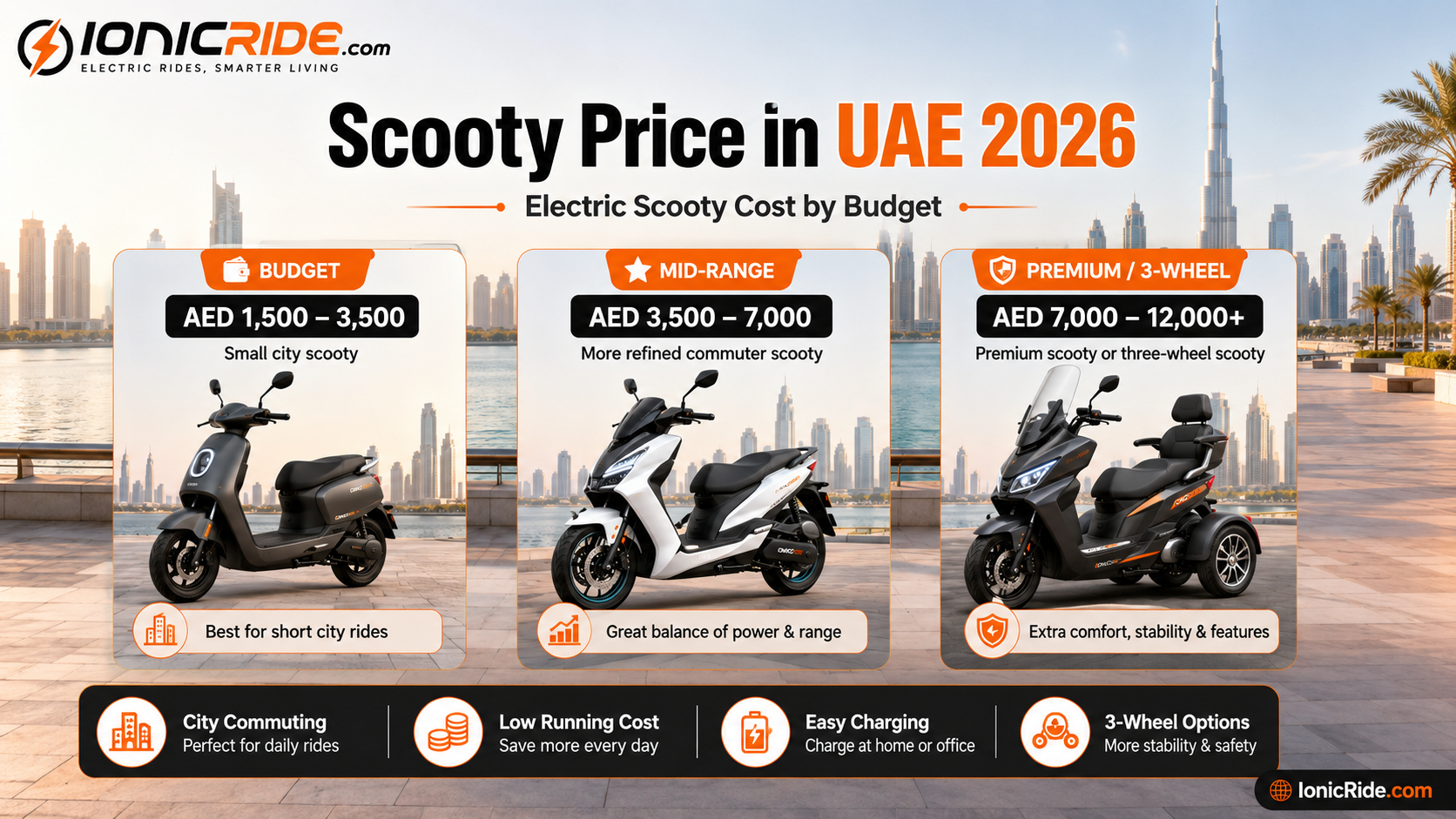
For most IonicRide readers shopping today, “scooty” means an electric scooty. Broadly, a reliable electric scooty in the UAE costs around AED 1,500–3,500, with budget models below and premium or seated models above. Three-wheel scooty options for ladies and seniors sit in a mid-to-upper bracket.
The catch is legality: a small, low-speed electric scooty may ride under personal-mobility rules, while a petrol or fast motorcycle-style scooty can need registration, insurance, and a licence. This guide covers prices, best types, the 3-wheel options, and the rules to check first.
⚡ Quick Facts — Scooty in Dubai 2026
What Is a “Scooty” in Dubai? (And Why the Word Matters)
“Scooty” is an everyday word, not a legal one — and that’s exactly why it causes confusion. Different shoppers use it for very different vehicles:
- Petrol gearless scooter — the classic small automatic motorbike-style scooter. Legally a motor vehicle.
- Seated electric scooty — a battery-powered scooter you sit on, often step-through, throttle-driven.
- Electric scooty with a seat added — a kick-scooter platform fitted with a seat for comfort.
- Three-wheel electric scooty — a seated trike for stability, popular with ladies and seniors.
- Mobility scooter — a low-speed three- or four-wheel scooter aimed at reduced-mobility riders.
The price and the rules change completely depending on which of these you mean. A petrol scooty and a fast electric scooty are generally treated as motor vehicles — registration, plate, insurance, and a licence territory. A small, low-speed electric scooty may fall under the friendlier personal mobility device framework. A mobility scooter is usually restricted to pedestrian areas. So before you compare prices, decide which type you actually want.
Pick the category before the model. The same budget buys a very different machine depending on whether you want a low-speed seated e-scooty, a three-wheeler for stability, or a road-style scooty. The category also decides whether you’ll need a permit or a full licence and registration.
Scooty Price in UAE 2026: What You Actually Pay
Here’s the honest price picture. These are broad UAE ranges for guidance — actual prices move with battery size, motor, brand, warranty, and stock, so always check the current UAE seller listing, warranty, and registration requirements before buying.
Scooty Price Guidance — UAE 2026 (Estimates Only)
Verify Current Price| Type | Expected UAE Range | Best Buyer | What to Verify |
|---|---|---|---|
| Budget electric scooty | ~AED 600–1,500 | First-timers, short trips | Build quality, battery, warranty |
| Commuter electric scooty (sweet spot) | ~AED 1,500–3,500 | Daily riders | Range, parts, brand support |
| Seated / fat-tyre electric scooty | ~AED 3,000–4,500 | Comfort seekers | Weight, classification, licence need |
| Three-wheel electric scooty | ~AED 2,000–5,000+ | Ladies, seniors, light cargo | Width, category, where allowed |
| Premium / motorcycle-style scooty | ~AED 4,000–9,500+ | Registered road riders | Full registration, insurance, licence |
For context, UAE retailers commonly list everyday electric scooters from a few hundred dirhams at the very bottom up to AED 9,000–14,000 for high-performance models, and the most-recommended reliable commuter tier tends to land around AED 1,500–3,500. Prices change depending on seller, battery, motor, warranty, and stock, and two listings that look identical can differ a lot once you account for battery quality and a real, claimable UAE warranty. Our deeper e-scooter price guide for Dubai and our best e-scooters by price range break each tier down further. If cash flow is the issue, some UAE sellers offer installment plans through Tabby, Tamara and banks.
Tight budget? See the best electric scooter under AED 1,500 in the UAE — what you actually get for the money.
Electric Scooty Cost: Buying vs Running
The sticker price is only half the story. The real electric scooty cost in Dubai includes what you spend keeping it alive in the heat. Budget for these:
- Charging: Electricity is cheap — running cost per km is tiny compared with petrol.
- Battery replacement: The big one. UAE summer heat shortens battery life, so a cheap pack may need replacing after a couple of summers. Factor this in on budget models.
- Tyres & brakes: Routine wear items; pneumatic tyres may need occasional replacement.
- Parts availability: A scooty from a brand with local parts is far cheaper to keep running than a no-name import with none.
- Accessories: Helmet, lock, lights — small but worth budgeting.
On a budget electric scooty, the battery is usually the first thing to fail in Dubai heat. A slightly more expensive model with a quality, certified battery and local replacement parts often costs less over two years than a cheap one you replace early. Let the battery cool before charging, and charge indoors out of direct sun.
Are Scooty Legal in Dubai?
The honest answer is: it depends on which scooty you mean and where you ride it.
A low-speed electric scooty in the e-scooter category may be allowed in permitted areas if it meets technical standards and you follow the rules. Reporting on the RTA framework indicates personal e-scooters generally don’t need vehicle registration but must meet technical standards and be used only in approved areas, and a free RTA permit is required unless you hold a valid UAE driving licence. The maximum speed in designated areas is commonly cited as 20 km/h, with riders expected to wear a helmet and stay off highways and pedestrian-only paths.
A petrol scooty or a fast, motorcycle-style electric scooty is a different story. These are generally treated as motor vehicles, which can mean registration, a number plate, insurance, and a valid motorcycle or driving licence before they’re legal on public roads. You should verify with the RTA before riding, because the threshold depends on the exact vehicle. And a mobility scooter is typically restricted to pedestrian areas rather than roads. For the full framework, see our guide to the e-scooter laws in Dubai 2026.
Don’t buy a scooty just because a seller says it’s “road legal.” Ask for proof of compliance, the registration category, the warranty, and whether it can legally be ridden where you actually plan to use it. A vehicle legal on a private track isn’t automatically legal on a community road or public highway. When in doubt, confirm with the RTA and Dubai Police first.
Do You Need a License for a Scooty in Dubai?
It depends on the classification:
- E-scooter-class electric scooty: in most cases a free RTA permit may be enough, and holding a valid UAE driving licence can exempt you from the permit. Confirm the current age and permit requirements when you apply.
- Petrol scooty or motorcycle-style electric scooty: you may need a motorcycle or driving licence, plus registration and insurance.
- Either way, verify first. The label on the box (“cycle,” “scooty,” “scooter”) doesn’t decide the legal category — the vehicle’s speed, power, and design do.
If your scooty qualifies as a personal mobility device, the fastest route is the RTA e-scooter permit application (with screenshots), and our e-scooter licence guide for Dubai covers the requirements. If your vehicle is closer to a moped or motorcycle, read our companion guide on whether electric mopeds are legal in Dubai — the same classification logic applies.
Best Scooty Types in Dubai 2026
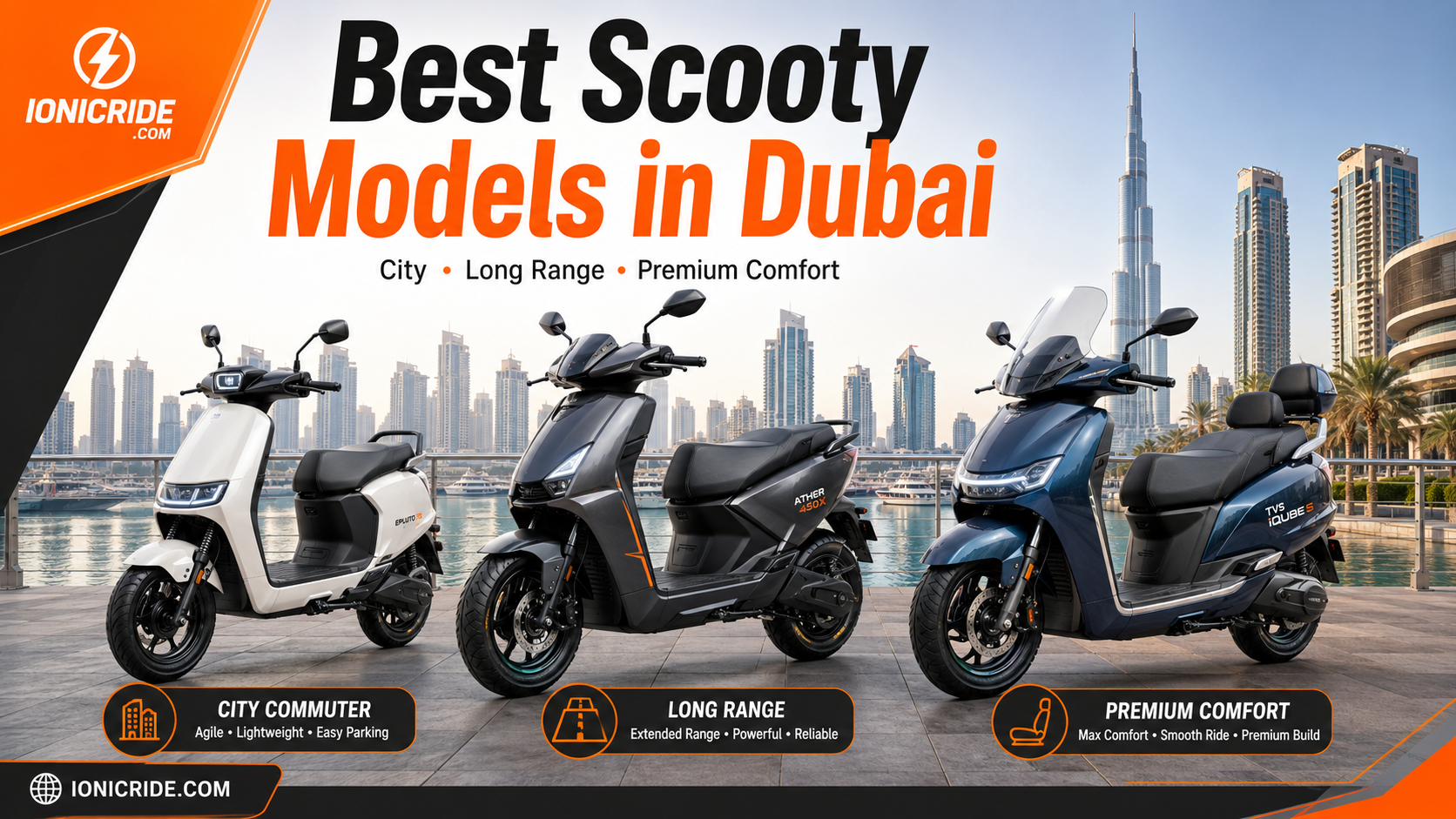
We won’t invent specific model names, prices, or ratings — stock changes constantly and fake “tested” claims help nobody. Instead, here are the main types of scooty UAE buyers consider, with what to check for each. The UAE practicality score is a general workshop view of how easy each type is to own and keep legal here, not a legal ruling.
A compact, low-speed seated scooty — the easiest type to keep within friendlier categories and the simplest to store and handle.
Bigger tyres and a relaxed riding position. Heavier, and the higher-power versions can drift toward the motor-vehicle side, so check the spec.
Extra wheel adds balance and load space. Width and legal classification are the trade-offs — covered in detail in the next section.
The classic scooty silhouette with real road performance. Expect registration, plate, insurance and a valid licence as part of the deal.
Prefer to sit, not stand? Compare seated vs standing e-scooters for Dubai commutes before you choose a scooty.
Scooty with 3 Wheels: The Complete Guide
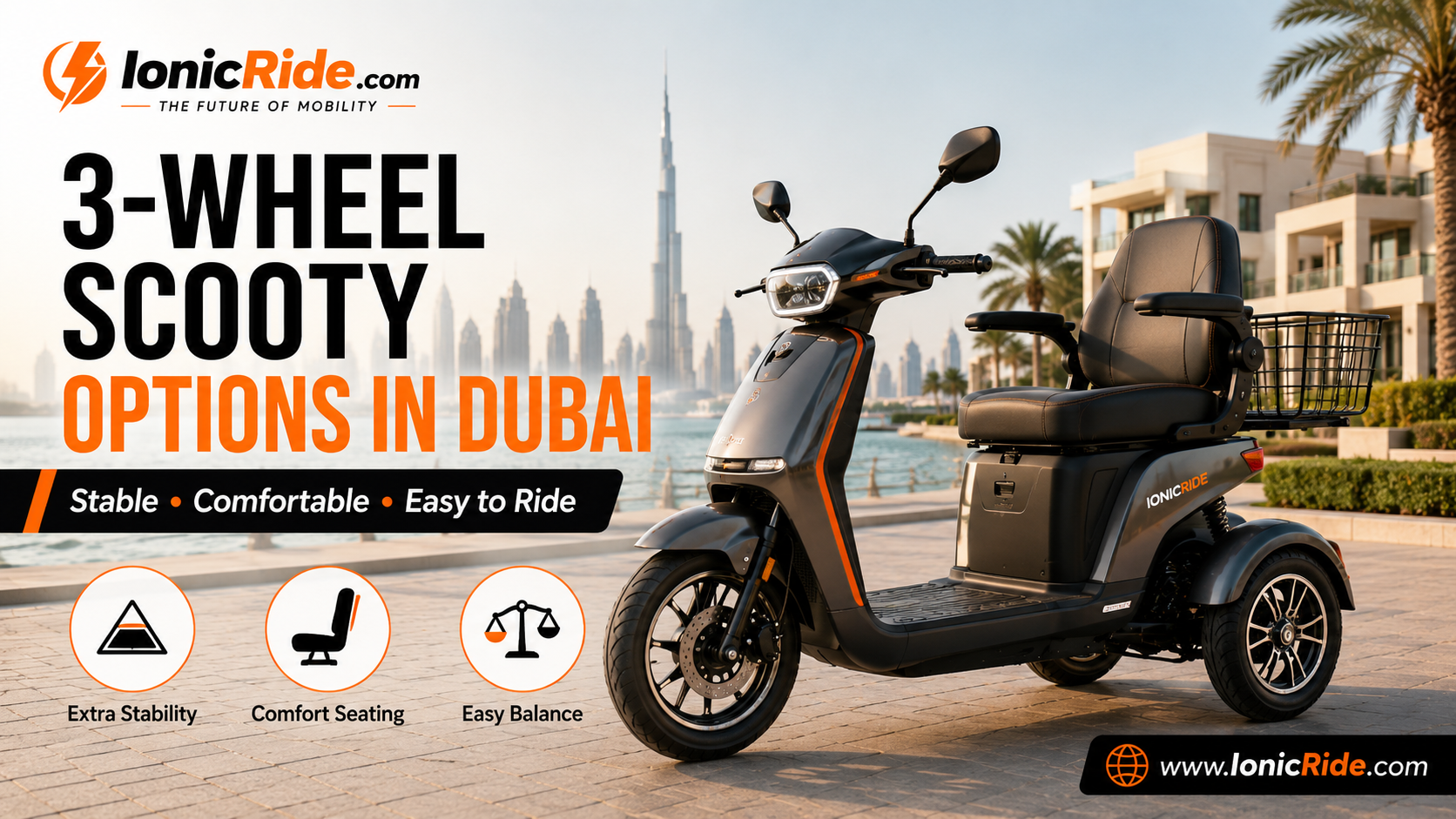
A scooty with 3 wheels is one of the most-searched scooty styles in the UAE, and for good reason: it solves the balance problem. With two wheels at one end, an electric three wheeler scooty stays upright at low speed and at a stop, which makes it far less intimidating than a two-wheeler. Here’s the honest balance for Dubai:
- Stability: The standout benefit — easy to balance, easy to stop, confidence-inspiring for nervous riders.
- Comfort: Usually a proper padded seat, sometimes with a backrest, for relaxed seated riding.
- Cargo: Room for shopping bags or a basket — practical for local errands.
- Weight capacity: Many seated trikes support higher rider weights than slim two-wheelers.
- Width & parking: The same width that adds stability makes it harder to park, store, and squeeze through gates and lifts.
- Legal classification: This is the big one. Some three-wheel models are sold as mobility scooters, which the RTA generally restricts to pedestrian areas rather than roads. Faster trikes may fall under motor-vehicle rules. Either way, confirm the category before buying.
- Path access: A wide trike may not be allowed on narrow shared tracks where a slim e-scooter would be fine.
In the UAE, several retailers list seated electric tricycles and mobility-style three-wheelers with features like 500W motors, 48V batteries, 20–25 km range, and weight capacities up to around 150 kg. Prices vary widely, so treat any figure as a starting point and verify the current listing, warranty, and — crucially — the legal category and where you’re permitted to ride.
If a three-wheel scooty is classed as a mobility scooter, it may be intended for pedestrian areas only, not roads. If it’s a faster electric trike, it may be treated more like a motor vehicle. Don’t assume it’s a free-to-ride “cycle” — confirm the classification and permitted areas with the RTA before you pay.
Three Wheeler Scooty for Ladies: Is It a Good Choice?
A three wheeler scooty for ladies can be an excellent choice — particularly for shorter local trips, school runs within a community, and shopping. Here’s where it shines and where to be careful:
- Easy to handle: Step-through frame, low seat, and three-wheel stability make mounting and riding simple, even for nervous or first-time riders.
- Comfortable: A real seat and upright posture beat standing on a kick scooter for relaxed, everyday use.
- Practical: Basket and cargo space make it genuinely useful for errands.
- Watch the width: Measure your gate, lift, and parking spot first — three-wheelers are wider than they look.
- Watch the rules: Confirm whether it’s a mobility scooter (pedestrian areas) or a road vehicle, and where you can ride locally.
If you want stability without committing to a trike, it’s worth comparing the lighter options first. Our roundups of the best electric scooters for women in Dubai and the best electric scooters for seniors in the UAE cover stable, easy-to-ride two-wheelers that may suit you just as well — sometimes at a lower price and with simpler storage.
Scooty vs Electric Scooter vs E-Bike in Dubai
Buyers often use these terms interchangeably, but they’re not the same. Here’s a quick comparison — the licence and permit risk column is a general indication, not a legal ruling, so use it as a starting point for your own RTA check.
Scooty vs Electric Scooter vs E-Bike — UAE Quick Comparison
General Guide| Vehicle | Seat | Pedals | Power | Typical Use | License / Permit Risk | Best For |
|---|---|---|---|---|---|---|
| Electric scooter (standing) | No | No | Battery | Short city / Metro trips | Lower | Commuters, students |
| Seated electric scooty | Yes | No | Battery | Seated commuting | Medium | Comfort seekers |
| Three-wheel scooty | Yes | No | Battery | Stability, cargo | Medium | Ladies, seniors |
| E-bike / electric cycle | Yes | Yes | Pedal-assist | Mixed riding, fitness | Lower | Everyday riders |
| Petrol / motorcycle-style scooty | Yes | No | Petrol / high-power | Road riding | Higher | Registered road use |
The pattern is the same as with mopeds: the more a vehicle leans toward low speed and lighter weight, the more likely it sits in the friendlier e-scooter/e-bike space; the more it leans toward high power, petrol, or motorcycle styling, the more likely it’s a motor vehicle. If you’re torn between an e-bike and a scooter generally, our e-bike vs e-scooter guide for Dubai commutes is a useful tie-breaker.
Where Can You Ride a Scooty in Dubai?
Even a legal scooty can land you a fine in the wrong place. As a careful general rule, here’s how riding areas tend to work — but always follow on-site signage and current RTA rules, which take priority.
Where You Might Ride a Scooty — General Guidance
Verify Locally| Area | Can You Ride? | Notes |
|---|---|---|
| Approved cycling / e-scooter tracks | Often | If the scooty qualifies, you hold a permit, and you keep to the speed limit. |
| Private communities (where allowed) | Maybe | Communities set their own rules and fines. Check local policy. |
| Pedestrian areas (mobility scooters) | Often | Mobility-style scooters are typically for pedestrian areas, not roads. |
| Highways / main roads | No* | Generally not, unless the vehicle is legally registered for road use. |
| Pedestrian-only crowded pavements | No | Crowded footpaths are typically off-limits and carry fines. |
Reporting reflects this split: e-scooter-class vehicles are allowed on designated tracks, approved communities and specific zones, but not on highways, main roads, or pedestrian-only sidewalks — while mobility scooters are generally for pedestrian areas. Our where you can and can’t ride e-scooters in Dubai guide maps it zone by zone, and the breakdown of Dubai e-scooter fines shows what the penalties look like.
What to Check Before Buying a Scooty in UAE
Run through this before you pay. Each item affects the legal category, the safety, or the long-term cost in UAE conditions.
- Vehicle category — e-scooter-class, mobility scooter, or motor vehicle? Confirm with the RTA.
- Max speed & motor power — key factors in classification and where it’s allowed.
- Registration / licence need — ask the seller, in writing, what’s required.
- Brakes — dual braking is far safer than a single rear brake in Dubai traffic.
- Seat & comfort — seat height and padding matter for daily seated riding.
- Real-world range — assume real range is well below the headline figure in heat.
- Battery & charger — certified, quality battery and charger reduce fire risk.
- Width (3-wheel) — measure your gate, lift, and parking spot first.
- Warranty — a real, claimable UAE warranty beats a sticker with no local service.
- Spare parts & seller address — local parts and a physical address make support realistic.
- Return policy — get the window and conditions in writing before paying.
Want to buy in person? Compare 10 electric scooter shops in Dubai on price, warranty and after-sales.
Common Mistakes Scooty Buyers Make
Confusing the categories — assuming a petrol scooty, an e-scooty, and a mobility trike follow the same rules. They don’t.
Buying on price alone — the cheapest scooty often has the weakest battery and no local parts, costing more within a year.
Believing “road legal” without proof — ask for the registration category and compliance documents, not a verbal promise.
Ignoring RTA rules — being on sale doesn’t make a vehicle legal to ride wherever you like.
Buying a three-wheeler without measuring — width and storage catch out many trike buyers.
Ignoring battery safety — uncertified batteries and chargers are a real fire risk in heat.
Skipping the warranty and return policy — get both in writing before paying.
Final Verdict: Should You Buy a Scooty in Dubai?
A scooty can be a great buy in Dubai — if you match the type to your needs and check the rules first:
- For most commuters, a reliable seated electric scooty in the AED 1,500–3,500 range hits the sweet spot of price, comfort, and parts support.
- For ladies and seniors who want stability, a three-wheel scooty is worth considering — just verify the category, width, and where you can ride.
- For road riding, a petrol or motorcycle-style scooty can work, but expect registration, insurance, and a licence.
- Across all types, prioritise braking, battery quality, real-world range, warranty, and local spare parts over top-speed claims.
There’s no single “scooty” — and no single price or rule. Decide whether you want a low-speed electric scooty, a stable three-wheeler, or a road-style scooty, because that choice drives both the cost and the legal requirements.
Budget around AED 1,500–3,500 for a dependable electric scooty, more for seated or three-wheel comfort, and confirm the category and permitted riding areas with the RTA before you buy.
Skip anything sold on a vague “road legal” promise
Before You Buy — Verify First
Confirm your scooty’s category and permit requirements with official sources, then read the IonicRide guides that match your situation and budget.
Frequently Asked Questions
It depends on the type. A low-speed electric scooty may be allowed in designated areas under RTA personal-mobility rules, usually with a free permit. A petrol scooty or a fast motorcycle-style scooty is generally treated as a motor vehicle needing registration, a plate, insurance, and a licence. Verify your exact vehicle’s category with the RTA before riding on public roads.
Prices vary by type. Budget electric scooty models often start around AED 600–1,500, the reliable commuter sweet spot sits around AED 1,500–3,500, and premium or seated models run from AED 4,000 up to AED 9,500 or more. Three-wheel models fall in a mid-to-upper bracket. These are estimates — check the current UAE listing, warranty, and registration requirements before buying.
A genuine, repairable electric scooty for daily commuting usually costs around AED 1,500–3,500. Budget options exist below that but often have shorter battery life in the heat. Factor in running costs — charging, parts, and a possible battery replacement after a couple of UAE summers.
Possibly. An e-scooter-class scooty may need only a free RTA permit, and holding a valid UAE driving licence can exempt you. A petrol or motorcycle-style scooty may need a motorcycle or driving licence plus registration and insurance. Confirm the classification with the RTA before riding.
It’s a seated electric tricycle or mobility-style scooter with two wheels at one end for stability — popular with seniors, ladies, and anyone carrying light cargo. The trade-offs are width, storage, and legal classification: some are mobility scooters for pedestrian areas, others closer to motor vehicles. Check the category before buying.
It can be. A three wheeler scooty for ladies offers easy mounting, a stable seated ride, and good carrying capacity — ideal for short local trips and shopping. The downsides are width, storage, and uncertain legal status. If stability and comfort matter most, it’s worth considering; confirm where you can ride and that there’s a real UAE warranty.
It depends on design and speed. Some are sold as mobility scooters, which the RTA generally restricts to pedestrian areas. Faster, motorcycle-style trikes may fall under motor-vehicle rules. There’s no single answer — verify the exact model’s category and permitted areas with the RTA before buying.
“Scooty” is an everyday word for small seated scooters — it can mean a petrol gearless scooter, a seated electric scooty, or a three-wheel model. “Electric scooter” more specifically means a battery-powered scooter, often the standing kick-scooter style. The seat and the power source are the key practical differences, and both affect price and classification.
In most cases, e-scooter-class vehicles are allowed on designated tracks, approved communities, and specific zones, but not on highways, main roads, or pedestrian-only pavements. Mobility-style three-wheelers are often for pedestrian areas. A registered, road-legal scooty follows road rules. Always follow signage and current RTA rules for your vehicle type.
For beginners and many women riders, a lightweight, lower-speed seated electric scooty with strong dual brakes, a comfortable seat, and manageable weight is usually easiest to handle. A three-wheel scooty adds stability if balance is a concern. Prioritise braking, comfort, real-world range, warranty, and local parts over top-speed claims.
Before You Pay — 60-Second Checklist
- Decide the type: low-speed e-scooty, three-wheeler, or road-style scooty
- Confirm the legal category and licence/registration need with the RTA
- Set a realistic budget — around AED 1,500–3,500 for a dependable commuter
- Check it’s allowed where you’ll actually ride — track, community, or road
- Verify a real, claimable UAE warranty, local parts, and a certified battery
- Measure your storage and gate width (especially for three-wheelers)
- Get your RTA permit if your scooty qualifies as a personal mobility device
- Read the return policy before paying