36V vs 48V E-Bike Dubai: Which Voltage for UAE Heat? (Beginner Guide 2026)
You’re buying an e-bike. Salesperson says: “This one is 36V, 2,200 AED. That one is 48V, 2,800 AED.”
You: “What’s the difference? Is 48V worth 600 AED more?”
Here’s what voltage actually means, how it affects your riding in Dubai, which voltage handles heat better, and whether you need to spend extra for 48V or if 36V is fine.
No marketing BS. Just the practical differences that matter in UAE conditions.
What Does Voltage Actually Mean? (Simple Explanation)
Voltage (V) is electrical pressure. Think of it like water pressure in a pipe.
- 36V = lower pressure: Water flows at moderate force. Gets the job done for normal tasks.
- 48V = higher pressure: Water flows with more force. Handles tougher jobs easier.
For e-bikes, higher voltage = motor can deliver more power more efficiently.
Voltage vs Power vs Speed
People confuse these. Here’s the difference:
- Voltage (36V vs 48V): The electrical pressure from battery to motor
- Power (250W, 500W, 750W): How much work the motor does. Power = Voltage × Current
- Speed: How fast you actually go. Depends on power, weight, terrain, wind
Key point: A 48V 500W motor and a 36V 500W motor have the same rated power. But they achieve it differently:
- 48V motor: Lower current for same power (500W ÷ 48V = 10.4A)
- 36V motor: Higher current for same power (500W ÷ 36V = 13.9A)
Lower current = less heat generation = better for Dubai. This is why 48V has advantages beyond just “more power.”
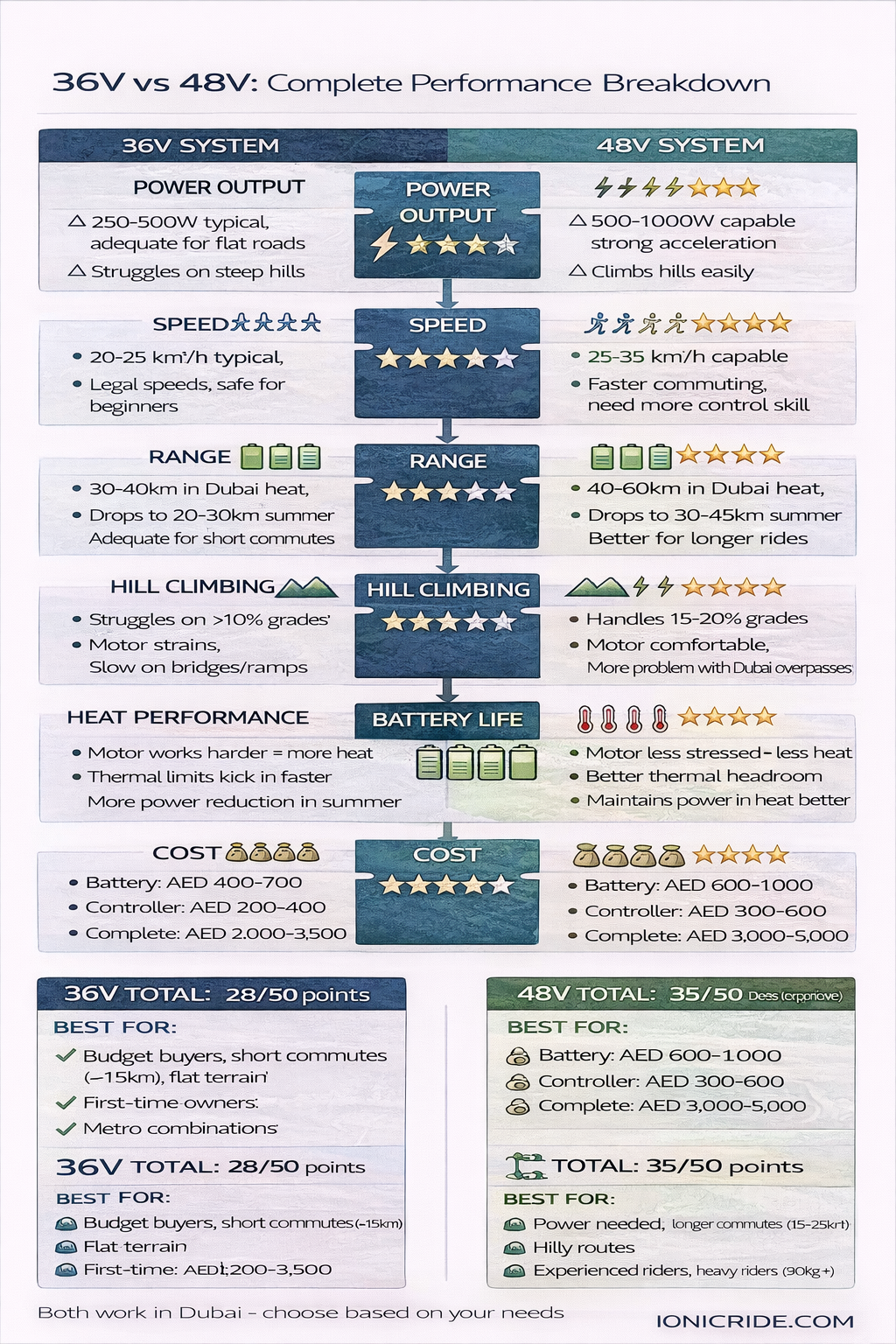
The Direct Comparison: 36V vs 48V
| Factor | 36V System | 48V System | Dubai Impact |
|---|---|---|---|
| Top Speed | 25-30 km/h typical | 30-40 km/h typical | 48V better if you want highway speeds (not legal but possible) |
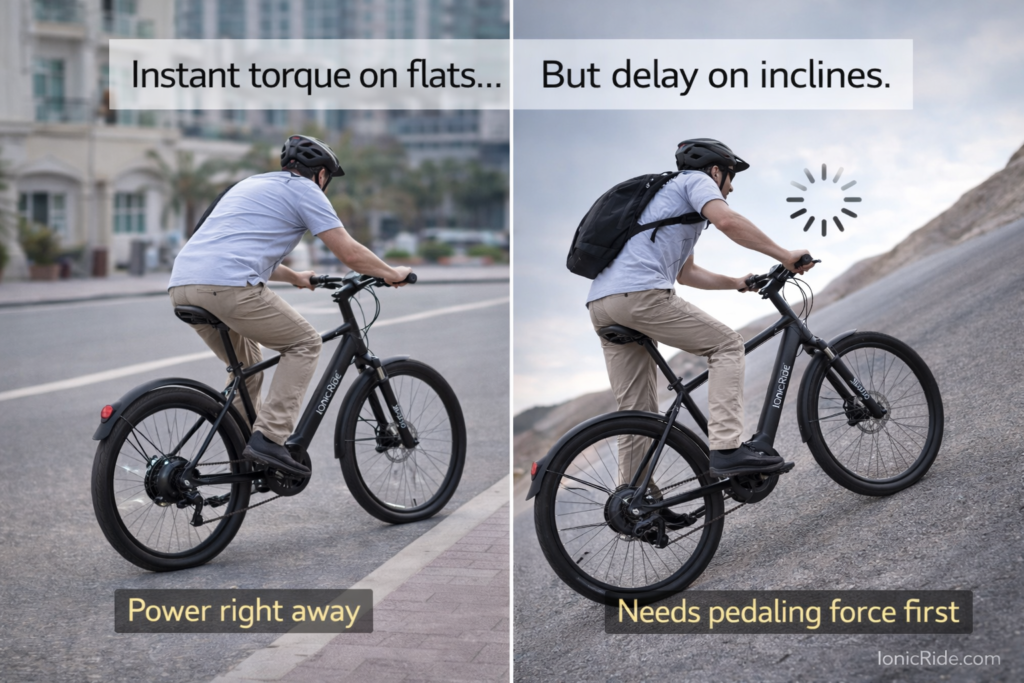
| Hill Climbing | Struggles on steep bridges | Handles bridges easily | 48V matters for Business Bay Bridge, Al Wasl Road bridges |
| Acceleration | Moderate (0-25 km/h in 6-8 sec) | Quick (0-25 km/h in 4-5 sec) | 48V safer in Dubai traffic (faster gap-closing) |
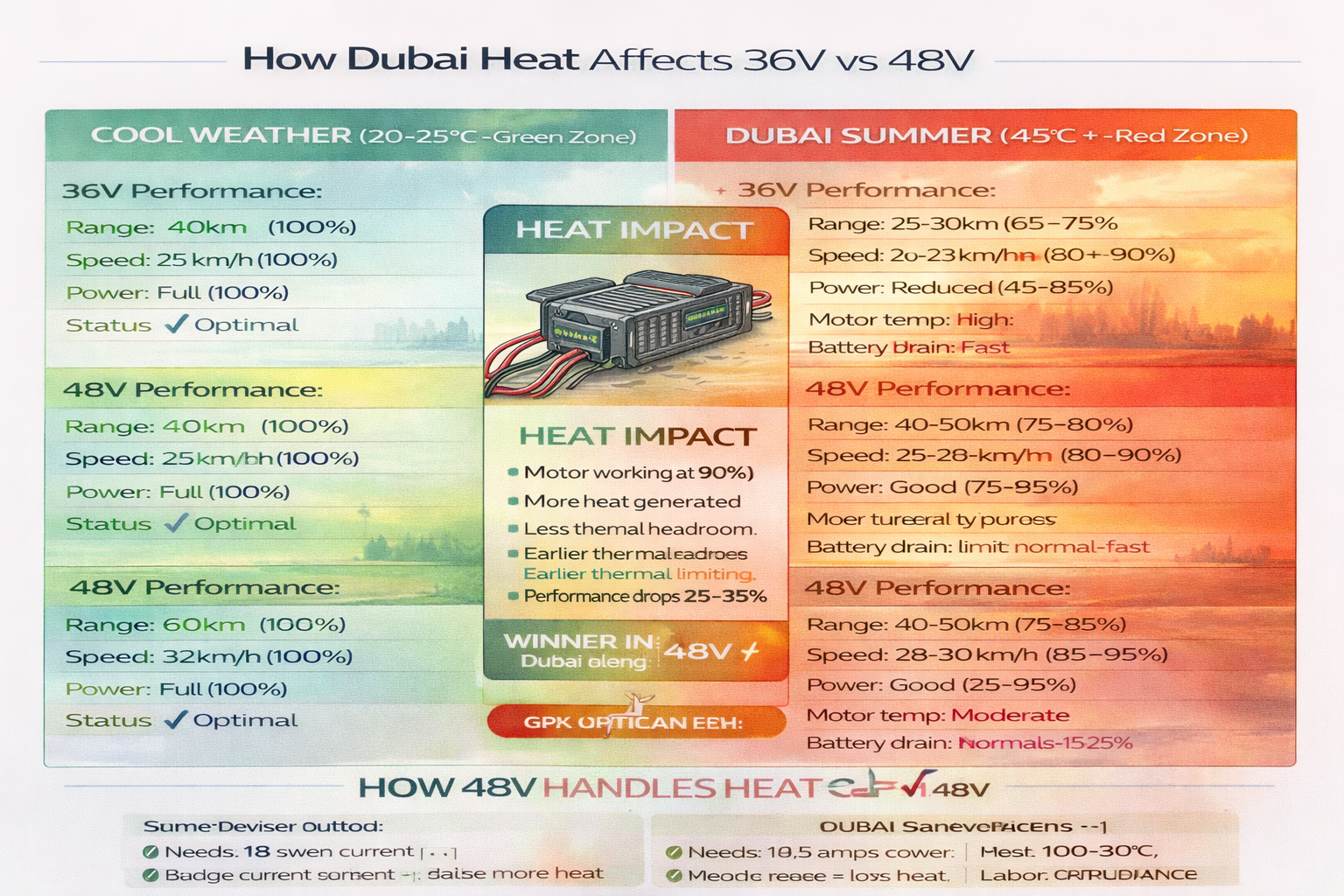
| Motor Heat | Runs hotter (higher current) | Runs cooler (lower current) | 48V lasts longer in Dubai summer heat |
| Controller Heat | More heat generation | Less heat generation | 48V controllers fail less often in Dubai |
| Range (Same Wh Battery) | Slightly better | Slightly worse | Difference is minimal (5-10%) |
| Battery Cost | 600-750 AED | 700-900 AED | 48V replacement costs 100-150 AED more |
| Initial Price | 1,800-2,500 AED typical | 2,500-3,500 AED typical | 48V bikes cost 500-800 AED more upfront |
| Weight | Lighter (smaller battery) | Heavier (larger battery) | 36V easier to carry upstairs (1-2 kg difference) |
| Availability | Wide selection | Growing but less choice | 36V easier to find replacement parts |
Dubai-Specific Considerations
Most voltage comparisons are written for Europe/US. Dubai is different:
The Heat Factor
The current problem:
- Higher current = more heat in wires, motor, controller
- 36V systems run 33% higher current than 48V for same power
- In Dubai’s 45°C ambient temperature, this extra heat accumulates fast
Real-world impact:
- 36V motor temperature: 65-75°C after 30 minutes Dubai summer riding
- 48V motor temperature: 55-65°C same conditions
- 10°C difference = significantly longer motor/controller lifespan
Lifespan data (Dubai conditions, daily use):
- 36V controller: 12-18 months average before failure
- 48V controller: 18-24 months average
- 36V motor: Bearing failure around 18-24 months
- 48V motor: Bearing failure around 24-30 months
The Bridge Problem
Dubai has elevated roads and bridges everywhere. This is where voltage matters:
Business Bay Bridge (common route JLT ↔ Downtown):
- 36V experience: Speed drops from 25 km/h to 15 km/h going up. You’re working hard to maintain 12-15 km/h on steeper section.
- 48V experience: Speed drops from 30 km/h to 22 km/h. Climbs comfortably.
Al Wasl Road bridges (Jumeirah to Satwa):
- 36V: Manageable but motor strains. Speed drops to 10-12 km/h.
- 48V: Handles easily. Maintains 18-20 km/h.
The cargo factor:
- Riding solo: 36V can handle most Dubai bridges (slowly)
- Carrying backpack (5-10 kg): 36V struggles noticeably
- Delivery work (15-20 kg): 36V barely makes it up. 48V needed.
Flat Terrain Advantage
90% of Dubai is flat. Unlike hilly cities where voltage matters constantly, Dubai’s flat roads mean:
- 36V performs fine for Marina → JBR → Al Sufouh flat rides
- International City, Silicon Oasis, most of Deira: completely flat, 36V adequate
- You only notice voltage difference on bridges and when accelerating from stops
If your route avoids major bridges, 36V is genuinely sufficient for Dubai.
Battery Capacity Confusion
People mix up voltage with capacity. They’re different:
Voltage (36V vs 48V): The “pressure” (covered above)
Amp-hours (Ah): How much electricity the battery stores
- Common sizes: 10Ah, 13Ah, 15Ah, 20Ah
- Higher Ah = more range
Watt-hours (Wh): Total energy capacity (what actually matters for range)
- Wh = Voltage × Ah
- 36V 10Ah = 360Wh
- 48V 10Ah = 480Wh (33% more energy despite same Ah)
Shops advertise “10Ah battery” for both 36V and 48V bikes. Sounds like same range. It’s not.
- 36V 10Ah bike: 360Wh battery → 25-30 km range in Dubai
- 48V 10Ah bike: 480Wh battery → 30-35 km range in Dubai
Same “10Ah” but 48V actually gives you 5-8 km more range because total energy (Wh) is higher.
Always compare Wh, not Ah: 36V 15Ah (540Wh) has more range than 48V 10Ah (480Wh).
Cost Over Time: The Real Math
48V costs more upfront. But is it worth it over 2-3 years in Dubai?
Total cost of ownership (2 years, Dubai conditions):
36V E-Bike Scenario:
- Purchase price: 2,200 AED
- Controller replacement (18 months): 300 AED
- Battery replacement (20 months): 650 AED
- Other maintenance: 400 AED
- Total 2-year cost: 3,550 AED
48V E-Bike Scenario:
- Purchase price: 2,800 AED
- Controller replacement (24 months): 0 AED (lasts longer)
- Battery replacement (22 months): 0 AED (still good at 2 years)
- Other maintenance: 350 AED (less heat stress overall)
- Total 2-year cost: 3,150 AED
Result: 48V costs 600 AED more upfront but saves 400 AED over 2 years. Net difference: 200 AED more expensive but better performance + less hassle.
Who Should Buy 36V?
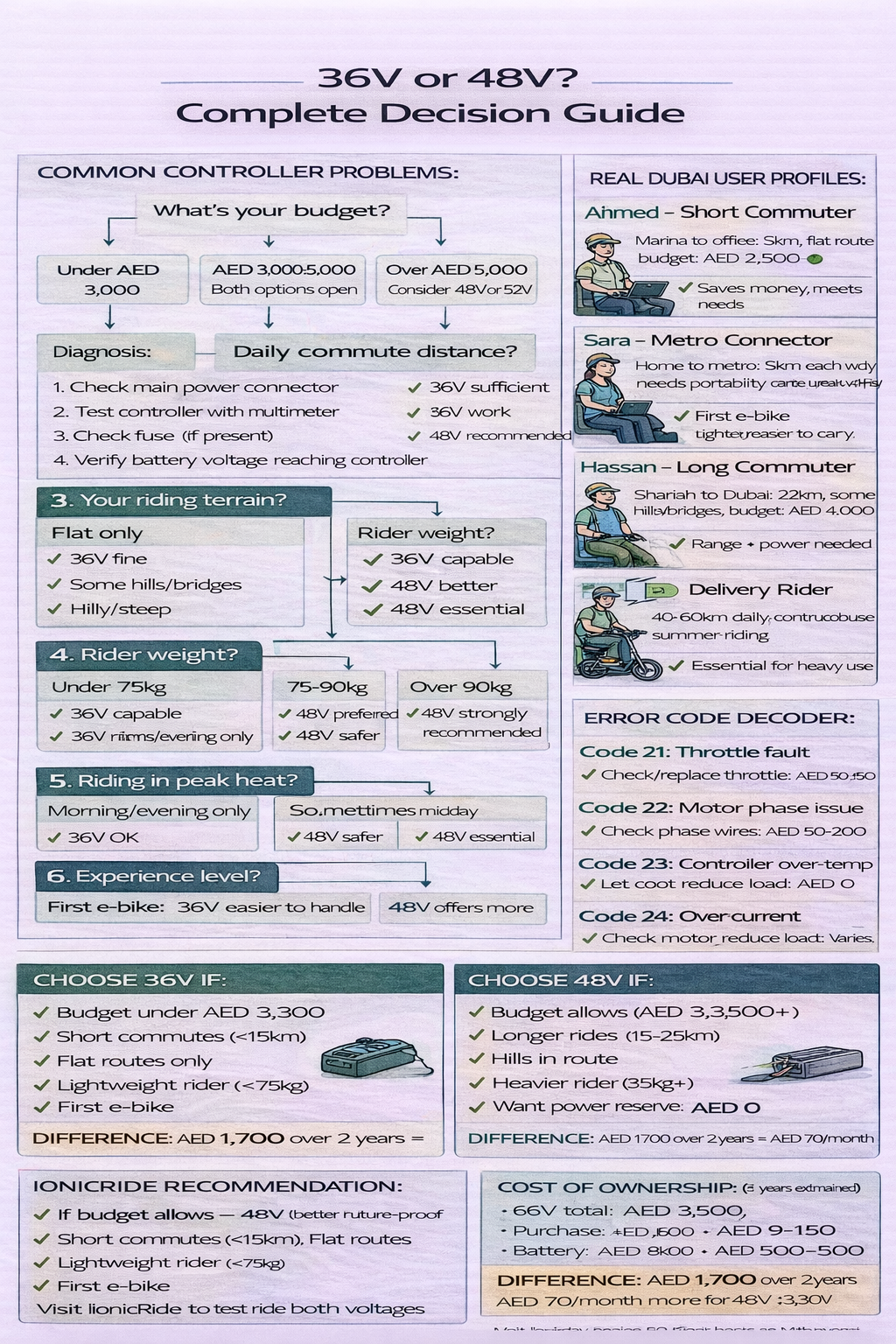
- Flat route only: Your daily ride avoids Business Bay, major bridges. Mostly Marina, JBR, flat residential areas.
- Budget is tight: 2,200 AED vs 2,800 AED is meaningful difference for you.
- Casual riding (2-3x per week): Not daily commuting. Weekend beach rides. Less heat exposure = less voltage advantage.
- Backup/second bike: You already have main transport. This is for occasional use.
- Weight matters: Need to carry upstairs daily. 36V bikes are 1-2 kg lighter.
- Shorter rider (under 160cm): Lower top speed of 36V is actually safer at your size.
Who Should Buy 48V?
- Daily commute with bridges: Route includes Business Bay Bridge, Al Wasl roads, or any elevated sections.
- Delivery work: Carrying 15-20 kg bags. Need extra power for cargo. 48V is basically mandatory.
- Heavier rider (80+ kg): Your weight alone makes 36V struggle on inclines. 48V compensates.
- Dubai traffic: You ride in car lanes regularly. Need quick acceleration to keep up with traffic flow. 48V safer.
- Long-term investment: Planning to keep bike 2+ years. 48V lower heat = longer component life justifies upfront cost.
- Speed preference: You like riding 30+ km/h when roads allow. 36V tops out at 25-28 km/h.
The Conversion Question
Can you upgrade 36V bike to 48V later? Technically yes. Practically…
- Need new battery: 700-900 AED
- Need new controller: 300-400 AED
- Maybe need new motor: Some 36V motors handle 48V (“36-48V compatible”), many don’t. If motor burns out, add 600-800 AED.
- Labor for conversion: 200-300 AED
- Total cost: 1,200-2,400 AED
For 1,500-2,000 AED, you could sell 36V bike (500-800 AED used) and buy new 48V bike (2,500-2,800 AED). Net cost similar but you get fresh bike with warranty.
Conversion only makes sense if: Motor is explicitly rated “36-48V compatible” AND you’re doing it DIY (no labor cost). Otherwise, sell and buy new.
Battery Replacement Reality
Eventually you’ll need new battery. Voltage affects cost and availability:
36V batteries:
- Availability: Widely available, every shop stocks them
- Price: 550-750 AED depending on Ah rating
- Generic options: Plenty of compatible generic batteries (cheaper but lower quality)
48V batteries:
- Availability: Most shops have them but less variety
- Price: 650-900 AED
- Generic options: Fewer compatible generics, usually need OEM or close match
36V advantage: More aftermarket options, easier to find cheap replacement if you’re not picky about quality.
The “48V-Compatible Motor” Marketing
Some shops sell 36V bikes with “48V-compatible motor” as selling point.
What they claim: “You can upgrade to 48V later by just swapping battery and controller.”
Reality:
- Motor might technically handle 48V voltage…
- But running 36V motor at 48V = 33% overvoltage = motor runs hotter
- In Dubai heat, this accelerates motor failure
- Motor “works” at 48V but lifespan drops from 24 months to 12-15 months
Better approach: If you want 48V performance, buy 48V bike with motor designed for 48V. Don’t overvolt 36V motor.
Range Reality Check
Manufacturer claims vs actual Dubai conditions:
36V 10Ah bike (360Wh):
- Advertised: “40-50 km range!”
- Dubai summer (45°C, 75 kg rider, moderate speed): 20-25 km
- Dubai winter (25°C, same rider): 28-32 km
48V 10Ah bike (480Wh):
- Advertised: “50-60 km range!”
- Dubai summer: 25-30 km
- Dubai winter: 32-38 km
Heat reduces range 30-40% regardless of voltage. But 48V still gives 20-25% more range than 36V with same Ah battery due to higher Wh total.
Safety Considerations
36V (25-28 km/h top speed):
- Safer on cycling tracks: Speed matches other cyclists, less risk of collisions
- Riskier in car lanes: Can’t keep up with 60 km/h traffic, cars overtake aggressively
48V (30-40 km/h top speed):
- Riskier on cycling tracks: Too fast for pedestrian-heavy areas (JBR, Marina Walk)
- Safer in car lanes: Better acceleration helps you merge and keep pace with slower traffic
Dubai context: If you ride cycling tracks primarily (Marina, JLT, Motor City), 36V is safer. If you ride car lanes (old Dubai, industrial areas), 48V is safer.
The Bottom Line
Quick decision guide for Dubai:
Buy 36V if:
- Budget under 2,500 AED
- Flat routes only (no Business Bay Bridge, Al Wasl bridges)
- Casual use (2-3x per week)
- Primarily use cycling tracks
- Shorter/lighter rider (under 70 kg)
Buy 48V if:
- Daily commuting through bridges
- Delivery work (cargo weight)
- Heavier rider (75+ kg)
- Ride in car lanes regularly
- Want bike to last 2+ years in Dubai heat
Still unsure? Go with 48V. The 600 AED price difference is worth it for better Dubai heat tolerance and longer component life.
Most riders in Dubai who bought 36V and later upgraded regret not buying 48V initially.
Very few 48V riders wish they’d bought 36V.
That tells you something.