Best E-Bikes for Dubai Commutes Under 3,000 AED (2025)
Customer walked into the shop last week with a budget: 3,000 AED. Wanted an e-bike for commuting from Discovery Gardens to Ibn Battuta Metro. About 8 km round trip.
“What can I get for this?” he asked.
Honest answer: You can get something that works. But you need to know what you’re compromising on.
Here’s what’s actually available in Dubai at this price — and what to expect.
Let’s be realistic about 3,000 AED
Three thousand dirhams is entry-level for e-bikes. Not bad. Not premium. Somewhere in between “this might work” and “I hope this lasts a year.”
At this price point, you’re looking at Chinese OEM brands sold through local distributors. Kugoo. Wind Horse. Jetson. Generic fat tire bikes with 500-1000W motors, basic batteries, and names you won’t recognize.
That’s not inherently bad. But it comes with tradeoffs.
- Working e-bike that will get you from A to B (if A and B aren’t too far apart)
- 30-50 km realistic range (not the 70 km they claim)
- 6 months to 2 years of reliable use before something needs fixing
- Basic after-sales support from local retailers (if you bought from the right place)
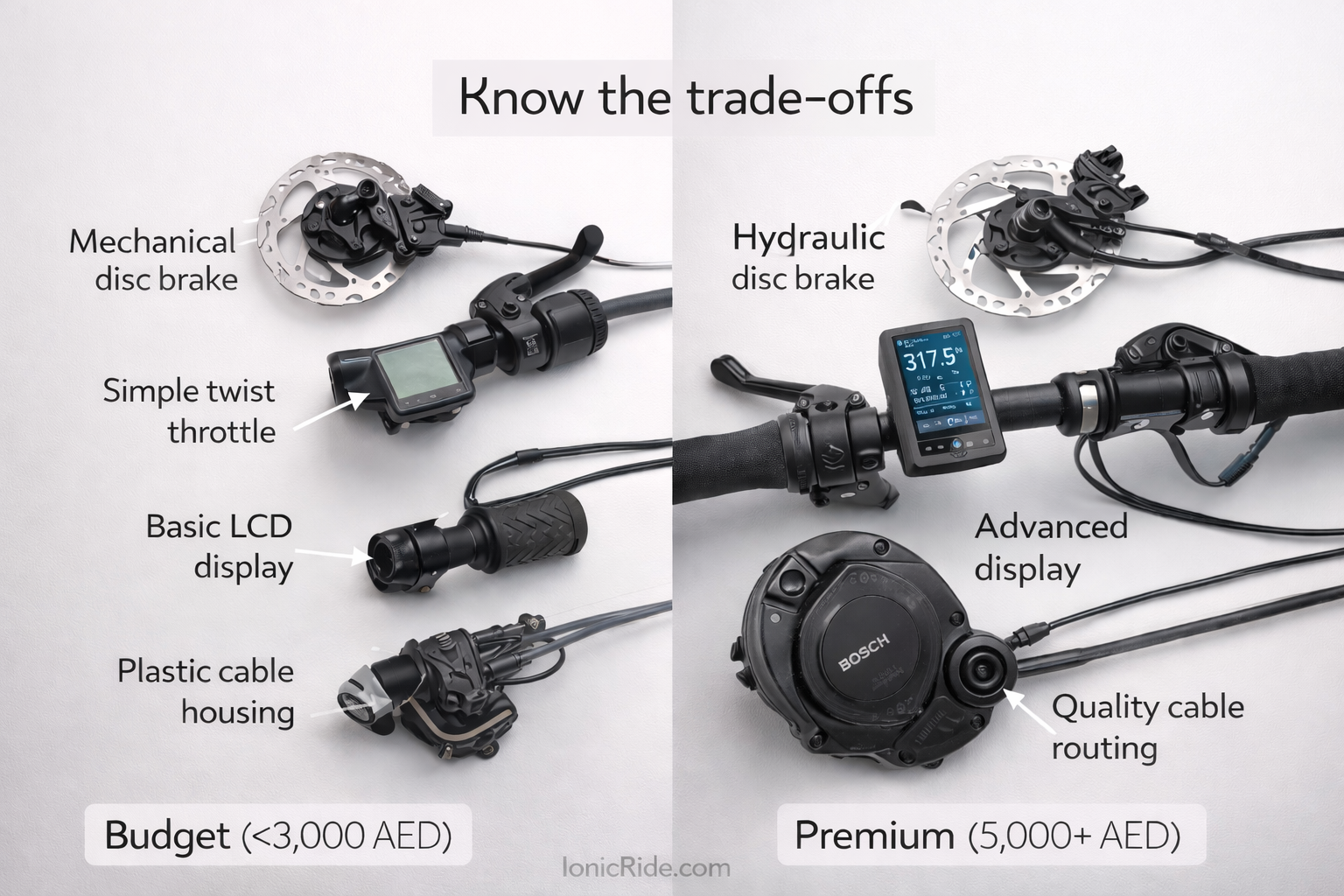
- Hub motor (not mid-drive — those start around 5,000 AED)
- Name-brand components (Shimano, Bosch, Bafang — you’ll see no-name parts)
- Long-term battery reliability (generic cells degrade faster in heat)
- Warranty that’s easy to claim (most offer 6 months to 1 year, enforcement varies)
- Torque sensor (you’ll get cadence sensor — less natural feel)
- Premium build quality (expect rattles, loose bolts, occasional squeaks)
If you’re okay with those compromises — and many people are — there are decent options.
What actually matters for Dubai commuting
Before we look at specific bikes, let’s talk about what features matter in UAE conditions.
Battery capacity (and honesty)
Most budget e-bikes claim 40Ah, 50Ah, 60 km range. Those numbers are wildly optimistic.
Realistic range on flat ground, moderate speed, no AC-draining heat: about 60-70% of claimed range.
So a bike claiming 60 km? Expect 35-40 km in real Dubai conditions. Maybe less if you’re riding in summer heat or carrying a backpack.
For a 10 km round-trip commute, a 36V 10-15Ah battery is fine. You’ll charge every 2-3 days.
For longer rides (15+ km one way), look for 48V 15-20Ah minimum. That’ll give you buffer for battery degradation over time.
Motor power (what the numbers actually mean)
Every budget e-bike claims 500W, 750W, 1000W. That’s usually peak power, not sustained.
What matters more: torque and how the motor behaves under load.
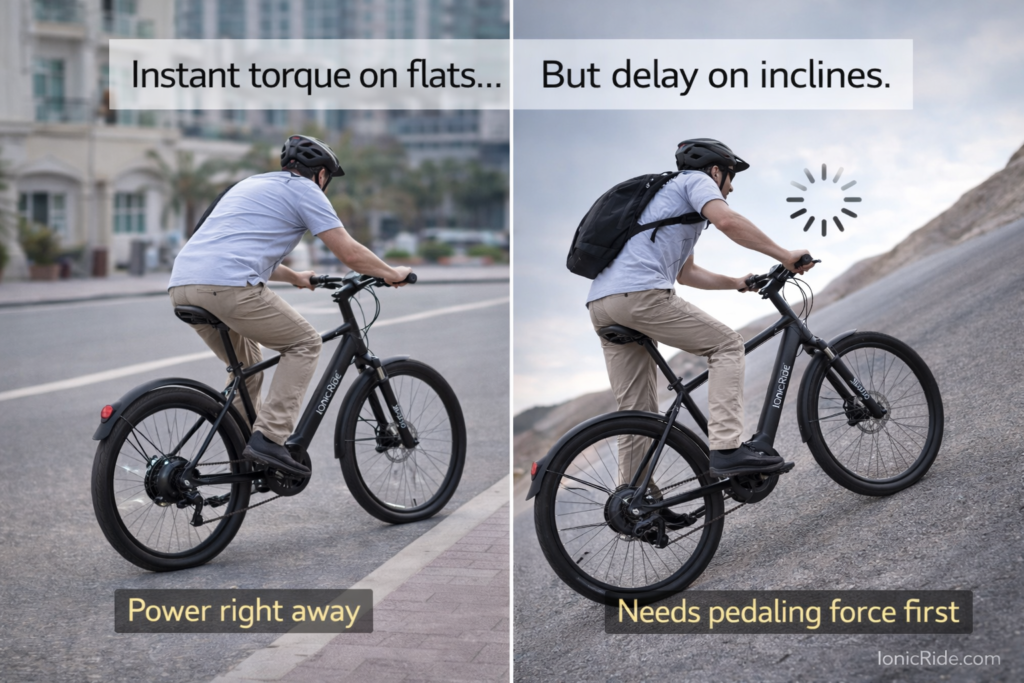
A 500W hub motor with decent torque will handle flat Dubai roads fine. It’ll struggle on ramps and hills. If your commute includes the Jebel Ali-Lehbab Road or any significant incline, you’ll feel it.
1000W motors sound better but draw more current, which drains the battery faster. And most controllers in budget bikes can’t sustain 1000W anyway — they’ll throttle down after a few minutes to prevent overheating.
Don’t chase wattage. Focus on: Does the motor assist smoothly? Does it overheat in summer? Does it make weird noises after 3 months?
(We’ve seen 1000W motors burn out faster than 500W motors because they were pushed beyond what the cheap controller could handle.)
Hub motor vs mid-drive (spoiler: you’re getting hub)
At 3,000 AED, you’re getting a hub motor. Mid-drives don’t exist at this price in Dubai.
Hub motors are fine for flat commutes. They’re simple, low-maintenance, and they work.
Downside: less efficient on hills, less natural pedaling feel, harder to repair if the motor fails (because the motor is built into the wheel).
But for most Dubai commutes — Marina to DIFC, Motor City to Mall of the Emirates, Springs to Ibn Battuta — a hub motor is adequate.
Fat tires vs thin tires
Most budget e-bikes come with fat tires (3-4 inches wide). They look cool. They handle sand and rough terrain better.
But they also add weight, rolling resistance, and make the bike slower on pavement.
For pure road commuting in Dubai, thin tires (1.5-2 inches) are more efficient. But good luck finding a budget e-bike with thin tires — fat tires are the default aesthetic at this price point.
If you’re riding mostly on paved cycle paths, the fat tires won’t hurt you. Just know you’re carrying extra weight for no real benefit.
Brakes (this matters more than you think)
Cheap e-bikes often come with mechanical disc brakes. They work. But they require frequent adjustment, especially in dusty conditions.
Hydraulic disc brakes are better — more stopping power, less maintenance. But they’re rare under 3,000 AED.
If the bike has mechanical brakes, plan to adjust them every few months. Brake pads wear faster on e-bikes because you’re stopping more weight at higher speeds.
One brake-related tip we give every customer: test the brakes *hard* before you buy. If they feel spongy or require a lot of lever pull, walk away.
Build quality and rattles
Budget e-bikes are not precision machines. Bolts come loose. Fenders rattle. Kickstands bend.
This is normal. Bring a set of Allen keys and a wrench. Every month, tighten everything. It’s part of owning a cheap e-bike.
If that sounds annoying — it is. But it’s the cost of saving 5,000 AED.
Brands you’ll see in Dubai under 3,000 AED
These are the brands that dominate the budget e-bike market in the UAE right now.
Kugoo (most common)
Chinese brand, widely available through multiple Dubai retailers (Al Mubdie Scooters, Kugoo Kirin UAE, Arabian Cart, others).
Models in this range: Kugoo V1, V1 Pro, V5, V6 (the V6 is usually just over 3,000 AED but sometimes on sale).
What we’ve seen: Parts availability is decent. If something breaks, you can usually find a replacement locally. Quality control is hit or miss — some bikes arrive perfect, others have loose wiring or misaligned brakes out of the box.
Battery longevity: 1-2 years before noticeable degradation in UAE heat. Not great, but not terrible for this price.
Motors hold up okay on flat terrain. We’ve had customers use them daily for 6+ months without major issues.
Wind Horse
Another Chinese OEM brand with a dedicated Dubai shop in Dragon Mart 2.
Models: V6, V8, various city bike and fat tire configurations.
What we’ve seen: Similar quality to Kugoo. Slightly better build finish on some models. Motors tend to run quieter initially but can develop a whine after a few months of heavy use.
Customer service through the Dragon Mart shop is decent — they’ll help with basic repairs and part replacements.
Generic Alibaba rebrands
Walk into any small electronics shop in Deira or Sharjah and you’ll see e-bikes with no recognizable branding. Just a sticker that says “Electric Bike 1000W.”
These are straight imports from Alibaba or similar platforms. No local distributor. No after-sales. No parts availability.
Our advice: Avoid unless you’re comfortable doing all repairs yourself. When something breaks — and it will — you’re on your own.
Specific models we’d consider (and why)
Based on what we’ve tested and what customers have had success with:
Kugoo V1 Pro (~1,600-1,800 AED)
Best for: Short commutes (5-10 km total), riders who need to fold the bike for storage or metro transport.
Compromises: Small battery means limited range. Motor struggles on any incline. Build quality is basic — expect rattles.
Kugoo V5 (~2,200-2,500 AED)
Best for: Medium-distance commutes (10-15 km), riders who want more power and range without spending over 3,000 AED.
Compromises: Heavy (about 35 kg). Fat tires are overkill for pavement. Battery is adequate but not exceptional.
Wind Horse V6 / V8 (~2,500-3,000 AED)
Best for: Commuters who want a more traditional bike aesthetic (not just fat tire cruiser style).
Compromises: Parts availability slightly worse than Kugoo. Warranty claims have to go through Dragon Mart shop.
What about the Kugoo V6?
Why we’re cautious: The 1000W motor sounds great. But we’ve seen overheating issues in summer when pushed hard. The 28Ah battery is impressive on paper, but it’s heavy and the cells are generic — degradation happens fast.
What to check before you buy
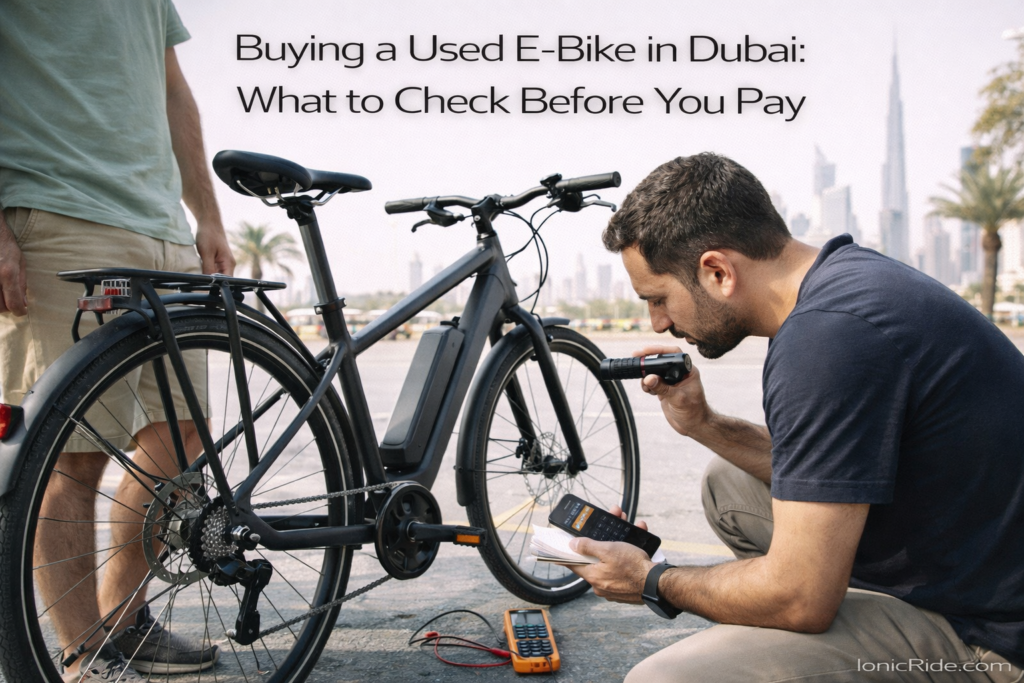
If you’re buying from a shop (not online), here’s what to test:
Ride it first
Don’t just look at it. Ride it. Even if it’s just around the parking lot.
Feel how the motor engages. Is it smooth or jerky? Does it cut out randomly?
Test the brakes hard. Do they stop you quickly or require a long squeeze?
Listen for weird noises from the motor or chain.
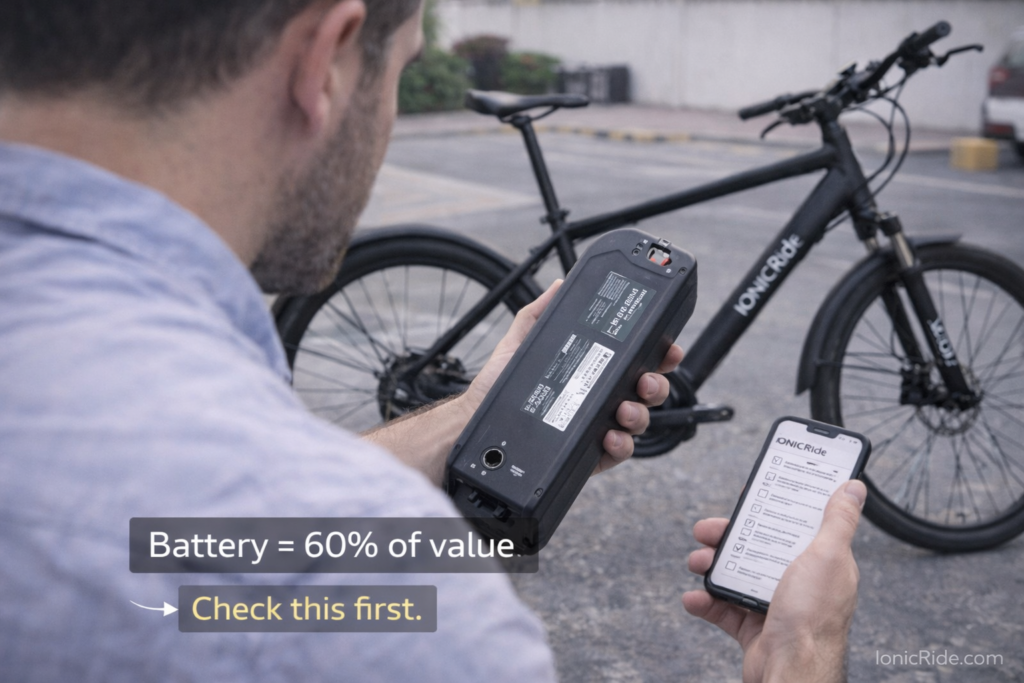
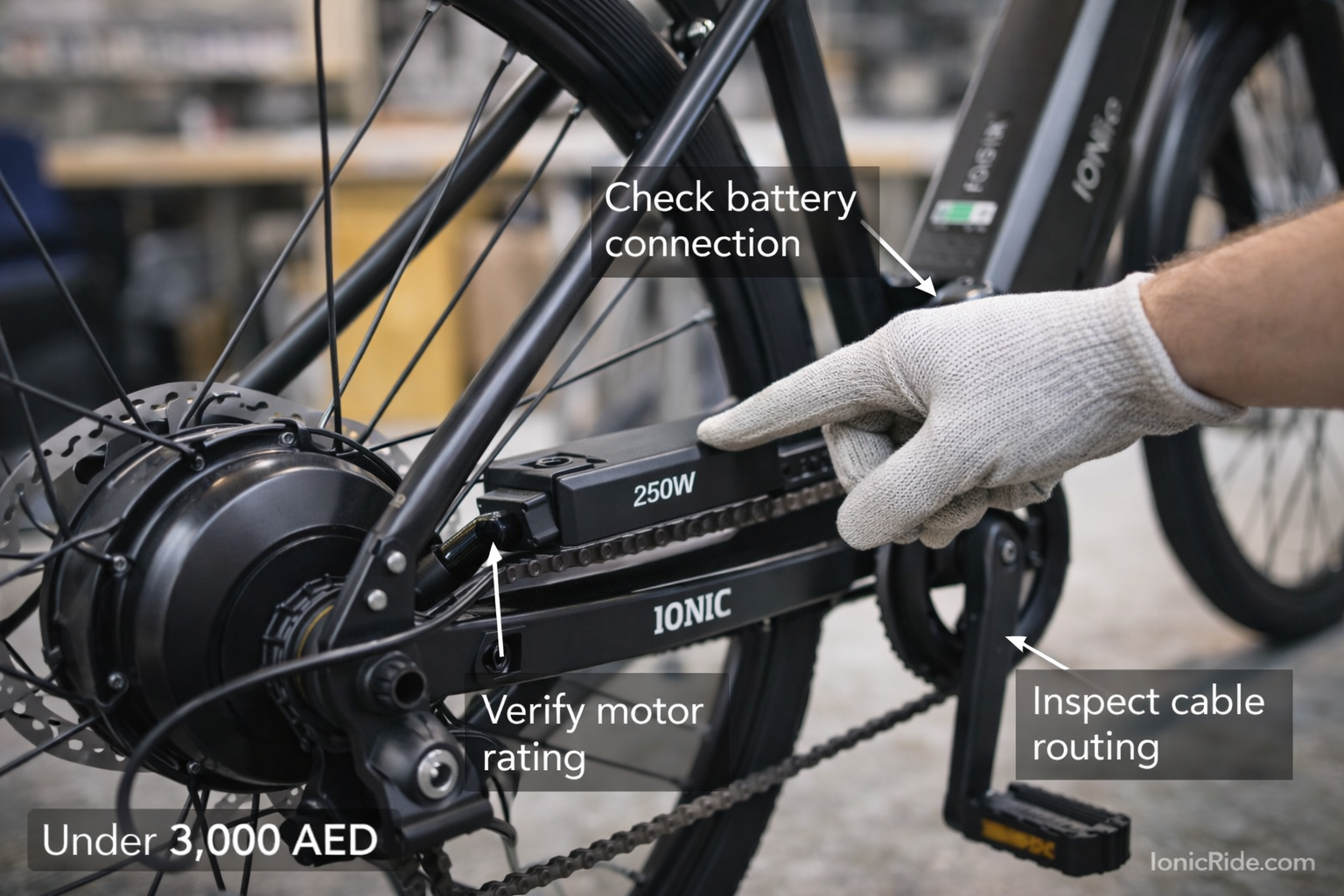
Check the battery connection
Remove the battery and inspect the connector. Is it tight? Are the pins clean?
A loose battery connection is one of the most common failure points on cheap e-bikes. If it wiggles at all, that’s a red flag.
Inspect the welds and frame
Look at the frame welds. Are they clean and even, or do they look like they were done by someone with shaky hands?
Bad welds mean the frame might crack under stress. This is rare, but it happens.
Ask about warranty and parts
What’s the warranty? 6 months? 1 year?
More importantly: if something breaks, can they fix it? Do they have spare parts in stock?
Some retailers just sell bikes and offer no support. Avoid those.
Test the display and controls
Turn everything on. Cycle through the pedal assist levels. Make sure the display is readable in direct sunlight (most aren’t, but at least check).
If the display is glitchy or unresponsive, that’s a sign of cheap electronics. It might work now, but it’ll fail in 6 months.
What breaks first (and how to prevent it)
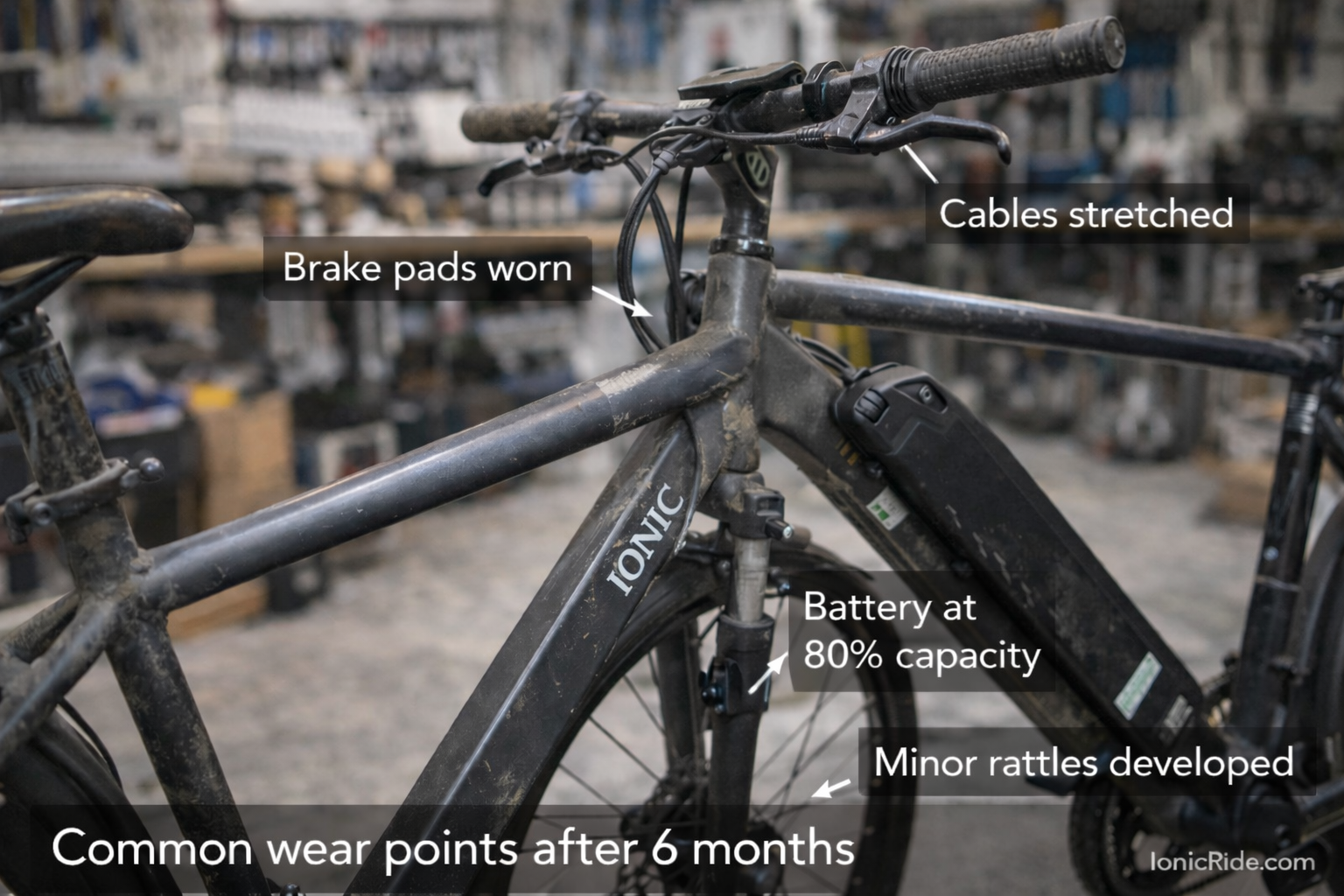
We see the same failures on budget e-bikes over and over. Here’s what usually goes wrong:
Battery degradation (6 months to 2 years)
The battery will lose capacity. This is inevitable with cheap cells, especially in UAE heat.
How to slow it down:
- Don’t leave the bike in direct sun if you can avoid it
- Don’t charge immediately after a hot ride — let the battery cool for 20 minutes
- Store at 50-70% charge if you’re not riding for a week
When the battery dies, replacement costs 600-1,200 AED depending on capacity. At that point, you’ll need to decide if it’s worth replacing or just buying a new bike.
Brake adjustment (every 2-3 months)
Brake pads wear. Cables stretch. Rotors get dirty.
Learn to adjust your brakes yourself (YouTube is your friend) or take it to a bike shop every few months.
Loose bolts (constant)
Vibration + cheap assembly = bolts that come loose.
Every month, go over the bike with Allen keys and a wrench. Tighten everything. This takes 10 minutes and prevents bigger problems.
Flat tires
Fat tires are harder to change than normal bike tires. If you’re not comfortable doing it yourself, factor in 50-100 AED per flat at a shop.
Invest in tire liners or puncture-resistant tubes if you’re riding through construction zones or rough areas.
Controller or motor failure (1-3 years)
This is the big one. When the motor or controller dies, repair costs can be 40-60% of what you paid for the bike.
At that point, most people just buy a new bike.
Is it worth buying under 3,000 AED, or should you save more?
Depends what you need it for.
Buy under 3,000 AED if:
- Your commute is under 10 km round trip
- Your route is mostly flat
- You have a place to charge every day or two
- You’re okay with basic maintenance
- You accept that it might not last more than 2 years
- You want to test if e-bike commuting works for you before investing more
Save more (5,000-7,000 AED) if:
- Your commute is over 15 km one way
- You ride in hilly areas (rare in Dubai, but parts of Al Barsha and Jebel Ali qualify)
- You want something that lasts 3-5 years
- You value smooth, quiet operation
- You want name-brand components and real warranty support
- You plan to ride daily in summer heat and need better battery longevity
There’s no shame in starting with a budget bike. Lots of people do. If it works for your use case and you’re realistic about its limits, you’ll be fine.
But if you can stretch to 5,000 AED, you get into a different quality tier — name-brand motors (Bafang), better batteries, mid-drives on some models, and bikes that won’t rattle apart after 6 months.
Where to buy in Dubai
A few places we’ve heard decent things about (not exhaustive, just based on customer feedback):
Al Mubdie Scooters — Multiple locations, stocks Kugoo and Wind Horse, offers some after-sales support. Prices are competitive.
Kugoo Kirin UAE — Kugoo official distributor, same-day delivery in Dubai. If you’re buying Kugoo, this is a safe bet for parts availability.
Wind Horse UAE (Dragon Mart 2) — Physical shop, you can test ride before buying. Good if you want to see the bike in person.
Avoid: Random shops in Deira or Sharjah that can’t tell you anything about warranty or parts. Also avoid Instagram “dealers” unless they have a physical location and reviews you can verify.
Buying e-bikes online from Amazon or Noon is risky. Returns are complicated for large items. Warranty claims are a nightmare. And if the bike arrives damaged, you’re stuck dealing with customer service for weeks.
If you buy online, at least use a platform where the seller has a physical presence in the UAE.
Final thoughts: Set your expectations correctly
A 3,000 AED e-bike is not going to feel like a premium bike. It’s not supposed to.
It’s a tool. A functional, imperfect tool that gets you from home to work without sweating through your shirt in UAE summer.
If you’re okay with occasional maintenance, realistic about range, and accept that it might not last 5 years — you’ll be happy with it.
If you expect perfection at this price, you’ll be disappointed.
That’s the trade-off. Know it going in.