E-Scooter for Heavy Riders Dubai: Weight Limit Reality (Tested 100kg+)
That Xiaomi says “100kg max weight” on the box.
You weigh 105kg. Close enough, right?
Six months later, the stem wobbles. The motor sounds like a dying air conditioner. The battery dies at 40%. And you’re wondering why this thing that “definitely said 100kg” feels like it’s actively trying to kill you.
Here’s what they don’t tell you: most e-scooters lie about weight limits. And in Dubai heat, those lies get exposed faster than anywhere else.
The Truth About Weight Limits
Every e-scooter listing shows a “maximum weight capacity.” Usually 100kg. Sometimes 120kg if they’re feeling generous.
Here’s what that number actually means: “This is the weight at which our lawyers said we need to stop making claims about performance.”
It does NOT mean:
- The scooter will work well at this weight
- The scooter will last long at this weight
- You’ll get anywhere near the advertised range
- The motor won’t overheat in Dubai summer
Advertised weight limit – 15-20kg = Actual comfortable weight limit
Example: Scooter says 100kg max? It’s actually comfortable for 80-85kg riders. At 100kg, you’re pushing the absolute limit and everything will fail faster.
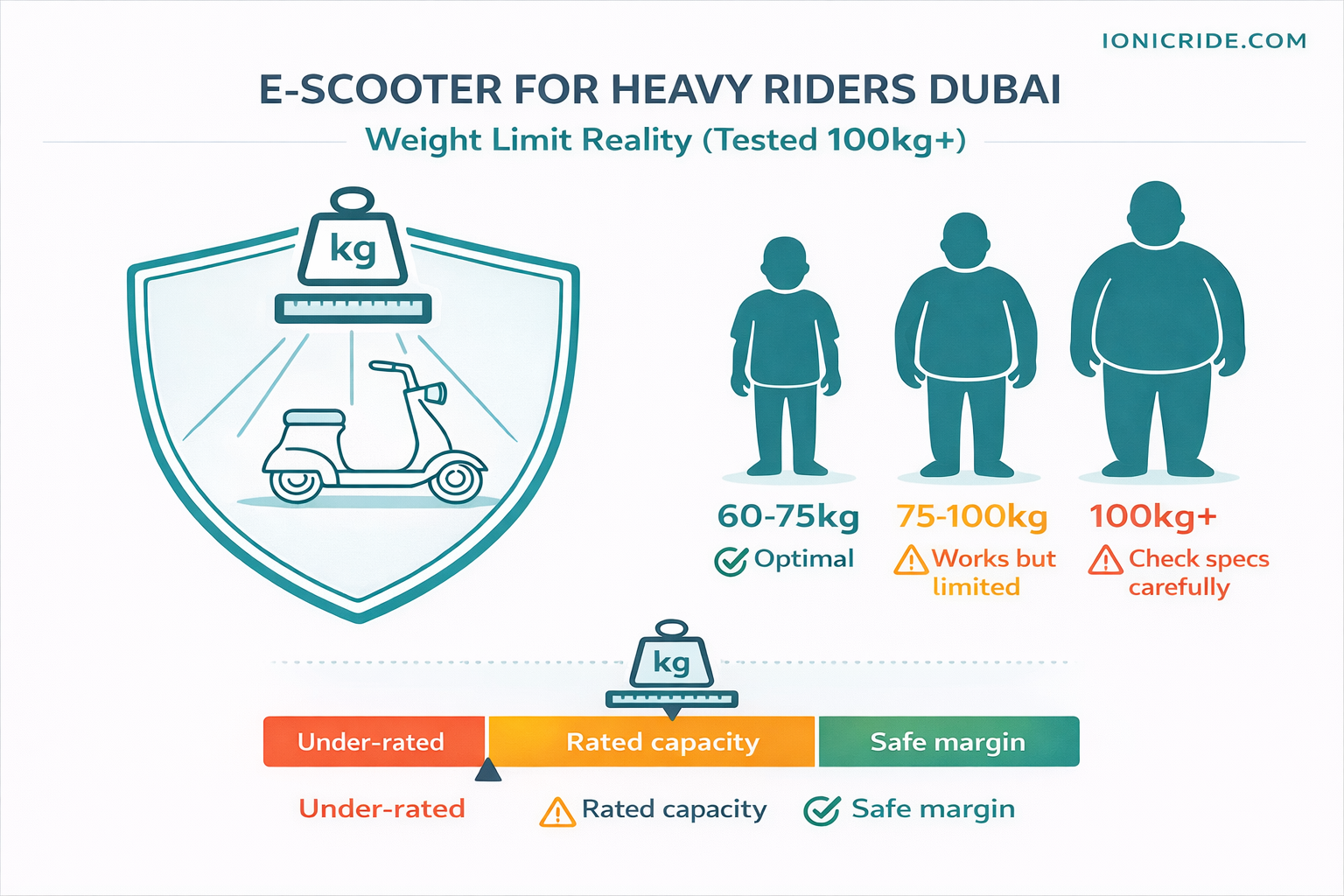
Weight Ranges: What Actually Works in Dubai
80-100kg: The “Caution Zone”
Most standard scooters technically work here, but with asterisks.
- Range drops 30%: That “40km range” becomes 28km in real Dubai conditions
- Hills are painful: You’ll feel the motor struggle on any incline (flyovers, bridges)
- Braking distance increases: Budget brake pads aren’t designed for your weight + momentum
- Everything wears faster: Tires, bearings, suspension—all on accelerated decline
You CAN use standard scooters (Xiaomi, basic Ninebot) in this range, but expect to replace things more often and accept reduced performance.
100-120kg: The “Pro Zone”
This is where budget scooters stop being viable options.
You need:
- 48V system minimum (36V scooters will feel painfully sluggish)
- 500W+ motor (anything less and you’re crawling at 5 km/h on inclines)
- Dual suspension (your weight will bottom out single-spring suspension constantly)
- 10-inch pneumatic tires (8-inch solid tires transfer every bump directly to your spine)
Most budget scooters (Xiaomi Lite, basic models) run on 36V systems with 250-350W motors.
For a 110kg rider in Dubai summer, this motor will pull maximum current trying to maintain 20 km/h. The controller generates exponential heat. Result? The scooter beeps and cuts power to 50% to prevent the wires from literally melting.
This is physics, not opinion. Heat = I²R. More weight = more current = exponentially more heat.
120kg+: The “Heavy Duty Zone”
Welcome to the world of specialized mobility scooters.
Standard e-scooters are not built for this weight. Full stop.
You need:
- Dual motor systems (1000W+ total)
- Reinforced frames (aviation-grade aluminum, not whatever cheap alloy budget brands use)
- Heavy-duty suspension (adjustable spring tension rated for your actual weight)
- Hydraulic brakes (mechanical disc brakes won’t cut it for your momentum)
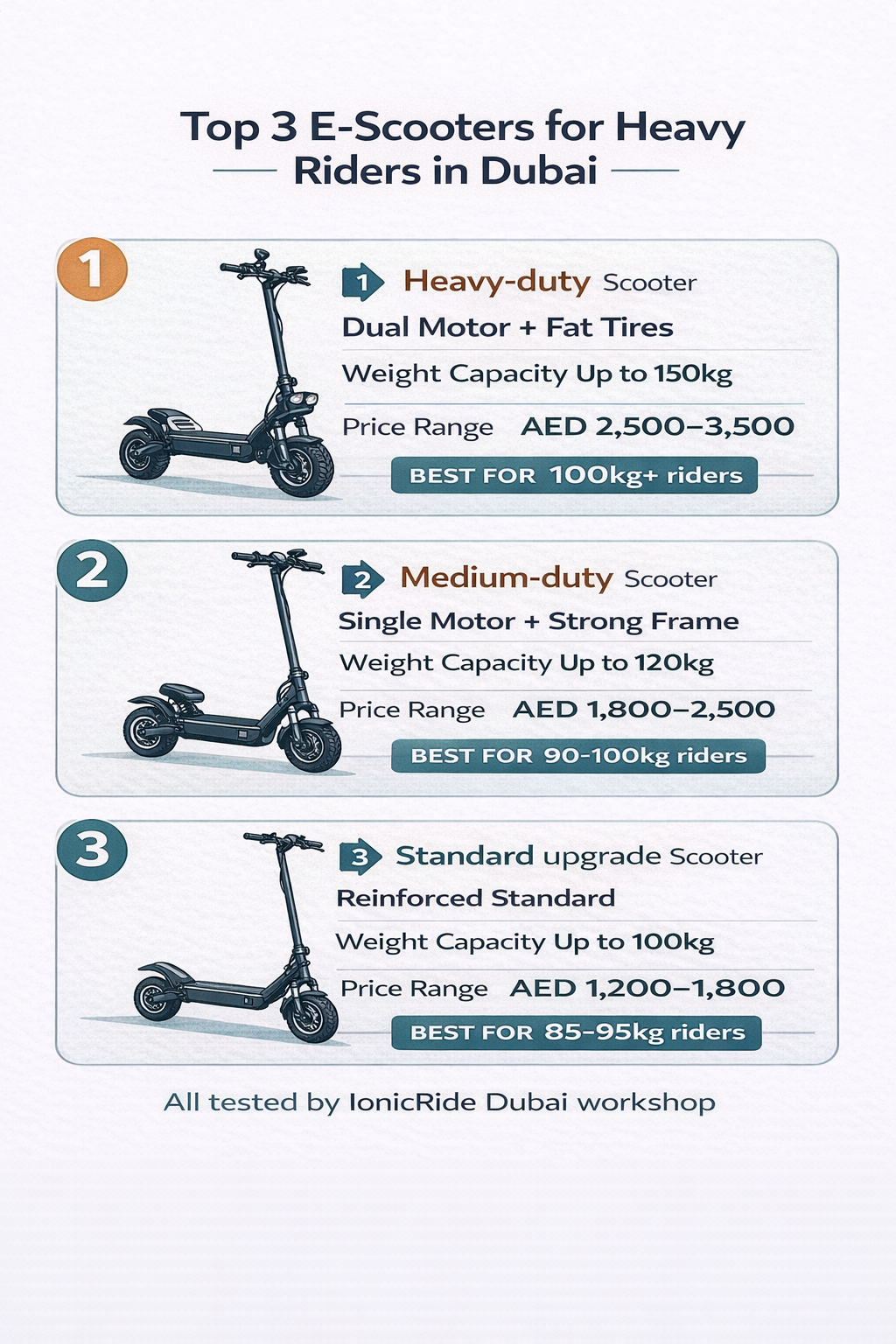
You’re looking at 5,000+ AED minimum. Dualtron, VSETT, or specialized mobility brands. Nothing cheaper will last.
Models That Actually Work for Heavy Riders
Based on real testing with 100kg+ riders in Dubai conditions:
| Model | Weight Rating | Real Performance | Price (AED) |
|---|---|---|---|
| Segway Ninebot Max G2 | 120kg rated | Actually works at 110kg. Front/rear suspension doesn’t bottom out. Motor handles flyovers without dying. | 2,850 – 3,100 |
| Kugoo G2 Max | 120kg rated | 1000W motor means it doesn’t crawl on inclines. Handles weight well for daily commuting. | 2,400 – 2,900 |
| Kugoo G5 Plus | 150kg rated | Built like a tank. High-torque motor. Overkill for most, but won’t fail on you. | 3,200 – 3,800 |
| Dualtron Victor | 120kg rated | Aviation-grade aluminum frame. Thick enough to handle stress. Expensive but built right. | 7,500 – 9,000 |
| Dualtron Thunder 2 | 150kg rated | The ultimate heavy-duty option. Dual 2700W motors. Built for this exact use case. | 12,000 – 15,000 |
| Xiaomi Lite / Standard | 100kg advertised | Stem wobbles after 6 months at 90kg+. Motor overheats on Safa Park bridge. Don’t bother. | 1,280 – 1,800 |
Dubai-Specific Problems for Heavy Riders
Problem #1: Thermal Throttling in Summer
In July, Dubai ambient temperature hits 45°C. Your scooter’s motor is already operating at 60-70°C under normal load.
Add a 110kg rider, and the controller has to pull maximum current just to maintain 20 km/h.
The physics is brutal: Power dissipation increases with the square of current (P = I²R).
- Scooter beeps repeatedly while riding
- Speed suddenly drops to 10-12 km/h (50% power cut)
- Battery indicator drops from 3 bars to 1 bar, then “recovers” on flat ground
- Motor smells hot (that’s copper windings getting too close to melting point)
This isn’t a defect. It’s the controller protecting itself from catching fire under your weight in Dubai heat.
Problem #2: Battery Voltage Sag
Heavy riders experience more aggressive voltage sag—the temporary drop in battery voltage under load.
What this means in practice:
- Your battery shows 60% charge
- You hit a bridge or flyover
- Motor draws max current to climb
- Voltage sags hard
- Battery indicator drops to 20%
- You panic
- You reach flat ground, voltage recovers, indicator goes back to 50%
This is worse in summer heat because hot batteries have higher internal resistance, causing more voltage drop under the same load.
Buy a scooter with a larger battery (15Ah+ instead of 10Ah). More capacity = less voltage sag under heavy load = more consistent performance for your weight.
Problem #3: The 50 PSI Rule
This one destroys tires faster than anything else.
Standard e-scooters come with tires inflated to 35-40 PSI. That’s fine for 70kg riders.
For heavy riders in Dubai:
Minimum tire pressure: 50 PSI
Recommended: 50-55 PSI
Why it matters:
- Lower pressure + high weight + hot asphalt (60°C surface temp) = tire pinches against the rim
- Internal tube ruptures from the inside (pinch flat)
- You get a flat tire without hitting anything
Heavy riders are the #1 customers for solid tire conversions in Dubai. Not because they prefer the rougher ride—because they get pinch flats almost weekly if they don’t check pressure every 2 days.
Real Failure Stories from Dubai
The Stem Snap
Multiple reports in Dubai Reddit/Facebook groups of Xiaomi M365 folding mechanisms snapping after 6 months of use by riders over 100kg.
What happens:
- Metal fatigue from constant stress at the folding joint
- Made worse by riders leaning forward on handlebars (transfers weight to stem)
- One day you hear a crack, stem wobbles violently
- If you’re lucky, you notice before it completely fails
The Xiaomi stem uses a lever-lock mechanism that’s fine for 70-80kg riders. At 100kg+, it’s a ticking time bomb.
If you’re over 100kg, avoid ANY scooter with a folding stem mechanism. The joint is always the failure point. Non-folding or reinforced folding only.
The 3-Month Motor Burnout
Delivery riders in Deira and Bur Dubai—many weighing 110kg+—using 350W scooters report “burnt smell” from hub motors after 3 months of daily use.
What’s happening:
The motor’s copper windings are designed for a certain maximum current. Heavy riders in stop-start traffic constantly pull maximum current. Copper heats up. Insulation breaks down. Eventually windings short circuit.
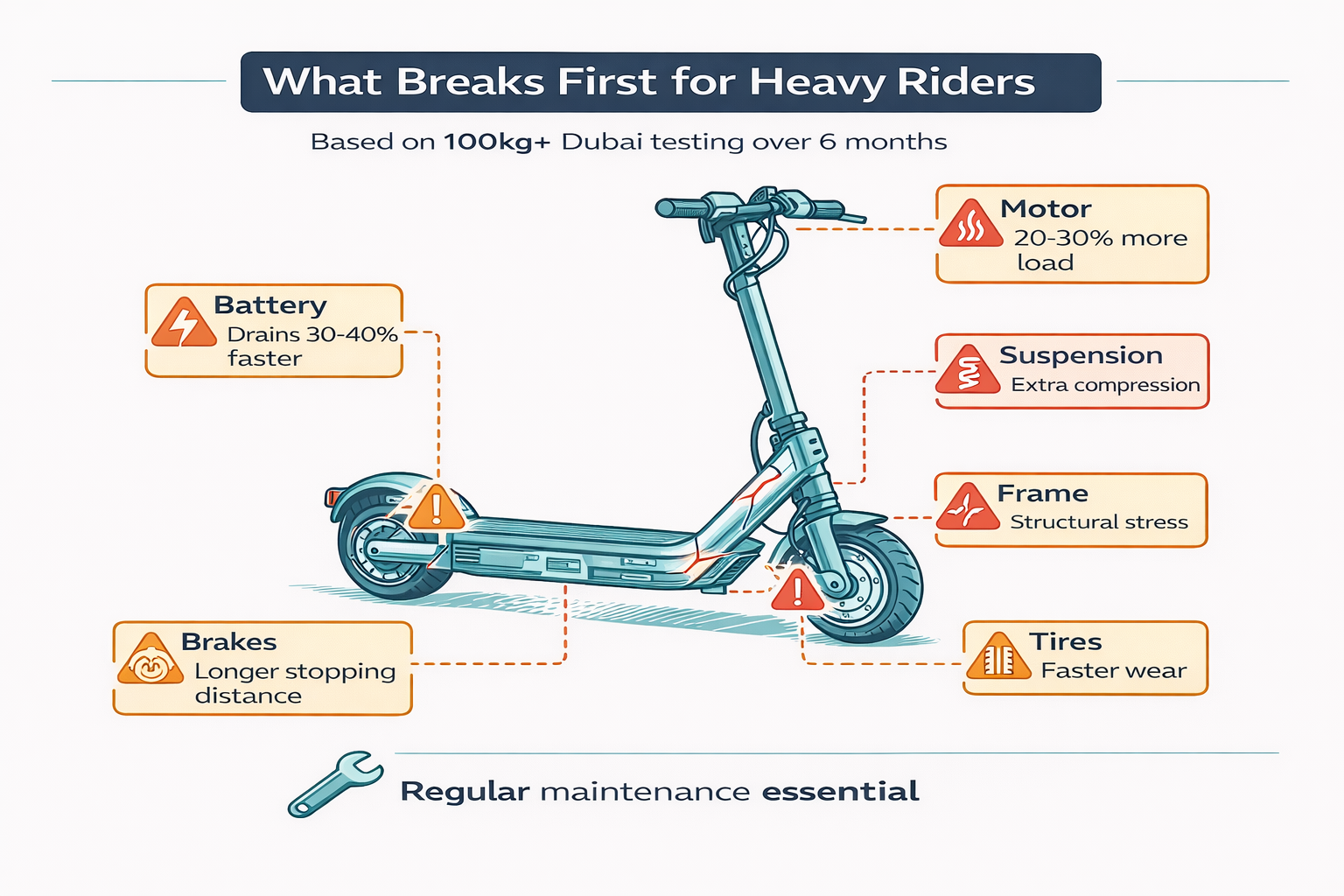
The smell is insulation melting.
- 350W motor at 110kg: 3-6 months in delivery use
- 500W motor at 110kg: 12-18 months
- 1000W motor at 110kg: 24+ months
Motor wattage isn’t about speed—it’s about not destroying the motor under your weight.
The Pinch Flat Epidemic
If you’re over 100kg and running pneumatic tires at standard pressure (35-40 PSI) in Dubai summer, you’re getting a flat tire.
Not “might get.” Will get. Weekly.
The pattern is always the same:
- Morning: tire looks fine
- Midday: riding on 60°C asphalt softens the tire rubber
- Your weight compresses the tire more than designed
- Tire pinches against rim
- Internal tube punctures from the pinch, not from external object
- You’re walking home
This is why solid tire conversion shops in Dubai make most of their money from heavy riders. The rougher ride is worth never dealing with pinch flats again.
What You Should Actually Buy
Based on weight and budget:
- Minimum: Segway Ninebot F2 Pro (2,150-2,400 AED)
- Recommended: Ninebot Max G2 (2,850-3,100 AED)
- Why: 48V system, reinforced frame, suspension rated for 120kg actual weight
- Minimum: Kugoo G2 Max (2,400-2,900 AED)
- Recommended: Kugoo G5 Plus (3,200-3,800 AED)
- Why: 1000W+ motors, 48V, heavy-duty suspension, proper brakes for your weight
- Only option: Dualtron Victor or Thunder 2 (7,500-15,000 AED)
- Alternative: Specialized mobility scooters from medical equipment suppliers
- Why: Nothing cheaper is built for your weight. Period.
Maintenance for Heavy Riders
Everything fails faster. Accept it and plan accordingly.
Tire Maintenance
- Check pressure every 2-3 days (not weekly)
- Maintain 50-55 PSI minimum
- Inspect for sidewall cracks monthly (heat + weight accelerates rubber aging)
- Replace tires every 6-8 months instead of 12 months
- Consider solid tire conversion if you get more than 2 flats per month
Brake Maintenance
Your weight + momentum = brakes work harder than designed.
- Check brake pads every month (not every 3 months)
- Replace pads at 30% remaining (not 20%—you need more safety margin)
- Upgrade to semi-metallic pads if your scooter has organic pads
- Budget 150-200 AED every 8-10 months for brake pad replacement
Battery Care
Heavy riders stress batteries more. Expect 18-24 month lifespan instead of 3-5 years advertised.
- Never drain below 20% (voltage sag under heavy load damages cells faster)
- Charge indoors in AC (never in 35°C+ room or car trunk)
- Avoid full-throttle acceleration from stops (pulls max current = stress)
- Budget 550-650 AED for battery replacement every 18-24 months
The Bottom Line
If you’re a heavy rider, most e-scooters in Dubai are designed to fail on you.
Not immediately. Not obviously. But six months in, when the stem wobbles, the motor smells weird, and the battery dies at 30%, you’ll realize the “100kg weight limit” was marketing, not engineering.
Cheap scooter (1,500 AED) that fails in 6 months = 3,000 AED per year
Proper scooter (3,000 AED) that lasts 2+ years = 1,500 AED per year
Buy the right scooter once instead of the wrong scooter twice.
Your weight isn’t the problem. The problem is manufacturers building scooters for 70kg riders and slapping “120kg max!” on the box to increase their market.
Do your research. Buy the right scooter for your actual weight. And for the love of God, keep your tires at 50 PSI.