How to Choose an E-Bike in the UAE: A Practical Guide
Every week, someone walks into the shop and asks: “Which e-bike should I buy?”
And every week, I ask the same question back: “What are you actually going to use it for?”
Because the right e-bike for commuting 5km on flat roads is completely different from the right one for weekend rides with cargo or long-distance touring.
Here’s how to figure out what you actually need — not what the marketing tells you to want.
Start with how you’ll actually use it
Forget specs for a minute. Forget brands. Forget what looks cool.
Answer these questions honestly:
- How far will you ride on a typical trip?
- Will you ride on roads, bike paths, or rough terrain?
- Do you need to carry cargo (backpack, groceries, work gear)?
- Will you ride in Dubai summer heat regularly?
- Do you have stairs or an elevator? (Weight matters.)
- Can you charge at your destination, or only at home?
Those answers will narrow your options faster than any spec sheet.
Motor type: Hub vs mid-drive
This is the first real decision. And most people overthink it. If you want the UAE-specific breakdown, see hub motor vs mid-drive: which one makes sense in the UAE.
Hub motor (rear or front wheel)
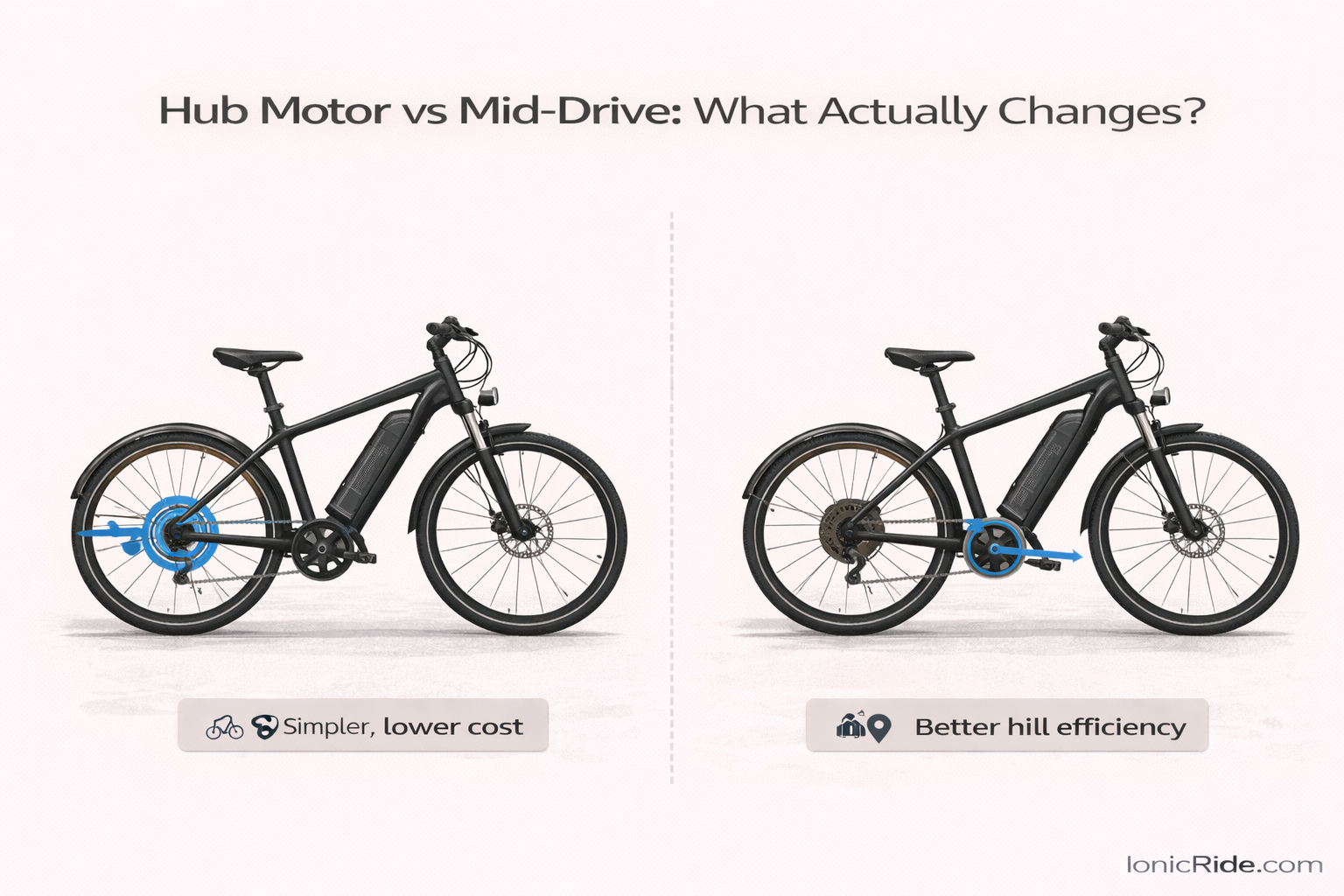
The motor is built into the wheel hub. Simple. Reliable. Cheaper.
Pros:
- Lower cost (usually AED 700–1,800 less than mid-drive)
- Less maintenance (no extra wear on chain or gears)
- Quieter operation
- Works fine on flat terrain
Cons:
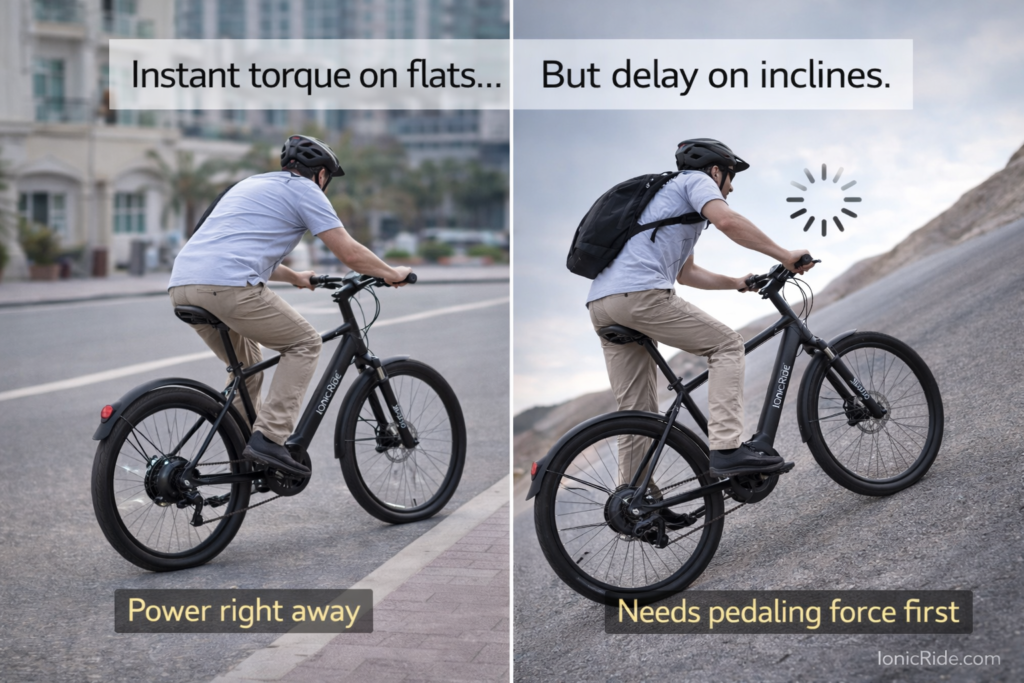
- Weaker on steep hills
- Less natural feel (power doesn’t sync with pedaling as smoothly)
- Harder to change a flat tire (wheel has motor built in)
Best for: Commuting on mostly flat roads. Dubai, Abu Dhabi, most of the UAE is flat. Hub motors handle this perfectly.
Mid-drive motor (mounted at the cranks)
The motor drives the chain directly. More efficient. Better for hills. More expensive.
Pros:
- Better hill climbing (uses the bike’s gears)
- More natural feel (power syncs with pedaling)
- Better weight distribution (motor at center, not in wheel)
- More efficient on varied terrain
Cons:
- Higher cost (AED 1,800–3,600+ more than hub motors)
- More wear on chain and gears (you’ll replace them more often)
- Slightly louder
Best for: Hilly areas, off-road riding, long distances, or if you want the most natural cycling feel.
Unless you’re riding in Hatta or doing serious off-road trails, you probably don’t need a mid-drive. The UAE is flat. Hub motors work great here and cost less. Mid-drives are impressive, but they’re solving a problem most UAE riders don’t have.
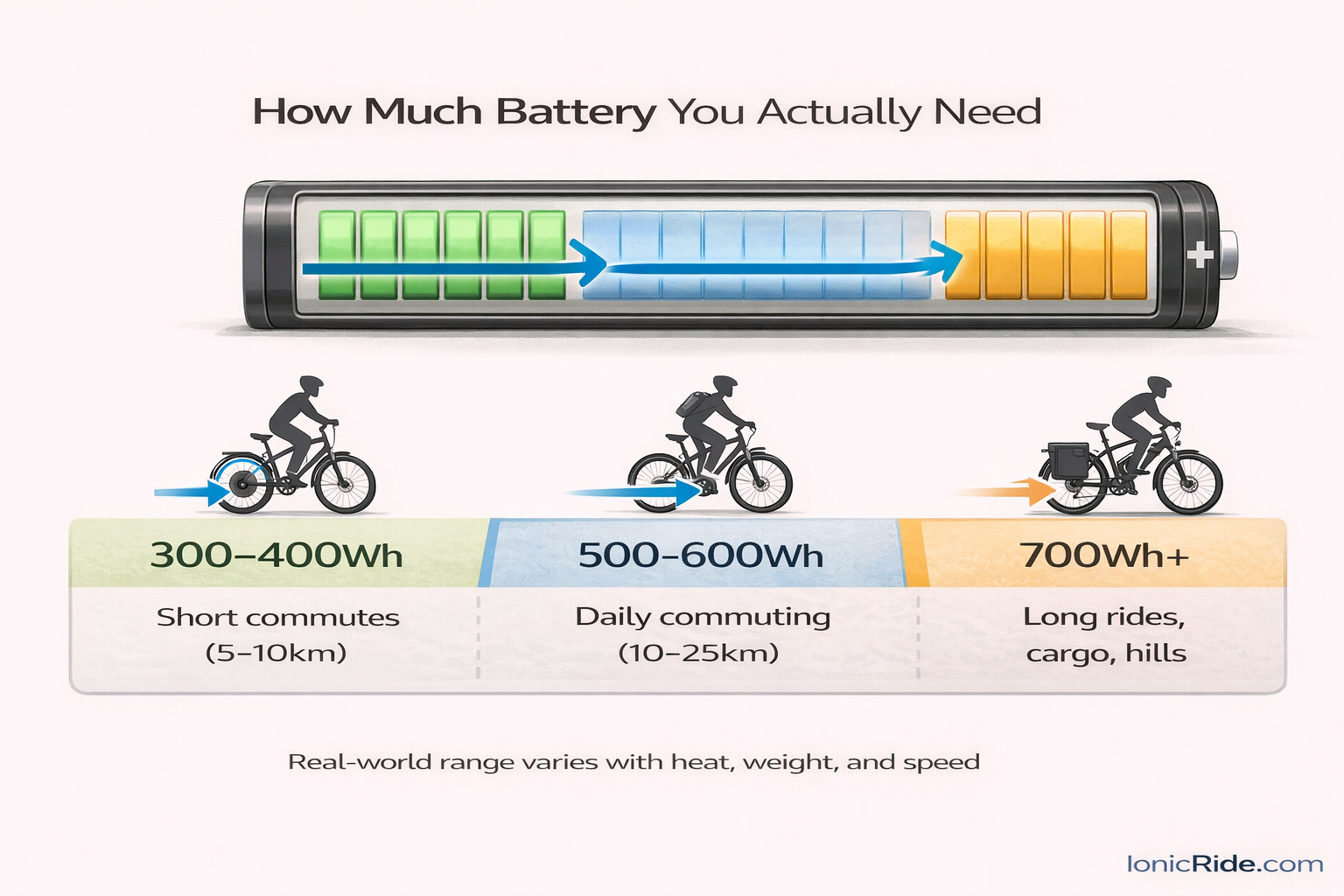
Battery capacity: How much do you actually need?
Battery capacity is measured in watt-hours (Wh). Higher number = more range.
But here’s the thing: range estimates on spec sheets are lies. (Okay, not lies. Optimistic projections.)
A battery rated for “80km range” means 80km under ideal conditions: flat road, light rider, no wind, slow speed, perfect temperature.
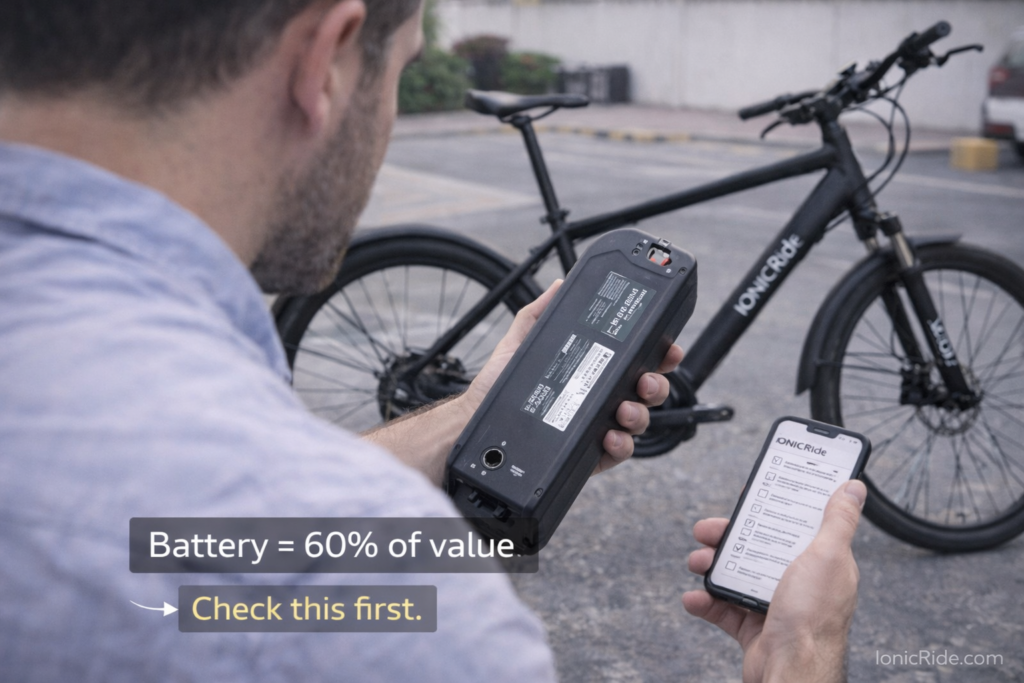
In real-world Dubai conditions — heat, occasional headwinds, stop-and-go traffic — expect 60–70% of the advertised range. This is explained in detail here: why your “60 km” battery usually only goes 40 km.
Battery size recommendations:
300–400 Wh: Good for 20–30 km real-world range. Fine if you’re commuting short distances and can charge daily.
400–500 Wh: The sweet spot for most riders. 30–50 km real range. Enough for a full day of errands or a longer commute without range anxiety.
600+ Wh: Overkill for most people, but great if you want to charge less frequently or ride long distances. Also useful if the battery will degrade over time and you want headroom.
Bigger batteries cost more upfront but save you from needing a replacement sooner. In UAE heat, batteries degrade faster. Starting with more capacity means you’ll still have decent range after 2–3 years of degradation.
Motor power: Watts don’t tell the whole story
People obsess over wattage. “Should I get 500W or 750W?”
Here’s the truth: Advertised wattage is often peak power, not sustained power. And it doesn’t account for controller efficiency, motor quality, or gearing.
A well-designed 250W mid-drive can outperform a cheap 500W hub motor on hills.
Wattage guidelines:
250W: Legal limit in many countries. Fine for flat terrain and light riders. Feels weak if you’re over 80kg or carrying cargo.
350–500W: The practical sweet spot for most riders. Enough power for hills, cargo, and heavier riders without overkill.
750W+: More power than most people need for commuting. Useful if you’re carrying heavy cargo, riding steep hills regularly, or weigh over 100kg.
In the UAE, there’s no strict wattage limit for personal e-bikes (as of 2025). But higher wattage drains the battery faster and generates more heat. Unless you need it, stick with 350–500W.
Torque sensor vs cadence sensor
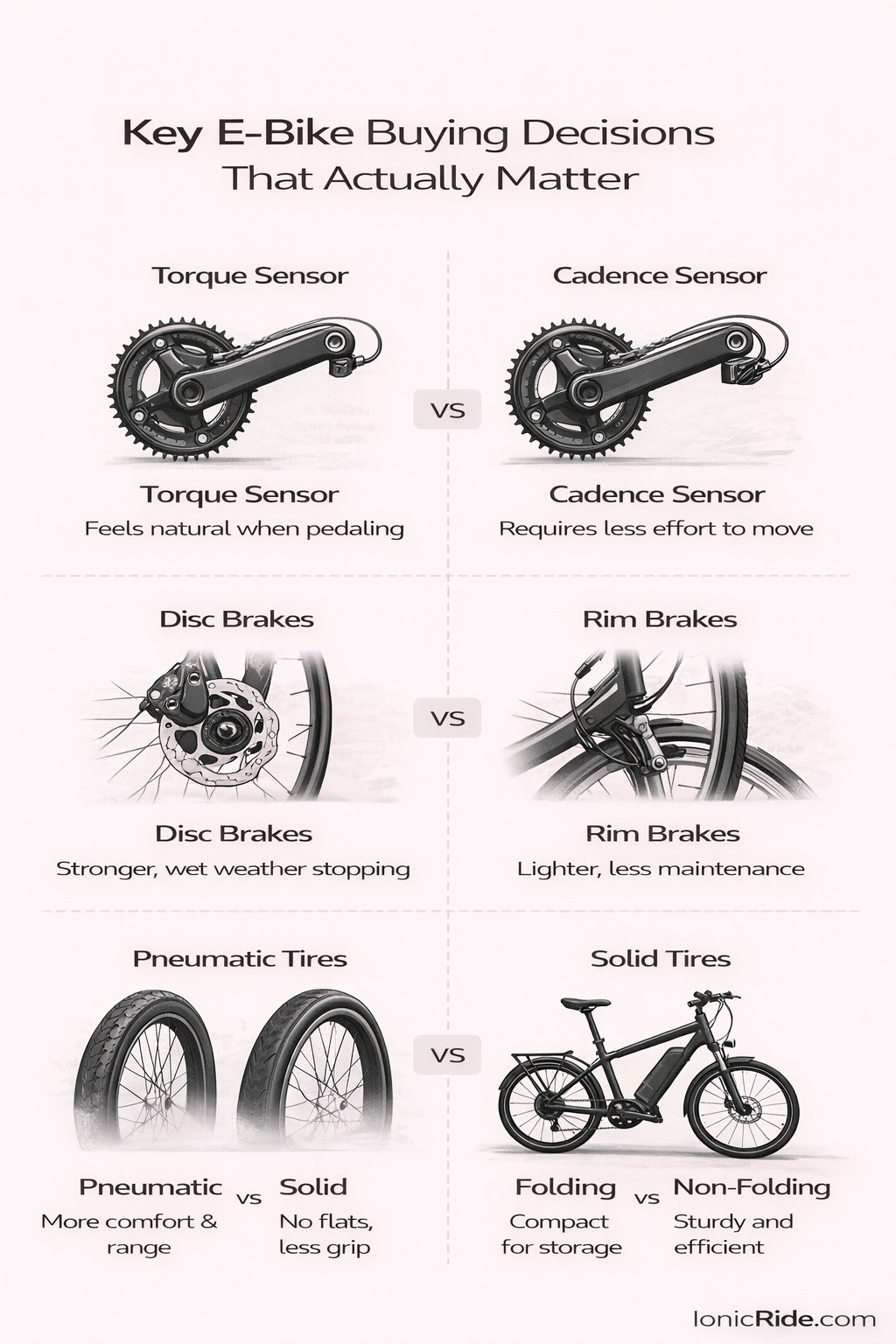
This affects how the bike feels when you ride. Here’s a full breakdown of the difference: torque sensor vs cadence sensor — which feels better.
Cadence sensor
Detects that you’re pedaling and turns on the motor. It doesn’t care how hard you’re pedaling — just that you are.
Feels like an on/off switch. Start pedaling, motor kicks in. Stop pedaling, motor cuts out.
Best for: Casual riders, flat terrain, or if you want predictable assist without thinking about it.
Torque sensor
Measures how hard you’re pedaling and adjusts motor power to match.
Push hard, motor pushes hard. Pedal gently, motor assists gently.
Feels more like riding a bike with super-strong legs instead of riding something with a motor bolted on.
Best for: Riders who want a natural cycling feel, or if you’re using the e-bike for exercise (not just transportation).
(Think of it like this: cadence sensor is like having Jarvis turn on Iron Man’s suit. Torque sensor is like the suit responding to how hard Tony moves. Both work. One feels more natural.)
If you can afford it, get a torque sensor. It makes the bike more enjoyable to ride. But if budget is tight, cadence sensors work fine — especially on flat roads.
Weight and portability
E-bikes are heavy. 20–30 kg on average. Some go up to 35 kg.
If you live in a building with stairs and no elevator, this matters a lot.
If you need to lift the bike onto a car rack or carry it into your apartment regularly, weight becomes a deciding factor.
Weight classes:
Under 20 kg: Lightweight e-bikes. Usually smaller batteries, less powerful motors. Easier to carry but shorter range.
20–25 kg: The sweet spot. Manageable weight with decent battery and motor.
25–30 kg: Heavier, but usually means bigger battery, stronger frame, more cargo capacity.
30+ kg: Cargo bikes or heavy-duty models. Not something you want to carry up stairs.
Lift the bike. Can you get it up a flight of stairs without struggling? If not, consider where you’ll store and charge it.
Tires: Pneumatic vs solid
This is a comfort vs maintenance tradeoff.
Pneumatic (air-filled) tires
Pros: Comfortable. Better grip. Absorbs bumps well.
Cons: Can get flats. Need to check pressure regularly (especially in UAE heat).
Solid (airless) tires
Pros: No flats. Zero maintenance. Great for city commuting.
Cons: Harsher ride. Less grip. Wears down over time and can’t be repaired — you replace the whole tire.
My take: Pneumatic tires are worth the occasional flat if you’re riding more than 5 km regularly. Solid tires make sense if you’re doing short city trips and never want to deal with a pump.
Brakes: Disc vs rim, mechanical vs hydraulic
Disc brakes (mechanical or hydraulic)
Better stopping power. Work well in wet conditions. Less rim wear.
Mechanical disc: Cable-actuated. Cheaper. Easier to adjust yourself.
Hydraulic disc: Fluid-actuated. Better modulation. More expensive. Harder to service at home but more reliable long-term.
Rim brakes (V-brakes)
Cheaper. Easier to replace pads. But they wear down the rim over time, and they’re less effective in wet conditions (not a huge issue in the UAE, but still).
My recommendation: Disc brakes. Mechanical if budget is tight. Hydraulic if you can afford it. Rim brakes are fine for casual riding but not ideal for heavier e-bikes.
Folding vs non-folding
Folding e-bikes are convenient if you need to store them in tight spaces or transport them in a car.
But they come with tradeoffs: smaller wheels (harsher ride), hinges (potential weak points), and usually shorter range (smaller batteries fit in compact frames).
Get a folding bike if: You live in a small apartment, take it on public transport, or store it in a car trunk regularly.
Skip it if: You have space to store a full-size bike and don’t need portability. Non-folding bikes are more comfortable and durable.
Features that matter (and features that don’t)
Features worth paying for:
- Integrated lights: Powered by the main battery. Always work. No separate batteries to replace.
- Fenders/mudguards: Keep you clean if you ride after rain (rare, but it happens).
- Cargo rack: Essential if you’re commuting with a backpack or groceries.
- Kickstand: Obvious but often overlooked. You’d be surprised how many bikes skip this.
- Removable battery: Makes charging way easier. You bring the battery inside instead of parking the whole bike near an outlet.
Features you can skip:
- Bluetooth app connectivity: Sounds cool. Rarely useful. Just another thing that can break.
- Suspension: Nice to have, but UAE roads are mostly smooth. Only worth it if you ride rough terrain regularly.
- Multiple color options: Doesn’t affect performance. Pick what you like, but don’t pay extra for it.
- USB charging port on the handlebars: Drains your main battery. Just carry a power bank.
Budget ranges and what you get
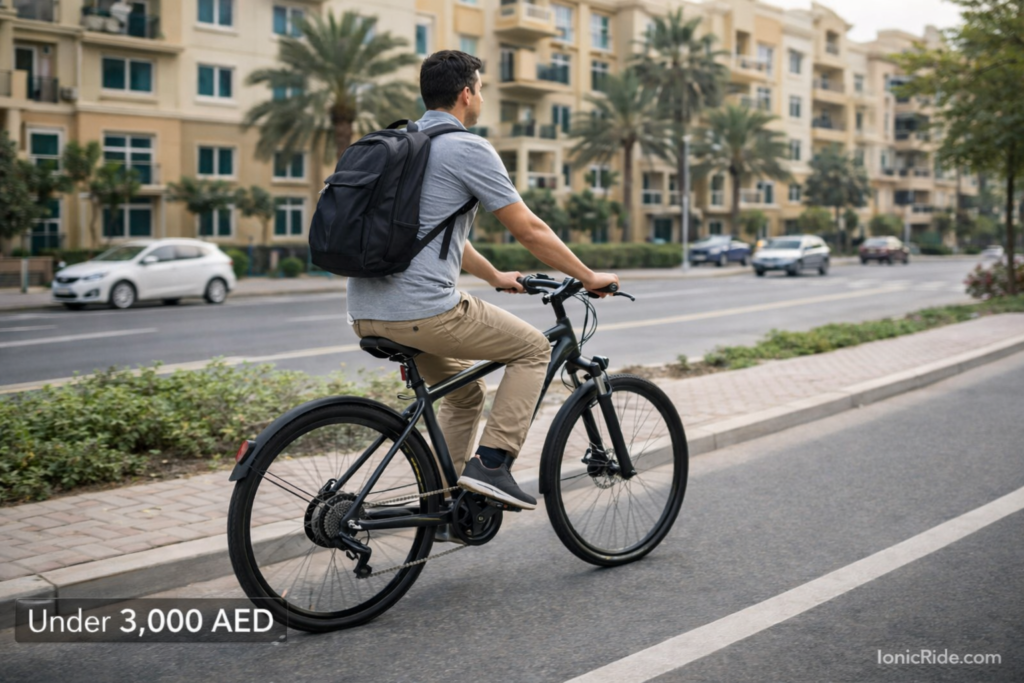
Under AED 2,000: Basic hub motor, small battery (300–400 Wh), mechanical brakes. Fine for short commutes but expect compromises on build quality.
AED 2,000–5,000: The sweet spot. Decent hub motor or entry-level mid-drive, 400–500 Wh battery, disc brakes. This is where most commuters should shop.
AED 5,000–10,000: Higher quality components, bigger batteries, better motors, hydraulic brakes. Worth it if you ride daily and want something that lasts.
AED 10,000+: Premium builds, high-end mid-drives, long-range batteries, top-tier components. Diminishing returns unless you’re a serious rider.
Where to buy in the UAE
You’ve got three main options: online, local shops, or used.
Online (Noon, Amazon, Alibaba)
Pros: Cheaper. More selection.
Cons: No test ride. Warranty support can be a nightmare if something breaks. Assembly required (and not always straightforward).
Local shops
Pros: Test ride before buying. Local warranty support. Expert advice (if the shop is good).
Cons: Higher prices. Limited selection.
Used bikes
Pros: Save 30–50% vs new.
Cons: Battery might be degraded. No warranty. You’re trusting the seller’s word on condition.
Buy from a local shop if it’s your first e-bike. Test ride matters. And if something breaks in month 2, you want someone nearby who can fix it.
Test ride checklist
When you test ride, pay attention to:
- Comfort: Does the saddle hurt after 5 minutes? Can you reach the handlebars comfortably?
- Power delivery: Is the assist smooth or jerky? Does it feel natural or like an on/off switch?
- Braking: Can you stop quickly and confidently?
- Weight: Can you lift the bike? Maneuver it easily?
- Display: Is it readable in bright sunlight? (This matters in the UAE.)
- Noise: Motors make some noise. But if it’s grinding or whining, that’s a bad sign.
If anything feels off, trust your gut. There are plenty of e-bikes out there.
Final thought
The best e-bike is the one you’ll actually ride.
Don’t get caught up in specs. Don’t buy the most expensive one thinking it’ll make you ride more. And don’t buy the cheapest one and regret it three months later when the battery dies.
Figure out what you need. Test ride a few options. Buy something reliable from a shop that’ll support you if things go wrong.
And ride it.