Should You Buy an E-Bike or E-Scooter in the UAE? (Honest Comparison)
This question comes up at least three times a week at the shop: “I want something electric for my commute. Should I get an e-bike or an e-scooter?”
Short answer: Depends on your commute distance, where you need to store it, and whether you value comfort or portability more.
Long answer: They’re fundamentally different tools. One isn’t universally better. Here’s how to figure out which one actually makes sense for you.
The fundamental difference
Before we compare specs, let’s be clear about what these are.
E-bike: A bicycle with an electric motor that assists your pedaling. You’re sitting. You can pedal without motor assist if the battery dies. Feels like cycling.
E-scooter: A stand-up scooter with a motor. No pedaling. You’re standing (or sitting if it has a seat). When the battery dies, you’re pushing a heavy scooter. Feels like… standing on a skateboard with a motor.
That fundamental difference affects everything: range, comfort, where you can ride, how tired you get, and whether it works for your commute.
The quick comparison (if you just want the answer)
| Factor | E-Bike | E-Scooter |
|---|---|---|
| Best for commute distance | 10+ km daily | Under 5-7 km daily |
| Price range (budget to mid) | 2,500-6,000 AED | 1,000-4,000 AED |
| Real-world range | 40-80 km | 20-40 km |
| Comfort (long rides) | High (seated, suspension) | Low (standing, fatigue after 20 min) |
| Portability | Low (heavy, hard to carry) | High (foldable, lighter) |
| Can use on Metro/bus | Only if foldable (still heavy) | Yes (most fold easily) |
| Dubai legal complexity | Low (allowed most places) | High (restricted zones, permit required) |
| Works if battery dies | Yes (pedal like normal bike) | No (heavy to push) |
| Maintenance frequency | Higher (chain, gears, brakes) | Lower (fewer moving parts) |
When an e-bike makes more sense
E-bikes win if your priority is range, comfort, or riding longer distances.
Your commute is 10+ km one-way
Standing on an e-scooter for 30-40 minutes? Your legs will hate you. Sitting on an e-bike? Totally fine.
E-bikes are designed for longer rides. Comfortable seat, suspension (on many models), hand position variety. You can ride 20 km and arrive not tired.
E-scooters are designed for short hops. After 15-20 minutes of standing, your feet start hurting. After 30+ minutes, you’re actively uncomfortable.
You need serious range
E-bikes have bigger batteries (typically 36V 10-15Ah vs e-scooters’ 36V 7.5-10Ah). Plus, pedal-assist is more energy-efficient than pure throttle.
Real-world e-bike range: 40-80 km depending on assist level and terrain.
Real-world e-scooter range: 20-40 km.
If your daily commute is 15 km round trip, an e-bike gives you buffer. An e-scooter might leave you with range anxiety.
You ride in areas without cycling infrastructure
E-bikes are allowed on roads (under 60 km/h speed limit). E-scooters in Dubai are restricted to specific designated districts.
If your commute involves roads without bike lanes, an e-bike has more legal flexibility than an e-scooter.
You want backup when the battery dies
E-bike battery dies? Pedal home. Slower, but doable.
E-scooter battery dies? You’re pushing 15-20 kg of dead weight. Not fun.
This matters in Dubai summer when batteries degrade faster from heat.
You’re okay with higher maintenance
E-bikes have chains, derailleurs, cassettes — things that need cleaning, lubing, and occasional replacement. Monthly maintenance is non-negotiable if you ride daily.
But if you’re comfortable with basic bike maintenance (or willing to learn), this isn’t a dealbreaker.
E-bike works best for:
- Daily commutes 10+ km
- Riders who value comfort over portability
- Routes without complete cycling infrastructure
- People who want exercise option (can pedal without motor)
- Delivery riders or anyone carrying cargo regularly
When an e-scooter makes more sense
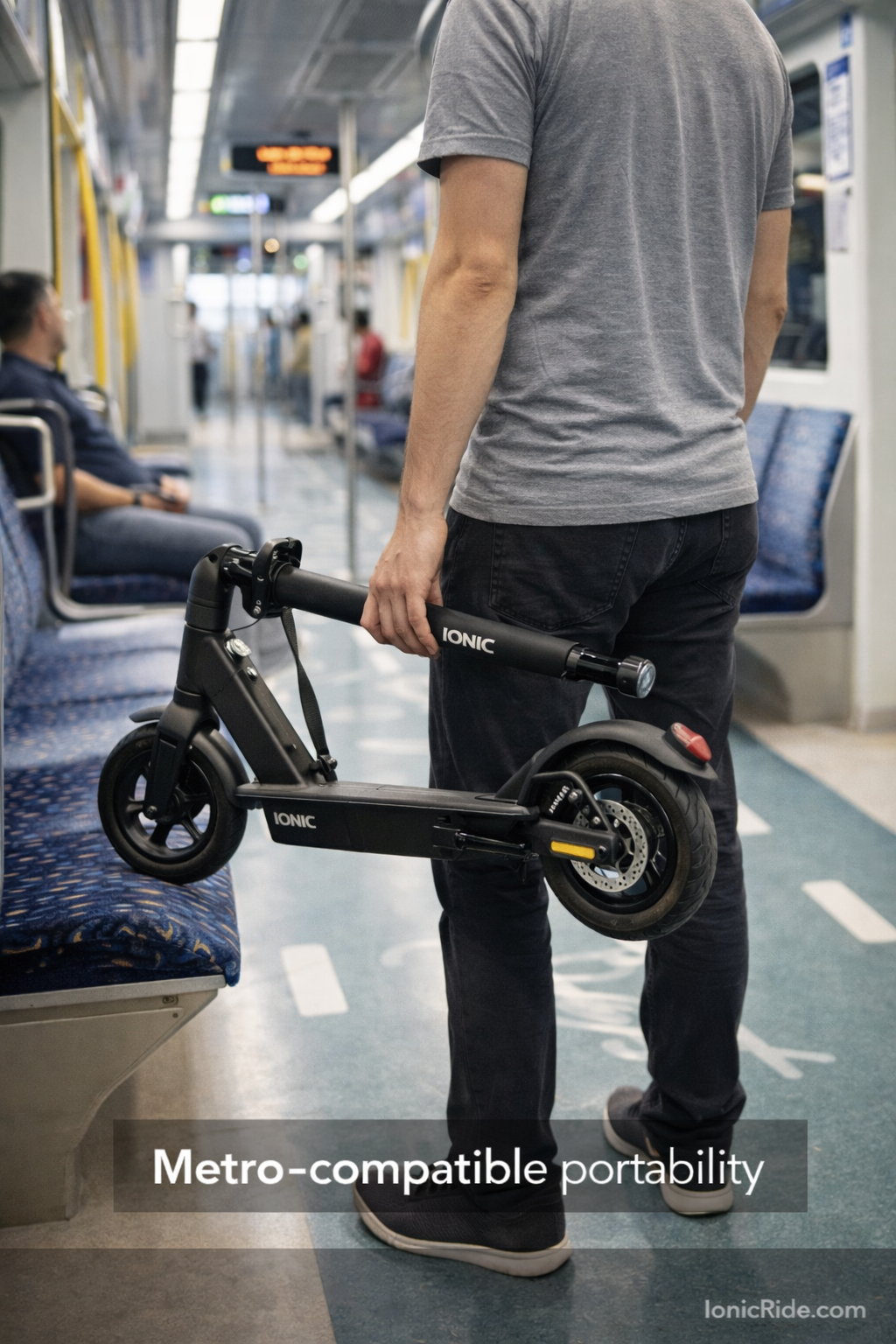
E-scooters win if your priority is portability, simplicity, or very short commutes.
Your commute is short (under 5-7 km)
Metro to office. Home to gym. Apartment to grocery store. These are e-scooter distances.
For short trips, the standing fatigue doesn’t matter. And the portability makes it easy to take the scooter into your office or apartment.
You need to combine with public transport
E-scooters fold in seconds and weigh 10-20 kg. You can carry them onto Metro, into buses, or in your car trunk.
E-bikes (even foldable ones) weigh 20-30+ kg and are awkward to carry. Taking an e-bike on Metro? Technically possible, but practically annoying.
If your commute is: home → e-scooter → Metro → e-scooter → office, the scooter is the obvious choice.
Storage space is limited
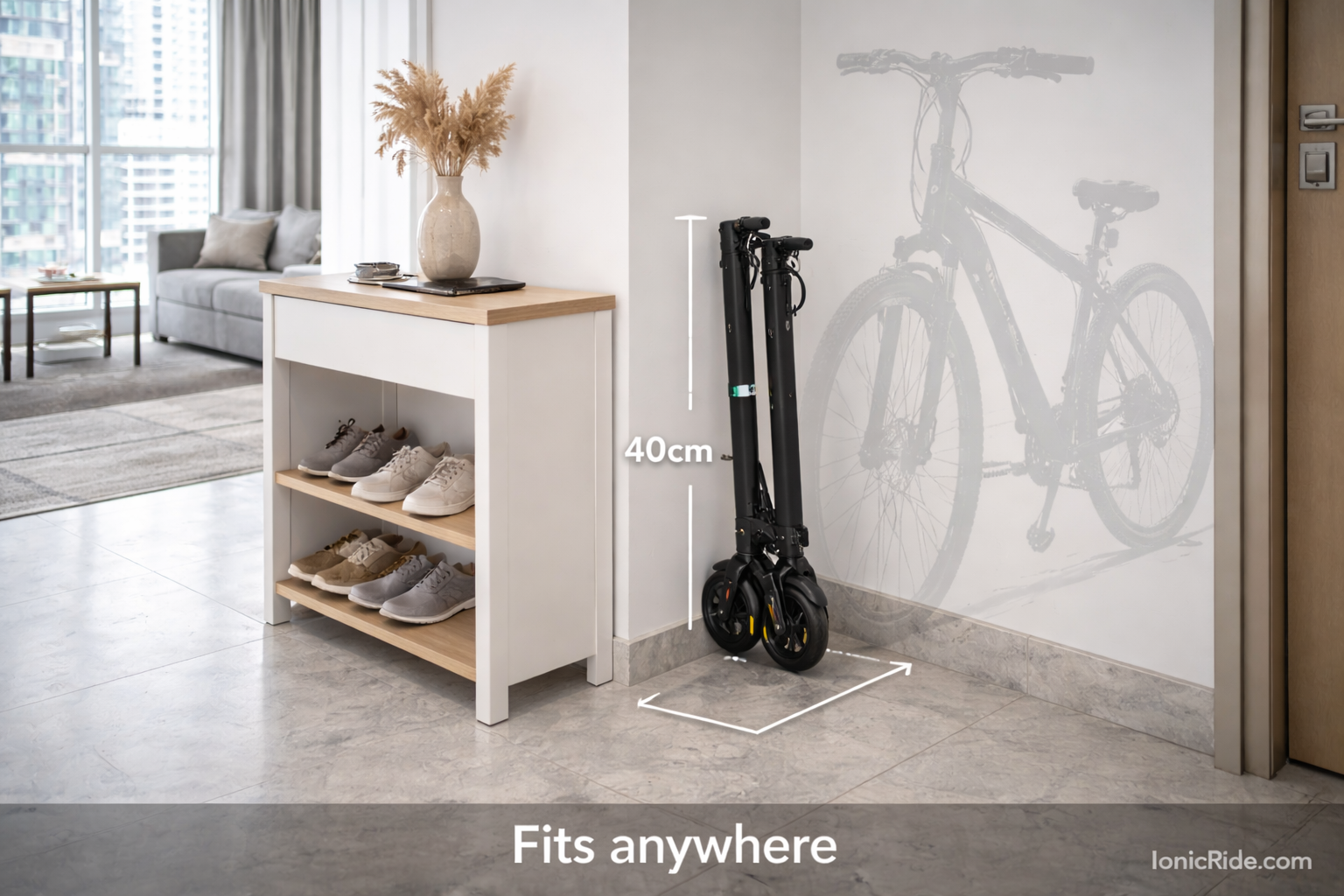
Living in a small apartment? E-scooter folds to the size of a large umbrella. Fits under a desk, in a closet, next to your door.
E-bike (even foldable) still takes up significant floor space. And you need to store it where you can charge it.
You want lower upfront cost
Budget e-scooters start around 1,000-1,500 AED. Budget e-bikes start around 2,500-3,000 AED.
Mid-range e-scooters: 2,000-4,000 AED. Mid-range e-bikes: 3,500-6,000 AED.
If budget is tight, e-scooters get you into electric mobility cheaper.
You want minimal maintenance
E-scooters have fewer moving parts. No chain, no gears, no derailleurs. Just motor, battery, brakes, and tires.
Maintenance is mostly: charge battery, check tire pressure, tighten bolts occasionally. That’s it.
For people who don’t want to think about maintenance, e-scooters are simpler.
E-scooter works best for:
- Short daily commutes (under 5-7 km)
- Multi-modal commuting (combining with Metro/bus)
- Riders who prioritize portability over comfort
- People with limited storage space
- Those wanting lower upfront cost and simpler maintenance
Legal differences in Dubai (this matters)
RTA treats e-bikes and e-scooters differently. This affects where you can ride.
E-bikes (more freedom)
- Allowed on all designated cycling tracks (Al Qudra, Nad Al Sheba, Jumeirah Corniche)
- Can ride on roads with speed limits under 60 km/h
- No special permit needed if you have a UAE driving license
- Fewer geographic restrictions
E-scooters (more restrictions)
- Restricted to 10 specific designated districts in Dubai
- Require RTA permit (even if you have a driving license)
- Banned from certain cycling tracks (Saih Assalam, Al Qudra, Meydan)
- More enforcement and stricter fines for violations
If you’re riding in areas without designated e-scooter zones, you’re technically illegal — even if there are bike lanes. E-bikes don’t have this problem.
E-scooter enforcement in Dubai is inconsistent but getting stricter. In designated zones (JLT, Marina, Downtown), you’re fine. Outside those zones? You risk fines.
E-bikes face much less enforcement. As long as you’re not on highways or being reckless, authorities generally don’t bother you.
Comfort comparison (the part no one talks about)
This is huge and often ignored in comparisons.
E-bike comfort
You’re sitting. Your weight is distributed across a saddle. Your hands rest lightly on handlebars. Your legs do some work (even with motor assist).
After 20 km on an e-bike: Slightly tired legs, maybe a sore butt if the seat isn’t great. Otherwise fine.
E-scooter comfort
You’re standing. Your entire weight is on your feet. Your hands grip handlebars tightly for stability. Your core and ankles work constantly to balance.
After 20 km on an e-scooter: Feet hurt. Lower back aches. Hands cramped from gripping. You’re done.
Some e-scooters have seats. That helps. But the riding position is still less comfortable than a proper bicycle seat.
Test this before buying: Stand still for 20 minutes. That’s what long e-scooter rides feel like. Now imagine doing that daily.
Range anxiety and battery realities
Both degrade in Dubai heat. But they degrade differently.
E-bike battery degradation
Larger battery = more capacity buffer. Even after 6-12 months of degradation, you still have usable range.
Example: 60 km advertised range becomes 45 km real-world after 6 months. Still plenty for most commutes.
Plus, you can pedal if battery runs low. Slower, but not stranded.
E-scooter battery degradation
Smaller battery = less buffer. After 6-12 months, range drops noticeably.
Example: 35 km advertised range becomes 22 km real-world after 6 months. Now your 15 km commute is pushing battery limits.
And if battery dies, you’re pushing dead weight. No backup.
E-scooters develop range anxiety faster than e-bikes as batteries age.
Cost comparison (upfront + long-term)
E-scooters are cheaper upfront. E-bikes might be cheaper long-term.
Upfront cost
Budget e-scooter: 1,000-2,000 AED
Budget e-bike: 2,500-3,500 AED
Mid-range e-scooter: 2,500-4,500 AED
Mid-range e-bike: 4,000-7,000 AED
E-scooters win on initial price.
Long-term cost
E-scooter battery replacement: 400-800 AED (every 1-2 years)
E-bike battery replacement: 800-1,500 AED (every 2-3 years)
E-scooter tire replacement: 100-200 AED (every 6-12 months)
E-bike tire replacement: 100-200 AED (every 12-18 months)
E-scooter maintenance: Minimal (mostly battery and tires)
E-bike maintenance: Regular (chain, cassette, brakes, gears)
E-scooters have lower maintenance frequency but higher battery replacement frequency (due to smaller batteries wearing out faster).
Over 3 years of daily use, costs even out. E-bikes cost more upfront, e-scooters cost more in consumables.
What most people get wrong
Mistake 1: Buying an e-scooter for a 12 km commute
We see this constantly. Someone buys an e-scooter because it’s cheaper and lighter. Then realizes standing for 40 minutes each way is miserable.
They either suffer through it or end up buying an e-bike 6 months later.
If your commute is over 8-10 km, skip the e-scooter. Just buy the e-bike.
Mistake 2: Buying an e-bike for last-mile Metro commuting
Someone buys an e-bike thinking they’ll take it on Metro. Then realizes carrying 25 kg up and down Metro stairs is awful.
For multi-modal commuting, e-scooters are objectively better. Accept the standing discomfort for short distances.
Mistake 3: Ignoring where they can legally ride
Someone buys an e-scooter, then discovers their commute route isn’t in a designated e-scooter zone. Now they’re riding illegally daily.
Check Dubai’s e-scooter zones before buying. If your route isn’t covered, get an e-bike.
The decision matrix
Answer these questions:
1. How far is your daily commute (one-way)?
– Under 5 km → E-scooter works
– 5-10 km → Either works, depends on comfort preference
– Over 10 km → E-bike strongly recommended
2. Do you need to combine with public transport?
– Yes → E-scooter (portability matters)
– No → E-bike (comfort matters more)
3. Where do you store it?
– Small apartment, limited space → E-scooter
– Have storage space → E-bike
4. Is your route in designated e-scooter zones (Dubai)?
– Yes → Either works
– No → E-bike (legal flexibility)
5. What’s your budget?
– Under 2,000 AED → E-scooter only option
– 2,500-4,000 AED → Either works
– Over 4,000 AED → Get a good e-bike
Rent an e-scooter for a day. Rent an e-bike for a day. Do your actual commute on both. See which one you don’t hate after the ride. That’s your answer.
One more thing: The hybrid option
Some people need both.
Buy a cheap e-scooter (1,500 AED) for last-mile Metro commuting and short errands. Buy a mid-range e-bike (4,000-5,000 AED) for weekend rides and longer commutes when you drive part-way.
Total cost: 5,500-6,500 AED. You have the right tool for each situation.
(It’s like owning both a car and a motorcycle. Different tools, different purposes. Both useful.)