Understanding E-Bike Range: Why Your 60km Battery Only Goes 40km
“The website said 60 km range. I barely got 40 km. Is my battery defective?”
I hear this at least once a week.
The battery’s probably fine. The range estimate? That’s the problem.
Range estimates are marketing, not reality
When a manufacturer says “60 km range,” they’re not lying. But they’re not telling the whole truth either.
That number is based on ideal test conditions:
- Flat, smooth road
- 70 kg rider
- No wind
- 20–25°C temperature
- Lowest assist level
- Constant 15–20 km/h speed (no stops, no acceleration)
- Brand new battery at 100% health
In the real world, none of those conditions hold.
You’re heavier than 70 kg (or you’re carrying cargo). It’s 40°C outside. You’re stopping at traffic lights. You’re accelerating from zero repeatedly. You want higher assist because you’re tired or in a hurry.
All of that drains the battery faster.
Expect 60–75% of the advertised range in real-world conditions. A “60 km” battery will give you 40–45 km in typical use. A “100 km” battery will give you 60–75 km.
Plan around that, not the marketing number.
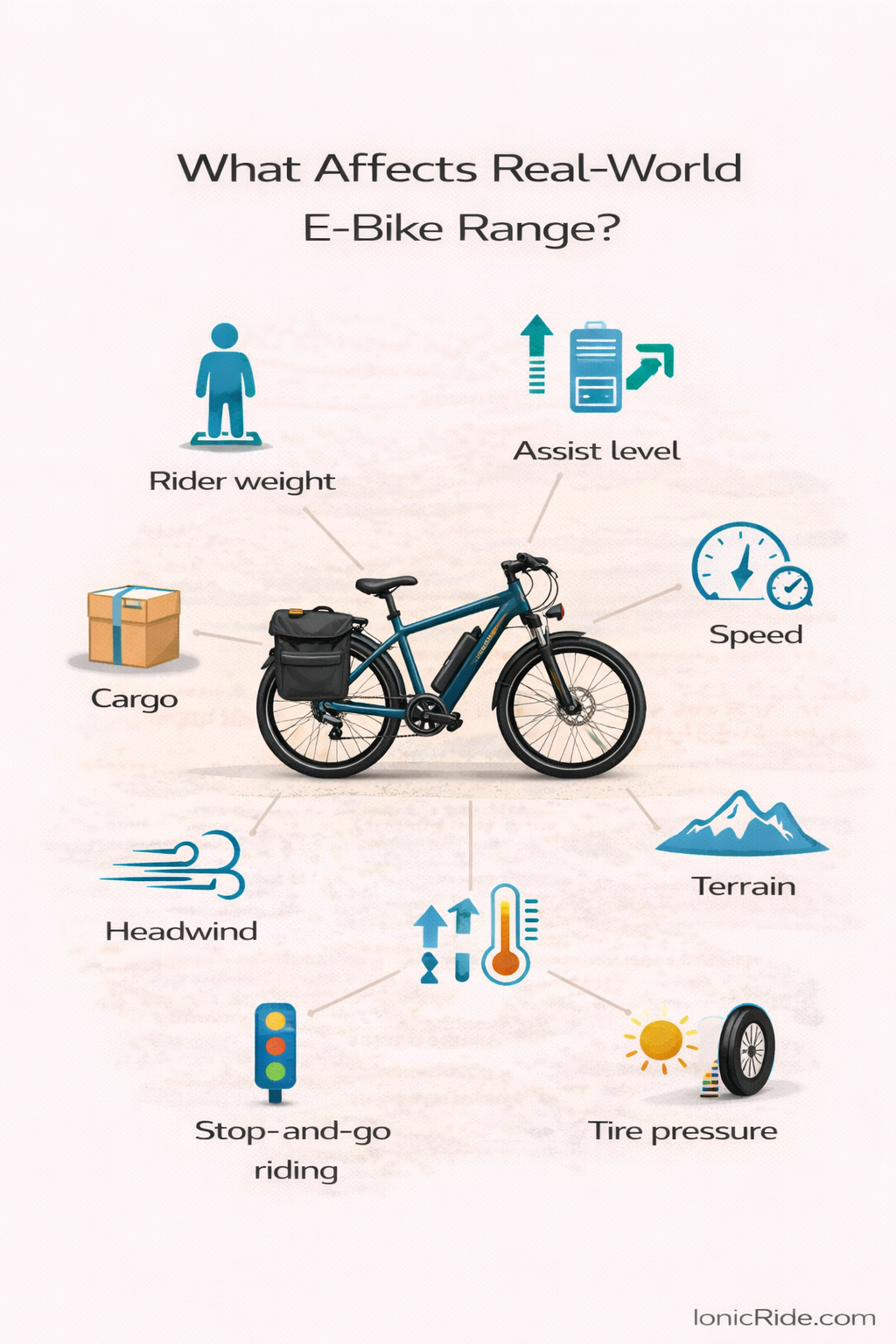
What actually affects range
Let’s break down the factors that eat into your battery — and how much each one matters.
1. Your weight (and cargo)
Heavier rider = more energy needed to move. Simple physics.
A 90 kg rider will get 15–20% less range than a 70 kg rider on the same bike, same route, same settings.
Add a backpack with 10 kg of groceries, and you lose another 10–15%.
Impact: High. Can reduce range by 20–30% easily.
2. Assist level
Most e-bikes have 3–5 assist levels. Eco, Normal, Sport, Turbo — whatever the manufacturer calls them.
Higher assist = more motor power = faster battery drain.
Riding in Turbo mode all the time can cut your range in half compared to Eco mode.
Impact: Very high. Difference between modes can be 50%+ in range.
3. Speed
Faster speeds require more power to overcome wind resistance.
At 15 km/h, wind resistance is minimal. At 25 km/h, it’s significant. At 30+ km/h (if your bike goes that fast), it’s eating your battery.
Riding at 25 km/h instead of 20 km/h can reduce range by 20–30%.
Impact: Moderate to high, especially above 25 km/h.
4. Terrain
Flat roads are easy. Hills are battery killers.
Climbing a steep hill can drain 3–5 times more battery per kilometer than flat ground.
In the UAE, most riding is flat. But if you’re in Hatta or doing mountain routes, expect significantly lower range.
Impact: Very high on hills. Negligible on flat ground.
5. Temperature
Lithium-ion batteries perform best at 20–25°C.
In Dubai summer, it’s 40–45°C. Battery efficiency drops. Internal resistance increases. You lose 10–20% range compared to ideal temps.
Cold weather (under 10°C) is even worse, but that’s not a UAE problem.
Impact: Moderate. 10–20% in extreme heat.
6. Stop-and-go riding
Constant speed is efficient. Accelerating from zero repeatedly is not.
Every time you stop at a light or slow down for traffic, you lose momentum. Accelerating back up to speed drains the battery.
City commuting with frequent stops can reduce range by 20–30% compared to uninterrupted riding.
Impact: High in city traffic. Low on open roads.
7. Tire pressure
Low tire pressure = more rolling resistance = more battery drain. This is one of the main reasons bikes start feeling weak over time — explained here: why your e-bike feels sluggish after 6 months.
If your tires are 10–15 PSI low (common in UAE heat where people forget to check), you can lose 10–15% range.
Impact: Moderate, but easy to fix.
8. Headwind
Wind resistance matters. A 20 km/h headwind can cut your range by 15–25%.
Tailwind helps, but not as much as headwind hurts. (Physics is unfair like that.)
Impact: Moderate on windy days. Negligible otherwise.
9. Battery age and health
Batteries degrade over time. A 2-year-old battery might only hold 80–85% of its original capacity.
In UAE heat, degradation happens faster. Here’s what’s actually happening inside the battery: how Dubai heat affects e-bike batteries (and what you can do). A battery that gave you 50 km when new might only give you 40 km after two years of use.
Impact: Increases over time. 15–20% after 2–3 years.
Real-world range example
Let’s take a hypothetical e-bike with a “60 km range” rating and see what actually happens.
Scenario 1: Best case (close to manufacturer estimate)
- 70 kg rider, no cargo
- Flat route, smooth roads
- Eco mode, 15–20 km/h steady speed
- No traffic, few stops
- Mild weather (25–30°C)
- Tires properly inflated
Actual range: 55–60 km
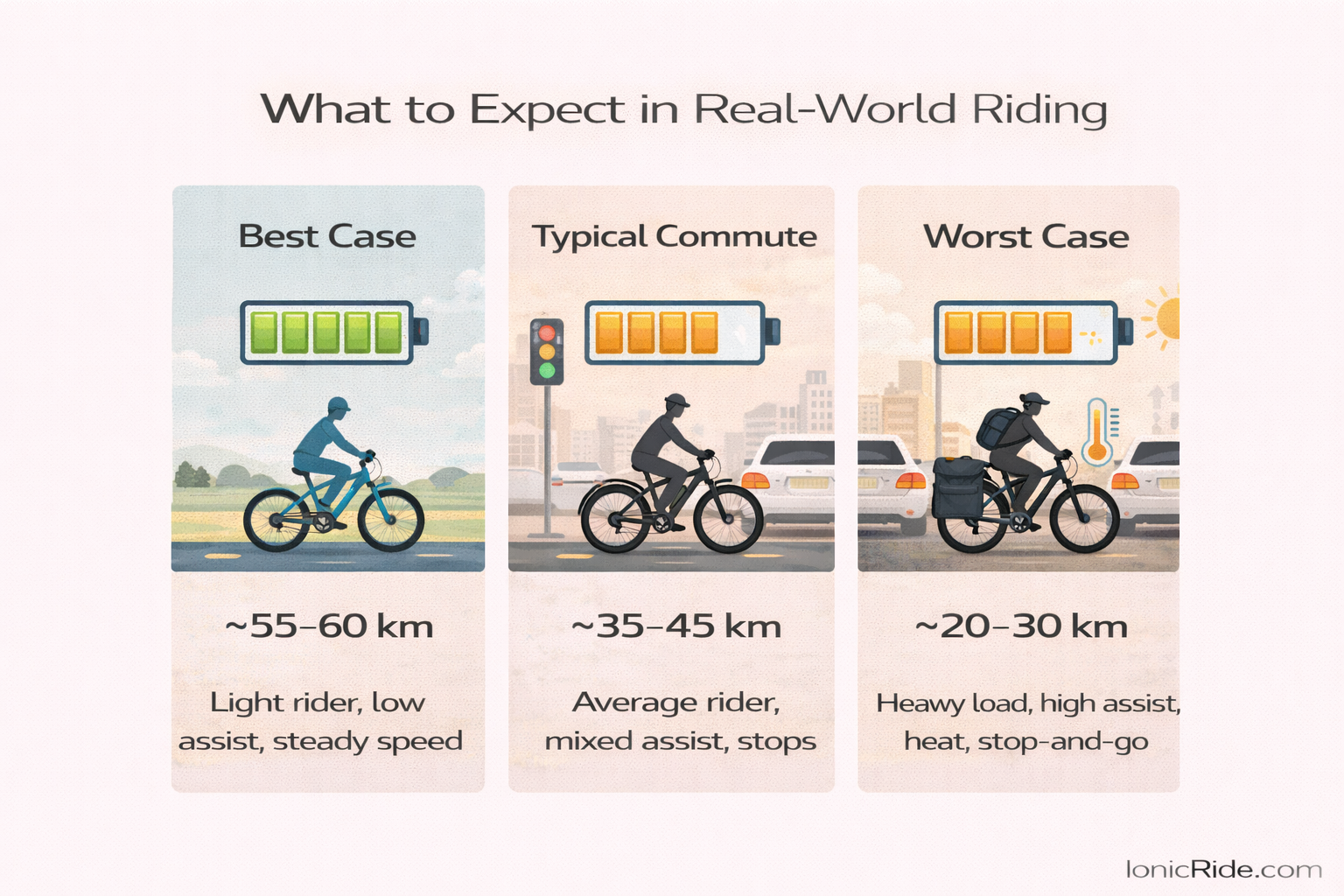
Scenario 2: Typical commute (what most people experience)
- 85 kg rider, 5 kg backpack
- Mixed terrain, some rough pavement
- Normal assist mode, 20–25 km/h
- City traffic, frequent stops
- Dubai summer (40–45°C)
- Tires slightly low (forgot to check)
Actual range: 38–45 km
Scenario 3: Worst case (battery dies way faster than expected)
- 100 kg rider, 10 kg cargo
- Hilly route or strong headwind
- Sport/Turbo mode, 25–30 km/h
- Heavy traffic, constant stop-and-go
- Peak summer heat (45°C+)
- Older battery (2+ years, degraded)
Actual range: 25–35 km
Same battery. Same bike. Range varies by more than 2x depending on conditions.
(It’s like MPG ratings on cars. The EPA says 30 MPG highway. But if you’re doing 80 MPH in stop-and-go traffic with the AC blasting, you’re getting 18 MPG. Not the car’s fault. That’s just reality.)
How to maximize your range
You can’t change the weather or eliminate hills. But you can control some things.
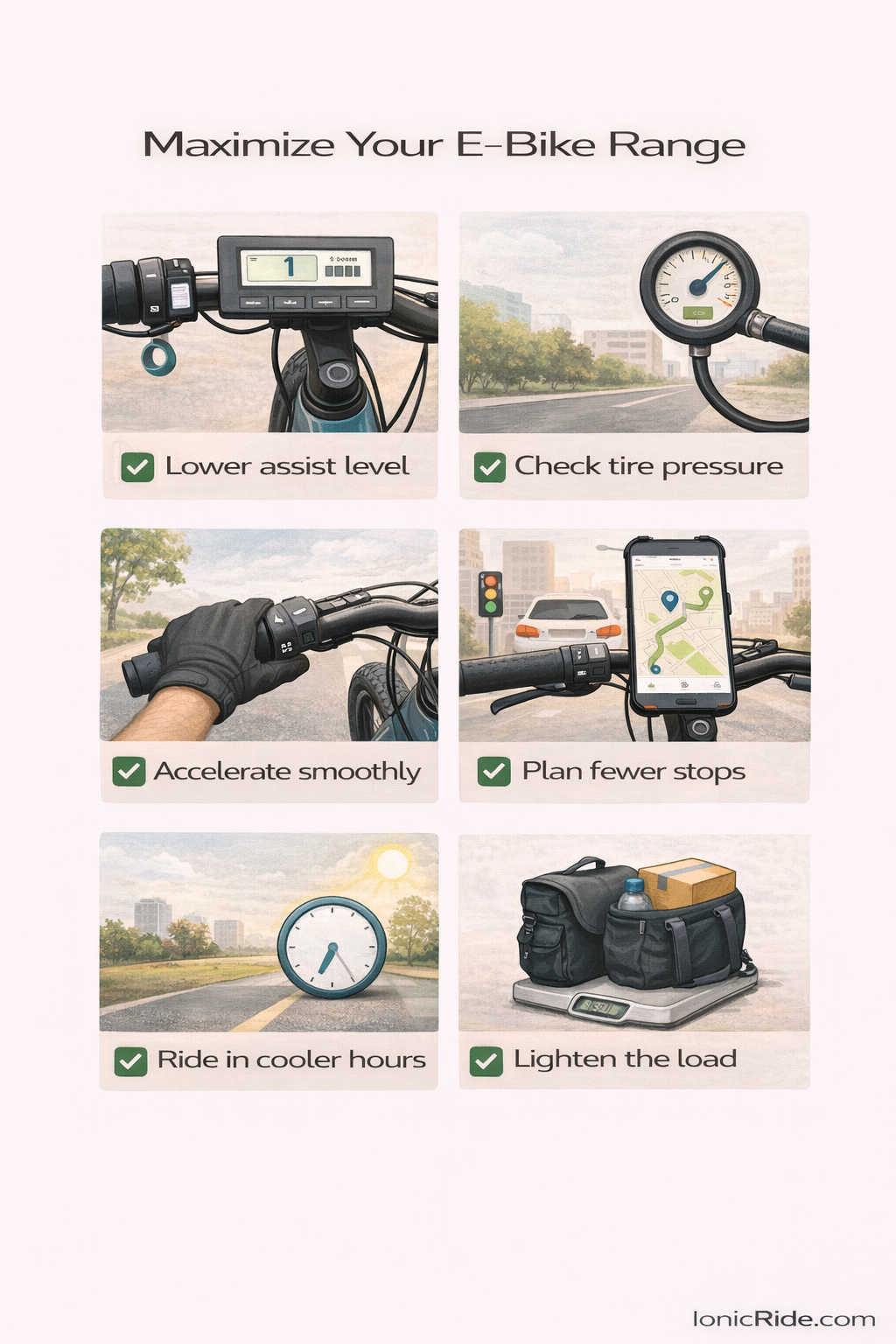
Use lower assist levels when possible
If you’re not in a hurry and the terrain is easy, drop to Eco mode. You’ll go slower, but your battery will last way longer.
Save Sport/Turbo for when you actually need it — hills, headwinds, or when you’re late.
Keep tire pressure at spec
Check your tires every week. Inflate to the recommended PSI (check the sidewall).
This is the easiest 10–15% range gain you can get. Costs nothing. Takes two minutes.
Accelerate smoothly, not aggressively
Don’t hammer the throttle or pedal hard from every stop. Ease into it. Gradual acceleration uses less battery than jackrabbit starts.
Plan routes with fewer stops
If you have two routes to your destination — one with 10 traffic lights and one with 3 — take the one with fewer stops. Constant speed is more efficient than stop-and-go.
Ride during cooler times if possible
Early morning or evening rides in summer will give you better range than midday. The battery performs better at 30°C than 45°C.
Keep weight down
Don’t carry unnecessary stuff. Every extra kilogram costs you range.
If you’re commuting with a laptop and lunch, fine. But don’t haul 15 kg of stuff you don’t need.
What if your range is *really* bad?
If you’re getting 50% or less of what you’d expect even accounting for real-world conditions, something might actually be wrong.
Check for these issues: Many of them are caught early with a simple routine like this monthly e-bike maintenance checklist.
Brake drag. If your brakes are rubbing, the motor has to fight that resistance constantly. Spin the wheels — they should coast freely.
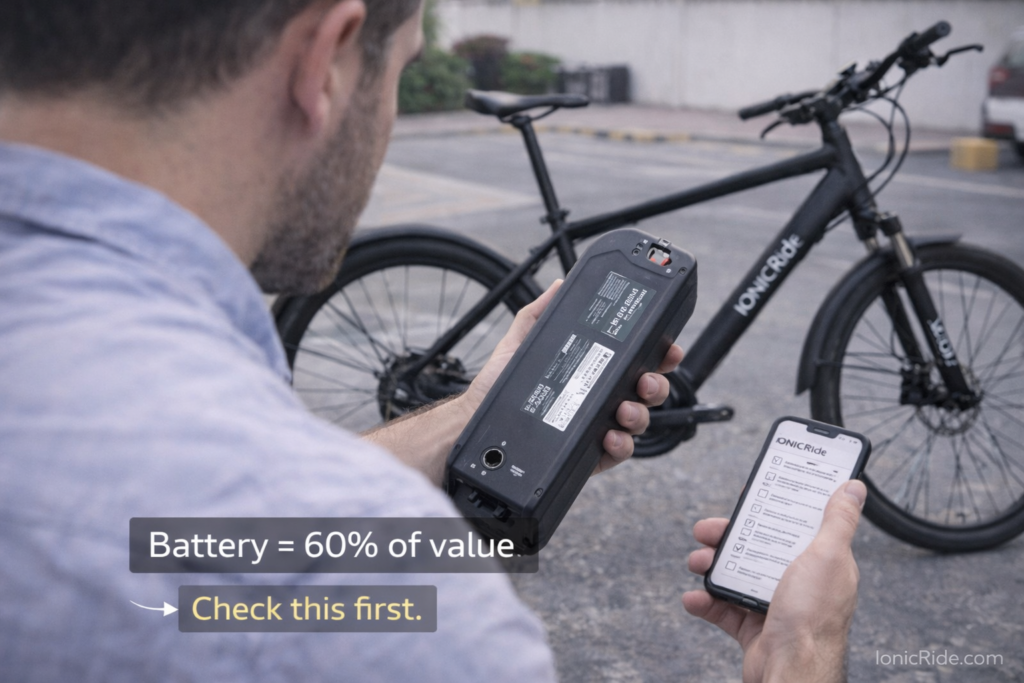
Battery degradation. If the battery is 3+ years old or has been abused (left in extreme heat, stored dead for weeks), it might be shot. A shop can test capacity.
Controller settings. Some e-bikes have hidden settings that limit power or speed. Check your display menu or app for power output limits.
Motor inefficiency. If the motor is failing or the gears are misaligned, more energy is wasted as heat instead of motion. You’d usually hear weird noises if this is the problem.
How to estimate your real-world range
Here’s a rough formula I use:
Real-world range = (Advertised range) × 0.65 × (Terrain factor) × (Assist factor)
Terrain factor:
- Flat roads: 1.0
- Gentle hills: 0.8
- Steep hills: 0.6
Assist factor:
- Eco mode: 1.2
- Normal mode: 1.0
- Sport mode: 0.8
- Turbo mode: 0.6
Example: 60 km advertised range, flat terrain, Normal assist:
60 × 0.65 × 1.0 × 1.0 = 39 km real-world range.
That’s conservative. You might get 40–45 km depending on your weight and riding style. But it’s a better starting point than the manufacturer’s number.
Final thought
Range anxiety is real. But it’s usually worse in your head than in practice.
Once you know your bike’s actual range in your normal riding conditions, you can plan around it. Charge at work if you’re doing 50 km round trips. Take a different route if needed. Or just accept that you’ll need to charge more often than you thought.
But don’t blame the battery for not matching the marketing. The battery’s doing its job. The marketing number was optimistic from the start.