E-Scooter Controller Explained: What It Does & Dubai Heat Failures 2026
You twist the throttle. Scooter jerks violently instead of smooth acceleration. Or it accelerates fine, then cuts power randomly. Or it won’t respond to throttle at all.
Shop diagnosis: “Controller problem. 400 AED to replace.”
You: “What even is a controller?”
Here’s what controllers actually do, why Dubai heat kills them faster than anything else, and whether that 400 AED replacement is legit or if you can get away with 150 AED repair.
What Is the Controller? (Simple Explanation)
The controller is your scooter’s “brain” for motor power. It sits between your battery and motor, deciding how much power to send based on what you tell it via throttle.
Without controller: Battery connects directly to motor. It’s either full power or off. No speed control. Motor burns out from excessive current.
With controller: You twist throttle 30% → Controller sends 30% of battery power to motor → Smooth, controlled acceleration.
The controller constantly adjusts power delivery 1,000+ times per second to match throttle input.
Where Is the Controller Located?
- Xiaomi M365/Pro: Under footdeck, attached to battery compartment. Visible if you remove deck panel.
- Ninebot MAX: Inside stem near base. Requires partial stem disassembly to access.
- Budget scooters: Usually in deck area, sometimes in handlebar stem (worse for heat exposure).
- Premium scooters (Dualtron, etc.): Dedicated controller compartment, often with heat sinks or cooling fins.
Controllers are metal boxes (5-15cm long) with thick wires coming out. If you’ve opened your scooter’s deck, you’ve probably seen it.
What Does the Controller Actually Do?
| Function | What Controller Does | What Happens If Controller Fails |
|---|---|---|
| Throttle Signal Processing | Reads throttle position (0-100%), converts to motor power command | No response to throttle, or erratic response (jerking) |
| Power Modulation (PWM) | Rapidly switches power on/off to control effective voltage to motor | Motor gets full power or no power (no in-between) |
| Overcurrent Protection | Limits maximum current to prevent motor/battery damage | Motor draws too much current, burns out or triggers BMS shutdown |
| Regenerative Braking | Converts motor into generator when braking, charges battery | E-brake doesn’t work, no regen (less range) |
| Temperature Monitoring | Measures controller temp, reduces power if too hot | Controller overheats, shuts down, or burns out |
| Speed/Power Modes | Implements eco/normal/sport modes by limiting max power | Stuck in one mode or modes don’t work |
| Cruise Control | Maintains constant speed without holding throttle | Cruise control doesn’t engage or stays stuck on |
How Controller Works (Technical But Simple)
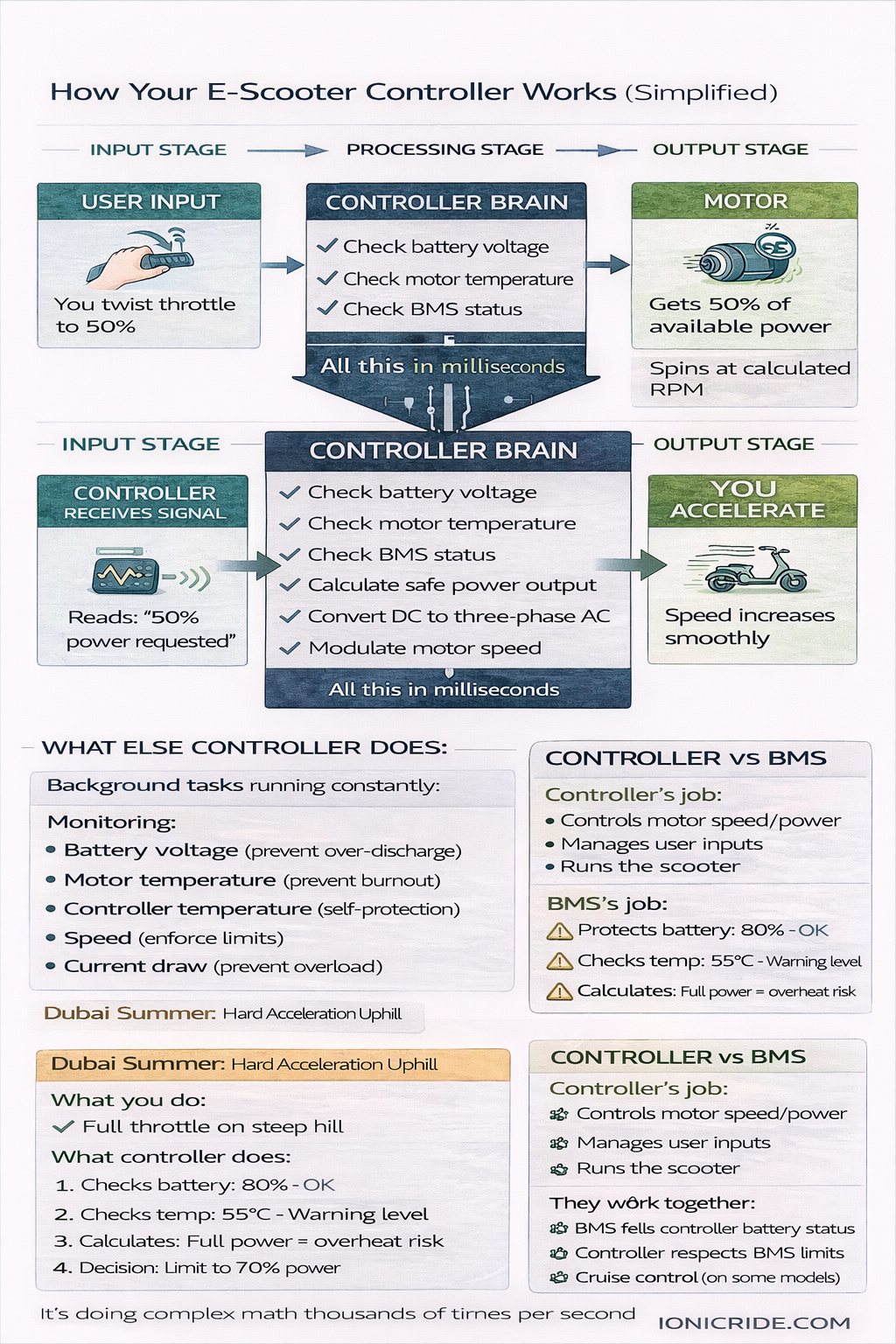
Your battery outputs constant voltage (e.g., 36V). Motor needs variable voltage (0-36V) for speed control.
Controller doesn’t actually vary voltage. Instead, it switches power ON and OFF super fast (1,000-20,000 times per second).
Example:
- 25% throttle: Controller ON for 25% of each cycle, OFF for 75% → Motor receives “effective” 9V (25% of 36V)
- 75% throttle: Controller ON for 75%, OFF for 25% → Motor receives “effective” 27V
Motor spins fast enough that ON/OFF pulses average out to smooth rotation. You don’t feel the switching.
Why this matters for Dubai: Switching generates heat. More switching = more heat. Dubai already hot = controller heat stress.
Why Controllers Fail in Dubai Heat
Controllers are the #2 most common electrical failure in Dubai (after BMS). Here’s why:
Problem 1: MOSFET thermal failure
- Controllers use MOSFETs (transistors) to do the rapid ON/OFF switching
- Every switch generates tiny amount of heat
- 20,000 switches per second × heat per switch = significant heat buildup
- MOSFETs rated for 100-125°C typically
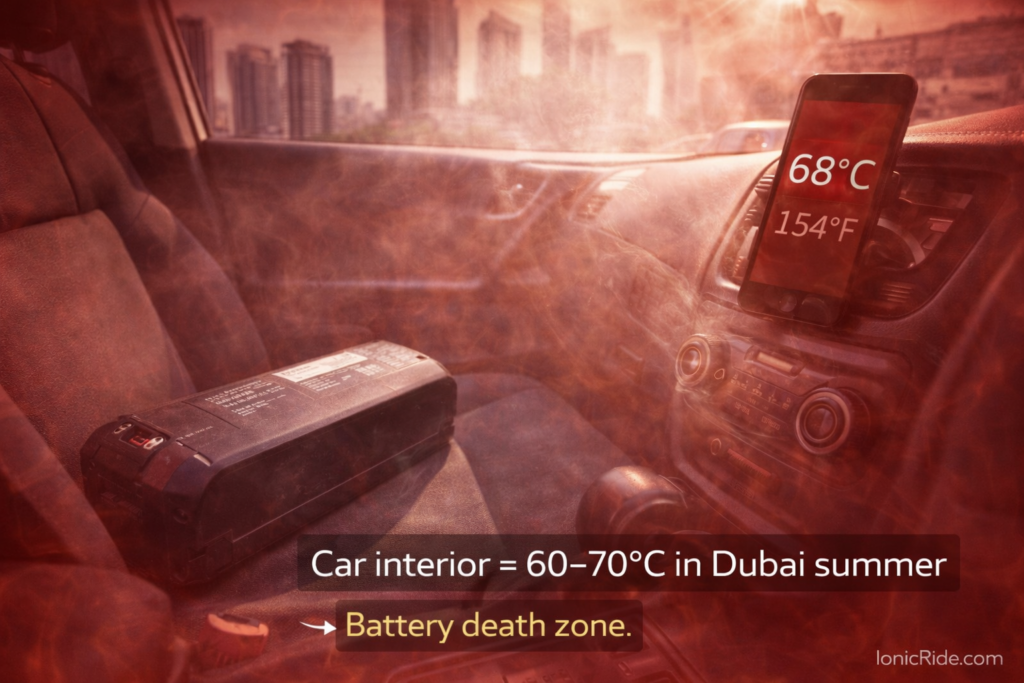
- Dubai ambient: 45°C + controller internal heat: 40-50°C = 85-95°C operating temp
- Running near max temp for months = MOSFET degradation and failure
Problem 2: Solder joint cracks
- Controller PCB has 50-100+ solder joints connecting components
- Dubai thermal cycling: 25°C night, 60-70°C in scooter deck during day riding
- PCB and components expand/contract at different rates
- Solder joints crack after 6-18 months of thermal stress
- Cracked solder = intermittent connection = erratic controller behavior
Problem 3: Capacitor failure
- Controllers use electrolytic capacitors to smooth power delivery
- These capacitors have liquid electrolyte inside
- Heat accelerates electrolyte evaporation
- Every 10°C above 25°C doubles evaporation rate
- Dubai average 35-40°C = 2-4x faster evaporation
- Dried capacitor = controller instability and failure
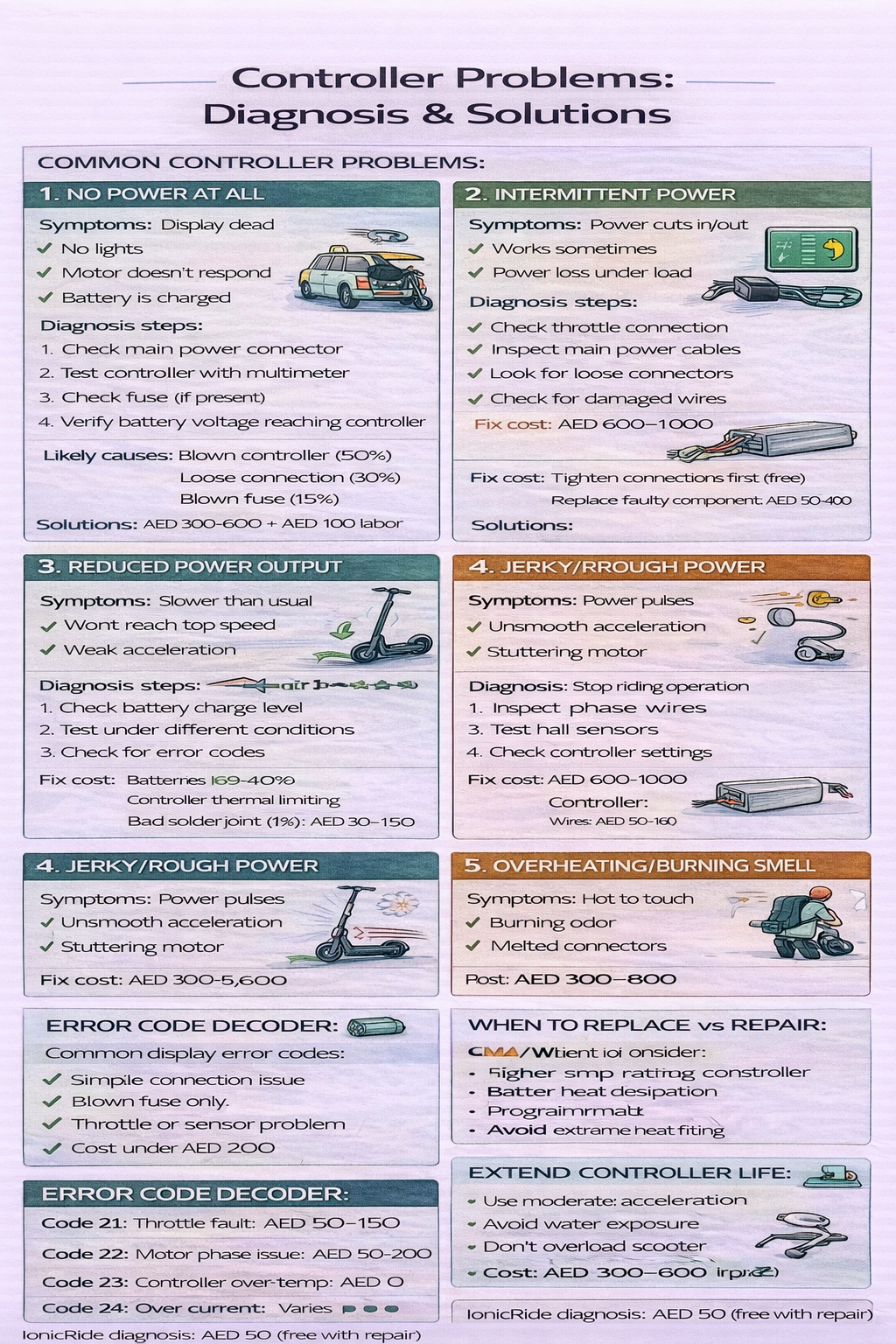
- Manufacturer claim: 3-5 years (based on temperate climate testing)
- Dubai reality (budget controller): 9-18 months before first failure
- Dubai reality (quality controller): 18-30 months
- Delivery riders (daily heavy use): 6-12 months
Controllers fail faster in Dubai than batteries. If you’re past 12 months, controller failure is more likely than battery issues.
Symptoms of Controller Failure
Controller failures have specific patterns different from motor or battery issues:
| Symptom | What’s Happening | Controller or Other? |
|---|---|---|
| Jerky acceleration (stuttering when you twist throttle) | MOSFETs not switching smoothly, intermittent power delivery | Controller (95% certain) |
| Power cuts out randomly during ride | Controller overheating protection or cracked solder joint | Controller or loose connection |
| Throttle works but scooter accelerates slowly | Controller in thermal protection mode, limiting power | Controller overheating |
| No response to throttle (display works fine) | Controller not processing throttle signal or power output dead | Controller or throttle sensor |
| Motor spins but won’t start moving scooter | Controller phase wires mixed up or one phase dead | Controller phase failure |
| E-brake doesn’t work (mechanical brake fine) | Regen braking circuit failed in controller | Controller |
| Speed modes don’t change anything | Mode switching logic failed in controller | Controller |
| Burning smell from deck area | Controller components overheating or burning | Controller (STOP RIDING) |
The Diagnostic Tests
Test 1: Throttle sensor check
- Disconnect throttle from controller
- Measure throttle voltage while twisting (should vary smoothly 0.8V to 4.2V typically)
- If throttle sensor works but scooter doesn’t respond, controller is problem
Test 2: Motor phase check
- Disconnect motor wires from controller
- Measure resistance between motor phases (should be equal, typically 0.1-1 ohm)
- If motor phases are fine but scooter doesn’t run, controller is problem
Test 3: Battery voltage check
- Measure battery voltage at controller input (should match battery voltage)
- If battery delivers correct voltage but motor doesn’t run, controller is problem
Don’t attempt these without electronics knowledge. Let shops diagnose. But knowing these tests exist prevents shops from lying about diagnosis.
Controller Failure Patterns by Scooter Brand
Xiaomi M365/Pro:
- Common failure: Phase wire solder joints crack (jerky acceleration symptom)
- Average lifespan Dubai: 15-20 months
- Replacement cost: 250-350 AED
Ninebot MAX:
- Common failure: Thermal shutdown (controller limits power to protect itself)
- Better heat tolerance than M365, but still fails in Dubai summers
- Average lifespan Dubai: 18-24 months
- Replacement cost: 350-450 AED
Budget Chinese brands:
- Common failure: Complete MOSFET burnout (no power at all)
- Cheap controllers, minimal heat protection
- Average lifespan Dubai: 6-12 months
- Replacement cost: 150-250 AED (if controller even available)
Premium brands (Dualtron, VSETT):
- Better quality MOSFETs, heat sinks, thermal management
- Still fail in Dubai but take longer
- Average lifespan Dubai: 24-36 months
- Replacement cost: 500-900 AED
Repair vs Replace: The Economics
Unlike BMS, controllers are harder to repair. But not impossible:
When controller repair is possible:
Repairable failures (~40% of cases):
- Cracked solder joints: Can be resoldered. 100-150 AED labor.
- Blown capacitors: Capacitors are cheap (5-10 AED). Labor: 80-120 AED.
- Single burned MOSFET: If only one MOSFET failed, can be replaced. MOSFET: 20-40 AED, labor: 150-200 AED.
Total repair cost: 150-300 AED depending on what failed
Not repairable (~60% of cases):
- Multiple MOSFETs burned: Replacing all MOSFETs costs more than new controller
- PCB trace damage: If circuit board copper traces burned, unrepairable
- Microcontroller chip dead: These chips aren’t sold separately, need whole controller
Replacement cost: 250-500 AED for new controller (varies by model)
Many shops won’t even attempt controller repair. They say “controllers can’t be repaired, need replacement” because:
- Replacement is faster (10 minutes vs 1-2 hours for repair)
- Higher profit margin on new controller sale
- Less liability (new controller has warranty, repaired one doesn’t)
Reality: About 40% of controller failures ARE repairable if you find skilled technician.
How to find repair shops: Look for independent electronics repair shops in Deira/Naif. Ask “can you repair controller, not just replace?” Shops that do phone/laptop repair often can do controller repair.
The Replacement Decision Tree
Should you replace controller or buy new scooter?
Replace controller if:
- Scooter under 18 months old: Rest of scooter still has life, worth fixing
- Replacement cost under 300 AED: Relatively cheap fix
- Battery still good (range hasn’t dropped): No other major failures imminent
Consider buying new scooter if:
- Controller replacement costs 400+ AED: Premium controllers expensive
- Scooter over 2 years old: Battery and other components likely degraded too
- Multiple previous repairs: Throwing good money after bad
The 50% rule: If controller replacement costs more than 50% of similar new scooter price, buy new instead.
Extending Controller Life in Dubai
You can’t prevent controller failure entirely, but you can delay it:
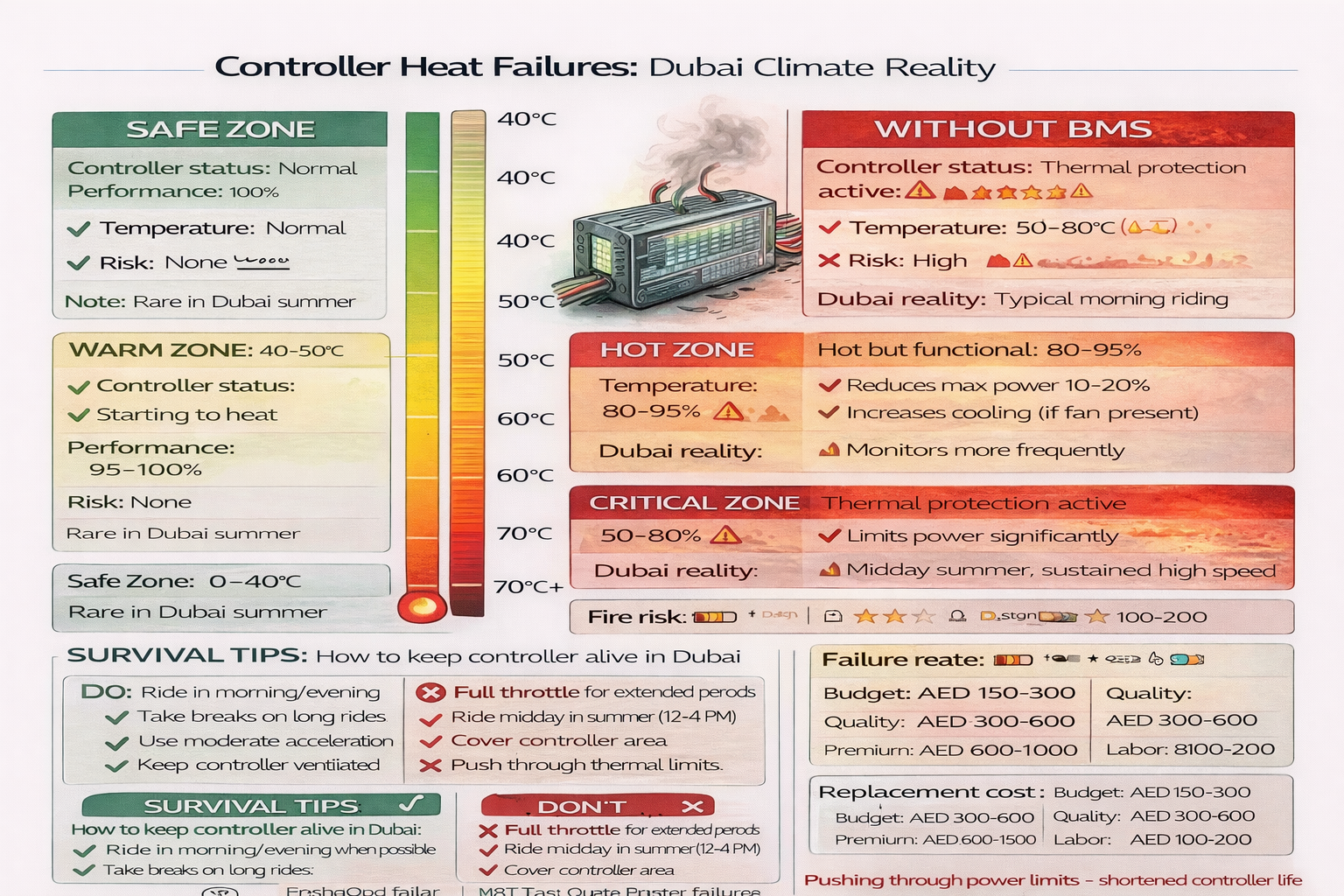
- Avoid sustained high-speed riding in summer: Cruising at max speed for 10+ minutes = maximum controller heat buildup. Ease off throttle occasionally to let controller cool.
- Don’t ride immediately after parking in sun: If scooter been in 45°C sun for hours, controller is already hot. Wait 10 minutes in shade before riding.
- Use lower power mode in summer: Eco mode = less current = less heat. Sport mode in summer accelerates controller wear.
- Coast when possible: Constant throttle input = constant controller work. Let momentum carry you when safe, reduces controller duty cycle.
- Smooth throttle inputs: Jerky on/off throttle makes controller work harder. Smooth acceleration reduces electrical stress.
What Doesn’t Help
- “Performance upgrades” that bypass limits: Flashing controller firmware to remove power limits = faster controller death in Dubai heat. Don’t do it.
- External cooling fans: Controller is sealed inside deck. External fan doesn’t reach it. Waste of money.
- Heat-reflective deck tape: Looks cool, doesn’t meaningfully reduce controller temperature. Save your 80 AED.
- “Heat-resistant” controllers: Some shops sell “upgraded” controllers claiming better heat tolerance. Often same controller with different label. Ask for temp rating specs.
The Upgrade Question
Can you upgrade to better controller when replacing?
Compatibility issues:
- Controller must match motor voltage (36V motor needs 36V controller)
- Controller must match motor type (hall sensor vs sensorless)
- Controller current rating must be appropriate (too high = burns motor, too low = underpowered)
- Connector types must match or be adapted
When upgrades make sense:
- Upgrading from budget controller to quality branded controller (Xiaomi, Ninebot OEM)
- Original controller constantly failing in Dubai (cheap design)
- Cost difference is small (50-100 AED more for better controller)
When NOT to upgrade:
- “Performance” controllers claiming +50% power = shortened motor life in Dubai heat
- Controllers requiring software modifications = voiding any warranties
- Generic Chinese controllers with no brand/support (even if cheaper)
DIY Controller Replacement: Should You Try It?
Difficulty: Medium. Requires basic tools and careful wire tracking, but not dangerous like battery work.
What you need:
- Replacement controller (exact model or confirmed compatible)
- Screwdriver set, wire cutters, electrical tape
- Camera or phone to photograph original wiring before disconnecting
- 1-2 hours time
Steps:
- Take photos of all wire connections (color coding varies)
- Label wires with tape if colors don’t match new controller
- Disconnect old controller (power off first!)
- Connect new controller following photos/labels
- Secure new controller in same location
- Test before reassembling deck
Cost savings: DIY: 250 AED (controller) vs shop: 250 AED (controller) + 100-150 AED (labor)
- Reversing battery polarity: Instant controller death. Check twice before powering on.
- Mixing up motor phase wires: Motor spins backward or makes noise but doesn’t move scooter. Swap any two phase wires to fix.
- Forgetting hall sensor wires: If motor has hall sensors, they MUST be connected. Without them, motor won’t start smoothly.
- Not securing controller properly: Loose controller vibrates, wires fatigue and break.
Controller vs Motor: Confusion
Shops sometimes confuse these for upselling:
Controller failure symptoms:
- Jerky, erratic behavior
- Works sometimes, not others (intermittent)
- Responds to mode changes weirdly
- Display and lights work fine
Motor failure symptoms:
- Grinding or clicking noise from wheel
- Consistent lack of power (not intermittent)
- Physical resistance when pushing scooter
- No noise from motor when throttle applied (completely silent)
Test: If shop says “motor problem,” ask them to disconnect motor and measure phase resistance. If all three phases measure similar resistance (typically 0.1-1 ohm), motor is fine and controller is the issue.
The Bottom Line on Controllers
Controllers are electronic components that hate Dubai heat. Accept they’ll fail faster here than manufacturer specs.
Key takeaways:
- Controller = power delivery brain: Converts your throttle input to motor power via rapid switching.
- Dubai heat = 12-24 month lifespan: Not the 3-5 years advertised. Budget for eventual replacement.
- 40% of failures repairable: Find electronics repair shop that does component-level work. 150-300 AED vs 250-500 AED replacement.
- Symptoms are specific: Jerky acceleration, random power cuts, throttle not responding = controller issues.
- DIY replacement possible: Unlike battery work, controller swap isn’t dangerous. Save 100-150 AED in labor.
- Smooth riding extends life: Avoid sustained max power in summer heat, use eco mode, smooth throttle inputs.
Next time your scooter jerks or cuts out, you’ll know: probably controller. And you’ll know whether shop’s 400 AED quote is fair or if you should find repair shop for 200 AED.
That knowledge alone might save you 200-300 AED over your scooter’s lifetime.