How Dubai Heat Affects E-Bike Batteries (And What You Can Do)
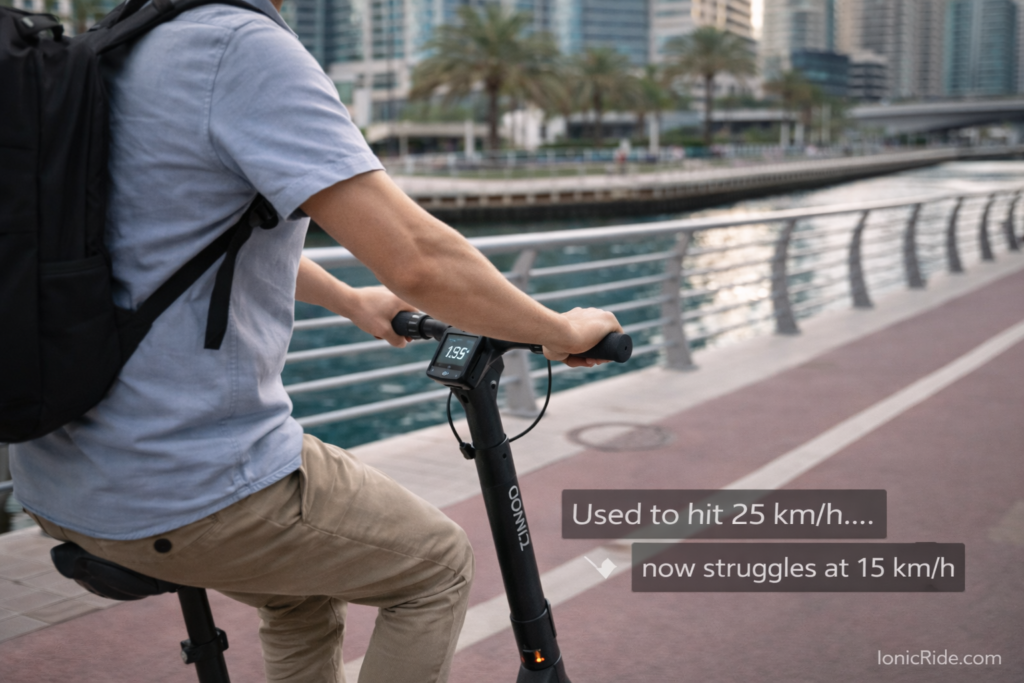
Last week, a customer brought in an e-bike battery. Eight months old. Barely used. Range dropped from 50km to maybe 20km on a good day.
“I don’t get it,” he said. “I charged it right. Never dropped it. What happened?” Soon, his battery wouldn’t charge at all.
I asked one question: “Where do you keep it?”
“In my car. Why?”
That’s why.
Heat doesn’t just reduce battery life — it kills it
Most people think battery degradation is about charge cycles. How many times you plug it in and unplug it.
That matters. But in the UAE, heat is the bigger problem.
Lithium-ion batteries — the kind in almost every e-bike — are sensitive to temperature. Not a little sensitive. Extremely sensitive.
For every 10°C above 25°C, the rate of battery degradation roughly doubles.
Dubai summer hits 45°C regularly. Inside a parked car? 60–70°C.
That’s not ideal operating conditions. That’s accelerated aging.
The battery doesn’t fail all at once. It just quietly loses capacity — month by month, ride by ride — until one day you realize it’s not giving you the range it used to.
And by then, the damage is done.
What actually happens inside the battery when it gets hot
I’m not going to hit you with a chemistry lecture. But understanding what’s happening helps you know why the fixes work.
The electrolyte breaks down faster, which is why proper battery care in hot climates is critical.
Inside your battery are lithium-ion cells. Each cell has an electrolyte — basically a liquid that lets ions move between the positive and negative sides.
Heat accelerates chemical reactions. When the electrolyte heats up repeatedly, it breaks down. Think of it like cooking oil that’s been reused too many times — it stops working as well.
Once that starts, the battery can’t hold as much charge. Capacity drops. Range drops.
Internal resistance increases
As the battery degrades, it gets harder for current to flow through it. That’s internal resistance.
Higher resistance means the battery works harder to deliver the same power. It heats up more under load. Which causes more degradation. Which increases resistance further.
It’s a feedback loop. And heat kicks it off.
The BMS gets more protective
Your battery has a BMS — Battery Management System. Its job is to protect the cells from damage.
When it detects high temperatures, it throttles performance. Reduces current. Cuts off charging early. All to keep the cells from dying completely.
That’s why a hot battery might show 80% charge but feel weak. The BMS isn’t lying to you — it’s protecting what’s left.
How bad is it in Dubai specifically?
Let me give you real-world numbers from batteries I’ve tested in the shop.
Battery stored at 25°C (ideal conditions):
After 1 year: ~95% of original capacity remaining
Battery stored at 35°C (typical UAE indoor temp without AC):
After 1 year: ~85% of original capacity remaining
Battery stored at 45°C+ (car interior, direct sun, outdoor storage):
After 1 year: ~65–70% of original capacity remaining
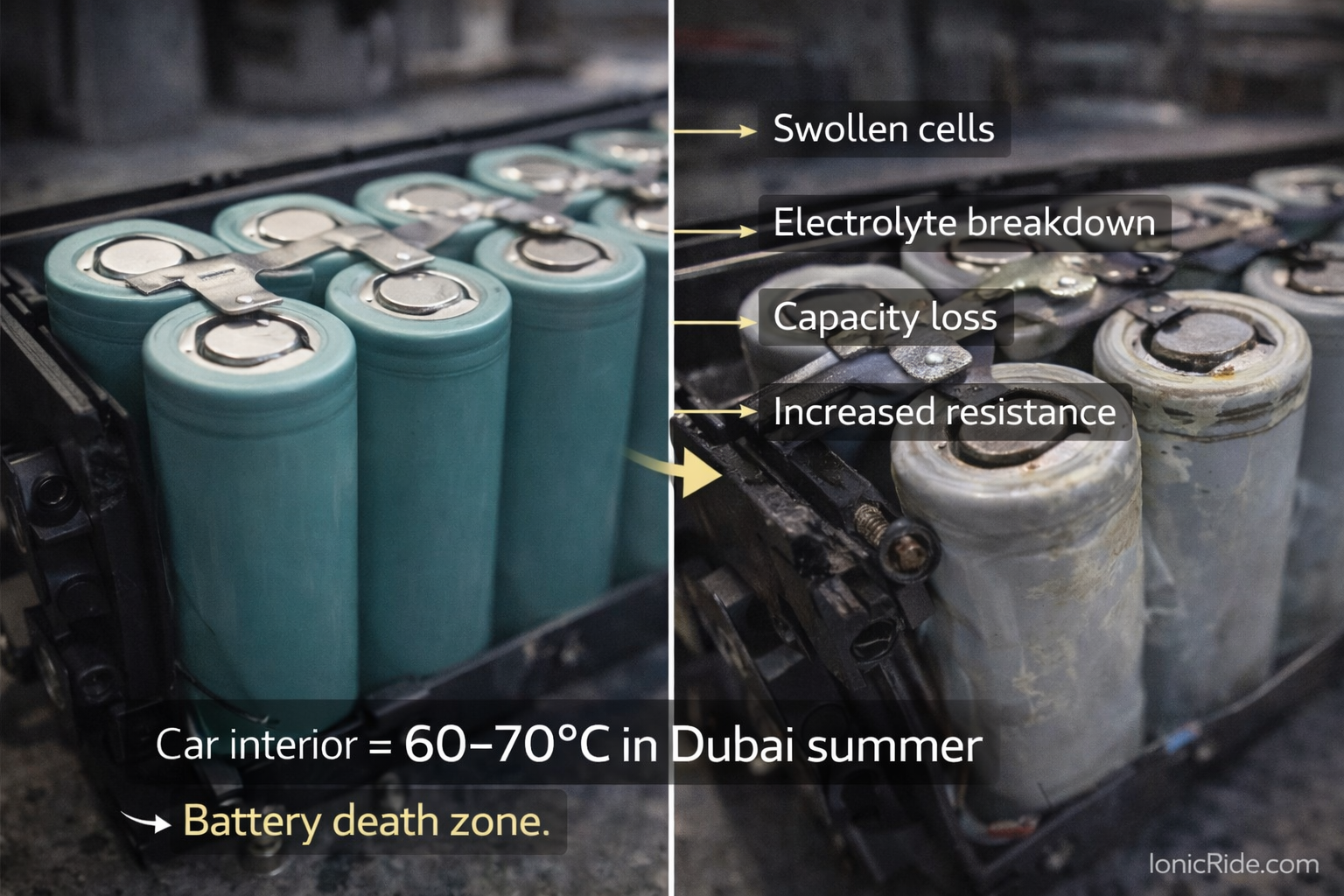
That last one? That’s the customer I mentioned at the start. His battery wasn’t defective. It was cooked.
Charging in the heat makes it worse
Here’s what most people don’t realize: charging generates heat.
If you plug in your battery right after a ride in 45°C weather, you’re asking it to handle two heat sources at once — the ambient temperature and the heat from charging.
The BMS will slow the charge to protect the cells. But if you do this repeatedly, you’re still accelerating degradation.
I’ve seen batteries that were charged outside in summer lose 20–30% capacity in six months. Not from heavy use. From heat stress during charging.
What you can actually do about it
You can’t control the weather. But you can control where and how you store and charge your battery.
Never leave the battery in your car
I can’t say this enough. Car interiors in Dubai summer hit 60–70°C easily. Even with windows cracked.
If you’re running errands, take the battery inside with you. Yes, it’s annoying. Yes, it’s heavy. But replacing a dead battery is more annoying and more expensive.
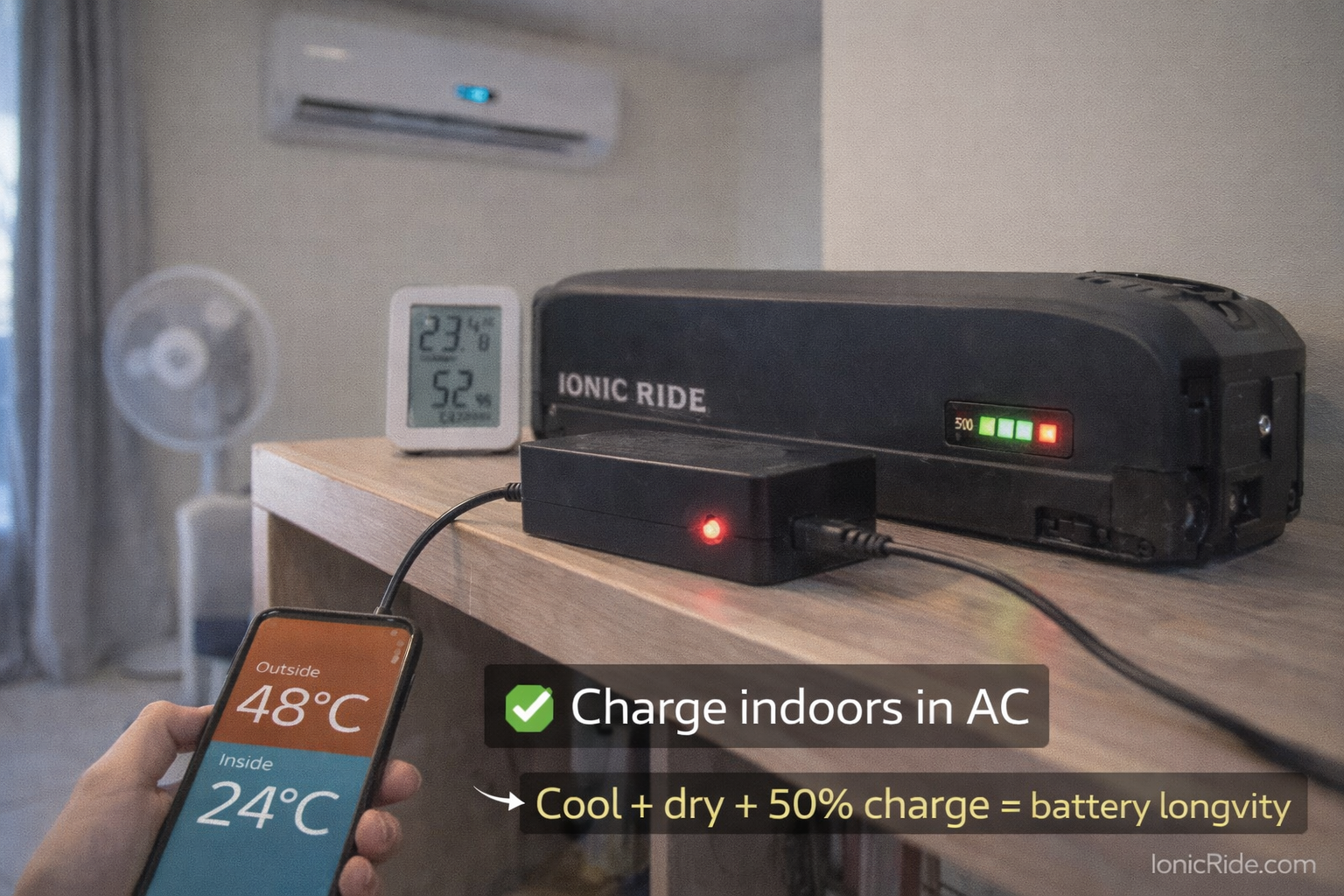
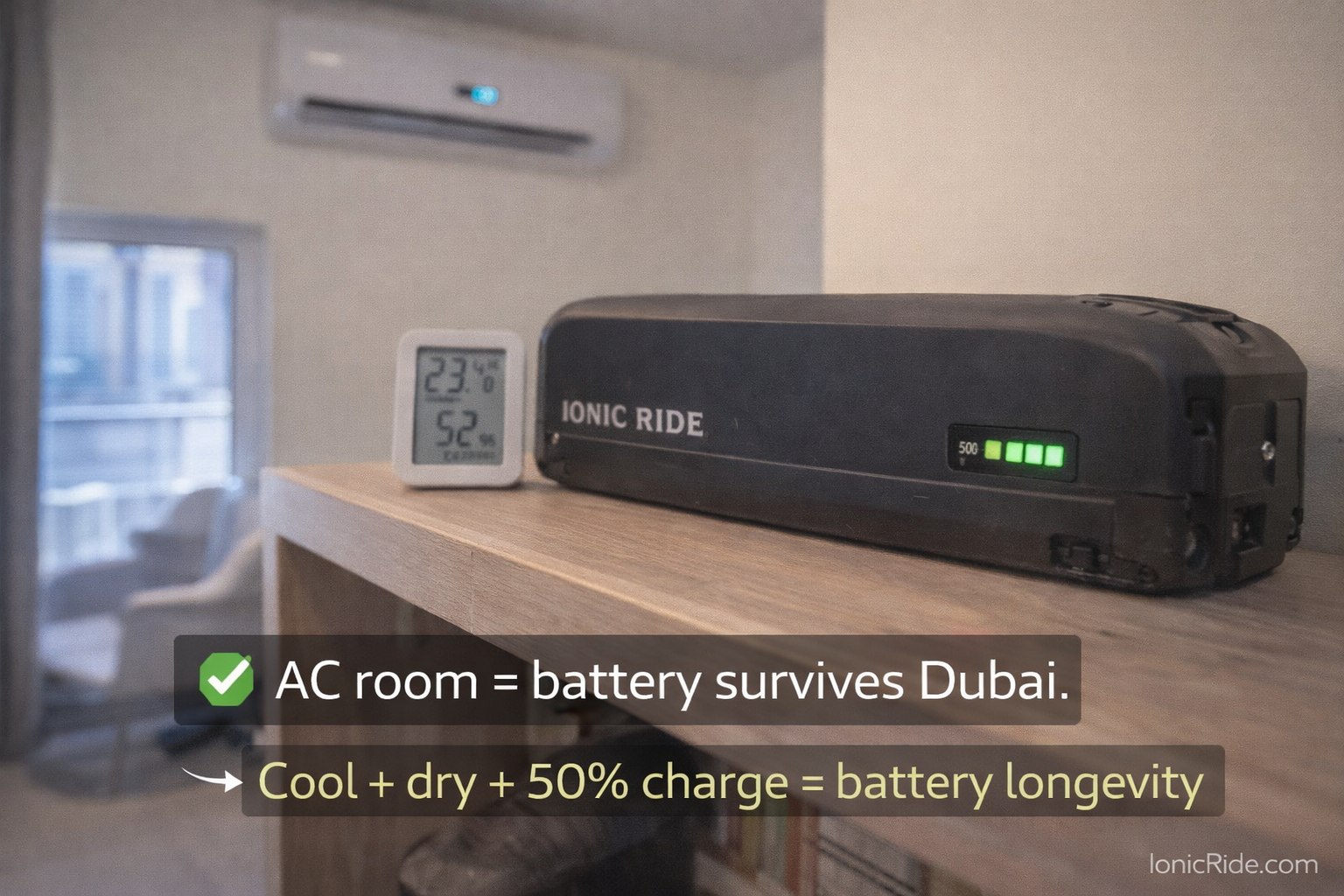
Charge indoors, in AC if possible
If you’ve got air conditioning, charge the battery in a cool room. 20–25°C is ideal.
If you don’t have AC, charge at night when it’s cooler. The difference between 30°C and 40°C is significant for battery health.
If your battery feels hot after a ride, let it cool down for 20–30 minutes before plugging it in. Touch it with your hand — if it’s warm to the touch, wait.
Store the battery indoors when not in use
Don’t leave your e-bike in the garage or on the balcony with the battery attached.
Remove the battery and store it inside. Even if your apartment gets warm, it’s still cooler than outside or in a garage with no ventilation.
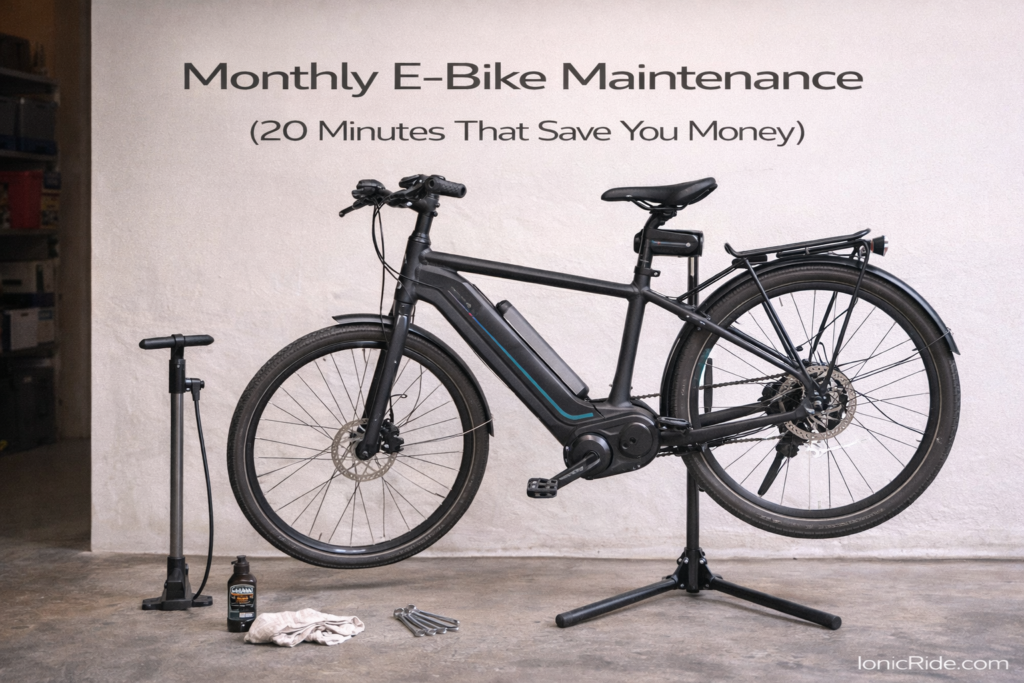
Keep it at 50–60% charge for long-term storage – part of essential monthly e-bike maintenance.
If you’re not using the bike for a few weeks, don’t store the battery fully charged or fully dead.
Lithium-ion batteries are happiest around 50–60% charge when sitting idle. Check it once a month and top it up if it’s dropped below 40%.
Never let a lithium-ion battery sit completely dead for weeks. The BMS might lock it out permanently, and you’ll need a shop to revive it — if it’s even possible.
Avoid fast charging in summer if you can
Fast chargers push more current into the battery, which generates more heat.
If you’ve got time, use the standard charger. It’s slower, but it’s gentler on the cells — especially in hot weather.
Can you reverse heat damage?
No.
Once capacity is lost, it’s gone. You can’t bring it back.
What you can do is stop further damage. If your battery’s down to 70% capacity, you can keep it there by following the storage and charging tips above. But you’re not getting that 30% back.
That’s why prevention matters. The earlier you start protecting your battery from heat, the longer it’ll last.
How long should an e-bike battery last in Dubai?
It depends on how you treat it.
Worst case (no heat protection, charged outside, stored in car): 1–2 years before noticeable degradation.
Average case (some care, mostly stored indoors, occasional heat exposure): 2–3 years before you’re thinking about a replacement.
Best case (AC-charged, indoor storage, minimal heat exposure): 4–5 years, sometimes longer.
That’s a big range. And it’s all about heat management.
One more thing: Your warranty probably doesn’t cover this
Most e-bike battery warranties exclude “environmental damage.”
That includes heat exposure, even if you live in a place where heat is unavoidable.
If your battery dies in 18 months because you stored it in your car, don’t expect the manufacturer to replace it for free. They’ll test it, see the heat degradation, and deny the claim.
I’ve had to deliver that news to customers more than once. It’s not fun.
So treat heat protection like insurance. You won’t regret it.
Bottom line
Dubai heat will kill your e-bike battery faster than anything else you do to it.
You can’t avoid the weather. But you can avoid leaving your battery in a hot car, charging it in direct sun, or storing it on a balcony in summer.
Do those things, and your battery will last years. Ignore them, and you’ll be shopping for a replacement a lot sooner than you thought.