Can You Ride E-Bikes on Dubai’s Cycle Paths? (Official Rules 2026)
Can You Ride E-Bikes on Dubai’s Cycle Paths? (Official Rules 2025)
Customer asked me this yesterday: “I just bought an e-bike. Can I ride it on the Marina cycle path, or will I get fined?”
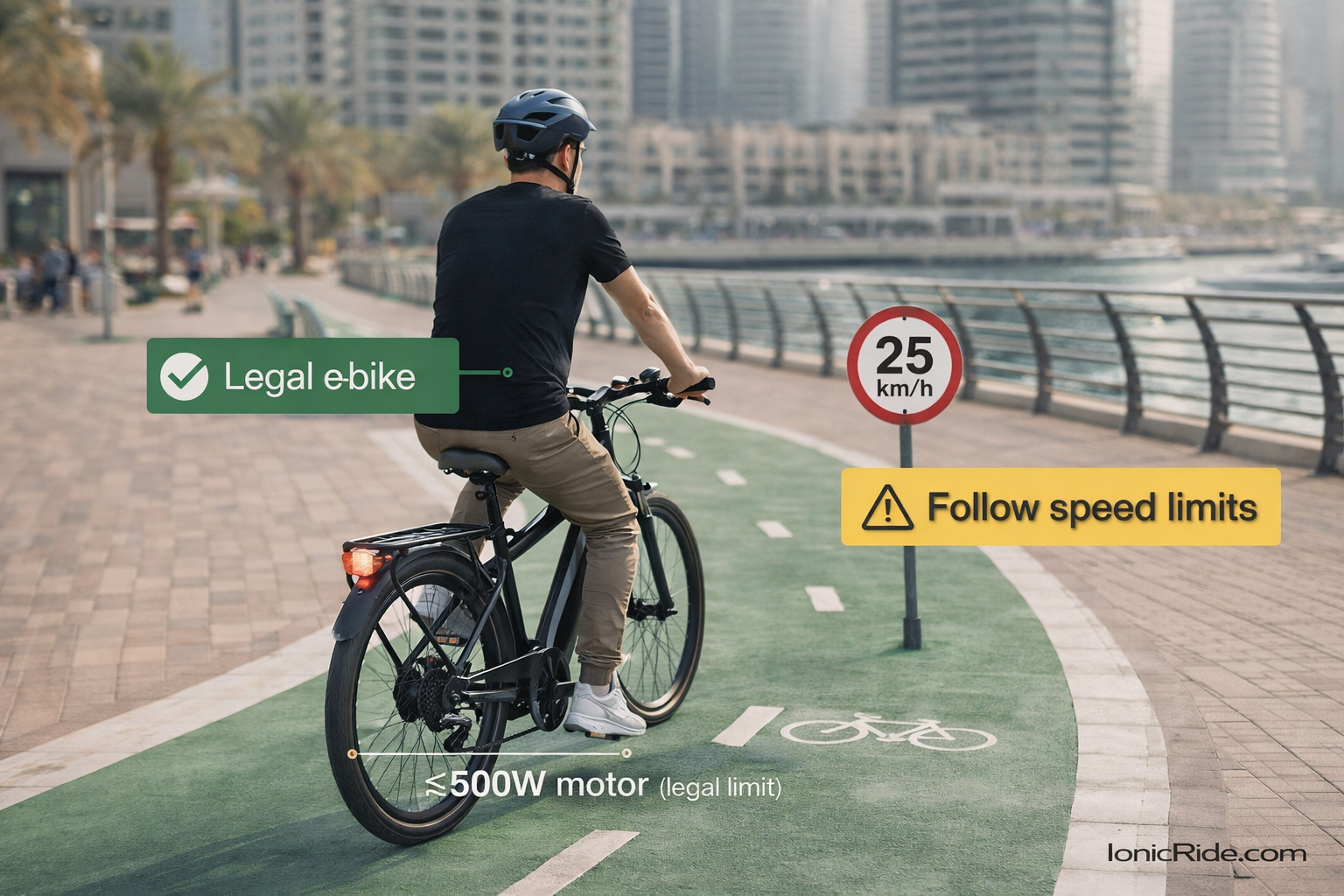
Short answer: Yes, you can — but only if your e-bike meets RTA requirements and you follow the rules.
Long answer: E-bikes are allowed on most cycle paths in Dubai, but there are specific rules about speed, motor power, and where you can actually ride. Some paths welcome e-bikes. Others don’t.
Here’s what you need to know before you ride.
Yes, e-bikes are allowed on Dubai cycle paths — with conditions
E-bikes aren’t banned from cycle paths in Dubai. The RTA explicitly permits them on designated cycling infrastructure.
But — and this is important — not all e-bikes qualify, and not all cycle paths allow them without restrictions.
The rules exist to keep speeds reasonable on shared paths and to separate e-bikes from pedestrians and faster vehicle traffic.
Let’s break down what’s actually allowed.
What counts as a legal e-bike in Dubai?
Before we talk about where you can ride, let’s clarify what the RTA considers a legal e-bike.
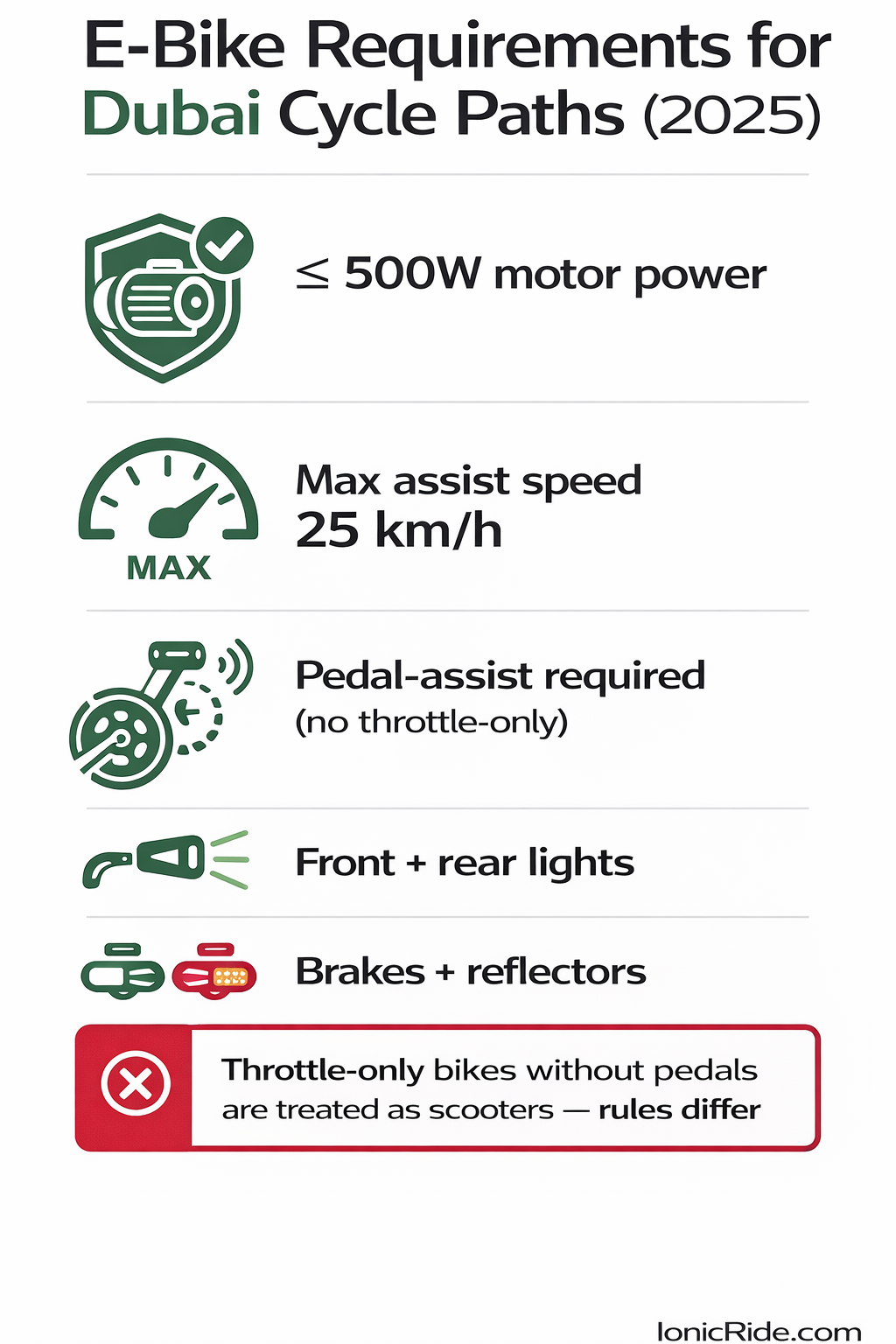
- Motor assist cutoff: Must not provide power above 25 km/h (some sources say 20 km/h on shared paths — enforcement varies)
- Age requirement: Rider must be 16+ years old
- Helmet: Mandatory at all times
- Lights: Front white light and rear red light required for riding after dark or in low visibility
- Permit: Free RTA e-bike permit required if you don’t hold a valid UAE or international driving license
- Registration: Not required for standard e-bikes under 25 km/h assist cutoff
Notice there’s no specific motor wattage limit listed by the RTA. That’s deliberate. Unlike Europe (which caps motors at 250W) or the US (which caps at 750W), Dubai focuses on speed, not motor power.
So a 250W, 500W, or even 750W motor is fine — as long as the controller cuts assist at 25 km/h.
Most e-bikes sold in the UAE are already compliant. But if you’ve imported a bike or modified the controller to remove the speed limiter, you’re technically riding an illegal vehicle. (More on that later.)
Where you CAN ride an e-bike in Dubai
These are the places where e-bikes are explicitly allowed and commonly seen:
Dedicated cycle tracks
If there’s a dedicated cycle track — separated from pedestrians and vehicles, usually marked with painted lines or a physical barrier — you’re good to ride your e-bike there.
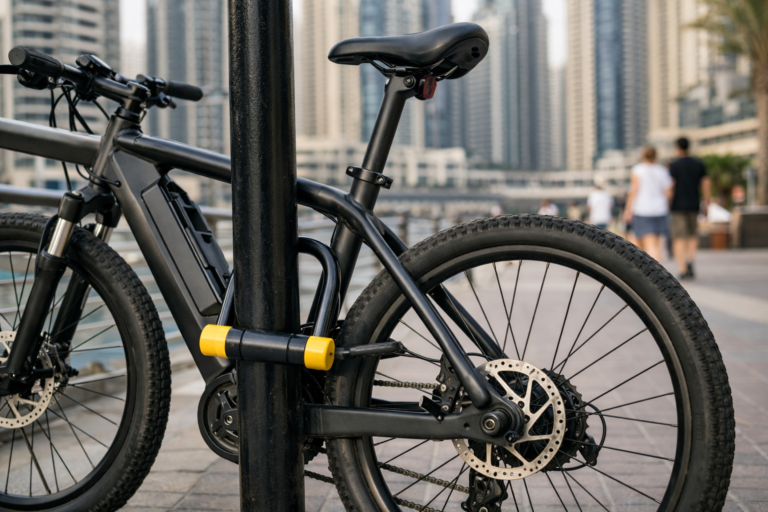
Examples: Dubai Marina promenade, JBR beachfront, Jumeirah Beach Road cycle lane, Nad Al Sheba Cycle Park. When parking at these locations, make sure to lock your e-bike properly.
These are your safest and clearest options. The RTA built these tracks specifically for bikes and e-bikes.
External training tracks (Al Qudra, Seih Al Salam, Nad Al Sheba)
The big desert tracks like Al Qudra are perfect for e-bikes. In fact, they’re some of the best places to ride in Dubai.
Al Qudra Cycle Track has 86 km of paved paths through the desert. E-bikes are allowed. Speed limits are more relaxed here — the RTA says “external training tracks remain without speed limit, but cyclists must abide by safety instructions.”
That doesn’t mean you can go 60 km/h. Your e-bike’s motor will still cut out at 25 km/h. But enforcement is lighter out here compared to urban paths.
(Fun fact: Al Qudra is where you’ll see serious cyclists doing 50 km loops at sunrise. If you’re new to e-bikes, stick to the shorter 18 km route first. The desert is beautiful, but it’s also *hot*.)
Shared paths (vehicles + bikes + e-scooters)
Some roads in Dubai have shared paths where vehicles, bikes, and e-scooters coexist. These are marked with specific RTA signage — usually a sign showing a car, bike, and scooter together.
Speed limit on shared paths: 30 km/h for bikes and e-bikes.
Examples: Parts of Al Sufouh Road, some residential areas in Dubai Hills and Business Bay.
These are less common than dedicated cycle tracks, but they’re legal for e-bikes.
Residential communities and private property
If you live in a gated community — Arabian Ranches, The Springs, Dubai Marina residential areas — you can usually ride your e-bike within the community.
But that’s up to the community management, not the RTA. Some allow it. Some don’t. Check with your building or security.
If you’re not sure whether a path allows e-bikes, look for RTA signage. There are specific signs for “bicycle and e-scooter shared path” and “bicycle only.” If you see the shared path sign, you’re clear. If you see “bicycle only” with no e-scooter icon, technically e-bikes might be restricted — but enforcement is rare.
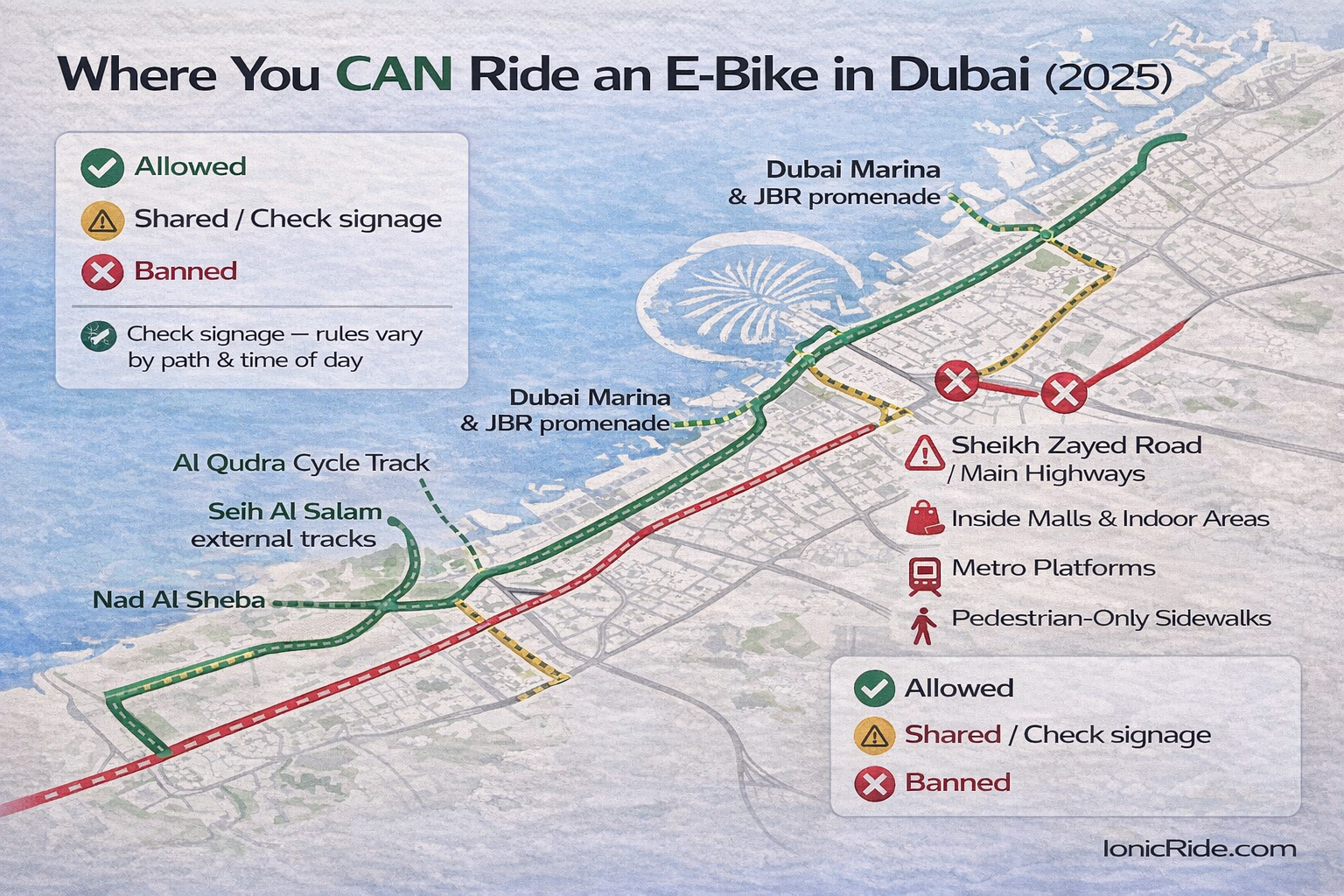
Where you CANNOT ride an e-bike in Dubai
This is where people get into trouble.
Main roads and highways
You cannot ride an e-bike on Sheikh Zayed Road, Al Khail Road, or any road with a speed limit above 60 km/h.
This should be obvious.” No. It’s illegal and extremely dangerous.
Roads without cycling infrastructure (gray area)
If you’re on a regular street with no bike lane — just cars and sidewalks — you’re not supposed to ride an e-bike there.
The rule is: e-bikes must use cycling infrastructure. If there’s no cycle track, you’re supposed to walk the bike or use another route.
Do people ride e-bikes on neighborhood streets without bike lanes anyway? Yes. Do they always get stopped? No. But if a police officer sees you, they *can* fine you. Whether they do depends on the area, time of day, and how you’re riding.
If you’re riding cautiously in a quiet residential area, you’ll probably be fine. If you’re weaving through traffic on a busy road, you’re asking for trouble.
Most sidewalks and pedestrian-only paths
Sidewalks are for pedestrians. E-bikes are supposed to use bike lanes, not sidewalks.
That said — enforcement on sidewalks is inconsistent. In busy areas like JBR or Dubai Mall walkways, riding on the sidewalk is more likely to get you stopped. In quieter residential streets, less so.
But the official rule is: don’t ride on sidewalks unless there’s a clearly marked shared pedestrian/cycle path.
Fine for riding on pedestrian-only paths: AED 200.
Inside malls and indoor public spaces
You can’t ride inside Dubai Mall, Mall of the Emirates, or any other shopping center. Some malls won’t even let you bring the e-bike inside.
This varies by mall. Dubai Mall is strict. Smaller neighborhood malls are more relaxed. But assume you can’t ride indoors unless you see others doing it.
Speed limits on cycle paths — what the RTA actually says
This is where it gets slightly confusing, because speed limits vary by location.
- Most dedicated cycle paths: 20-25 km/h (varies by path)
- Shared paths with vehicles: 30 km/h
- External tracks (Al Qudra, Seih Al Salam): No enforced speed limit, but e-bike assist still cuts at 25 km/h
The key thing to understand: your e-bike’s motor assist will cut out at 25 km/h by design (if it’s a legal, unmodified bike). So even if the path technically allows 30 km/h, your motor won’t help you go faster than 25 km/h.
You *can* pedal faster than 25 km/h — the motor just stops assisting. On flat ground or downhill, you might hit 30-35 km/h on your own power. That’s fine.
But if your e-bike has been modified to provide assist above 25 km/h, you’re riding an illegal vehicle in Dubai. And if you get stopped, you’ll have a problem.
Specific cycle paths and their e-bike rules
Let’s get practical. Here’s what we know about the most popular cycle paths in Dubai:
Al Qudra Cycle Track
E-bikes allowed: Yes
Speed limit: None enforced (motor still cuts at 25 km/h)
Notes: Best place for e-bikes in Dubai. 86 km of paved desert paths. Bring water.
Dubai Marina / JBR Promenade
E-bikes allowed: Yes
Speed limit: 20-25 km/h
Notes: Shared with pedestrians in some sections. Ride cautiously, especially evenings.
Jumeirah Beach Road
E-bikes allowed: Yes
Speed limit: 20-25 km/h
Notes: Dedicated cycle lane. Great for commuting. Watch for pedestrians crossing.
Nad Al Sheba Cycle Park
E-bikes allowed: Yes
Speed limit: 20-25 km/h
Notes: Well-lit track, good for evening rides. Popular with families.
Business Bay / Dubai Water Canal
E-bikes allowed: Yes (on marked paths)
Speed limit: 20-25 km/h
Notes: Some sections unclear — look for signage. Tolerated so far.
Al Sufouh to Dubai Hills Track
E-bikes allowed: Yes
Speed limit: 30 km/h (shared with vehicles in some sections)
Notes: New 13.5 km track with bridges over SZR and Al Khail Road. Part of RTA’s 1,000 km plan.
Do you need a permit to ride an e-bike in Dubai?
It depends whether you have a driving license.
If you hold a valid UAE or international driving license: No permit needed. You’re good to ride.
The permit process is simple. Go to the RTA website, fill out the application, complete a short online safety course (covers traffic rules and e-bike operation), and you’re done. No fee. No test. Just watch the videos and answer a few questions.
This applies whether you’re a UAE resident or a tourist. If you’re visiting Dubai and plan to ride an e-bike, get the permit before you ride.
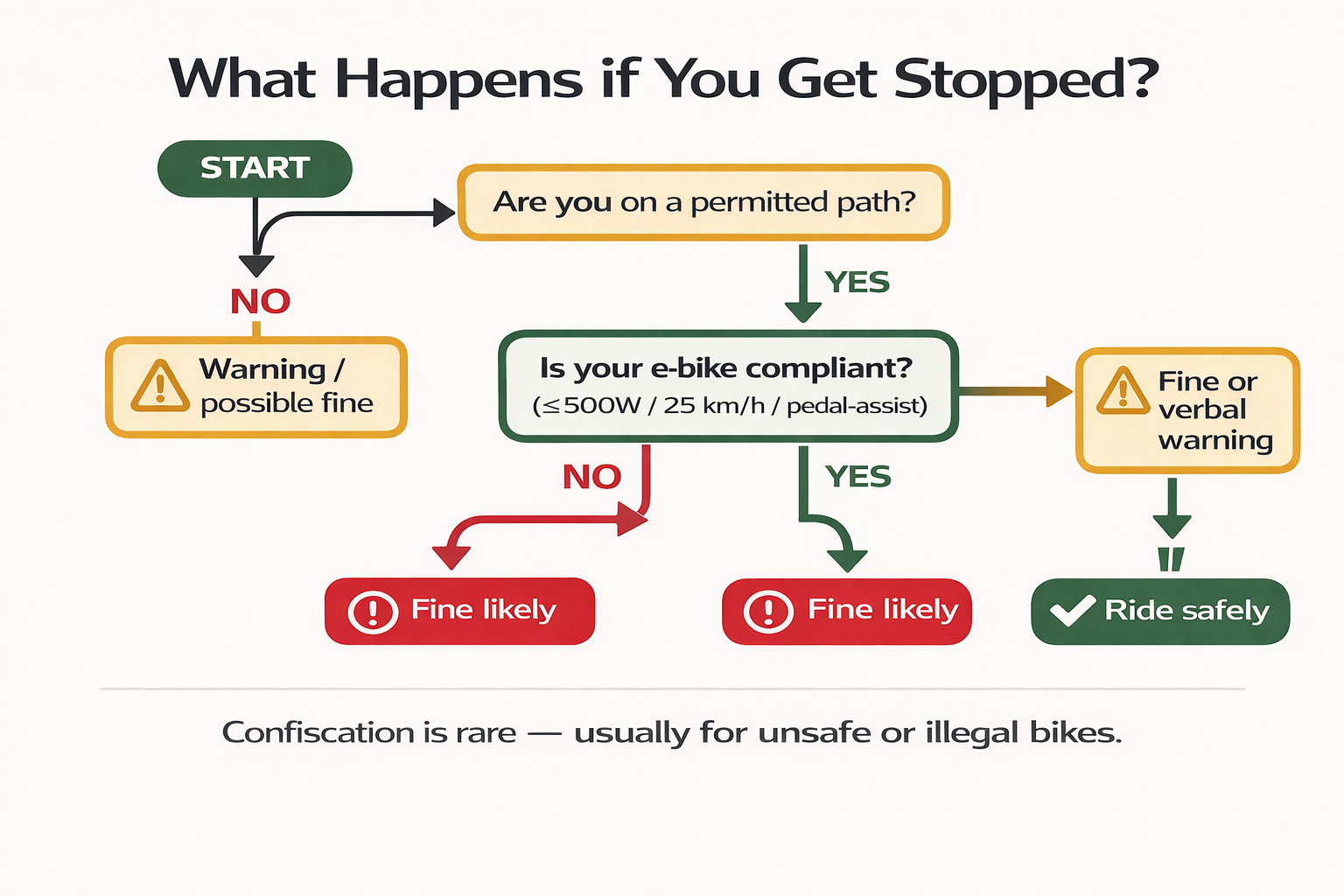
What happens if you get stopped?
If you’re riding in a permitted area, following the rules, wearing a helmet, and your e-bike is legal — you won’t have a problem.
But if you’re riding somewhere you shouldn’t, or your bike doesn’t meet RTA requirements, here’s what can happen:
Scenario 1: Warning
If you’re in a borderline area — neighborhood street, not causing problems, riding safely — the officer might just tell you to walk the bike to a permitted area or go home.
No fine. Just a warning. This is common in less busy areas.
Scenario 2: Fine
If you’re riding on a main road, in a prohibited area, or without a helmet, you’ll get fined.
Common fines:
- Riding in a prohibited area: AED 200-300
- Riding on a pedestrian-only path: AED 200
- No helmet: AED 200
- Riding without a permit (if required): AED 200
- Carrying a passenger (unless bike is designed for two): AED 200
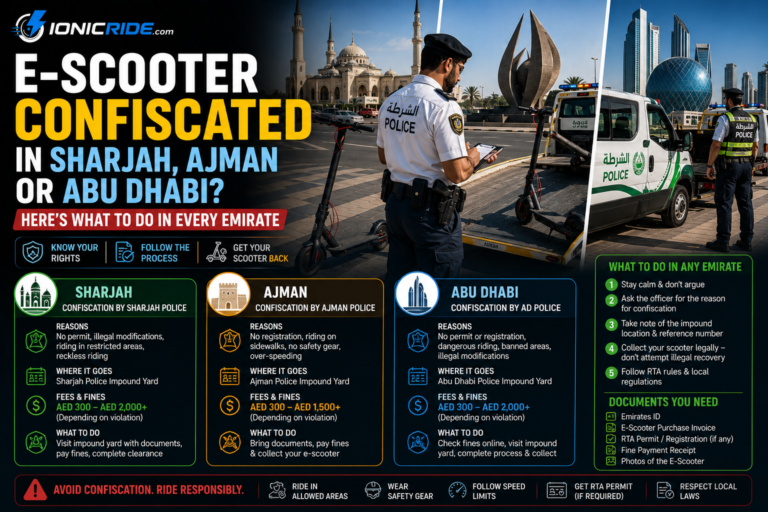
Scenario 3: Confiscation (rare)
In extreme cases — riding on a highway, repeated violations, modified bike doing 50 km/h on a pedestrian path — the police can confiscate the e-bike.
You’ll have to go to a police station to retrieve it, pay fines, and possibly sign paperwork saying you won’t do it again.
This is rare. But it happens.
If you cause an accident while riding in a prohibited area or on an illegal bike, you could be held liable for damages. Insurance typically doesn’t cover e-bike accidents on public roads, so any medical or property damage costs fall on you.
What about modified e-bikes?
Some people buy e-bikes and then modify them to go faster — removing the speed limiter, upgrading the controller, adding more battery voltage.
I get why. 25 km/h feels slow if you’re used to riding a motorcycle or if you’re trying to keep up with traffic.
But here’s the problem: a modified e-bike that provides assist above 25 km/h is no longer classified as an e-bike in Dubai. It’s closer to an electric motorcycle, which requires registration, a license plate, and insurance.
If you’re stopped on a modified bike, the officer can:
- Fine you for riding an unregistered motor vehicle
- Confiscate the bike
- Require you to register it as a motorcycle (which means you’d need a motorcycle license and insurance)
Is it worth it? Not really. If you want more speed, buy a proper electric motorcycle and register it legally.
(Or just accept that 25 km/h is fast enough for cycle paths. It’s not a race. Unless you’re on Al Qudra at 6 AM, in which case… yeah, it’s kind of a race.)
Can you realistically commute on an e-bike in Dubai?
If your commute involves cycle tracks or well-connected paths, yes. E-bikes work great for short-to-medium distances.
Examples of realistic e-bike commutes:
- If you’re choosing an e-bike for commuting, see our budget recommendations under 3,000 AED. (via promenade)
- Jumeirah Beach Road corridor (if you live and work along the cycle lane)
- Within Business Bay (internal roads and canal paths)
- Around Downtown Dubai (if staying on cycle infrastructure)
- Within large residential communities
Examples of *not* realistic e-bike commutes:
- Deira ↔ Bur Dubai (no safe cycle route across)
- Sharjah → Dubai (would require riding on highways or roads without bike lanes)
- Any route that requires crossing Sheikh Zayed Road without a bridge
- Long distances (15+ km) on roads without cycling infrastructure
The rule of thumb: if your route has dedicated bike lanes or tracks for 80%+ of the distance, an e-bike works. If you’d be riding on main roads with no bike lane for more than a few kilometers, it’s not practical — or legal. RTA official cycling path rules Dubai
Will the rules get stricter or more relaxed?
The RTA is expanding cycling infrastructure. The goal is 1,000 km of cycle tracks by 2030 (currently at ~560 km as of 2025).
As the network grows, e-bikes will become more practical for commuting. More routes will be safe and legal.
But I expect enforcement to get *stricter* in certain areas — especially on pedestrian paths and in crowded zones like Dubai Marina.map of all 21 legal e-scooter zones in Dubai
Dubai seized 656 e-scooters in 2024 for violations. E-bikes weren’t the primary target, but it shows the RTA is paying attention to micromobility enforcement.
My guess? Over the next few years:
- More cycle tracks will be built, making e-bikes more viable
- Speed limits on shared paths might drop to 20 km/h everywhere (currently varies)
- Enforcement will tighten on modified bikes and riding in prohibited areas
- Registration *might* eventually be required for e-bikes (like it is for e-scooters in some emirates), but that’s speculation
For now, the rules are clear enough. Follow them, and you’ll be fine.
So — should you ride an e-bike on Dubai’s cycle paths?
If you live near cycle tracks, yes. E-bikes are a great way to get around parts of Dubai without sitting in traffic.
If your routes require main roads with no bike lanes, probably not. You’ll spend more time walking the bike or risking fines than actually riding.
The infrastructure is growing. In a few years, e-bike commuting in Dubai will be a lot more practical. For now, stick to the areas where cycling infrastructure exists, follow the rules, and you’ll have a good experience.
Just don’t try to cross Sheikh Zayed Road. I’ve seen some things.