E-Bike Conversion Kits UAE: Are They Legal? (RTA Rules + Cost Breakdown 2026)
E-Bike Conversion Kits UAE: Are They Legal? (RTA Rules + Cost Breakdown 2026)
You have a regular bike sitting in your garage. Someone tells you: “Just add a motor kit for 1,200 AED and boom—e-bike.”
Sounds cheaper than buying a new e-bike for 3,000+ AED, right?
But then the questions start: Is this legal in Dubai? Will RTA fine me? Does it actually save money? And will it blow up my bike?
Here’s the truth about conversion kits in UAE—including the legal gray zone nobody talks about.
What Actually Is an E-Bike Conversion Kit?
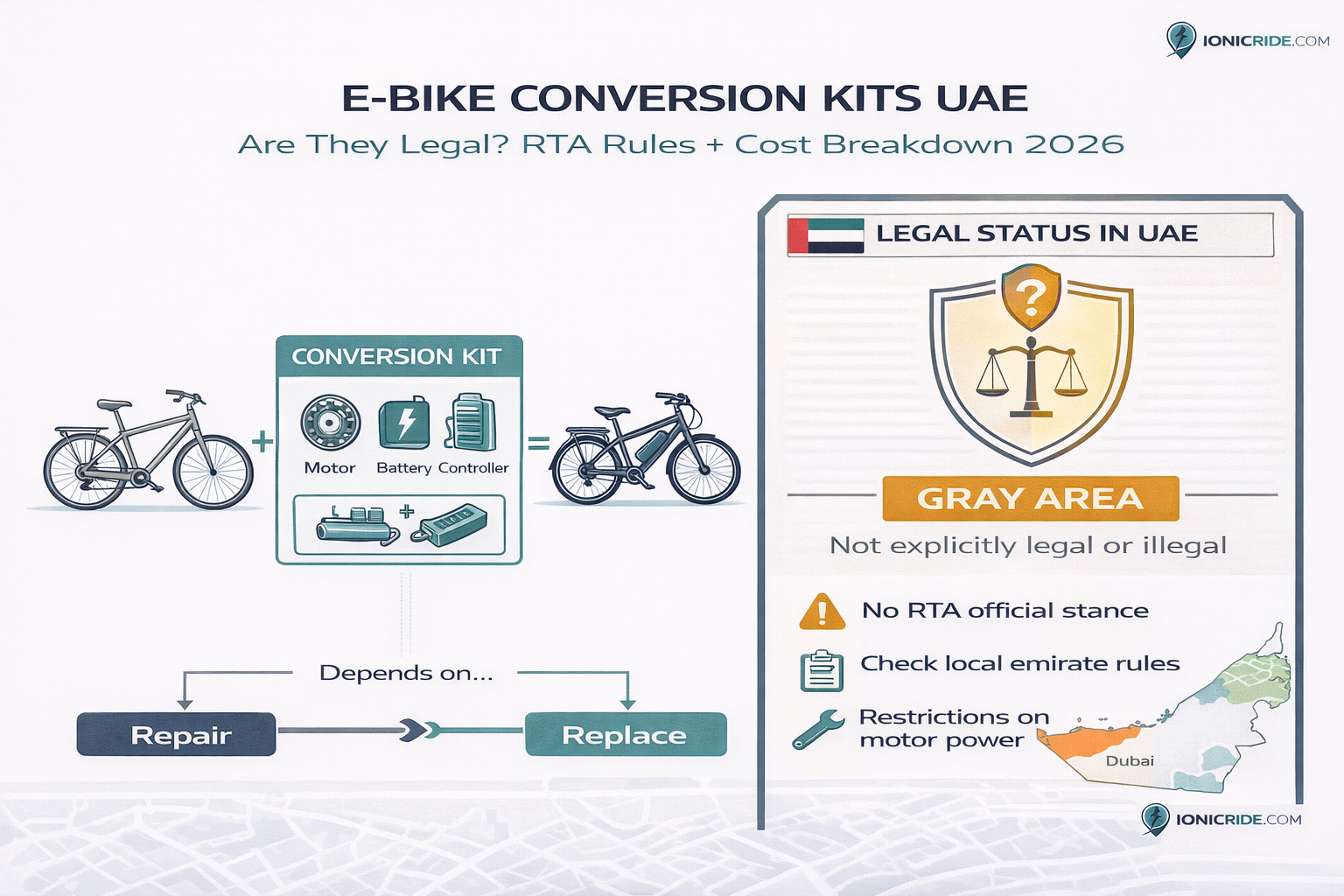
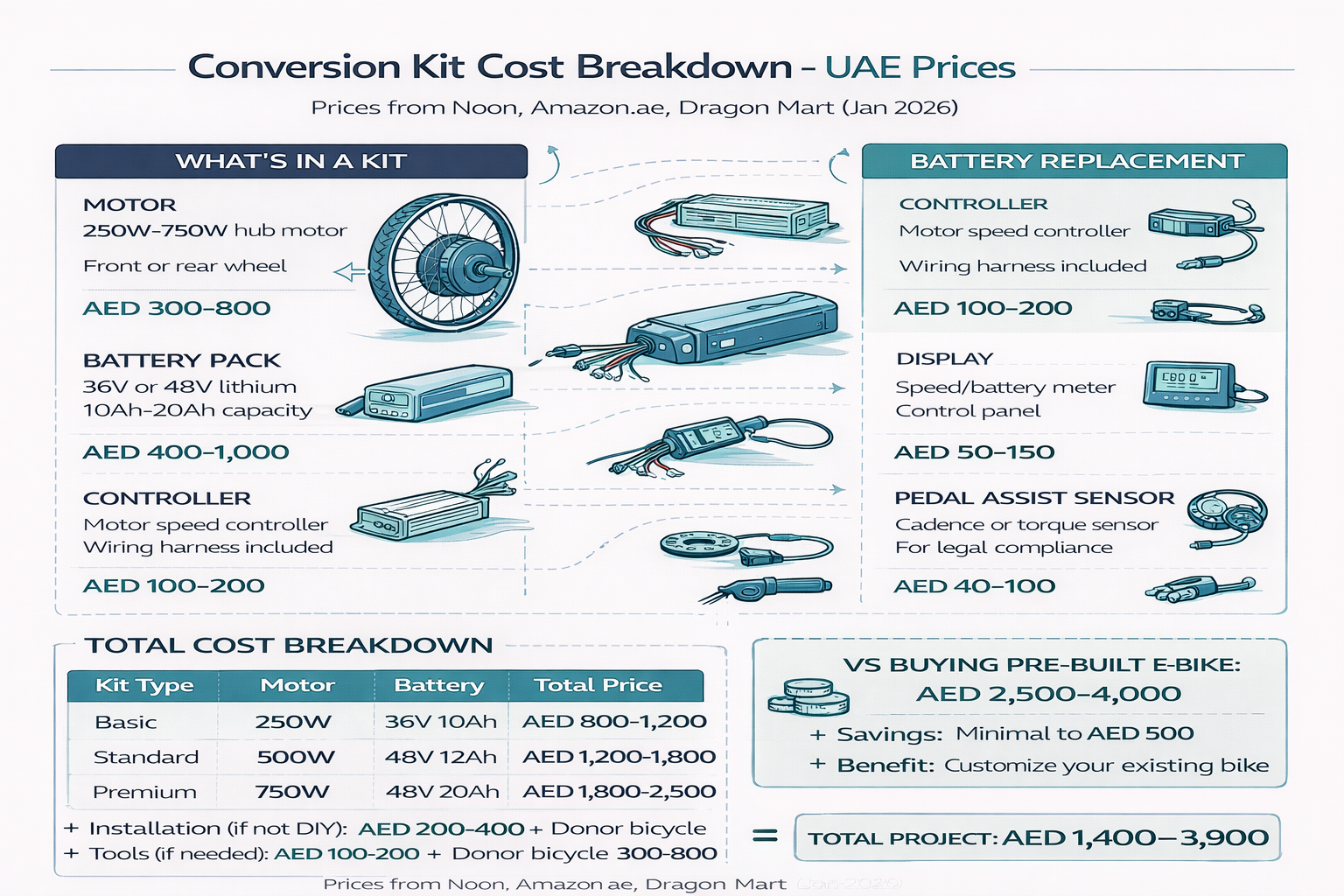
A conversion kit transforms your regular bicycle into an electric bike by adding a motor, battery, and controller.
- Hub motor: Front or rear wheel with built-in motor (250W-1000W)
- Battery pack: Usually 36V or 48V lithium battery
- Controller: Brain that manages power delivery
- Throttle or pedal-assist sensor: How you activate the motor
- Display: Shows speed, battery level, power modes
- Wiring and mounting hardware: Connects everything together
Installation is theoretically simple: replace your existing wheel with the motor wheel, mount the battery, connect the wires. Shops quote 2-4 hours for installation.
Front Wheel vs Rear Wheel Kits
The first decision you’ll face:
- Pros: Easier installation (no chain tension issues), works with any bike
- Cons: Worse traction on hills, unnatural riding feel, steering feels heavy
- Best for: Flat terrain, casual riding, bikes with disc brakes in rear
- Pros: Better traction, more natural power delivery, balanced weight
- Cons: Harder to install (chain/derailleur compatibility), not compatible with all bikes
- Best for: Hills, higher speeds, better performance overall
For Dubai conditions (mostly flat, some bridges), either works. Rear is better if your bike can accommodate it.
The Legal Question: Are Conversion Kits Legal in UAE?
This is where it gets messy. There’s no clear “yes” or “no.”
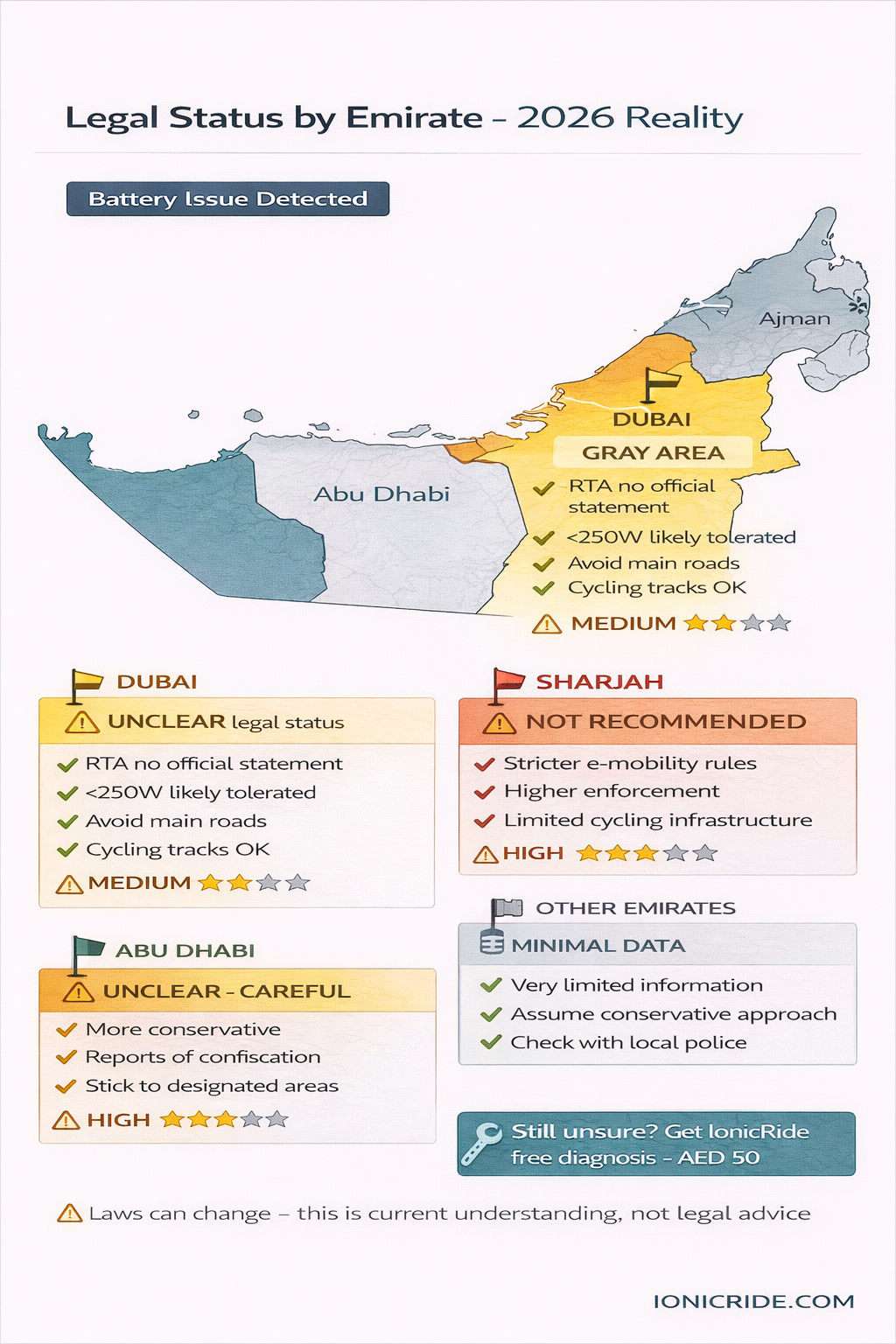
As of January 2026, RTA does not have specific regulations addressing e-bike conversion kits. Their rules cover “electric bicycles” but don’t distinguish between factory-built and converted bikes.
The key regulation: E-bikes must have motors under 250W and not exceed 25 km/h to be treated as bicycles (allowed on cycling tracks, no e-bike license needed).
The problem: Most conversion kits sold in UAE are 500W-1000W motors capable of 35-45 km/h. These technically fall into a regulatory gray zone.
What This Means in Practice
- Buying the kit: Perfectly legal. Dragon Mart openly sells 1000W kits.
- Installing it: Also legal. No law against modifying your own bike.
- Riding it on public roads: Gray area. Technically if it’s over 250W, it should be registered as a motorcycle (which is impossible because it doesn’t meet motorcycle safety standards either).
- Reality: Police don’t currently stop riders to check motor wattage. You blend in with factory e-bikes.
- Ride them exactly like regular e-bikes
- Stay on cycling tracks and bike lanes where allowed
- Don’t ride recklessly (that’s what attracts police attention)
- If stopped, police usually focus on helmet/lights compliance, not motor specs
Thousands of conversion bikes operate daily in Dubai without issues. But understand: you’re in a gray zone, not clearly legal.
Dubai Metro and Public Transport Rules
RTA Metro rules say “folding bicycles allowed during off-peak hours.” They don’t specify electric or non-electric.
- If your bike folds and looks like a regular bike: Usually fine during off-peak (10AM-4PM, 8PM-6AM weekends/public holidays)
- If battery is large/obvious: Metro staff might refuse entry (fire safety concerns)
- Best practice: Remove battery if possible, carry it separately. Less questions.
Cost Breakdown: Conversion Kit vs Buying New E-Bike
Let’s do the actual math:
| Component | Budget Kit | Mid-Range Kit | Premium Kit |
|---|---|---|---|
| Motor (hub wheel) | 400-600 AED | 700-1,000 AED | 1,200-1,800 AED |
| Battery (36V/48V) | 300-500 AED | 600-900 AED | 1,000-1,500 AED |
| Controller + Display | 150-250 AED | 250-400 AED | 400-600 AED |
| Installation (shop) | 200-300 AED | 300-400 AED | 400-500 AED |
| Total Conversion Cost | 1,050-1,650 AED | 1,850-2,700 AED | 3,000-4,400 AED |
Now add the cost of your existing bike (if you don’t have one):
- Decent quality regular bike: 800-1,500 AED
- Total if starting from scratch: 1,850-4,150 AED (budget to mid-range)
- Budget e-bike (ADO, Fiido): 1,800-2,500 AED
- Mid-range e-bike (Samebike, Engwe): 2,800-3,800 AED
- Premium e-bike (Lankeleisi, quality brands): 4,000-6,000 AED
The math: If you don’t already have a good bike, conversion barely saves money compared to buying a budget factory e-bike.
When Conversion Actually Makes Sense
✓ Convert your bike if:
- You already own a quality bike: Nice mountain bike or road bike worth 2,000+ AED that you love riding
- Your bike has sentimental value: Gift from family, custom build, rare model
- You want specific performance: Need 1000W power or 60 km range that budget e-bikes don’t offer
- You enjoy DIY projects: Installation is part of the fun, not a hassle
- You need to carry it upstairs daily: Your bike is lightweight aluminum frame, easier to carry than heavy e-bikes
- You don’t have a bike: Buying bike + kit costs same as factory e-bike
- Your bike is old/cheap: 500 AED bike + 1,500 AED kit = waste of money
- You want warranty/support: Conversion voids any bike warranty, kit warranty is sketchy
- You’re not mechanically inclined: Installation isn’t hard but troubleshooting failures is
- You need it for daily commute: Factory e-bikes are more reliable long-term
Installation Reality: DIY vs Shop
DIY Installation
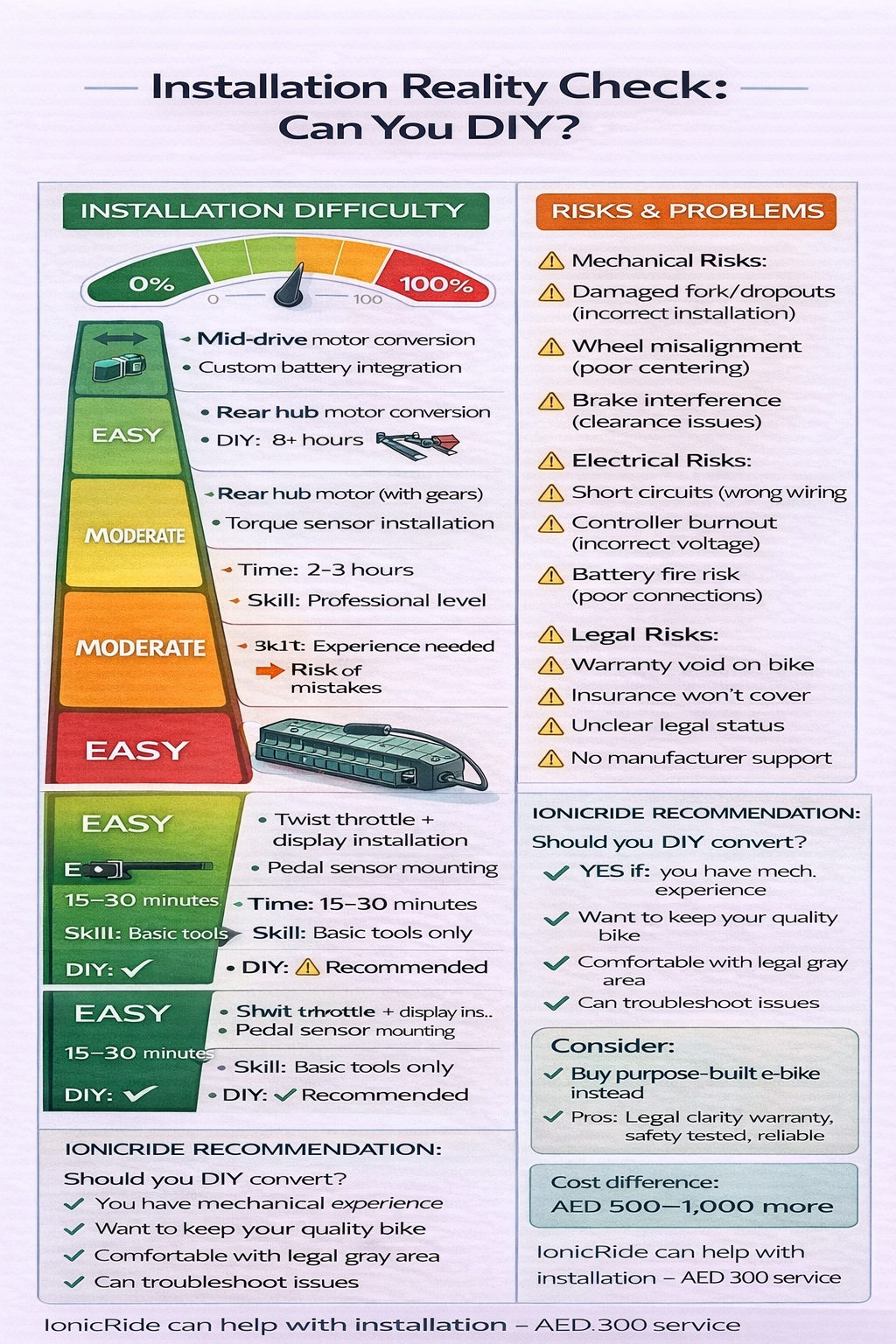
Conversion kit sellers claim “install in 2 hours, no special tools.”
- Hour 1: Unpack kit, realize instructions are in broken English or just diagrams
- Hour 2-3: Remove old wheel, install motor wheel, realize brake caliper doesn’t align anymore
- Hour 4-5: Mount battery, figure out wire routing so it doesn’t look like garbage
- Hour 6: Connect controller, wires don’t match colors in diagram, YouTube search begins
- Hour 7-8: Finally everything’s connected, test ride, motor jerks violently, back to troubleshooting
Realistic DIY time: 6-10 hours for first installation. 3-4 hours if you’ve done it before.
- 15mm wrench (axle nuts)
- Allen key set (brake calipers, fender, rack mounting)
- Wire cutters and electrical tape
- Cable ties (lots of them)
- Torque wrench (recommended, prevents overtightening)
- Multimeter (for troubleshooting if things don’t work)
If you don’t own these tools, add 200-300 AED to buy them.
Shop Installation
Most bike shops in Dubai now offer conversion kit installation.
- Front wheel motor kit: 200-300 AED labor
- Rear wheel motor kit: 300-450 AED labor (more complex)
- Mid-drive motor kit: 500-800 AED labor (rarely done, very complex)
Time: 2-4 hours. Most shops can do same-day if you drop off morning.
- Professional wire routing (looks clean, not zip-tied chaos)
- Brake adjustment after motor wheel installation
- Test ride to verify everything works
- Basic instruction on using controller/display
- 30-day warranty on installation work (not the kit itself)
Unless you’re experienced with bike mechanics, pay for shop installation. 300 AED is worth it to avoid 8 hours of frustration.
Common Problems with Conversion Kits
Here’s what actually goes wrong after installation:
Problem 1: Motor Cable Damage
The cable from hub motor to controller exits at the axle. If not routed carefully, it rubs against frame/fork and eventually shorts out.
Symptom: Motor stops working, controller shows error code, or motor runs but with no power.
Fix: Replace motor cable (200-400 AED parts + labor) or entire wheel (500-800 AED).
Prevention: Use cable guides, check routing every month, add protective sleeve if cable rubs anywhere.
Problem 2: Battery Mounting Failures
Cheap battery mounts use plastic clips or velcro straps. Dubai speed bumps + vibration = battery shakes loose.
Best practice: Use metal mounting bracket, not plastic. Add secondary safety strap. Check tightness weekly.
Problem 3: Brake Incompatibility
Motor wheels have different hub widths than regular wheels. Your brake calipers might not align anymore.
- Rim brakes: Usually need re-adjustment, sometimes need new brake pads if wheel diameter slightly different
- Disc brakes: Caliper position needs adjustment, might need new rotor if old one doesn’t fit new hub
Budget 50-150 AED for brake parts/adjustment if shop installation didn’t include this.
Problem 4: Controller Failures in Dubai Heat
Controllers are electronic components that hate heat. Dubai summer (45°C ambient, 60°C+ in direct sun) kills cheap controllers.
Symptom: Motor cuts out randomly, power delivery becomes erratic, display shows errors.
Solution: Mount controller in shaded area (under seat, inside frame bag). Upgrade to quality controller with better heat tolerance (300-500 AED).
Battery Lifespan: Conversion vs Factory E-Bikes
This is where conversion kits often disappoint:
Factory e-bike battery:
- Designed specifically for that bike’s power system
- Better battery management system (BMS)
- Typical lifespan: 18-24 months in Dubai before noticeable degradation
Conversion kit battery:
- Generic battery, not optimized for your specific motor
- Cheaper BMS (cuts corners on thermal protection)
- Typical lifespan: 12-18 months in Dubai conditions
Replacement cost: 600-1,200 AED for conversion kit battery (similar to factory e-bike replacement cost, but needed sooner).
Where to Buy Conversion Kits in UAE
- Dragon Mart: Multiple shops sell kits. Prices: 800-2,500 AED. Haggle-able. Ask about warranty in writing.
- Deira bike shops: Some traditional bike shops now stock kits. Slightly higher prices but better service.
- Karama: Few shops carry them. Better for installation than buying kits.
- Noon/Amazon UAE: Limited selection. Prices 15-25% higher than Dragon Mart but easier returns.
- AliExpress: Cheapest prices (600-1,800 AED) but 3-5 week shipping, customs hassle, zero support.
- Dubizzle: Used kits sometimes available. Risky—batteries might be degraded.
- “What’s the motor wattage?” (Verify it matches your needs)
- “What’s the battery capacity and brand?” (LG/Samsung cells = good, “generic” = avoid)
- “Is the kit compatible with disc brakes?” (If your bike has them)
- “Do you offer installation?” (Get price quote)
- “What’s the warranty period?” (Minimum 6 months, get in writing)
The Economics: Does Conversion Actually Save Money?
Let’s compare three scenarios over 24 months:
Scenario A: Convert Existing Bike
Scenario B: Buy Budget Factory E-Bike
Scenario C: Buy Mid-Range Factory E-Bike
Conversion saves money only if you already own a quality bike. Starting from scratch, budget factory e-bikes are cheaper over 2 years.
Mid-range factory e-bikes cost more but offer better reliability, warranty, and resale value.
Warranty and Support Reality
- Kit warranty: Usually 6-12 months on motor/battery. But… good luck actually claiming it.
- Process: “Send the faulty part back to China” (shipping costs 200+ AED, takes 6-8 weeks)
- Your bike’s original warranty: Void the moment you install conversion kit
- Bike shops: Most refuse to service converted bikes (liability concerns)
- 12-24 month warranty on entire bike
- Local service centers (for major brands)
- Replacement parts usually in stock in UAE
- Shops will service factory e-bikes normally
Performance Expectations: Be Realistic
Conversion kits won’t turn your bike into a high-performance e-bike:
- Perfect integration: There will always be visible wires, battery mount, controller box. It won’t look factory-clean.
- High reliability: More connection points = more potential failures vs integrated factory systems.
- Optimized efficiency: Generic motor + generic battery = adequate, not optimized performance.
- Maintain original bike weight: Expect to add 8-12 kg (motor wheel, battery, controller).
- Provide electric assist on a bike you already love
- Give you 1000W+ power if you want it (factory e-bikes usually max at 500W)
- Let you customize battery size for your specific range needs
- Preserve your bike’s original ride quality (geometry, components, etc.)
Our Final Recommendation
Should You Buy a Conversion Kit?
YES, if:
- You already own a bike worth 2,000+ AED that you want to keep
- You’re mechanically capable and enjoy tinkering
- You need custom specs (1000W motor, extra-large battery) not available in factory e-bikes
- Your budget is 1,500-2,500 AED and you have a good bike already
NO, if:
- You don’t have a bike or your bike is worth under 1,000 AED
- You want warranty and support
- You need daily reliable transport (not a project)
- You’re not comfortable with basic bike maintenance
For most people in Dubai, buying a factory e-bike makes more sense. Better integration, warranty, support, and similar total cost over 2 years.
Conversion kits shine in specific scenarios: you have a beloved bike you want to electrify, you want custom performance specs, or you enjoy DIY projects.
Just understand what you’re getting into. It’s not “cheap e-bike” territory—it’s “enthusiast project” territory.
As of January 2026, there’s no explicit law in UAE saying conversion kits are illegal. But kits over 250W exist in regulatory gray zone. Ride responsibly, don’t attract attention, understand the risk.
Laws may change. Stay updated on RTA regulations.