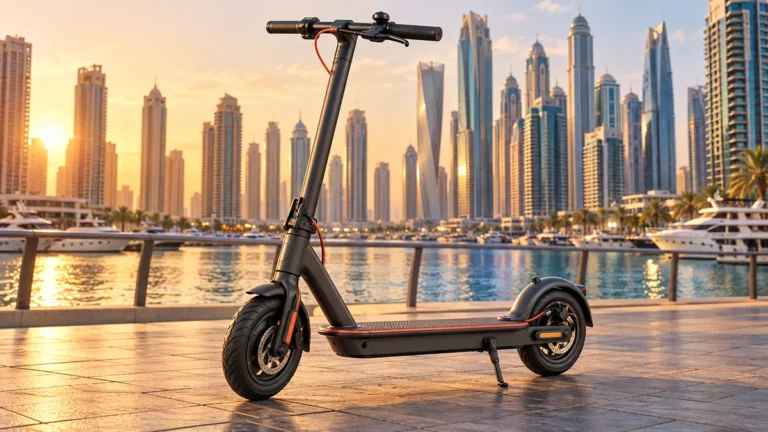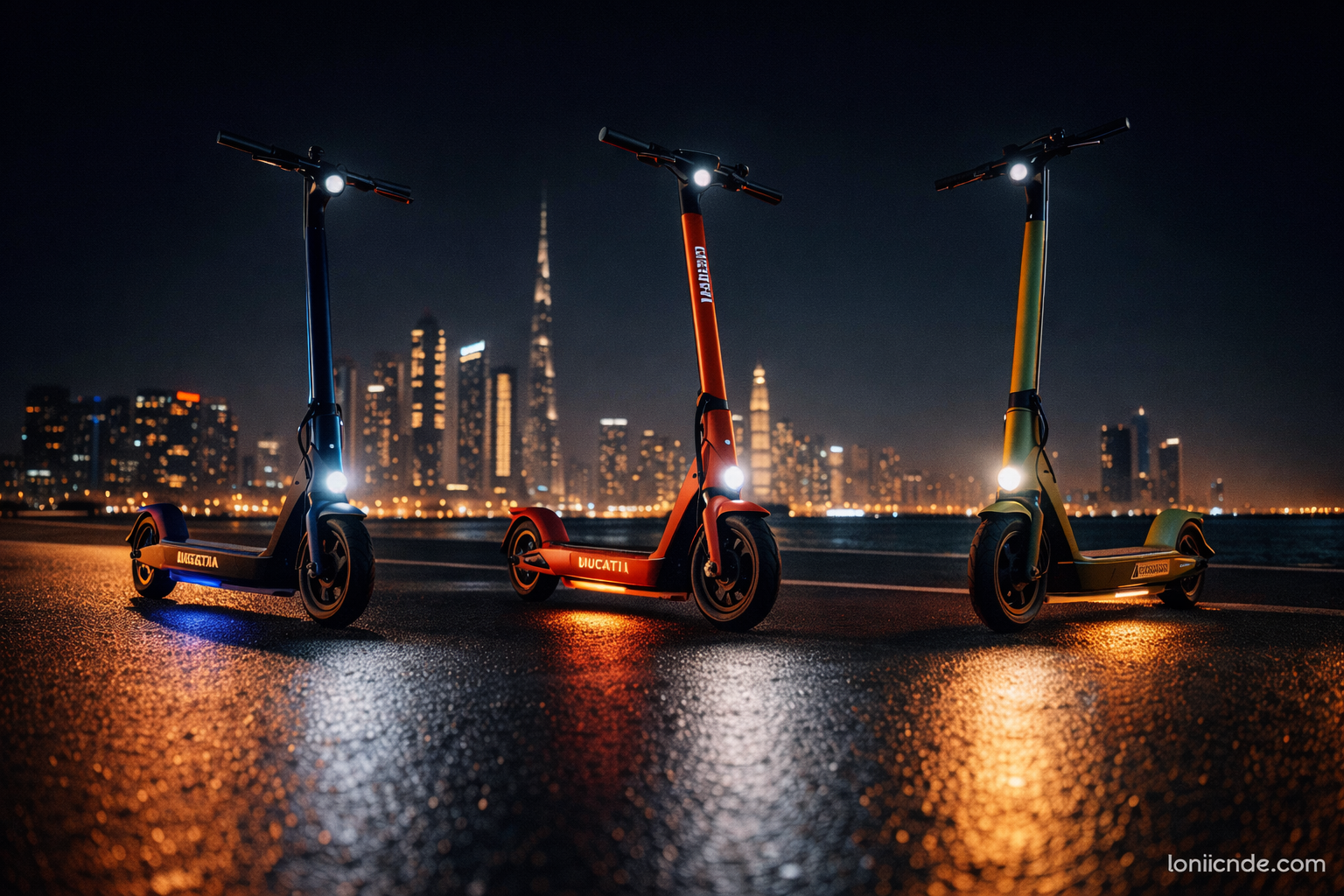
Luxury Electric Scooter Dubai 2026: Bugatti, Ducati, Lamborghini — Worth the Price?
Best Luxury E-Bikes & E-Scooters in UAE 2026: Premium Picks Tested (AED 4,199–27,300)
You’re not shopping by price — you’re shopping by quality. Maybe it’s a Palm Jumeirah villa where the AED 4,000 commuter scooter looks out of place. Maybe you ride 25+ km daily and have outgrown the mid-tier. Maybe the Range Rover in the garage deserves something more than a budget Xiaomi to match it.
The problem is most “luxury e-scooter Dubai” search results are e-commerce listings with no expertise — they’ll sell you a AED 19,000 Dualtron Thunder 2 the same way they sell you an iScooter.
This guide covers every premium e-mobility option actually available in UAE — Research-Based, ranked by what justifies its price tag in Dubai heat and pavement. From AED 4,199 entry-luxury to AED 27,300 ultra-premium golf carts. With current Noon UAE and Amazon UAE pricing.
Why Luxury E-Mobility Makes Sense in Dubai
The standard “buy a Xiaomi 4 Pro for AED 1,849” advice doesn’t apply here. Premium e-mobility in UAE makes sense for three specific buyer profiles:
1. The 20+ km daily commuter. A AED 1,849 Xiaomi 4 Pro forces a battery replacement every 12–18 months in UAE heat. A Dualtron Thunder 2 with a 72V/40Ah pack still delivers genuine range at 24 months. The math works long-term.
2. The 100kg+ rider. Mid-tier e-scooters struggle. Dual-motor luxury (Inokim OXO Super, Dualtron Storm) handles heavy riders without thermal cut-offs in summer.
3. The status / quality buyer. A Lamborghini-branded folding scooter sitting next to a McLaren in the Emirates Hills garage is a different kind of purchase. There’s nothing wrong with that — it’s a market segment that exists, and Dubai has a lot of it.
If you’re commuting 5–8 km daily on flat Marina/JLT routes, a AED 19,200 Dualtron Thunder 2 is genuine waste. The Xiaomi 4 Pro at AED 1,849 or Segway MAX G2 at AED 2,750 will serve you better — see our best e-scooters by price range guide for mainstream picks.
Entry Luxury & Status Picks
Where premium aesthetics start. Power, branding, or premium e-bike build at the entry-luxury price band.
Wind Horse H3 — Power-Per-AED Champion
✓ Strengths
- Highest power-per-AED in entry luxury
- Dual hydraulic brakes
- Real dual suspension
- Steel frame, heavy-duty build
- Strong 4.6/5 Noon rating
✗ Trade-Offs
- 85 km/h = 4x Dubai legal limit
- Heavy build (not portable)
- No established UAE service network
- Range drops sharply in heat
HASA Swift 27.5″ E-Bike — Best Online Premium E-Bike
Lamborghini AL Ext Foldable — Status Buyer’s Choice
✓ Strengths
- Genuine Lamborghini-licensed brand
- Premium bronze finish
- Foldable for car trunk transport
- Dual suspension at this price
✗ Trade-Offs
- You’re paying for the brand badge
- 500W is mid-tier power, not premium
- Status purchase, not value purchase
Premium Performance Tier
Where serious luxury starts. Inokim OXO, Segway GT3, and entry Dualtron — what we’d buy ourselves at this band.
Inokim OXO Super — Best Premium Long-Range Pick
✓ Strengths
- Inokim’s renowned build quality
- True dual-motor performance
- Adjustable suspension (rare)
- 6-LED light system
- Genuine 60+ km Dubai real range
✗ Trade-Offs
- 40 mph = illegal at full speed in UAE
- Inokim parts pipeline still thin
- Heavy at this premium tier
- Not Metro-portable
Inokim OXO — Standard OXO Variant
Segway Ninebot GT3 — Best Premium with Full UAE Warranty
✓ Strengths
- Full Segway UAE warranty & service
- Same-day parts at Dubai Segway dealer
- Dual hydraulic suspension
- Best premium battery longevity in heat
- Brand resale value protected
✗ Trade-Offs
- Less raw power than Dualtron Eagle Pro at same price
- Not as fast in straight line
- Segway aesthetic vs Dualtron’s “tactical” look
As of April 2026, the full Dualtron lineup is now stocked on Noon UAE — a major shift from 2024 when these were import-only. Here are all five models in stock, ranked by price.
Dualtron Eagle Pro — Cheapest Real Dualtron
Dualtron Achilleus — Mid-Tier Sweet Spot
Segway Ninebot GT3 Pro — Premium Touring with Full Warranty
Ultra-Premium Performance Flagship
The top of the Dualtron pyramid. For serious touring, daily 30+ km commuters, or hardcore enthusiasts.
Dualtron Ultra 2 — 72V Premium Performance
Dualtron Storm — Removable-Battery Long-Range Premium
Dualtron Thunder 2 — The Ultimate UAE Flagship
✓ Why It’s the Flagship
- Biggest battery in any Dualtron (40Ah)
- LG M50T cells — best chemistry available
- 2,880 Wh = real 140 km Dubai range
- Built for daily 50+ km commutes
- Resale value holds remarkably well
- Dualtron community status piece
✗ Reality Check
- Massive overkill for 5–10 km commutes
- 40+ kg — not portable at all
- Top speed exceeds UAE legal limits 5x
- Battery replacement AED 4,000+ when needed
Ultra-Niche: Resort & Estate Luxury
Beyond e-scooters. The category most buyers don’t know exists.
ELLWEE 1-Seater — Resort & Estate E-Vehicle
Premium European E-Bike Brands (Dealer-Only in UAE)
If you’re searching for Specialized, Trek, Giant, Riese & Müller, Bianchi, VanMoof, Cowboy, Stromer, Cannondale, Haibike, Bulls, or Brompton Electric — none of these are stocked on Noon UAE or Amazon.ae. They sell exclusively through authorised UAE dealers.
This isn’t necessarily bad — for premium European e-bikes, dealer relationships matter. You get fitting, professional assembly, ongoing service, and warranty handling. Here’s where to find each major brand in UAE:
Wolfi’s Bike Shop
Specialized · Trek · CannondaleLong-established Dubai cycle dealer. Carries the full Specialized Turbo (Vado, Como, Tero) e-bike line plus Trek Verve+ and Allant+ ranges.
Brands: Specialized · Trek · Cannondale · Pinarello
Cycle Hub Dubai
Specialized · BianchiPremium cycling boutique. Specializes in performance e-road and e-MTB. Strong service department for Bianchi e-Omnia line.
Brands: Specialized · Bianchi · Pinarello · Wilier
Trek Bicycle Store Dubai
Trek-onlyBrand-direct flagship store. Full Trek e-bike inventory: Verve+, Allant+, FX+, Domane+. Best for warranty-sensitive Trek buyers.
Brand: Trek-exclusive
Giant Dubai
Giant · LivAuthorized Giant dealer with full e-bike range. Explore E+, Quick E+, FastRoad E+. Liv e-bike line for women’s-specific fits.
Brands: Giant · Liv
Expect dealer pricing 15–25% above UK or German RRP due to import duty and dealer markup. Typical 2026 UAE prices:
- Specialized Turbo Vado SL: AED 18,000–22,000
- Trek Verve+ 2: AED 14,000–17,000
- Giant Explore E+ 2: AED 12,000–15,000
- Riese & Müller Charger4: AED 35,000–48,000
- Bianchi e-Omnia C: AED 28,000–38,000
- Cannondale Tesoro Neo X: AED 16,000–20,000
VanMoof, Cowboy, Brompton Electric: Limited UAE dealer availability post-2024. Check directly with brands or Cycle Hub for stock.
All 12 Luxury Picks Compared
Luxury E-Mobility UAE 2026 — Head-to-Head
12 Picks| Model | Price | Type | Best For | Buy |
|---|---|---|---|---|
| Wind Horse H3 | AED 4,199 | Power Scooter | Power-per-AED | NA |
| HASA Swift | AED 5,599 | E-Bike | Online premium e-bike | N |
| Lamborghini AL Ext | AED 5,999 | Status Scooter | Brand purchase | N |
| Inokim OXO Super | AED 8,049 | Premium Scooter | Long-range value | N |
| Inokim OXO | AED 8,490 | Premium Scooter | Inokim brand | N |
| Segway GT3 | AED 8,499 | Premium Scooter | Best UAE warranty | N |
| Dualtron Eagle Pro | AED 9,500 | Performance | Entry Dualtron | N |
| Dualtron Achilleus | AED 12,500 | Performance | Mid-Dualtron sweet spot | N |
| Segway GT3 Pro | AED 13,999 | Premium Touring | 150kg riders | A |
| Dualtron Ultra 2 | AED 17,200 | Flagship Tier | 72V Dualtron | N |
| Dualtron Storm | AED 18,400 | Flagship Tier | Removable battery | N |
| Dualtron Thunder 2 | AED 19,200 | Ultimate Flagship | Money no object | N |
| ELLWEE 1-Seater | AED 26,900+ | Resort EV | Estate / golf | N |
Even premium e-scooters require a free RTA e-scooter permit (15 minutes online). Dubai Police’s Personal Mobility Monitoring Unit launched May 2026 with active enforcement. Confirm your route is within one of Dubai’s 21 legal e-scooter zones. Most luxury scooters above can exceed 60 km/h — keep speed limiters engaged on cycle paths.
Luxury E-Mobility UAE 2026 — FAQ
The Dualtron Thunder 2 at AED 19,200 on Noon UAE is the best luxury performance e-scooter — 72V/40Ah battery, dual-motor, 110+ km real range. For premium long-distance touring with full Segway UAE warranty, the Segway Ninebot GT3 Pro at AED 13,999 on Amazon UAE is the smarter mainstream choice. Most luxury buyers in Dubai end up with one of these two.
Yes — as of April 2026, the full Dualtron lineup is now stocked on Noon UAE with prices ranging from AED 9,500 (Eagle Pro) to AED 19,200 (Thunder 2). Current stock includes Eagle Pro, Achilleus, Ultra 2, Storm, and Thunder 2.
Yes — the Inokim OXO at AED 8,490 and OXO Super at AED 8,049 are both stocked on Noon UAE. The OXO Super delivers 2,600W max power, 68-mile claimed range, and dual-motor performance.
Luxury e-scooters in UAE 2026 range from AED 5,999 (Lamborghini AL Ext) to AED 19,200 (Dualtron Thunder 2). The most popular luxury price band is AED 8,000–12,500 covering the Inokim OXO, Segway GT3, and Dualtron Achilleus. Above AED 17,000 you enter ultra-premium Dualtron Storm and Thunder 2 territory.
Yes, but typically through authorized dealers rather than Noon or Amazon UAE. Wolfi’s Bike Shop, Cycle Hub Dubai, Trek Bicycle Store Dubai, and Giant Dubai are the main retailers for European premium brands. For online luxury e-bike shopping in UAE, the HASA Swift at AED 5,599 on Noon UAE is the most-stocked premium option.
The ELLWEE 1-Seater at AED 26,900–27,300 is designed for resort and gated community use, not public roads. Perfect for Palm Jumeirah, Emirates Hills, gated developments, and golf course use — that’s where these vehicles thrive in UAE.
Money no object? Dualtron Thunder 2 at AED 19,200 on Noon — biggest battery, best cells, real 140 km Dubai range.
Smart-money premium? Segway GT3 at AED 8,499 — full UAE warranty, same-day Segway parts, best battery longevity in heat.
Long-range serious commuter? Dualtron Storm at AED 18,400 — removable battery is the killer feature for apartment dwellers.
Premium e-bike online? HASA Swift at AED 5,599. For Specialized/Trek/Giant/R&M — visit Wolfi’s, Cycle Hub, Trek Dubai, or Giant Dubai.
Status purchase? Lamborghini AL Ext at AED 5,999. It’s not the best engineering — but for Emirates Hills garages where the badge matches the rest of the collection, it’s the obvious choice.
Workshop honest take: Most luxury buyers in UAE end up with either a Segway GT3 (smart money) or a Dualtron Thunder 2 (no compromises). Pick your tribe.
Picked your luxury ride?
Get your free RTA permit before the first ride — 15-minute step-by-step guide here →