Solid Tires vs Air Tires Electric Scooter UAE: Which Handles Dubai Roads Better?
Solid Tires vs Air Tires Electric Scooter UAE: Which Handles Dubai Roads Better?
Almost every “solid vs pneumatic” guide online was written for someone riding in Berlin or Chicago. The roads are different there. The summer is different there. The reason tires fail is different there. Dubai has its own set of tire physics, and the answer that applies in Europe does not automatically apply here.
The standard global advice says pneumatic tires win on comfort, solid tires win on puncture resistance. That’s broadly true. But in Dubai, the heat dimension changes the maintenance math for pneumatic tires, and the road surface varies so dramatically by area that the “right” tire depends on your specific commute — not a generic recommendation.
We fix both types every week. Here’s what the workshop data actually tells us.
📋 The Short Answer by Situation

The Three Tire Types Available on UAE Scooters
Most comparisons only cover two options. Dubai’s scooter market sells three: fully solid, honeycomb solid, and pneumatic (which splits further into tubed and tubeless). Understanding what separates them — not just solid from air — is how you make the right call for your commute.
Pneumatic tires are air-filled — either with an inner tube (tubed) or without one (tubeless). The air acts as your primary suspension layer. In a city where scooters typically don’t have full front-and-rear suspension, this is not a small thing. The difference between riding Old Airport Road in Deira on pneumatic vs solid tires is immediately obvious. The air cushion absorbs what the frame doesn’t.
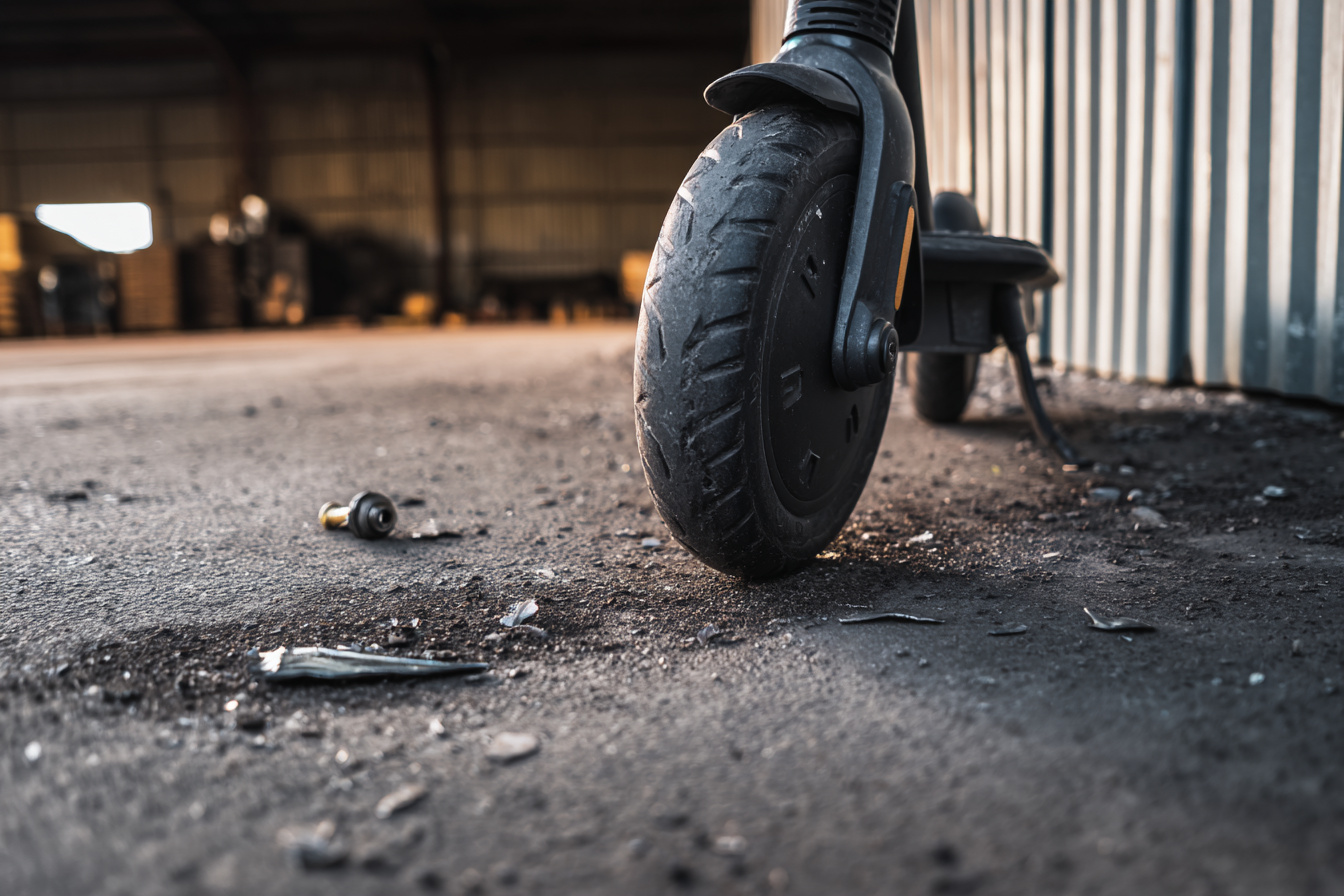
In Dubai specifically, pneumatic tires behave differently across seasons. When ambient temperature swings from 22°C in January to 45°C in July, the air inside your tires expands — roughly 1–2 PSI per 10°C of temperature change. A tire inflated to 45 PSI during a winter morning could read closer to 50–52 PSI on a summer afternoon after sitting in sun. This isn’t a blowout risk at e-scooter operating pressures, but it does affect handling: overinflated tires reduce grip, increase vibration, and wear unevenly in the centre of the tread. The practical fix is straightforward — check and set pressure in the morning before riding, and adjust seasonally.
Tubed vs tubeless matters more than most buyers realise. Tubed pneumatic tires are more vulnerable to pinch flats — where the tube gets caught between the rim and a hard impact and punctures from the inside, not from debris. Construction debris flats on tubed tires require full tube replacement. Tubeless tires, by contrast, can often be self-healed with sealant for smaller punctures, and even with a significant puncture, they lose pressure slowly rather than immediately — giving you time to reach a service point rather than being stranded.
The right choice for most Dubai commutes — and the right choice for any scooter that doesn’t regularly pass through industrial areas. Tubeless is strongly preferred over tubed for UAE conditions: slower pressure loss on puncture, sealant-repairable, and less susceptible to pinch flats on older-surface roads in Deira and Bur Dubai. Set pressure in the morning, check monthly, ride comfortably.
Solid tires are exactly what they sound like: full rubber, no air, no tubes. They cannot go flat. For riders who work in or near industrial areas — Al Quoz workshops, JAFZA, DIP, the construction corridors around Mohammed Bin Zayed Road — this matters. Metal filings, wire off-cuts, and nail-studded scraps are a daily road hazard in those areas. We see a disproportionate number of pneumatic flat repairs from riders in these zones. For them, solid tires are a rational choice.
The trade-off is vibration. Solid tires transmit every road texture directly to the deck and up through your feet, ankles, and wrists. On the smooth tarmac of Downtown Dubai or Business Bay, this is manageable — a firmer ride, not a painful one. On older, patchwork surfaces in Deira or the service roads behind any major development, solid tires turn a 10-minute commute into something that leaves your hands buzzing.
The less-discussed cost is what that vibration does to the scooter. Over time, the continuous shock loading accelerates wear on the frame welds, the folding mechanism latch, and the stem fasteners. Solid-tire scooters that see heavy commuting use typically come to us with loose stems and developing frame cracks earlier than equivalent pneumatic-tire models. The maintenance saving on tires can partially offset this — but it’s a real factor to weigh for a scooter you’ll ride daily for two or more years.
A rational choice specifically for industrial-area commuters where flat tires are a genuine frequent risk. Not recommended for general Dubai commuting — the ride comfort penalty is significant on the road surfaces you’ll actually encounter in Deira, JVC, or any older development. The maintenance saving is real, but it redistributes wear to the frame rather than eliminating it. If you go solid, choose a scooter with a suspension fork — it partially compensates for what the tire isn’t absorbing.
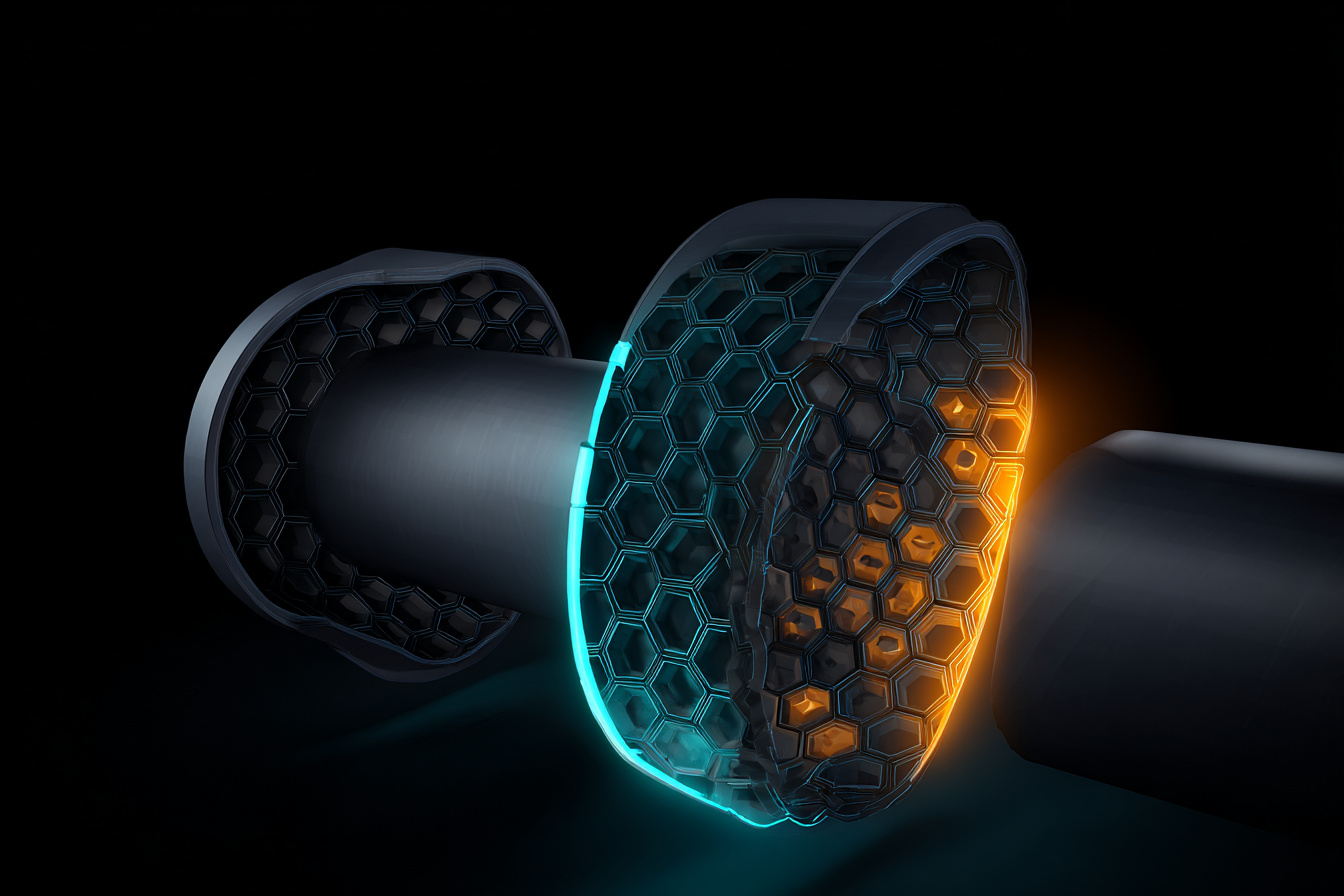
Honeycomb tires use a latticed internal structure rather than solid rubber throughout. The cells deform slightly under load, which gives them meaningfully better shock absorption than fully solid tires — not as good as pneumatic, but a real improvement on patchwork tarmac. They remain puncture-proof. For riders who want zero flat tire risk but find solid tires unbearably harsh, honeycomb is the correct choice.
The Dubai-specific caveat: that honeycomb structure traps dust, fine sand, and grit. In a desert city, this matters more than it does in London. Compacted sand in the cells reduces their ability to flex over time, gradually degrading the comfort advantage. Periodic cleaning with compressed air extends the effective life. It’s a minor maintenance task — but it’s maintenance, which removes the “zero upkeep” argument that makes solid tires appealing in the first place.
The bigger practical constraint is availability. Not many quality scooter models in the UAE market come with honeycomb tires as standard. You’ll find them on some Xiaomi entry-level models and a handful of budget brands. As an aftermarket fitment, compatibility depends on your rim size. Ask our workshop before attempting a swap — incompatible honeycomb tires can create fitment issues that affect handling.
The best compromise if you genuinely need puncture immunity but can’t stomach fully solid ride quality. Better than solid in Dubai’s dusty conditions when you clean them occasionally. Not a replacement for pneumatic tubeless on smooth-surface commutes — but a smarter choice than solid for riders who’ve been burned by flats in the past and want the peace of mind back.
The Dubai Heat Factor: What Changes at 45°C
This is the section that no other tire comparison covers, because they weren’t written for here. Dubai’s temperature range is extreme by global urban standards — from roughly 20°C in January nights to 48°C on a summer afternoon. That 28-degree swing has real consequences for pneumatic tires that most riders don’t account for.
Air pressure inside a tire increases by approximately 1–2 PSI for every 10°C rise in temperature (Gay-Lussac’s Law — same physics, whether you’re inflating a car tire or a scooter tire). A tire set to 45 PSI on a January morning at 20°C will measure closer to 49–51 PSI on a July afternoon at 45°C, before you even start riding. Add the additional heat generated by rolling friction, and that pressure climbs further. Overinflated tires reduce contact patch, which reduces grip and increases braking distance. They also wear unevenly — balding in the centre while the shoulders stay intact.
The fix is simple: check and set tire pressure in the early morning before your first ride, especially as seasons change. Run 3–5 PSI below the manufacturer’s maximum in summer. Your ride will be better and your tires will last longer.
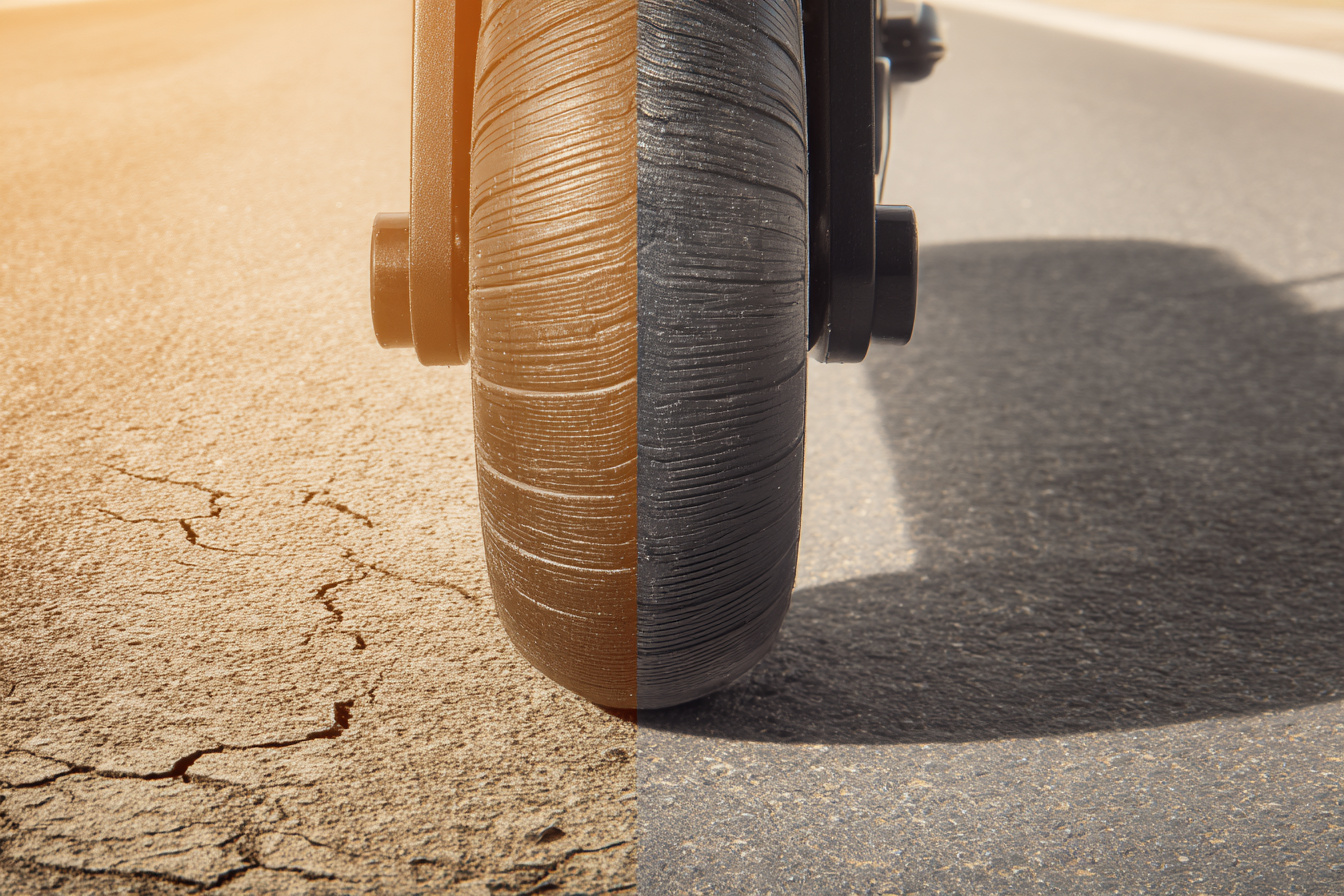
Sustained heat also affects the rubber compound itself, independent of pressure. UV exposure and high ambient temperature cause rubber to oxidise and crack — the same process that puts hairline cracks in sidewalls on cars left in the sun for months. E-scooter tires are more vulnerable than car tires because they’re smaller, thinner-sidewalled, and often stored outdoors or in direct sun between rides. Store your scooter indoors or in shade whenever possible. Sidewall cracks on a pneumatic tire are a replacement indicator — riding on cracked sidewalls is a blowout risk, especially in summer heat.
Solid tires handle heat better in one specific way: they don’t have pressure to manage. But solid rubber still hardens and becomes more brittle with sustained UV and heat exposure. A solid tire on a scooter that’s been parked outdoors in Dubai sun for 12 months will have meaningfully less grip than a new one, even if it shows no visible wear.
Dubai Road Surfaces by Area: What You’re Actually Riding On
Dubai is not a uniform road surface. The difference between Marina Walk and the back roads of Al Quoz is the difference between a well-maintained European boulevard and a patchy industrial service road. Your tire choice should reflect your actual route — not an average.
🗺️ Dubai Area Road Surface Profile — Tire Recommendation
All Three Types: Full Comparison
Solid vs Pneumatic vs Honeycomb — Dubai E-Scooter Tires
2026| Factor | Pneumatic Tubeless | Pneumatic Tubed | Honeycomb Solid | Fully Solid |
|---|---|---|---|---|
| Ride comfort | Best | Best | Medium | Worst |
| Flat tires | Low risk | Medium risk | None | None |
| Puncture recovery | Sealant often works | Tube replacement | N/A | N/A |
| Grip (dry) | Excellent | Excellent | Good | Adequate |
| Grip (wet) | Best | Best | Medium | Poor |
| Dubai summer heat | Manage pressure seasonally | Manage pressure seasonally | No issue | No issue |
| Maintenance | Monthly pressure check | Monthly check + flat risk | Occasional dust clean | None |
| Battery range effect | Best | Best | Good | Higher rolling resistance |
| Frame wear contribution | Low | Low | Medium | High |
| Best for Dubai area | Most of Dubai | Most of Dubai | Industrial, JVC | Al Quoz, JAFZA only |
| Workshop score | 9.0 | 7.2 | 7.0 | 5.5 |
Practical Dubai Tire Care Guide
Summer (May–September): Check tire pressure early morning, before the day heats up. This is your “cold pressure” reading — the accurate baseline. Target the manufacturer’s recommended PSI, not the maximum. Running 3–5 PSI below max in summer gives the tire room to expand during the day without overinflating.
Winter (November–February): Pressure drops as temperature falls. Top up as needed. The 5–8 PSI difference between a Dubai January morning and July afternoon is real and affects ride quality both ways.
If you have tubeless tires: Add sealant when new (Slime or equivalent, 50–60ml for most 10-inch e-scooter tires). Refresh every 4–6 months. It won’t prevent every puncture but it handles the small ones automatically while you’re riding — you won’t even notice.
Sidewall inspection: Check for cracking every few months. Park in shade or indoors. UV degradation on Dubai’s outdoor-parked scooters is real — cracked sidewalls are a blowout risk in summer heat.
Pneumatic: Replace when tread depth reaches 1–2mm, when sidewall cracking is visible, or after any impact that causes a visible bulge. Tread depth indicator marks are present on most quality tires — when the pattern is gone, so is the tire.
Solid: Replace when visible flat spots develop (from parking on a hot surface for extended periods), when surface cracking is deep, or when the outer rubber layer has worn enough to expose the inner structure. Solid tires don’t fail suddenly the way pneumatic ones can — but worn solid tires have reduced grip that you may not immediately notice.
UAE replacement cost: Standard 10-inch pneumatic tubeless replacement at our workshop runs AED 80–120 including fitting. Solid tire swap is AED 60–90. Honeycomb tires are AED 100–150 depending on brand and size, and availability requires lead time.
We said it earlier and it bears repeating more directly: if your commute takes you through Al Quoz industrial, JAFZA, any active construction logistics zone, or other areas with regular metal debris on the road surface, solid tires are the rational choice. We see the same riders repeatedly with pneumatic flats caused by wire off-cuts and metal filings. After the third flat in two months, the comfort argument becomes academic. The right tire for your route is the right tire — even if it’s not the performance-optimal choice on paper.
Buying a new scooter and choosing the tire type before purchase? Start with the full model comparison: Best Electric Scooter Dubai 2026: Workshop-Tested Top 10
Know which tire you want — now figure out where to buy safely: Electric Scooter Shops Dubai 2026: 10 Stores Compared
For most Dubai commutes, pneumatic tubeless is the right answer — and it isn’t close. Better comfort, better grip, better braking, better range. The maintenance is a monthly five-minute task and the puncture risk, managed with sealant, is lower than most riders expect. Solid tires save you that five minutes and cost you comfort every day.
The one exception is industrial-area commutes. If your route passes regularly through Al Quoz, JAFZA, or active construction logistics zones, solid or honeycomb tires are a genuine practical choice. Repeated flats from debris are worse than reduced comfort from solid rubber.
Dubai heat changes the pneumatic tire math slightly — but it doesn’t reverse it. Check pressure in the morning, run 3–5 PSI below max in summer, store indoors. That’s the full list of what heat requires of you. It’s manageable.
If you’re choosing between tubed and tubeless: always tubeless. The slow-deflation advantage alone is worth the small price premium in a city where not every street has a tyre shop conveniently located. Add sealant and forget about it.
Monthly Tire Check: 3-Minute Routine
- Check tire pressure (pneumatic only) — in the morning before riding, against manufacturer spec. Adjust for season: slightly lower in summer, back to spec in winter.
- Visual inspection of both tires — look for sidewall cracks, embedded debris, or visible tread wear indicators. Ten seconds per tire.
- Check for slow leaks — if your tubeless tire is consistently losing 5+ PSI between weekly checks, the sealant may need refreshing or the valve core may be leaking.
- Honeycomb tires: visual check for sand or debris packed into cells. Compressed air to clear if significant buildup visible.
- If storing outdoors: consider a scooter cover or UV protector spray on tires. Sidewall cracking from sun exposure is preventable and, once it starts, the only fix is replacement.