
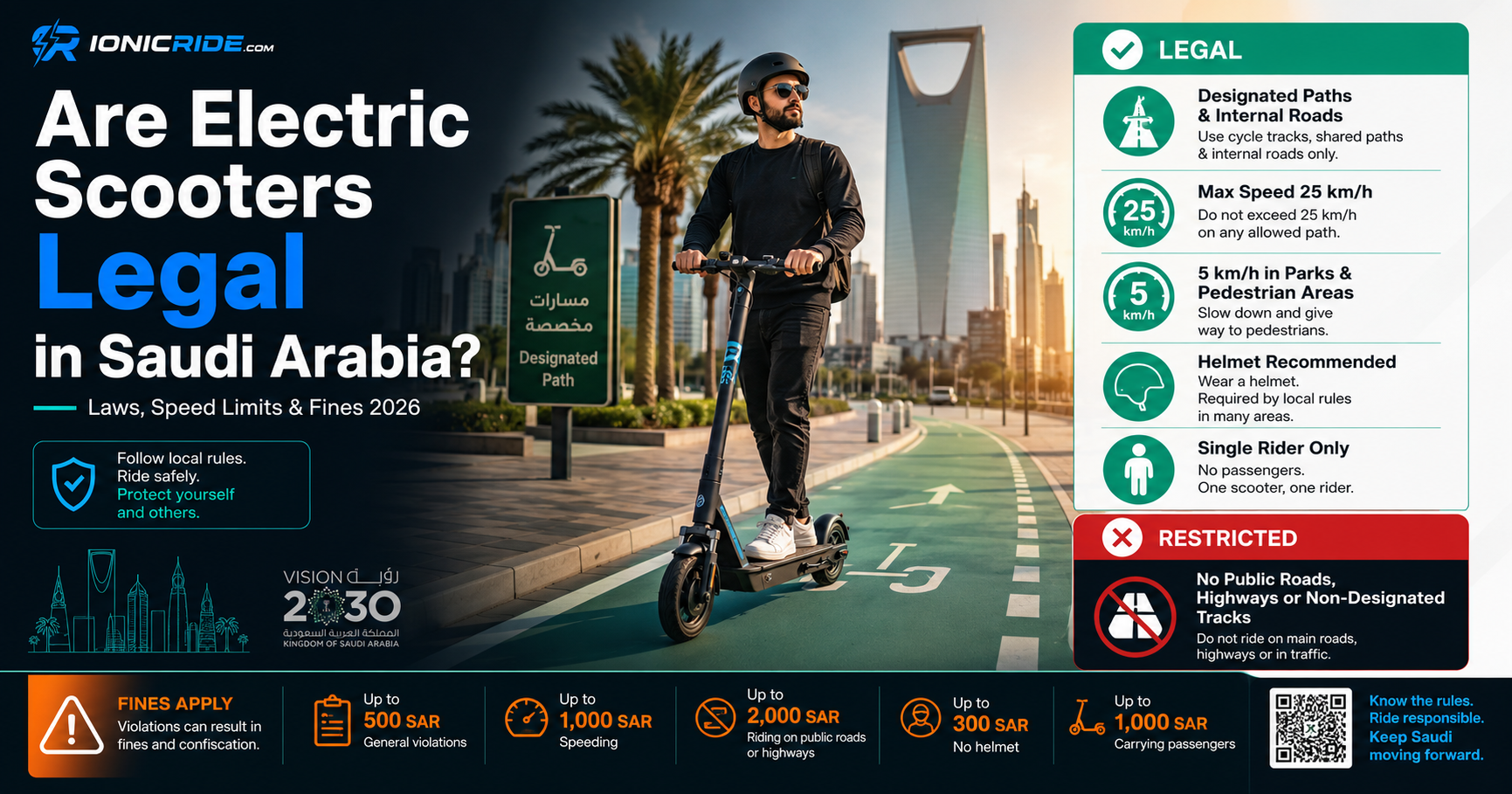
Are Electric Scooters Legal in Saudi Arabia?
Are Electric Scooters Legal in Saudi Arabia? Laws, Speed Limits & Fines 2026
Short answer: yes, electric scooters are legal in Saudi Arabia. They are not banned, you can buy one, and you can ride one. But “legal” comes with a big asterisk — where you ride and how fast matter far more than most people expect.
Here’s the part that trips people up. Unlike Dubai, which has one clear e-scooter law that spells out the permit, the speed and the fines, Saudi Arabia spreads its rules across several different bodies. One sets product and import standards. Another sets rental and operating rules. The traffic police and local municipalities handle the actual riding. So when you search “are e-scooters legal in Saudi Arabia” and get five different answers, that’s why — the answer genuinely depends on which rule you’re looking at.
This guide pulls all of it into one place: the legality, the real speed limits, the minimum age, where you can and can’t ride, the SASO product rules that affect buyers, and what we actually know about fines. Where the rules are still fuzzy, I’ll say so plainly instead of pretending there’s a clean number.

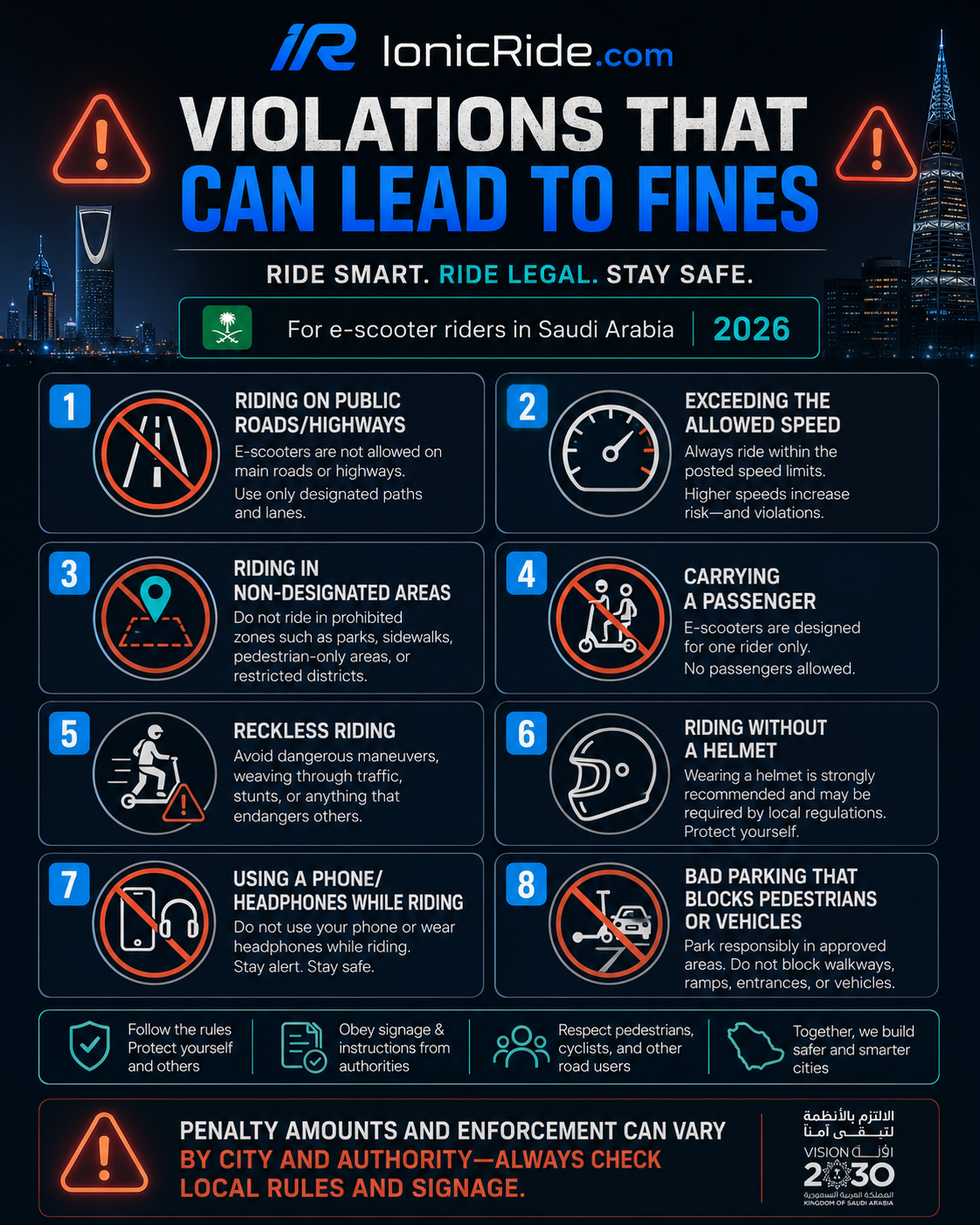
Why There’s No Simple Answer (And Who Actually Makes the Rules)
If you’ve ridden in Dubai, you know how it works there: one Executive Council resolution, one RTA permit, one published list of fines. Clean. Saudi Arabia isn’t set up that way yet.
In the Kingdom, e-scooter rules sit across at least three different authorities. Understanding who does what is the key to not getting confused by conflicting articles online.
Because no single nationwide e-scooter traffic law exists yet, the practical reality is this: ride only in clearly designated areas, keep your speed conservative, and treat the local municipality’s rules as the final word. If a path is built for bikes and scooters, you’re fine. If you’re weaving through traffic or down a busy sidewalk, you’re not — regardless of what any single rule technically says.
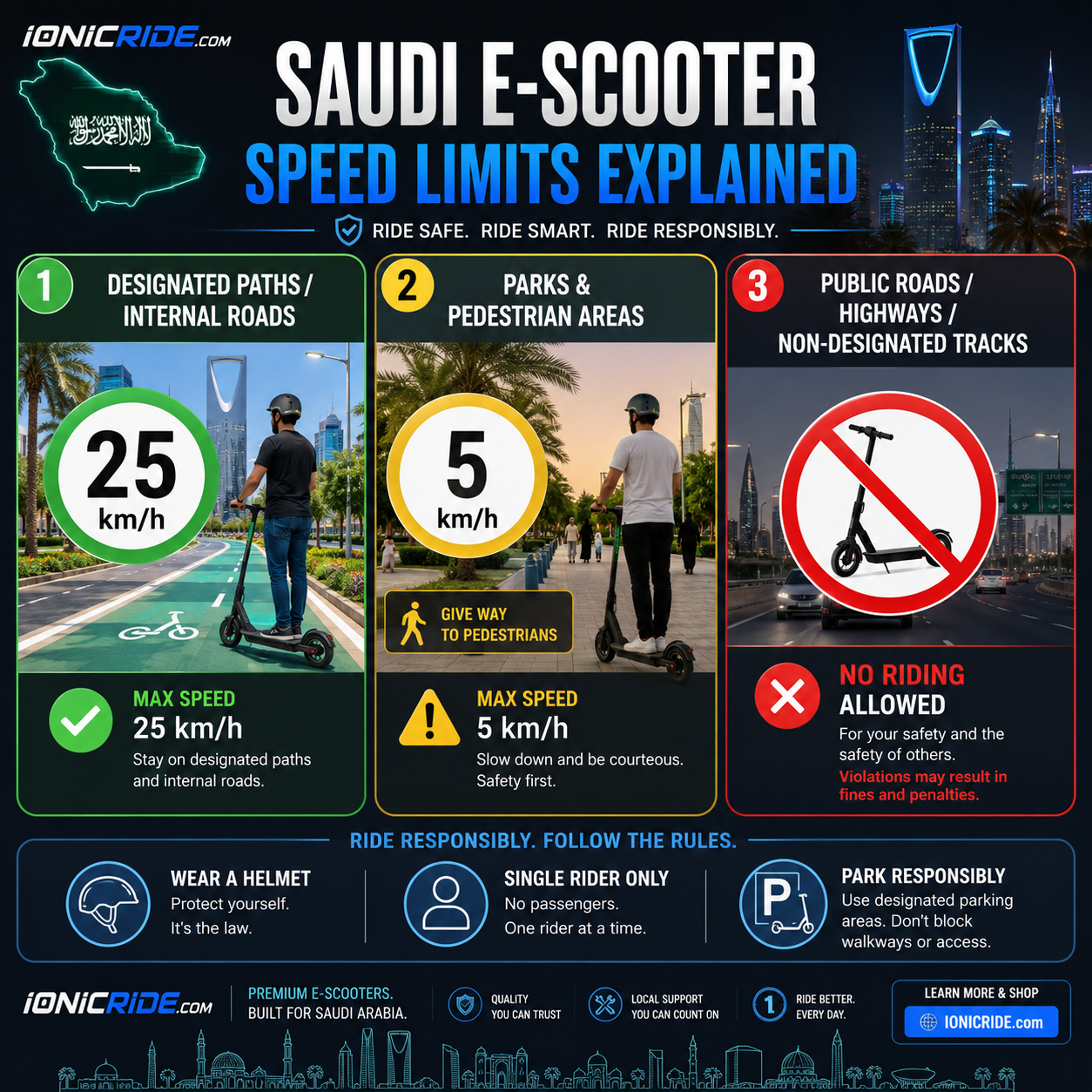
E-Scooter Speed Limits in Saudi Arabia — The Real Numbers
This is where most articles get sloppy and just print one number. The truth is the limit changes depending on the device, the operator and the surface you’re on. Here’s what the different sources actually say.
Saudi Arabia E-Scooter Speed Limits by Source & Location
| Where / What | Limit | Source |
|---|---|---|
| Shared rental e-scooter | 20 km/h | Rental operator terms |
| Shared rental e-bike | 25 km/h | Rental operator terms |
| On a cycle track | 25 km/h | Municipal rental rules |
| Inside a public park | 5 km/h | Municipal rental rules |
| Privately owned scooter | Not clearly published | — |
So what do you do with that? My honest advice as someone who works on these machines every week: treat 20 km/h as your working ceiling on any shared path, and slow to a walking pace anywhere pedestrians are around. Inside parks, the 5 km/h rule is basically “go at walking speed.” It feels slow, but it’s the number that keeps you out of trouble and keeps you from hurting someone.
Plenty of scooters sold online will do 40, 50, even 60 km/h. The fact that your scooter can go that fast has nothing to do with whether it’s legal to ride that fast. In designated Saudi areas the operating limits are well below most scooters’ top speed — so the speed cap is on the rider, not the machine. A fast scooter ridden at 20 km/h is fine; a slow scooter ridden recklessly on a sidewalk is not.
Minimum Age & Licence Rules
Minimum age: 17
Saudi Arabia’s rental regulations set the minimum age for scooter users at 17 years. That’s worth flagging for anyone coming from the UAE, where the minimum is 16. It’s a small difference, but if you’ve got a 16-year-old who rides legally in Dubai, that same rider is under the line in Saudi Arabia.
For privately owned scooters the published guidance is thinner, but 17 is the sensible benchmark to follow. Younger children should stick to quiet private property — not public paths.
Do you need a driving licence?
For ordinary low-power e-scooters, there’s no published requirement to hold a driving licence in Saudi Arabia. This is a genuine difference from Dubai, where you need either an RTA permit or a driving licence to ride legally.
But a word of caution here: the framework is still developing, and it can vary by city and by how powerful your device is. If you’re riding something fast or high-powered, don’t assume you’re exempt just because the rule was written with gentle commuter scooters in mind. When in doubt, ask the local municipality before you rely on the no-licence position.
Where You Can — and Can’t — Ride
This is the single most important section, because it’s where almost all the fines and confiscations actually happen. Saudi Arabia’s rules treat scooters as belonging on dedicated infrastructure, not mixed in with cars or pedestrians.
- Designated cycle tracks — the natural home for scooters, up to 25 km/h.
- Dedicated scooter and bicycle lanes in cities and new developments.
- Approved waterfront and recreational areas — Jeddah Corniche-style promenades, riverside and resort paths where scooters are permitted.
- Inside parks — but only at 5 km/h, essentially walking pace.
- Public roads and fast streets — scooters are not meant to mix with car traffic.
- Pedestrian-only sidewalks — riding among walkers is discouraged or prohibited, and you should dismount in crowded foot areas.
- Non-designated tracks — if it isn’t an approved path, assume it’s off-limits.
- Outside authorised rental zones — shared scooters are geofenced and will slow or stop if you leave the approved area.
Riyadh and Jeddah specifically
Both cities have growing cycle-path and waterfront networks, and shared rental scooters operate in approved zones. The detail of which paths are approved is set by each city’s municipality and changes as new infrastructure opens, so the safest move is to use the rental apps’ in-app maps as a live guide to where riding is permitted — even if you own your own scooter. If the rental operators won’t let their scooters into an area, that’s a strong signal you shouldn’t ride a private one there either.
SASO Rules: What They Mean If You’re Buying or Importing
This is the part buyers usually ignore — and then regret. SASO sets the product standards for electric personal mobility devices in Saudi Arabia. There’s a Technical Regulation covering electric scooters that controls what can legally be sold and imported, including labelling, safety and conformity through the SABER certification system.
For most riders, this is invisible — you buy a scooter from a proper retailer and the compliance has already been handled. But it matters in two real situations:
- Importing for sale: If you’re bringing scooters in commercially, they must meet SASO/SABER conformity or they can be held at customs. This is a seller problem, but it explains why some cheap grey-market models never appear through official channels.
- Buying a grey-import scooter: A scooter brought in without proper conformity may lack the documentation you’d want for warranty, service or resale — and in a worst case can run into market-availability issues. The cheaper “direct from overseas” deal can cost you later.
If you’re flying into Saudi Arabia with your own scooter, the bigger hurdle usually isn’t SASO — it’s the airline. Most airlines cap lithium batteries around 160Wh and many ban large scooter batteries outright, because they’re a fire risk in the hold. A typical commuter scooter battery is well over that limit. Check your airline’s exact lithium-battery policy before you pack, or you may be separated from your scooter at the gate.
Fines & Enforcement — What We Actually Know
Here’s where I have to be straight with you, because a lot of articles invent a tidy fine table that doesn’t really exist. Saudi Arabia does not publish a single dedicated e-scooter fine schedule the way Dubai publishes its AED 200–300 list.
What we do know: comparable bicycle and motorbike conduct violations under the General Department of Traffic have historically sat in a SR150 to SR300 band. Enforcement is handled by traffic police and municipalities, and rental operators can also charge their own penalties for misuse — riding outside the zone, parking badly, or damaging a scooter.
Because the framework is still developing and enforcement varies between cities, treat any exact riyal figure you read — including the SR150–SR300 band above — as indicative rather than fixed. The reliable way to avoid a fine isn’t memorising numbers; it’s simple: ride in designated areas, keep your speed down, wear a helmet, and don’t ride among pedestrians or in traffic. Do that and the fine schedule stops being your problem.
Saudi Arabia vs UAE — Quick Comparison
A lot of our readers ride in both countries, so here’s how the two frameworks line up. The headline: the UAE (especially Dubai) is more formalised, Saudi Arabia is more fragmented but heading the same direction.
E-Scooter Rules — Saudi Arabia vs UAE (2026)
| Rule | Saudi Arabia | UAE (Dubai) |
|---|---|---|
| Legal to ride? | Yes | Yes |
| Minimum age | 17 | 16 |
| Speed cap (typical) | 20 km/h | 20 km/h |
| In parks | 5 km/h | Designated zones |
| Permit / licence | Not required (low-power) | RTA permit or licence |
| Helmet | Required for rentals | Mandatory (AED 200 fine) |
| Single national law? | No — fragmented | Yes (Res. 13/2022) |
| Published fine schedule? | No | Yes |
Riding in the Emirates too? Here’s the full UAE breakdown: Are E-Scooters Legal in the UAE — Laws, Fines & Zones 2026
The Factor No Law Covers: Saudi Heat
You can follow every rule perfectly and still have a miserable, expensive time if you ignore the heat. Riyadh and Jeddah summers regularly push past 45°C, and that affects both you and your scooter.
- Battery range drops. Lithium batteries lose noticeable range in extreme heat, and sustained high temperatures shorten their lifespan. The range printed on the box assumes mild conditions — knock a chunk off it for a Saudi summer afternoon.
- Charging in heat is hard on the pack. Never charge a hot battery, and never leave a scooter charging in direct sun or a parked car. Let it cool first.
- Rider safety is the real risk. Mid-afternoon summer riding carries genuine heat-stress risk. Ride early morning or after sunset, carry water, and don’t push a long ride in peak heat.
This is the same advice we give UAE riders, and it’s just as true across the border. The machines and the bodies riding them don’t care which country’s law applies — physics is physics.
Full hot-climate riding and battery-care guide: Gulf Summer Survival Guide for E-Scooters
Common Mistakes & Things People Forget
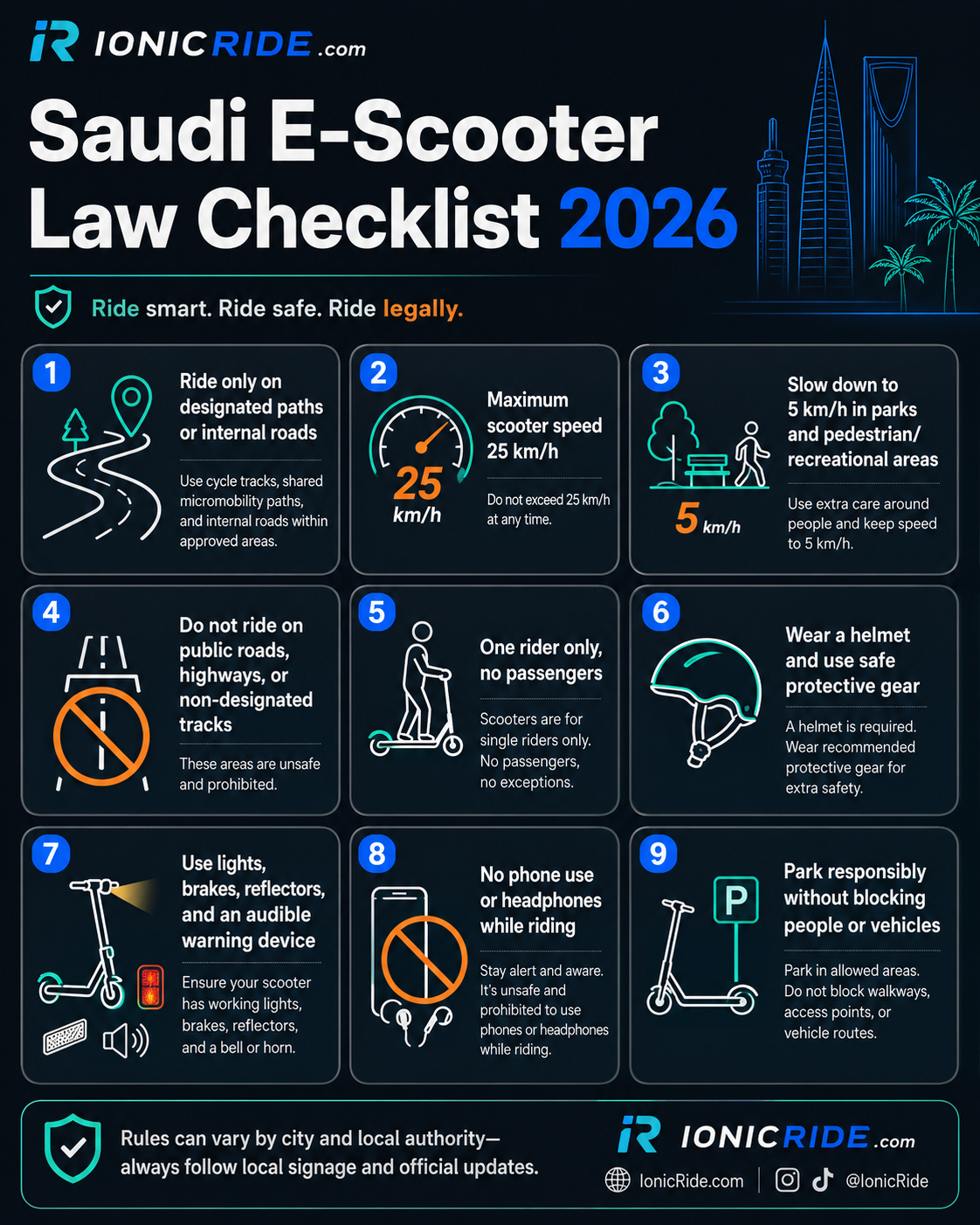
- Assuming Saudi rules are the same as the UAE — the minimum age is 17, not 16.
- Riding on the road or sidewalk because “there’s no scooter lane here” — that’s exactly how you get fined or confiscated.
- Believing your scooter’s top speed is a legal speed — the operating limits are far lower.
- Flying in with a big-battery scooter without checking the airline’s lithium rules first.
- Buying a grey-import model with no SASO/SABER paperwork, then struggling with warranty or service.
- Riding through a park at full speed — it’s a 5 km/h, walking-pace zone.
- Skipping the helmet because “no one’s checking” — it’s the cheapest insurance you’ll ever buy.
- Trusting one online article (including this one) as gospel — rules are still evolving, so verify locally before a big trip.
Yes — legal to own and ride. Not banned, no special licence needed for ordinary low-power scooters.
The catch is location and speed. Designated cycle tracks and scooter lanes only, ~20 km/h working ceiling, 5 km/h in parks, and stay off roads and sidewalks.
Minimum age is 17 — a year higher than the UAE, so double-check if a younger rider is involved.
The framework is still fragmented across SASO, the municipalities and the traffic department, with no single published fine schedule. That means the rules will keep tightening as cities like Riyadh and Jeddah build out their infrastructure. Ride conservatively in approved areas and you’ll stay well within the law as it stands in 2026.
Saudi Arabia E-Scooter Law — Full FAQ
Yes. E-scooters are legal to own and ride and are not banned. The condition is where and how you ride — designated cycle tracks, scooter lanes and approved areas only, not public roads, fast streets or pedestrian sidewalks. There is no single nationwide e-scooter traffic law yet; the rules come from SASO (products), the Ministry of Municipalities and Housing (operations and rentals), and the traffic department and local municipalities (conduct and zones).
There’s no single nationwide figure. Shared rental e-scooters are capped at 20 km/h and e-bikes at 25 km/h. Municipal rental rules allow up to 25 km/h on cycle tracks and just 5 km/h inside parks. For privately owned scooters no single number is clearly published, so treat 20 km/h as your working ceiling and slow to walking pace around pedestrians.
17 years, as set in the rental regulations — one year higher than the UAE’s 16. For privately owned scooters, 17 is the sensible benchmark. Younger children should only ride on quiet private property, not public paths.
For ordinary low-power e-scooters there’s no published requirement to hold a driving licence — unlike Dubai, which requires an RTA permit or driving licence. This can vary by city and by how powerful the device is, and the framework is still developing, so don’t assume a fast or high-powered scooter is exempt. Check with the local municipality if you’re unsure.
Yes, in both cities, within approved zones. Riyadh and Jeddah have growing cycle-path and waterfront networks and shared rental scooters operate in geofenced areas. The exact approved paths are set by each city’s municipality and change as new infrastructure opens, so use the rental apps’ in-app maps as a live guide to where riding is permitted — even if you ride your own scooter.
It’s the product and import standard set by the Saudi Standards, Metrology and Quality Organization, governing what scooters can legally be sold and imported (labelling, safety and SABER conformity). It mainly affects sellers and importers, but buyers should care too — a grey-import scooter without proper conformity can lack warranty and service documentation and may face customs or market issues.
There’s no single dedicated e-scooter fine schedule like Dubai’s. Comparable bike and scooter conduct violations have historically sat in a SR150–SR300 band under the General Department of Traffic, and rental operators can charge their own penalties for misuse. Because enforcement is developing and varies by city, treat any specific figure as indicative and focus on riding in designated areas to avoid trouble.
For personal use, generally yes. Commercial imports must meet SASO/SABER conformity. For a single personal scooter, the bigger obstacle is usually the airline’s lithium-battery policy — most cap batteries near 160Wh and many ban large scooter packs outright. Check your airline before you travel, and ride only in designated areas once you arrive.
The legal side is manageable; the heat is the real factor. Summers in Riyadh and Jeddah regularly top 45°C, which cuts battery range, ages the pack faster, and carries genuine heat-stress risk for riders. Ride early morning or after sunset, stay hydrated, and never charge or store a scooter in direct sun or a hot car.