Electric Scooter in Dubai Summer — Complete Survival Guide
Electric Scooter in Dubai Summer — Complete Survival Guide (May–September 2026)
The battery that delivered 35 km in February now cuts off at 22 km. The tyre that was fine in April blows on a Thursday morning in June. The fold mechanism that worked smoothly through winter is gritty and stiff after the first sandstorm of the season.
None of this is a surprise to us. Dubai summer is a specific, well-understood stress test for every component of an electric scooter. What surprises most riders is how much of the damage is preventable — and how much of it comes from things they do with the scooter, not from the heat itself.
Real failure patterns, real ranges, real fixes. Everything you need to ride through the summer and come out the other side with the same scooter you started with.
What Dubai Summer Actually Looks Like for Your Scooter
Most scooter specs are tested at 25°C in European labs. Dubai’s summer is a different operating environment entirely. Before getting into what to do, here’s what the scooter is actually dealing with:
That asphalt number is what most people miss. While you’re thinking about 45°C ambient air, your scooter’s deck and battery are sitting millimetres above a surface that’s hitting 65–70°C in direct midday sun. Any scooter parked outside in July is not sitting in 45°C heat — it’s sitting in a radiant oven that pushes battery surface temperatures well beyond the operating spec of the cells inside.
A scooter battery left in direct Dubai sun in July can reach 60°C+ surface temperature — 25 degrees above the optimal charging and storage temperature for lithium-ion cells. At that temperature, the battery isn’t degrading slowly over months. It’s being damaged actively, every hour it sits there. This is why the most important summer habit has nothing to do with how you ride — it’s where you park.
Real Range in Dubai Summer — What the Numbers Look Like
This is one of the most common questions from Dubai riders: “My scooter used to do 35 km, now it barely manages 22. Is the battery broken?” Usually, the answer is a combination of seasonal reduction and early degradation. Here’s how to separate them:
Typical Range Impact — Dubai Conditions by Season
Research Guide| Condition | Claimed Range | Real Range | Loss | Status |
|---|---|---|---|---|
| EU test conditions (25°C lab) | 45 km | 45 km | — | Baseline |
| Dubai winter (Nov–Feb, 22°C) | 45 km | 35–39 km | ~13–22% | Normal |
| Dubai spring (Mar–May, 32°C) | 45 km | 30–35 km | ~22–33% | Expected |
| Dubai summer (Jun–Sep, 40°C+) | 45 km | 25–30 km | ~33–44% | Plan for this |
| Peak heat (Jul–Aug, 45°C+) | 45 km | 22–26 km | ~42–51% | Reduced |
| Battery at 18 months daily use | 45 km | 18–22 km | ~51–60% | Battery check needed |
Apply a 50% discount to any claimed range when planning summer commutes in July–August on a scooter that’s over a year old. A 45 km claimed scooter gives you roughly 22–25 km in peak summer with battery age factored in. If your commute is over 10 km each way, build in a charging plan or consider a higher-capacity model. Running to empty in Dubai summer is genuinely stranding — not just inconvenient.
When to Ride — The Summer Timing Guide
This matters for both the scooter and the rider. Most heat-related scooter stress happens during sustained riding in peak afternoon temperatures. Most rider heat incidents happen in the same window. The solution to both is the same: ride in the right windows.
The early morning window is genuinely special in Dubai summer. Before 8am, ambient temperatures are at their lowest, the roads are quiet, and the scooter performs at its summer best. Early morning June riding on JBR, Marina Walk, or the Al Quoz cycling path is a completely different experience from a midday July commute through Deira traffic.
What Actually Breaks — Workshop Failure Patterns
Here’s what comes in, in order of frequency:
The Battery Protection Guide — Seven Rules
Battery degradation in Dubai heat is real, measurable, and largely preventable. Most riders who come to us with a degraded battery made the same two or three mistakes repeatedly. Here’s the complete list of what not to do — and what to do instead:
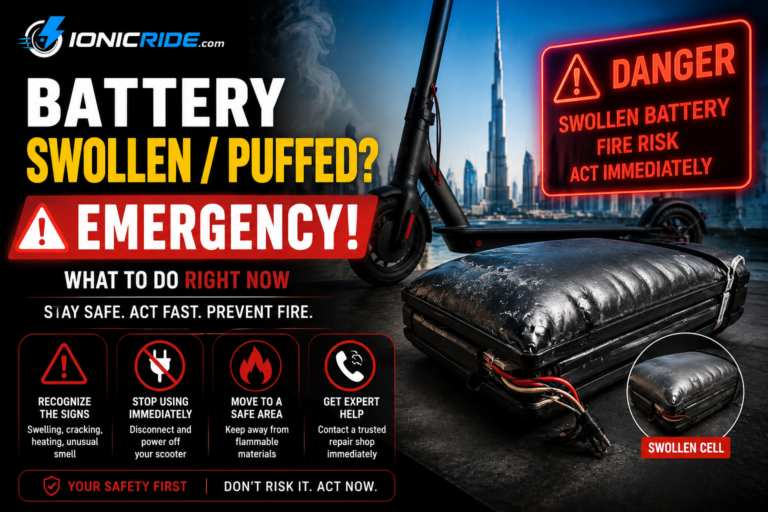
Battery swollen or puffed up? Stop riding immediately and read this: Swollen E-Scooter Battery in Dubai — Do This in the Next 30 Minutes
Tyre Care in Dubai Summer — The Overlooked Half
Most riders check battery range obsessively and ignore tyre pressure until something goes wrong. In Dubai summer, that’s a costly habit.
- Air expansion: The air inside a pneumatic tyre expands significantly between a cool 6am morning and a 45°C midday. A tyre correctly inflated at 7am can be over-inflated by 3–5 PSI at 2pm. Over-inflated tyres on Dubai’s construction debris roads are puncture risks — the hardened tyre has less ability to absorb sharp debris without rupturing.
- Rubber degradation: Sustained heat exposure accelerates tyre rubber ageing — the rubber stiffens and microcracks develop. You won’t see them, but the tyre becomes more vulnerable to catastrophic failure. A tyre that looks fine to the eye may be significantly compromised internally after two Dubai summers.
- Hot asphalt contact: At 65–70°C, the asphalt surface is actively softening tyre rubber on contact. Stop-start commuting keeps the tyre on hot tarmac repeatedly. Tubeless tyre sealant can liquify unevenly in sustained high heat, reducing puncture protection.
- Check pressure before your first ride of the day — before the tyre has heated up. This gives you the cold baseline reading. Check 3× per week minimum in June–September.
- Inflate to the lower end of the recommended range in summer. If the manufacturer says 40–50 PSI, inflate to 40–42 PSI in summer. The thermal expansion will bring it to the right operating pressure as you ride.
- Inspect tyres weekly for embedded debris — screws, wire fragments, tile chips. Dubai construction sites shed debris continuously onto cycling paths. Catching a small embedded screw before it causes a full flat is worth 30 seconds of inspection time.
- For tubeless tyres: top up sealant every 4–6 months in Dubai (not the standard 6–12 months for cooler climates). Sealant dries out faster in sustained heat, leaving the tyre unprotected against small punctures.
Sand, Dust & the Fold Mechanism — The Summer Grind
Dubai’s construction environment produces fine silica dust year-round, but summer sandstorms concentrate it dramatically. This dust is fine enough to get into fold mechanism joints, motor cooling vents, brake cable housing, and display connection ports. In winter, the occasional rain washes some of it away. In summer, it just accumulates.
The fold mechanism clean is 15 minutes of DIY work with a dry brush, a can of compressed air, and a silicone spray lubricant.
Rider Safety in Dubai Summer — Because the Scooter Can Handle It Better Than You Can
This section is short because most riders underestimate rider risk relative to scooter risk. A quality scooter handles Dubai summer fine if you follow the rules above. The rider is the more fragile component.
Standing on a moving scooter in direct 45°C sun creates a specific heat stress scenario: you’re exerting physical effort to balance, braking, and steering, you’re wearing a helmet which raises head temperature, and you’re not in shade at any point. A 20-minute afternoon ride in July delivers significant heat load. Signs of heat exhaustion — headache, dizziness, nausea — can come on faster than most riders expect. If you feel any of these mid-ride: stop immediately, move to shade, hydrate. Do not try to complete the route.
- Hydrate before riding, not just during. By the time you feel thirsty in Dubai summer heat, you’re already dehydrated. Drink 500ml of water before a summer morning commute, carry 500ml on the scooter for anything over 15 minutes.
- Light, breathable clothing — all skin covered. Counterintuitive but correct: covered skin in light fabric is cooler than bare skin in direct sun on a moving scooter. Sunburn happens fast on an exposed arm in Dubai July.
- Helmet is not optional in summer. Some riders think about removing the helmet to stay cooler. A helmet creates shade for your head, which is more thermally vulnerable than your torso. A vented helmet is your friend — a bare head in direct Dubai sun is worse.
- Plan a route with shade stops for rides over 15 minutes. Every major Dubai area has malls, covered parking, and shaded structures accessible from cycling paths. Know where your shade stops are before you leave.
Monthly Summer Maintenance Checklist
Stick this somewhere visible.
- Battery health check — Use the app (Xiaomi Home, Segway, Navee app) to check battery temperature and cycle count. Note if range has dropped more than 10% vs last month. Flag for workshop check if it has.
- Clean and lubricate fold mechanism — Dry brush, compressed air, silicone spray on the latch pin and stem hinge. 15 minutes. Prevents the #3 most common summer workshop visit.
- Check tyre pressure and inspect visually — Pressure in the morning before riding. Visual inspection for embedded debris, sidewall cracks, rubber hardening. Run your thumb around the full tyre circumference to feel for anything embedded.
- Test brakes for modulation and response — Both levers should engage firmly before reaching full pull. Spongy front brake = cable needs tightening. Rear disc should stop the scooter cleanly. If pads are worn to the wear indicator, replace now — don’t run summer months on worn pads in wet-road conditions when it does rain.
- Check all lights and the display — Evening riding windows in summer make front and rear lights non-optional. Test both. Check the display for any error codes that appeared during the month — the BMS logs heat events even if the scooter didn’t visibly throttle.
- Check stem bolts and handlebar clamps — Summer heat causes metal expansion and contraction cycles that can loosen fasteners. The handlebar clamp and stem-to-deck bolt are the two that matter most for rider safety. 2-minute check with the right hex key.
- Inspect IP seals if your scooter is over 18 months old — The charging port rubber cap, the brake connector cover, and any seal around the battery access panel. If any look cracked or hardened, replace before Dubai’s occasional summer rainstorms push moisture into compromised seals.
Battery failing or range dropping fast? Read the full comparison: Why Your Battery Dies Too Fast in Dubai — Complete Troubleshooting Guide
Summer Notes by Popular Model
Some models need specific attention in Dubai summer beyond the general rules above:
- 4 Pro (365Wh): Smallest battery in the commuter range — cycles more frequently per km, accumulates thermal stress faster. Stick to 80% charge limit strictly in summer. Battery at 18 months+ will feel the range drop most sharply in July. First in the Xiaomi family to need summer battery attention.
- 4 Ultra (IP55): Better IP protection helps with dust ingress — seal inspection is less critical than on IPX4 models. The 24.5 kg weight means the deck-to-asphalt radiant heat path is more direct. Park off the ground on a stand if possible.
- 5 Max (477Wh): Rated to +40°C — technically below Dubai’s peak. The thermal management handles it, but sustained high-power riding on the hottest afternoons may trigger brief throttling. Eco mode in summer is the right default.
- IPX5 is a genuine summer advantage — dust ingress through seals is less of a concern than on IPX4 models. Self-healing tyres mean the tyre blowout risk from embedded debris is lower than on standard pneumatics.
- The 551Wh battery handles summer better than smaller packs — more capacity means fewer charge cycles per week, less cumulative thermal stress. Still follow the 80–90% charge limit and shade parking rules.
- The heavier weight (24.3 kg) means more momentum carrying heat from the asphalt surface. Same parking rules apply — get it off the hot ground.
- Quad suspension means more joints and pivots that need sand/dust management. Monthly lubrication of all suspension pivot points is important in summer — more so than on rigid-frame scooters.
- Tubeless tyres (both GT3 models) are a summer advantage — sealant handles most small debris punctures automatically. Top up sealant every 4–5 months in Dubai heat rather than the standard 6–12.
- IPX5 protection is adequate for Dubai summer conditions — rain events and morning condensation are handled. Charging port cover should always be replaced after charging.
Dubai Summer E-Scooter — Complete FAQ
Expect 20–35% range reduction in peak summer (June–September). A scooter with 45 km claimed range delivers approximately 22–28 km in July–August depending on riding conditions, rider weight, and road type. For commute planning, apply a 40–50% discount to claimed range in peak summer — especially if the battery is over 12 months old. See the range table above for model-specific seasonal figures.
Before 9am and after 6pm. The early morning window (5:30–9am) is best — coolest temperatures, best battery performance, quietest roads. Avoid 11am–5pm entirely in June–September. This protects both the scooter and the rider — sustained outdoor exertion in 45°C+ direct sun carries genuine heat exhaustion risk even on a short commute.
Not in direct sun — ever. Battery surface temperatures reach 60°C+ in direct July sun. That’s active, permanent cell damage, not seasonal range reduction. Park in shade at minimum. Covered parking or indoors is ideal. A reflective thermal cover reduces surface temperature meaningfully if outdoor parking is unavoidable.
No — charge to 80–90% for daily use. Full charge + high ambient temperature is the fastest combination for permanent battery degradation. Only charge to 100% when you genuinely need the full range for a specific longer ride. If tomorrow is a normal commute, 80–90% is the right daily habit.
Batteries degrade from heat exposure and charging habits. Tyres blow from pressure spikes and debris on hot construction zone roads. Fold mechanisms jam from sand accumulation in joints. Most of these are preventable with the monthly checklist in this guide.
Seven rules: (1) Never park in direct sun. (2) Charge in air-conditioned rooms only. (3) Let scooter cool 15 minutes after riding before charging. (4) Charge to 80–90% daily. (5) Use Eco mode for summer commutes. (6) Don’t leave at 100% charge for days without riding. (7) Watch for early warning signs — sudden range drops, unusual heat from deck or charger. See the full seven-step guide above.
Before every ride, or at minimum 3× per week. Dubai heat causes significant air expansion in tyres between a cool morning and peak afternoon. Always check cold (before riding). Inflate to the lower end of the recommended range to allow for thermal expansion during riding.
Yes — in the right windows. Before 9am and after 6pm are safe for most riders. Midday is genuinely dangerous — not for the scooter, but for rider health. Heat exhaustion and heat stroke are real risks in sustained 45°C+ direct sun. Stay hydrated, cover exposed skin, keep rides under 20 minutes if you don’t have shade stops planned, and don’t push through dizziness or headache on a moving scooter.
Both can look the same. Test: charge fully, ride in the early morning when it’s coolest, note the range. If you’re getting 70–80% of your winter range — seasonal reduction, normal. If you’re getting less than 60% of winter range — early battery degradation, bring it in for a health check. A workshop battery test costs AED 60–80 and will tell you exactly where the cells are. Catching it at 60–65% capacity is repairable at lower cost than waiting for it to hit 40–50%.
Only if you genuinely won’t ride it. If you’re going away for the summer, store at 50–60% charge in an air-conditioned space. Don’t store at 100% — lithium cells sitting at full charge in heat degrades them even without riding. If you plan to ride through summer, riding is not the problem — poor storage and charging habits are.
Dubai summer doesn’t destroy electric scooters. Bad habits in Dubai summer do.
The riders whose scooters come in for routine September service — a brake pad, a clean and lube, a tyre inspection — share a different backstory: park in shade or indoors, charge in the air-conditioned room, ride before 9am, never leave it sitting at 100% charge.
The rules aren’t complicated:
- Park in shade — always
- Charge in AC — always
- Charge to 80–90% — daily
- Ride before 9am or after 6pm — summer
- Monthly clean, monthly tyre check — year-round, more important in summer
Follow those five and your scooter will outlast Dubai summer intact. Ignore them and we’ll see you in September.