E-Scooter Brakes Not Working: Disc vs Drum, Adjustment, Pad Replacement Dubai
You squeeze the brake lever and the scooter barely slows down. Or the brakes squeal every time you use them. Or they feel spongy — you have to pull the lever almost all the way before anything happens. Your brakes aren’t working properly and on Dubai’s roads, that’s not something you can ignore.
The problem is that e-scooters come with two completely different brake systems — disc brakes and drum brakes — and they fail in different ways and need different fixes. Adjusting a cable on a drum brake system won’t do anything if the real issue is worn disc pads. And trying to bleed hydraulic lines without knowing what you’re doing can make the brakes worse, not better. Dubai dust and heat make both systems degrade faster than in cooler climates.
This is how to diagnose exactly what’s wrong with your brakes, fix what you can yourself, and know when it’s time for a shop. Disc vs drum, mechanical vs hydraulic, adjustment vs pad replacement — all covered with actual Dubai costs.
What Type of Brakes Do You Have?
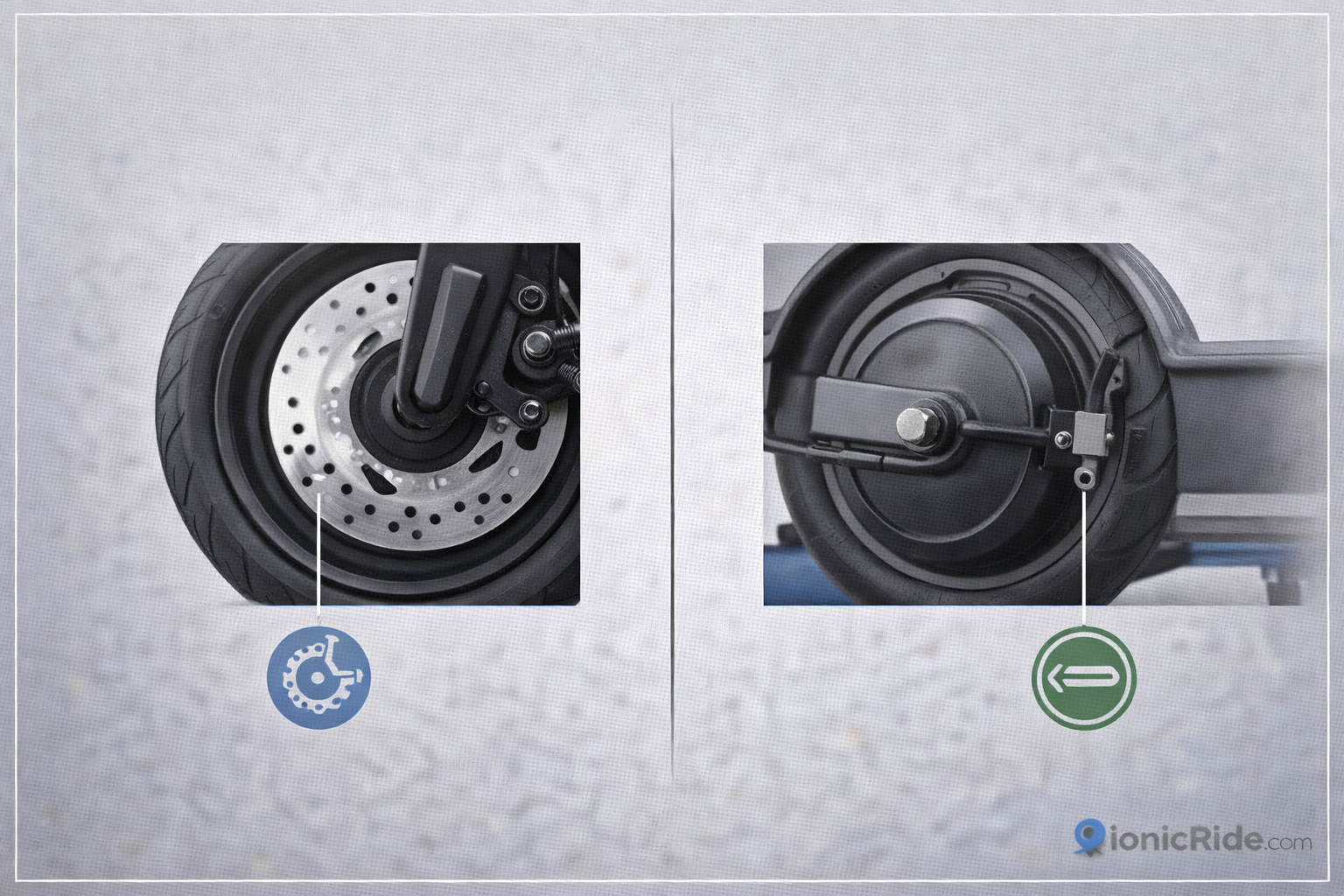
Before you diagnose anything, you need to know which brake system your scooter has. The fix is completely different depending on the answer. Most scooters have one type on the front and the same or different type on the rear.
Brake Types: How to Identify Yours
Identification| Brake Type | What It Looks Like | Common On |
|---|---|---|
| Mechanical disc | A metal disc (rotor) attached to the wheel hub. A small caliper clamps onto it when you brake. A single cable runs from the lever to the caliper. | Most Xiaomi models. Segway G30 / Max. Mid-range scooters AED 2,000–3,500. |
| Hydraulic disc | Same disc and caliper setup as mechanical, but instead of a cable, a hydraulic hose (fluid-filled tube) runs from the lever to the caliper. The hose is thicker and more rigid than a cable. | Segway P100 / P100S. Higher-end scooters AED 3,500+. Better stopping power, less maintenance. |
| Drum (internal) | No disc visible on the wheel. The brake mechanism is hidden inside the wheel hub. A cable runs from the lever into the hub. | Budget scooters under AED 1,500. Older models. Some rear brakes on mid-range scooters. |
| Rim brake (friction) | Brake pads press directly against the tyre or the rim itself. Very basic setup. | Very cheap scooters only. Rare on anything sold in Dubai above AED 800. |
Look at the front wheel hub. If you see a metal disc (usually 120–160mm diameter) with a clamp-style caliper next to it, that’s disc brakes. If the hub is just a plain round cover with no disc, it’s drum brakes. The rear is the same logic — disc visible or not.
Mechanical Disc Brakes: Symptoms and Fixes
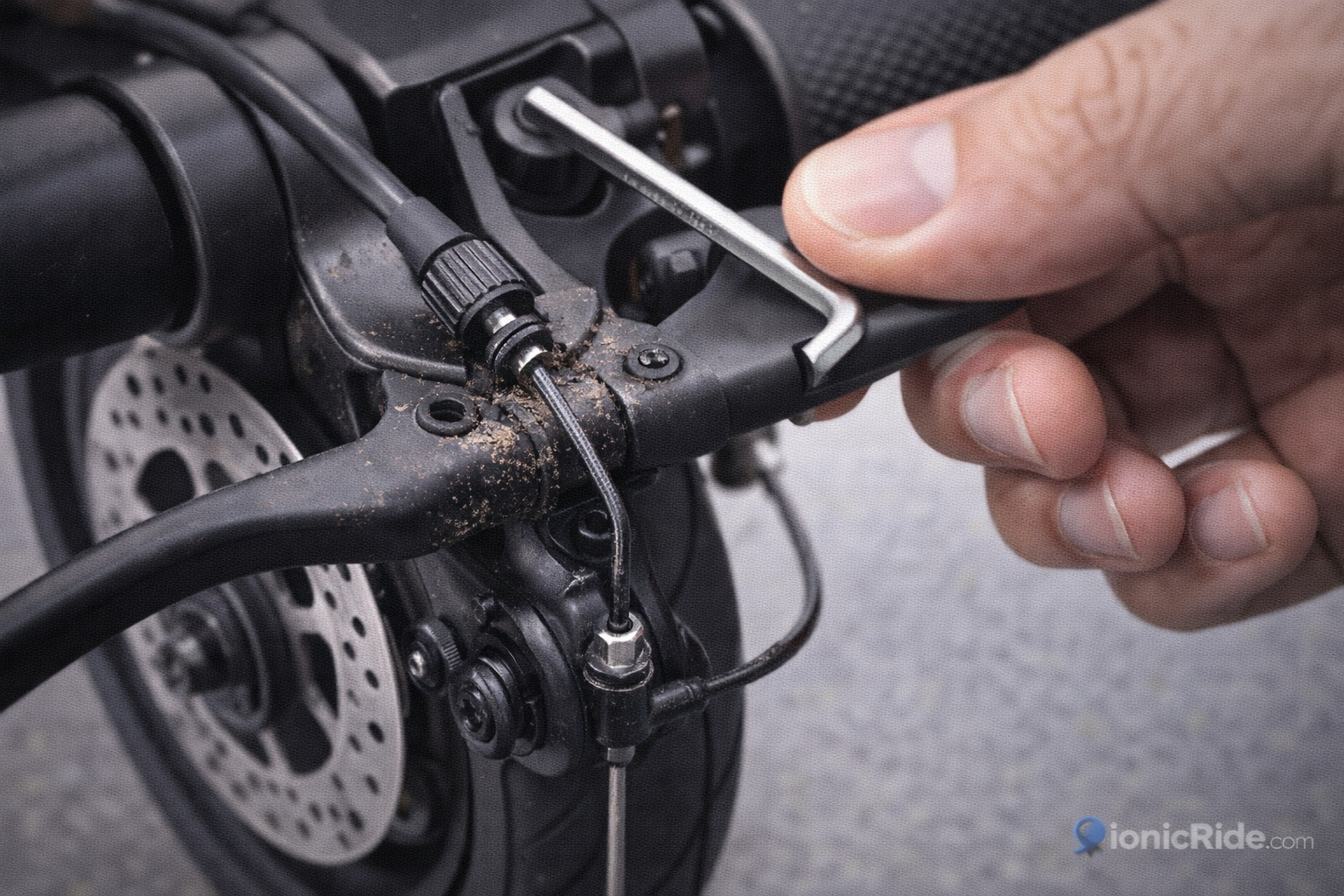
Mechanical disc brakes are the most common setup on mid-range Dubai scooters. They use a cable to pull the brake pads against the rotor. They’re good brakes — but the cable and pad system has specific failure modes.
Brakes Feel Soft or Need Full Lever Pull
The cable has stretched or the pads have worn down. Both are normal over time. Check the cable first — if it’s visibly slack when the lever is released, the cable needs tightening. Most calipers have an adjustment screw or dial on the caliper body itself. Turn it to take up the slack. If the cable is fine but the brakes are still weak, the pads are worn. Time to replace them.
Brakes Are Squealing
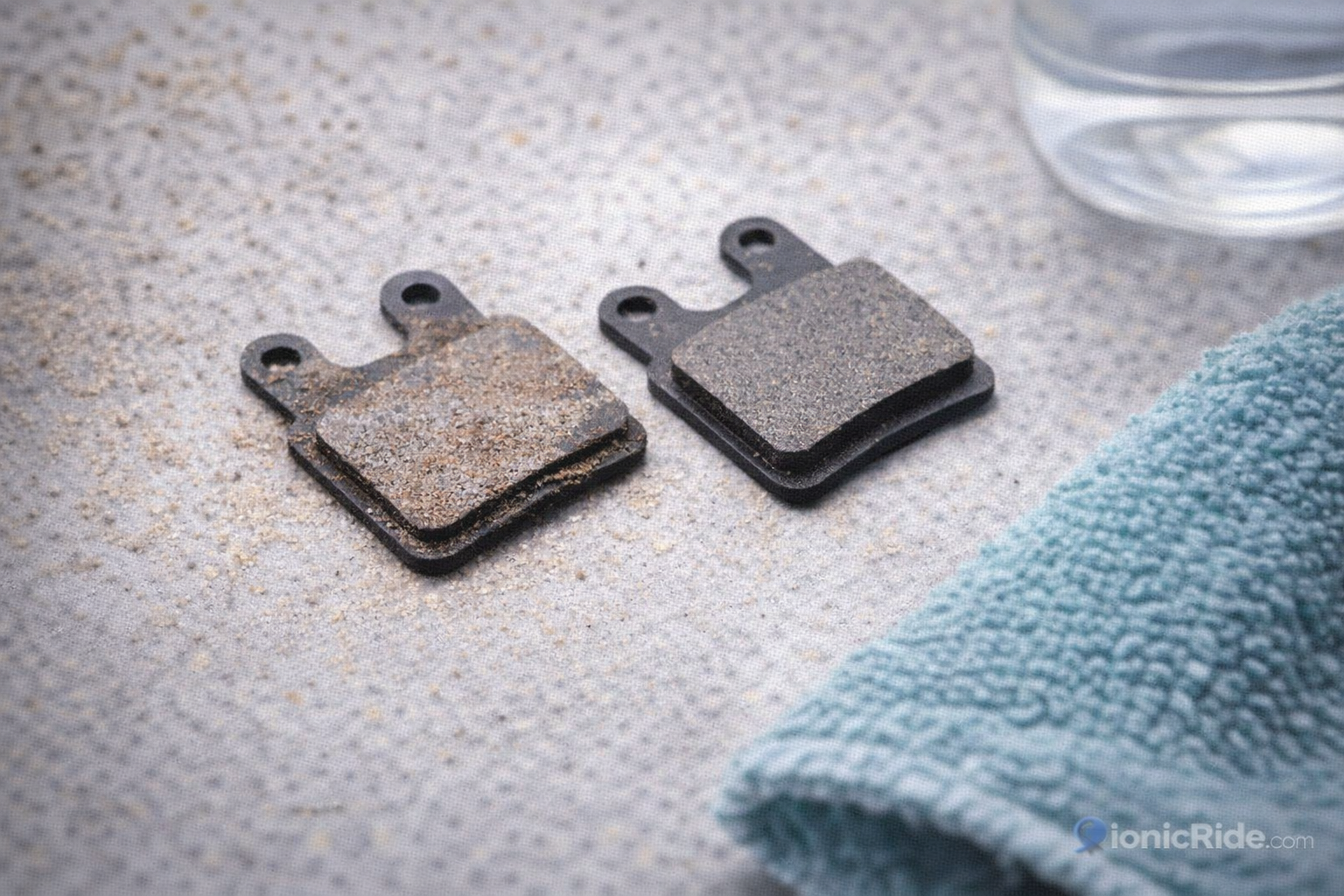
Dust, sand, or debris has contaminated the brake pads or the rotor surface. Dubai dust is abrasive — it works its way between the pad and the rotor and causes squealing. Clean the rotor with isopropyl alcohol (IPA) — AED 30–50 at a pharmacy or electronics shop. Wipe the pad surface too. Don’t use water or WD-40. If it keeps squealing after cleaning, the pads are glazed or worn unevenly and need replacing.
One Brake Works, the Other Doesn’t
Check the cable on the non-working side. It’s either snapped inside the housing, the cable housing itself is cracked, or the caliper is seized. A seized caliper — one that’s stuck and won’t move — is usually caused by corrosion or sand infiltration. It needs the caliper stripped, cleaned, and re-lubricated. That’s a shop job. AED 150–300 depending on the scooter.
How to Adjust Mechanical Disc Brakes Yourself
Here’s the thing…
Cable adjustment is the single most common brake fix and it takes 2 minutes. Most riders never do it and their brakes get progressively weaker over months until they notice. Check your cable tension monthly.
- 1
Find the Adjustment Point
On most mechanical disc brakes, there’s a knurled adjuster barrel where the cable enters the caliper — or sometimes at the lever end where the cable exits the brake lever. It’s a small rotating ring or screw. Turning it one way tightens the cable, the other way loosens it.
- 2
Loosen the Lock Ring (If There Is One)
Some adjusters have a small lock ring next to them. Loosen it first with a small wrench — usually 8mm or 10mm. If there’s no lock ring, the adjuster turns freely.
- 3
Turn the Adjuster Until the Lever Feels Right
Squeeze the lever. It should engage firmly about halfway through the pull — not at the end. Turn the adjuster to shorten the cable until you get that feel. Don’t over-tighten — if the pads are pressing against the rotor when the lever is released, you’ve gone too far. Back off until there’s a small gap.
- 4
Lock and Test
Tighten the lock ring back down. Test the brakes at walking speed first — squeeze firmly and make sure the scooter stops cleanly without the lever bottoming out. Then test at a slow ride. If it feels good, you’re done. If it’s still weak, the pads need replacing — no amount of cable adjustment will fix worn pads.
A customer from Jumeirah brought in his Xiaomi Mi Pro 2 — front brakes barely doing anything. He thought the caliper was seized. We checked: the cable was fine, the caliper moved freely, but the pads were worn down to almost nothing. He’d been riding for eight months without checking them. Dubai dust accelerated the wear — what should have lasted 12 months wore through in eight. New pads, AED 80 for the parts, 20 minutes to swap. Brakes were stronger than new after that. Check your pads every three months if you ride daily in Dubai.
Hydraulic Disc Brakes: Different Rules
Hydraulic disc brakes are on the higher-end scooters — Segway P100S, Dualtron models, and a few others. They’re better brakes: more stopping power, more consistent feel, less maintenance in normal conditions. But when they fail, the fix is different from mechanical.
✓ What You Can DIY
- Replace brake pads — same concept as mechanical, just different pad style
- Clean the rotor with IPA if it’s squealing
- Check for visible fluid leaks along the hose — tighten fittings if loose
- Bleed the system if the lever feels spongy (air in the line) — but only if you’re comfortable with the process
✗ Take It to a Shop
- Hydraulic hose is cracked or leaking fluid — needs replacement
- Master cylinder (inside the lever) is leaking or seized
- Caliper is seized or leaking internally
- You’ve never bled hydraulic brakes before — first time do it at a shop
- Lever feels completely dead despite fluid being present
Do not use DOT 3 or DOT 4 brake fluid on mineral oil hydraulic systems — and vice versa. Most e-scooter hydraulic brakes use mineral oil, not DOT fluid. Using the wrong type will destroy the seals and cause a total brake failure. Check your lever or caliper for a label, or look up your specific model before adding any fluid. When in doubt, ask a shop.
Drum Brakes: The Forgotten Rear Brake
A lot of scooters have disc brakes on the front and drum brakes on the rear. The rear drum brake is easy to forget about — it’s hidden inside the hub and you can’t see it wearing down. But it matters. In Dubai, rear drum brakes get clogged with dust faster than disc brakes because the mechanism is enclosed and dust works its way in through the gaps.
Rear Brake Barely Works
Cable needs adjusting — same principle as disc brakes. Find the adjustment point where the cable enters the drum brake housing. Tighten until the lever engages about halfway. If adjusting doesn’t help, the internal shoes are worn and need replacing. This requires removing the rear wheel and opening the drum housing.
Rear Brake Drags or Grinds
Sand or dust has gotten into the drum mechanism and is causing the shoes to catch or grind against the drum. The drum housing needs to be opened, cleaned out, and the shoes inspected. If the shoes are worn unevenly or the drum surface is scored, both need replacing. This is a shop job on most scooters — drum brake internals are fiddly and the rear wheel removal is awkward on many models.
Brake Pad and Part Replacement Costs in Dubai
Now here’s what most people miss…
Brake pads are one of the cheapest parts on an e-scooter, but people ignore them until the brakes stop working. Here’s what replacement actually costs — parts and labour — in Dubai in 2026.
Brake Repair Costs in Dubai (AED)
2026 Prices| Repair | Parts | Labour | Total |
|---|---|---|---|
| Disc brake pad replacement (per wheel) | AED 60–120 | AED 50–80 | AED 110–200 |
| Cable replacement (per brake) | AED 30–60 | AED 50–80 | AED 80–140 |
| Rotor replacement (per wheel) | AED 100–200 | AED 80–120 | AED 180–320 |
| Drum brake shoe replacement | AED 40–80 | AED 100–150 | AED 140–230 |
| Hydraulic caliper replacement | AED 200–400 | AED 150–200 | AED 350–600 |
| Hydraulic hose replacement | AED 80–180 | AED 100–150 | AED 180–330 |
Why Dubai Dust Destroys Brakes Faster
Dubai’s air is dry, dusty, and abrasive. Sand particles are essentially tiny pieces of silica — the same material that makes glass. When they get between your brake pads and rotors, they act as a grinding compound. They wear both surfaces down faster and cause uneven wear patterns.
✓ Protect Your Brakes
- Clean rotors with IPA every month — wipe off dust and grit
- Check pad thickness every 3 months if you ride daily
- Keep cable housings sealed — dust works into the housing and corrodes the cable inside
- After a dusty ride, give the brakes a few light squeezes to clear debris
- Park in shade — heat dries out any moisture that helps keep dust from sticking
✗ What Kills Brakes in Dubai
- Ignoring squealing — it means abrasive material is grinding your pads and rotor
- Riding through construction dust on Sheikh Mohammed Bin Zayed Road without cleaning after
- Never checking pad thickness until the brakes stop working
- Using WD-40 or oil on brake components — it contaminates the pads
- Letting hydraulic fluid get low — it evaporates faster in heat
Buy a spare set of brake pads for your scooter now — before you need them. They cost AED 60–120 and take up almost no space. When your current pads wear out (and they will, faster than you expect in Dubai), you can swap them yourself in 15 minutes instead of waiting for a shop appointment or ordering online and waiting for delivery.
Need a shop to do the brake work? Full directory with prices and wait times: E-Scooter Repair Dubai: 20 Shops with Prices, Reviews, Wait Times
Weak brakes are almost always one of three things: cable needs tightening, pads are worn, or dust has contaminated the system. Cable adjustment is a 2-minute DIY fix. Pad replacement is a 15-minute job. Dust contamination needs a clean with IPA.
Mechanical disc brakes are the most common on Dubai scooters and the easiest to maintain yourself. Hydraulic disc brakes are better but need proper fluid and bleeding when they go spongy. Drum brakes are simple but get clogged with Dubai dust — clean them out if the rear brake starts dragging.
Dubai dust eats brake pads in 6–8 months instead of 12. Check your pads every three months. Keep a spare set in your apartment. And never ignore squealing brakes — that sound is your pads telling you they’re being ground down by abrasive sand. Fix it now or replace the pads later.
Brakes Not Working — Quick Diagnosis Checklist
- Disc or drum brakes? Look at the wheel hub. Disc visible = disc brakes. No disc = drum. Different fix for each.
- Brakes squealing? Clean the rotor and pad surface with isopropyl alcohol. Dubai dust and sand cause most squealing. Don’t use water or oil.
- Lever feels soft or needs full pull? Adjust the cable first — find the adjuster barrel on the caliper or lever. If cable is fine, pads are worn.
- Hydraulic lever feels spongy? Air is in the line. The system needs bleeding. First time? Get a shop to do it and watch how it’s done.
- One brake works, the other doesn’t? Cable is snapped or caliper is seized on the dead side. Seized caliper = shop job.
- Pads checked? If the friction material is worn down to less than 2mm, replace them. Don’t wait until they’re metal-on-metal.
Brakes sorted but the motor feels weak or cuts out?
Motor problems are the trickiest to diagnose. Here’s how to tell if it’s the motor, the controller, or something else.