Hub Motor vs Mid-Drive: Which One Makes Sense in the UAE?
This is the first question most people ask when shopping for an e-bike: hub motor or mid-drive?
And the answer is usually simpler than the internet makes it sound.
For most UAE riders, hub motors are the better choice. Here’s why — and when mid-drives actually make sense.
What’s the difference?
Let’s start with what each one actually is.
Hub motor
The motor is built into the wheel hub — either the front wheel or rear wheel.
When you pedal (or twist the throttle, if your bike has one), the motor spins the wheel directly. Simple. Mechanical. Self-contained.
Mid-drive motor
The motor is mounted at the bike’s crankset — where the pedals attach.
Instead of spinning the wheel directly, it drives the chain. The chain turns the rear wheel through the gears, just like a regular bike.
This means the motor uses the bike’s gears to adjust power delivery. First gear for hills. Higher gears for flat ground and speed.
Hub motor: The workhorse
Hub motors are what you’ll find on most e-bikes under AED 5,000 — and plenty of bikes above that price too.
How they work
You pedal. The motor kicks in and spins the wheel. That’s it.
There’s no interaction with the bike’s gears. The motor does its thing, the gears do theirs. They’re independent.
Advantages
Cheaper. Hub motors cost less to manufacture, so bikes with hub motors are usually AED 700–1,800 cheaper than equivalent mid-drives.
Less maintenance. Because the motor doesn’t touch the chain or gears, it doesn’t add wear to those components. Your chain lasts longer. Your cassette lasts longer. Fewer trips to the shop.
Quieter. Hub motors hum quietly. Mid-drives whir and click as the motor engages with the drivetrain. Not loud, but noticeable.
Simple and reliable. Fewer moving parts interacting means fewer things that can go wrong. Hub motors are straightforward.
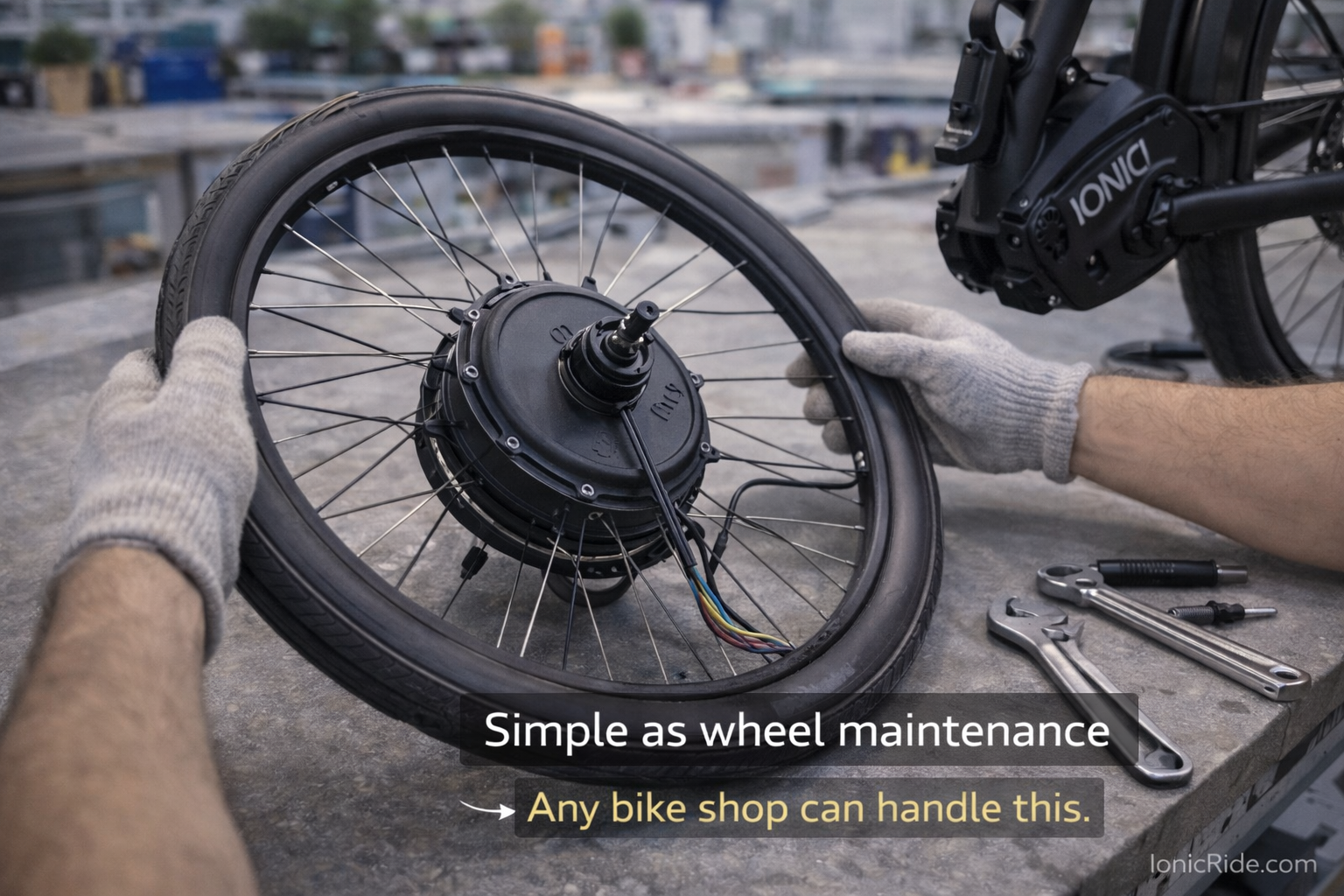
Easier flat tire repairs (rear hub). Okay, this one’s debatable. Changing a flat on a hub motor wheel is slightly more annoying than a regular wheel because of the motor weight. But it’s doable at home with basic tools.
For most Dubai commuters choosing their first e-bike, understanding these trade-offs is essential.Disadvantages
Weaker on steep hills. Hub motors deliver constant power regardless of terrain. On a steep hill, the motor works harder but can’t shift gears to get more mechanical advantage. You feel that as slower speed or higher battery drain.
Less natural feel. Power delivery is more binary. Motor on, motor off. It doesn’t respond to how hard you’re pedaling — just that you are (if it’s a cadence sensor) or how hard you push (if it’s a torque sensor). Still, it can feel less integrated than a mid-drive.
Weight in the wheel. The motor adds 3–5 kg to the wheel. This makes the bike feel slightly less nimble, especially at slow speeds or when maneuvering.
Mid-drive motor: The enthusiast’s choice
Mid-drives are what serious cyclists and e-bike enthusiasts prefer. They’re more efficient, more powerful on hills, and feel more like riding a bike (with superhuman legs) than riding a motorized vehicle.
How they work
You pedal. The motor drives the chain. The chain drives the rear wheel through whichever gear you’re in.
Because the motor uses the bike’s gears, it can adjust its mechanical advantage. Low gear for hills. High gear for speed on flat ground.
Advantages
Better hill climbing. The motor uses the bike’s gears, so it can “gear down” for steep climbs just like you would. This makes mid-drives way more efficient on hills than hub motors.
More natural feel. The power comes through the pedals and chain, which is how regular bikes work. It feels like you’re just stronger, not like there’s a separate motor pushing you.
Better weight distribution. The motor is at the center of the bike (near the bottom bracket) instead of in the wheel. This keeps the center of gravity low and makes the bike handle more naturally.
More efficient on varied terrain. Because the motor works with the gears, it can stay in its optimal power range across different speeds and inclines. Hub motors, by contrast, are less efficient at low speeds (like climbing) and high speeds (where they’re maxed out).
Disadvantages
More expensive. Mid-drives cost AED 1,800–3,600 more than comparable hub motor bikes. That’s a real price jump.
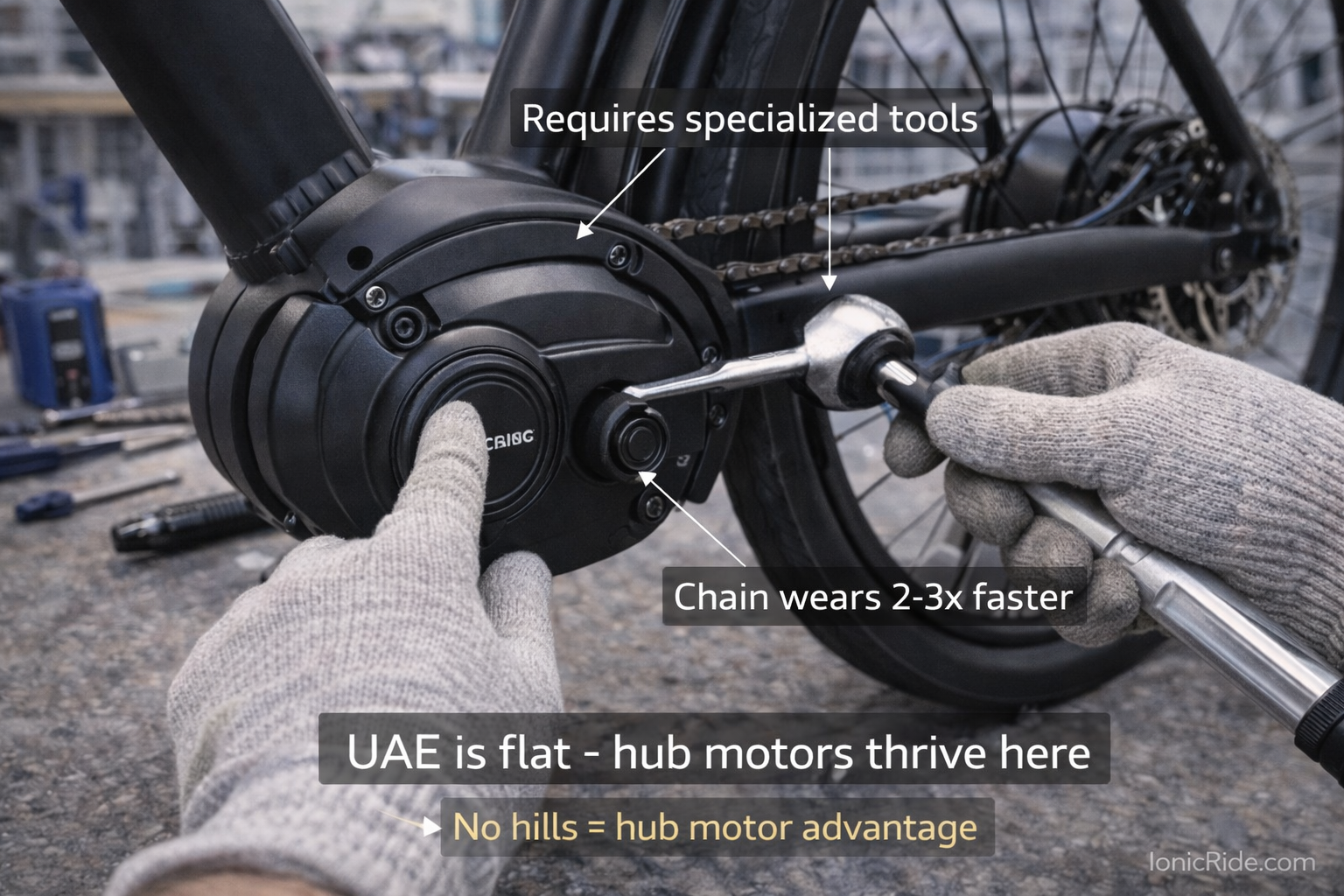
More wear on the drivetrain. The motor puts additional stress on the chain, cassette, and derailleur. You’ll replace these components more often — maybe every 2,000–3,000 km instead of 5,000+ km on a hub motor bike.
Slightly louder. The motor engaging with the chain creates more mechanical noise. It’s not obnoxious, but it’s there.
Harder to service. Mid-drives are more integrated into the bike’s frame. If the motor fails, it’s a bigger job to replace than a hub motor (which is just “remove wheel, replace motor, reinstall wheel”).
The real-world difference in the UAE
Here’s what actually matters for riding in Dubai, Abu Dhabi, Sharjah, and most of the UAE.
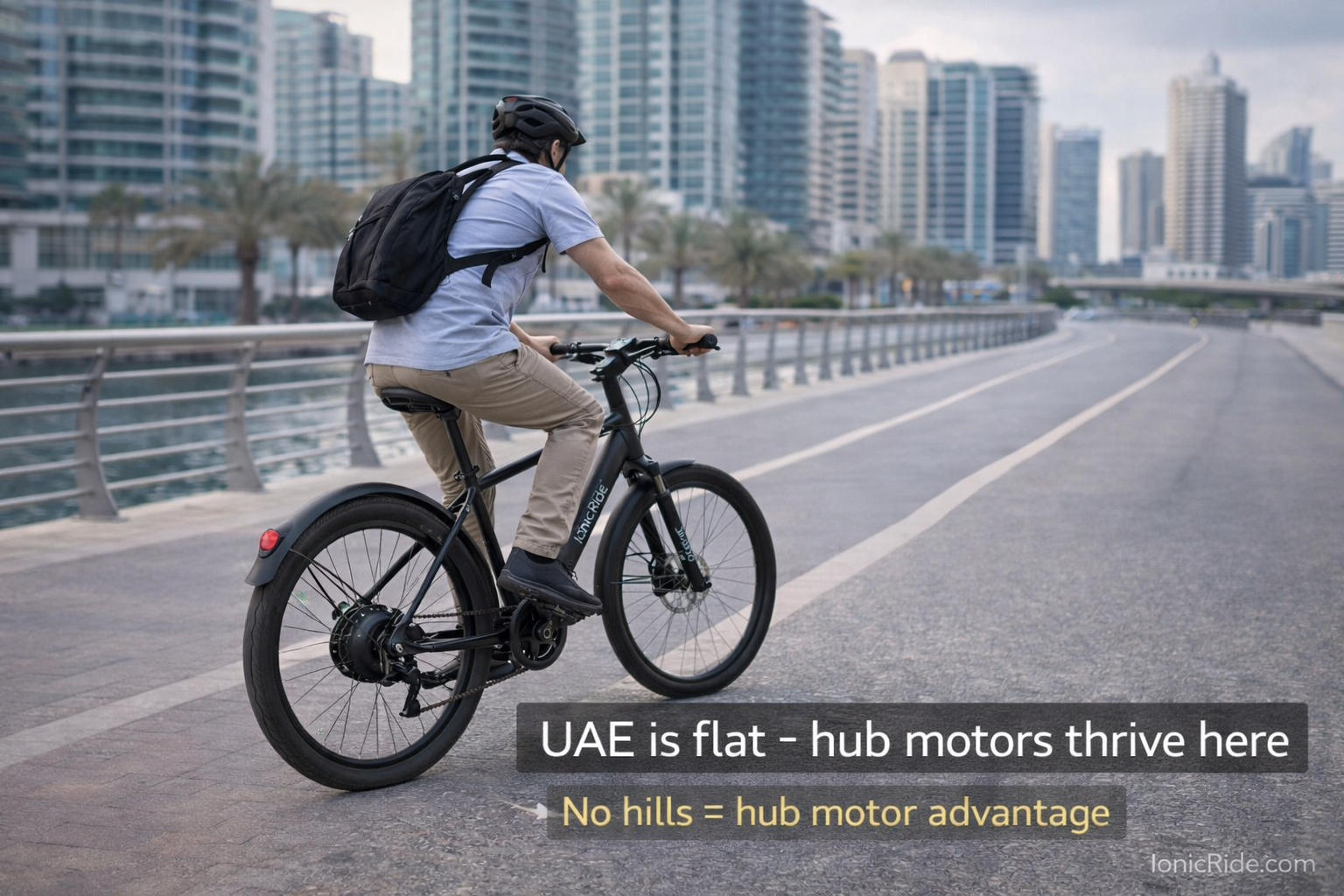
The UAE is flat
Mid-drives shine on hills. But unless you’re riding in Hatta or doing mountain trails, you’re not encountering steep hills.
Dubai, Abu Dhabi, Sharjah — mostly flat roads. This is why budget hub motor e-bikes work perfectly for most Dubai commutes..
The main advantage of a mid-drive — hill climbing efficiency — doesn’t apply here.
Heat affects both equally
Both hub motors and mid-drives generate heat. Both can throttle in extreme conditions.
The UAE summer hits 45°C regularly. If you’re riding hard in that heat, either motor type can overheat. There’s no clear winner here.
Serviceability matters more than specs
Hub motors are simpler to service. More shops can work on them. Parts are easier to source.
Mid-drives — especially brand-specific ones like Bosch or Shimano — require specialized tools and training. If you’re outside Dubai or Abu Dhabi, finding a shop that can service a mid-drive might be harder.
I’ve seen plenty of mid-drive bikes sit unused because the owner couldn’t find anyone local to service them. Meanwhile, hub motor bikes keep running because any bike shop can handle basic repairs.
When hub motors make sense
Hub motors are the right choice if:
- You’re riding on flat or gently rolling terrain (which is most of the UAE)
- You want lower upfront cost and cheaper long-term maintenance
- You’re commuting short-to-medium distances (10–30 km daily)
- You don’t care about having the most “natural” cycling feel
- You want something that any bike shop in Dubai can service – especially important when considering regular maintenance needs
(It’s like choosing between automatic and manual transmission. Manual is more engaging and efficient in the right hands. But automatic is simpler, easier, and honestly fine for most people.)
When mid-drives make sense
Mid-drives are worth the extra cost if:
- You’re riding in hilly areas regularly (Hatta, off-road trails, mountain routes)
- You’re doing long-distance rides (50+ km) where efficiency matters
- You want the most natural cycling feel and plan to use the bike for exercise, not just transportation
- You’re carrying heavy cargo regularly (the gearing advantage helps with load)
- You have access to a shop that services mid-drive systems (or you’re comfortable doing it yourself)
Cost breakdown: Hub vs mid-drive
Let’s talk real numbers.
Purchase price
Hub motor e-bike: If I’m commuting in Dubai or Abu Dhabi — flat roads, 15–25 km daily, mostly bike lanes or quiet streets — I’m getting a hub motor. Learn more about choosing the right e-bike for UAE conditions.
Mid-drive e-bike: AED 4,000–8,000 for comparable quality.
You’re paying AED 1,800–3,600 more for the mid-drive motor and associated components.
Maintenance over 3 years
Hub motor:
- Chain replacement: AED 80–150 (every 3,000–5,000 km)
- Cassette replacement: AED 150–300 (every 5,000–7,000 km)
- Brake pads: AED 100–200 (once or twice over 3 years)
- Typical total: AED 500–800
Mid-drive:
- Chain replacement: AED 100–200 (every 1,500–3,000 km — wears faster)
- Cassette replacement: AED 200–400 (every 3,000–5,000 km)
- Chainring replacement: AED 150–300 (once over 3 years, maybe)
- Brake pads: AED 100–200
- Typical total: AED 800–1,500
So over 3 years, you’re spending roughly AED 300–700 more on drivetrain maintenance with a mid-drive.
Add that to the AED 1,800–3,600 higher purchase price, and the total premium for mid-drive is AED 2,100–4,300 over three years.
That’s not nothing.
What I’d choose (and why)
If I’m commuting in Dubai or Abu Dhabi — flat roads, 15–25 km daily, mostly bike lanes or quiet streets — I’m getting a hub motor.
It’s cheaper. It’s reliable. It’s easy to maintain. And it does everything I need.
If I’m planning weekend rides in Hatta, or if I’m using the bike for long-distance touring with cargo, I’d consider a mid-drive. The efficiency on hills and the natural feel justify the extra cost in those scenarios.
But for most riders? Hub motor wins.
For 80–90% of UAE riders, a hub motor is the smarter choice.
It’s not that mid-drives are bad. They’re excellent. But they’re solving problems most UAE riders don’t have — and charging a premium to do it.
One more thing: Don’t let the marketing fool you
Mid-drives get pushed hard by premium brands. And they’re genuinely better in specific scenarios.
But “better” doesn’t always mean “right for you.”
A mid-drive bike sitting in your garage because it’s too expensive to maintain or too complicated to service isn’t better than a hub motor bike you actually ride every day.
Choose the tool that fits the job. For most UAE commuters, that tool is a hub motor.