Personal Mobility Monitoring Unit: Inside Dubai’s 2026 E-Scooter Crackdown
Personal Mobility Monitoring Unit: Inside Dubai’s 2026 E-Scooter Crackdown
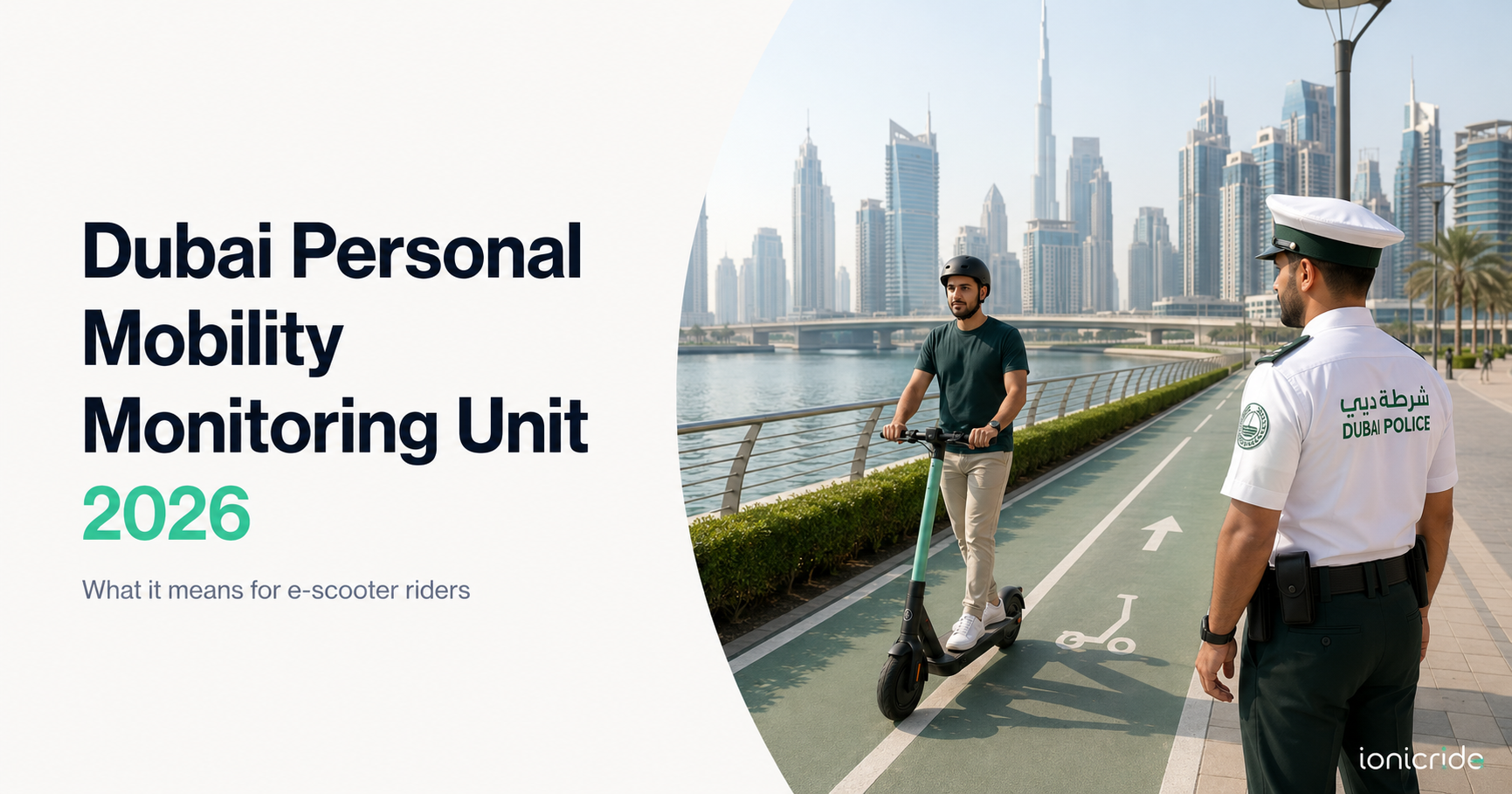
If you ride an e-scooter in Dubai, the rules just got a full-time enforcer. On 1 May 2026, the RTA and Dubai Police switched on a dedicated team whose entire job is watching personal mobility riders — and handing out fines.
It’s called the Personal Mobility Monitoring Unit, and it changes the calculation for every rider in the city. The years when you could quietly bend the rules — skip the helmet, cut across the wrong area, double up with a friend — and count on nobody checking are over. There’s now a unit patrolling the exact spots where riders cut corners, around the clock.
Here’s the full picture: who they are, when they started, where they patrol, what they’re checking, what it costs you, and — most usefully — how to ride so they never have a reason to stop you.
What the Personal Mobility Monitoring Unit Actually Is
The unit is a joint task force between Dubai’s Roads and Transport Authority (RTA) and Dubai Police. Both bodies already had a hand in scooter rules — the RTA writes the regulations and builds the tracks; the police enforce conduct on the ground. The Monitoring Unit fuses the two into a single team with one narrow, focused mandate: personal mobility means. That term covers electric scooters, electric bikes and ordinary bicycles.
It was announced on 27 April 2026 and began operating on 1 May 2026, running patrols across Dubai at all hours. This is the part most riders underestimate — it isn’t an occasional awareness drive or a one-week blitz. It’s a permanent unit, and its officers do nothing else but watch how people ride scooters and bikes.
The unit enforces Executive Council Resolution No. 13 of 2022, which regulates the use of cycles — defined to include bicycles, electric scooters and electric bikes — across the Emirate of Dubai. It’s the same resolution behind Dubai’s published fine schedule, so the unit isn’t inventing new rules; it’s putting muscle behind ones that already existed but were lightly policed.
Why Now — The Numbers Behind the Crackdown
This didn’t come out of nowhere. E-scooter use in Dubai has exploded, and the safety record hasn’t kept pace. The figures that authorities have pointed to are sobering, and they explain why the response was a permanent unit rather than a poster campaign.
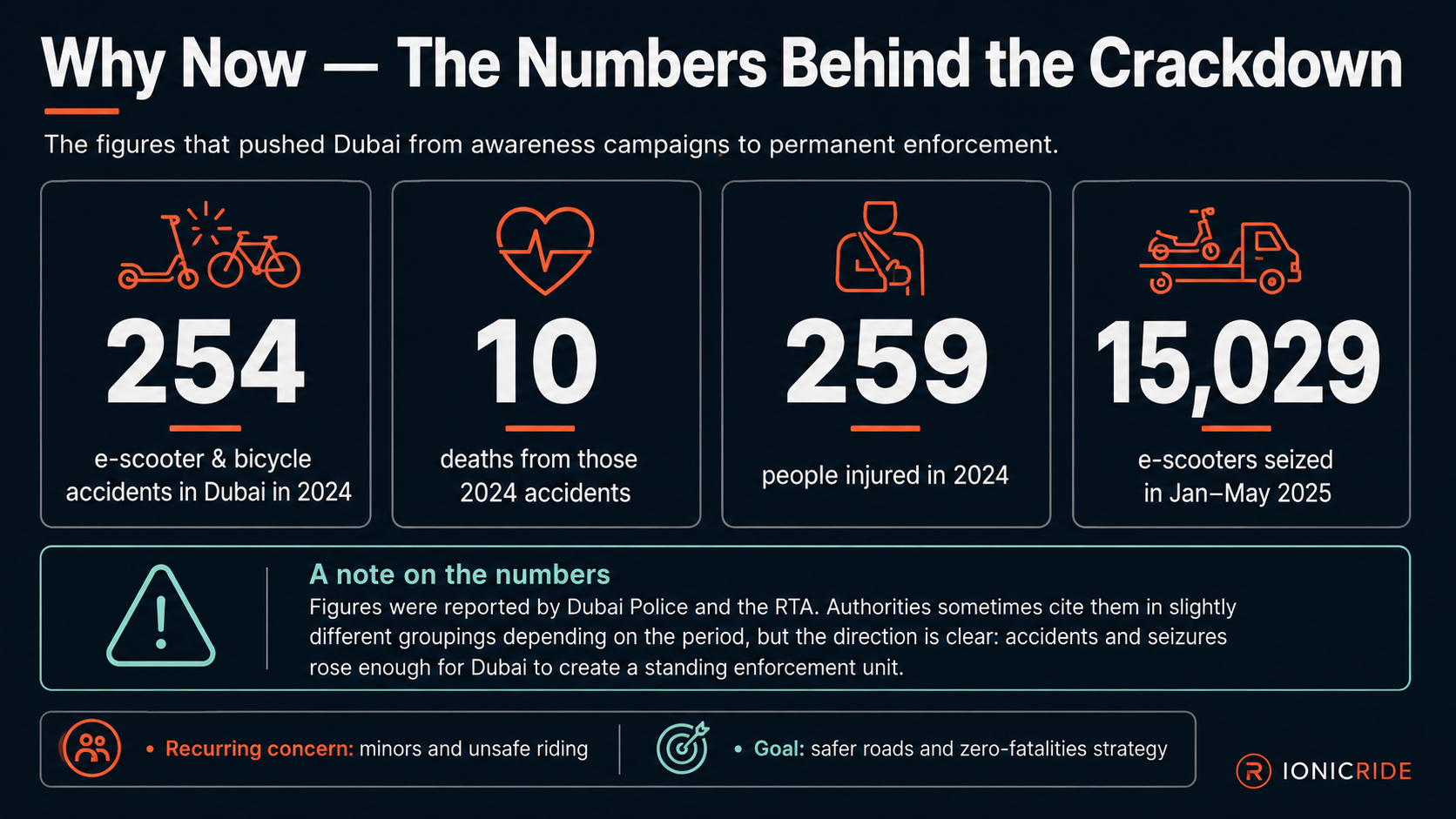
According to figures reported by Dubai Police and the RTA, the Emirate logged 254 accidents involving e-scooters and bicycles in 2024, which caused 10 deaths and 259 injuries. The momentum carried into 2025: in the first five months of that year alone, Dubai Police confiscated more than 15,000 e-scooters for traffic breaches, and reported road deaths in that period tied to unsafe behaviour — several of them e-scooter-related.
A recurring and uncomfortable theme in those reports is minors. Some of the e-scooter fatalities involved children, and one widely covered case saw the parents of an injured 13-year-old taken to court over negligence — a reminder that letting an underage child ride is both illegal and a genuine legal exposure for the adult responsible.
These figures come from official statements and UAE news reporting, and authorities cite them in slightly different groupings depending on the period (calendar year vs. the first five months). Treat them as the order of magnitude of a real problem rather than a single audited table. The direction is what matters: accidents and seizures rose enough that Dubai created a standing unit to deal with them, in line with its Traffic Safety Strategy and long-term zero-fatalities goal.
Where They Patrol — The Hotspots
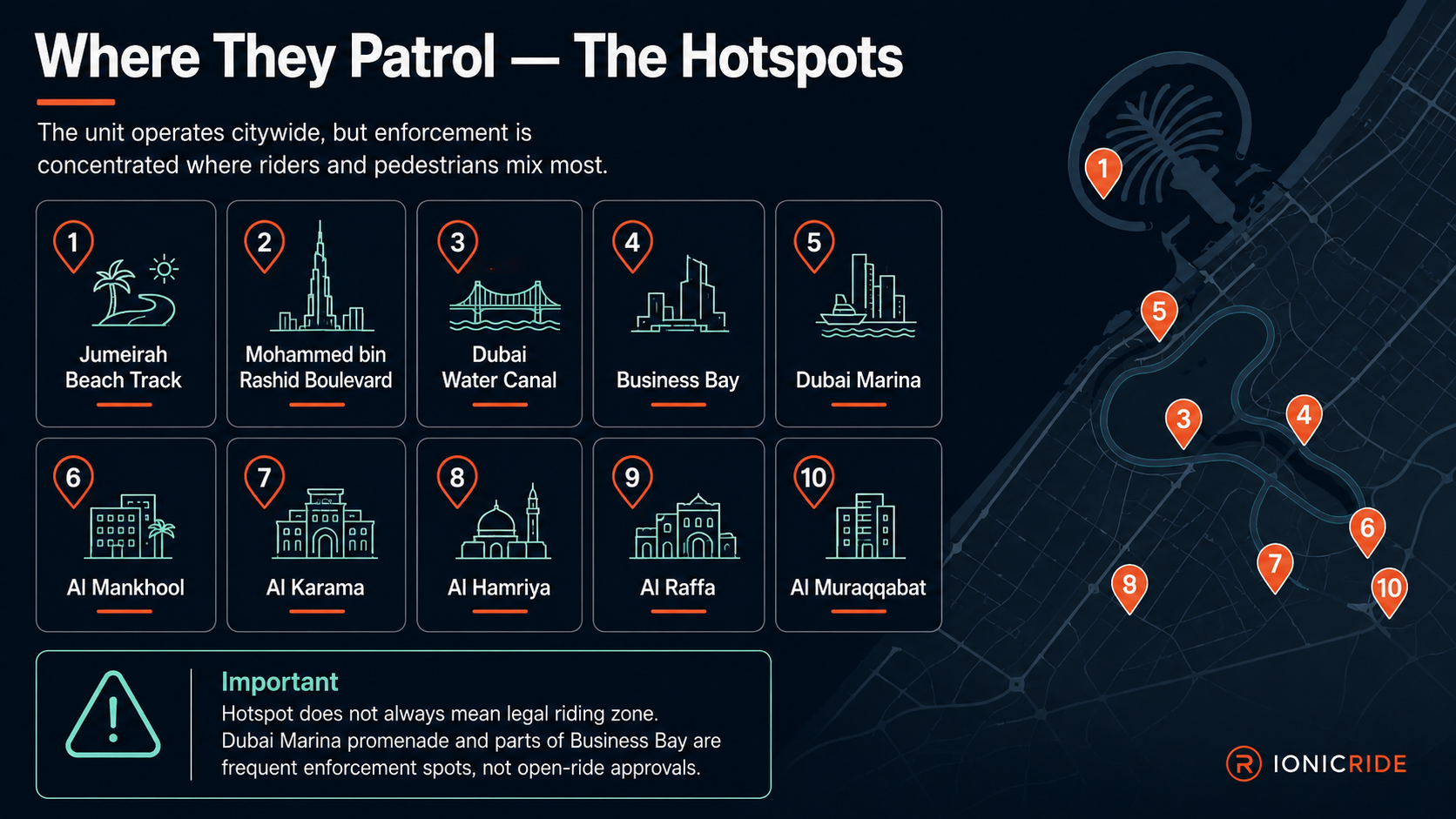
The unit’s writ runs across all of Dubai, but it concentrates its patrols on a defined set of hotspots — the places with the heaviest mix of riders and pedestrians, which is where collisions and complaints cluster. If you ride in any of these, assume you’re being watched:
Look closely at that list and you’ll spot the trap. Dubai Marina is a named patrol hotspot — but most of the Marina is not a designated riding zone. The promenade is a pedestrian area. So the unit isn’t patrolling Marina to wave riders through; it’s patrolling it because so many people ride there illegally, assuming the crowds and the rental scooters mean it’s allowed. It isn’t. The same logic applies to stretches of Business Bay, where only specific tracks are legal.
This is exactly why knowing the boundaries matters: Where You Can (and Can’t) Ride E-Scooters in Dubai — the 21 designated zones
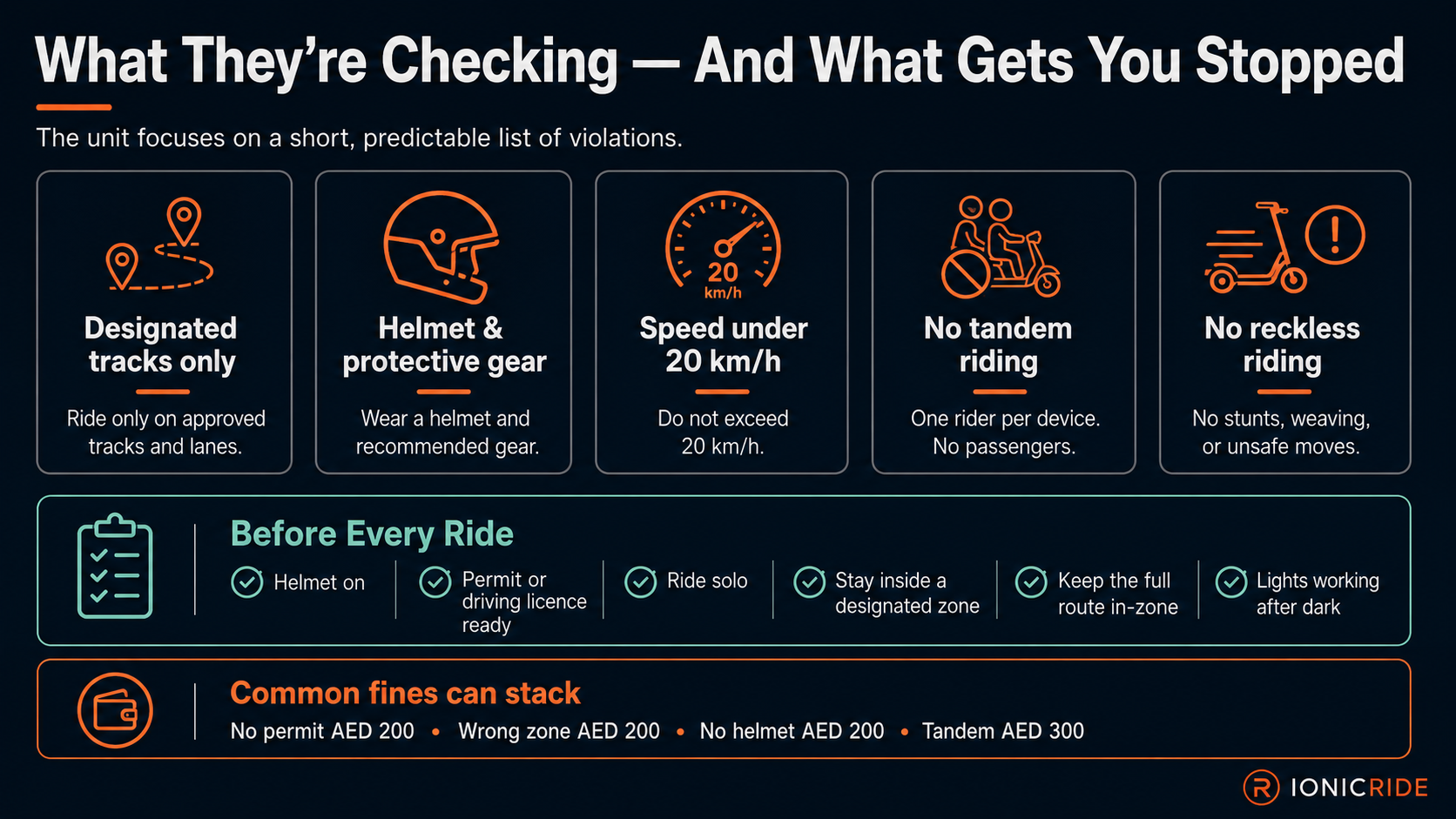
What They’re Checking — And What Gets You Stopped
The unit’s officers aren’t looking for obscure technicalities. They’re checking a short, predictable list — the same handful of violations that cause most of the accidents. Here’s what’s on it:
- Designated tracks only — riding off the approved tracks, on main roads, or on pedestrian areas is the headline target.
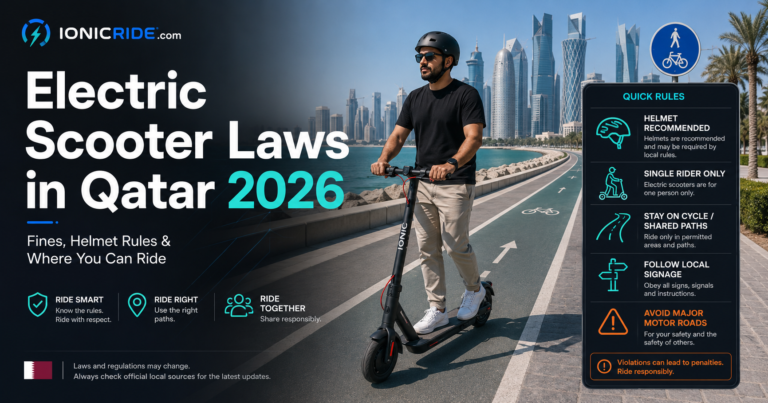
- Helmet & protective gear — no helmet is the single most common fine, and the easiest to avoid.
- Speed limit — e-scooters are held to a 20 km/h ceiling on shared paths.
- No tandem riding — carrying a passenger on an e-scooter is specifically prohibited and specifically watched for.
- No reckless riding — weaving through pedestrians, dangerous speed, stunting.
When officers stop you, they verify your identity and your right to ride — Emirates ID, and either an RTA e-scooter permit or a driving licence. If you’re in breach, they issue the fine through their system and you receive the details by SMS. And if the violation is serious, the scooter doesn’t go home with you.
The Fines — What Each Violation Costs
The penalties are the same ones set out under Resolution No. 13 of 2022. Here are the common ones the unit issues:
Common Dubai E-Scooter Fines (2026)
| Violation | Fine (AED) |
|---|---|
| Riding without a permit | 200 |
| Riding outside designated zones | 200 |
| No helmet | 200 |
| Carrying a passenger (tandem) | 300 |
| Road with limit over 60 km/h | 300 |
| Reckless / dangerous riding | 200–500 |
The detail that catches people out: fines stack. One stop for riding in the wrong area with no helmet and a friend on the back isn’t one fine — it’s three. Riders have walked away from a single encounter owing 600–700 AED.
Every fine, the early-payment discount, and how to check and pay: The Complete Dubai E-Scooter Fine Breakdown 2026
Impoundment — What Happens to a Seized Scooter
This is the part that hurts more than the fine. The unit doesn’t just ticket serious violations — it impounds the device, working in coordination with Emirates Auction LLC, the body that handles seized vehicles in Dubai.
Confiscation generally follows the heavier offences: riding on a highway or a road above 60 km/h, repeat violations, reckless riding, an underage rider, or a modified scooter. Getting it back isn’t a quick favour — you clear every outstanding fine first, then pay a release fee that routinely runs into the thousands of dirhams. For a typical 1,000–2,000 AED commuter scooter, that release fee can cost more than the scooter is worth, which is why a lot of riders simply don’t bother reclaiming it.
A budget scooter seized for a highway shortcut can mean: the fine, plus a release fee larger than the scooter’s value, plus the hassle of the police station and the wait. Many riders do the arithmetic and buy a new scooter instead — which means the shortcut effectively cost them the entire price of their scooter.
If it’s already happened to you: E-Scooter Confiscation in Dubai — Documents, Fees & How to Get It Back
How to Ride So They Never Stop You
Here’s the reassuring part. The unit isn’t trying to trap careful riders — it’s hunting the obvious stuff. Tick these boxes and a patrol has no reason to pull you over:
- Helmet on your head — not clipped to the stem.
- RTA permit or driving licence on your phone (a screenshot plus the app).
- Riding solo — no passenger, no oversized load.
- You’re inside one of the 21 designated zones and on a marked track.
- Your whole route stays in-zone — no highway crossings, no Marina promenade.
- Speed under 20 km/h, slower around pedestrians.
- Lights working if you’re out after dark.
Two of those do most of the work: wear a helmet and know your zone. Helmet fines and wrong-zone fines are the bread and butter of enforcement, and both are completely free to avoid.
Don’t have your permit yet? It’s free and takes about 15 minutes: How to Get Your RTA E-Scooter Permit in 15 Minutes
Beyond Dubai — The Rest of the UAE Is Tightening Too
Dubai’s unit is the most structured response, but it’s part of a wider UAE pattern. Sharjah allows e-scooters from age 14 with its own permit framework; Abu Dhabi prohibits riding on pedestrian lanes and on roads with limits of 60 km/h or higher; and Ajman has taken the strictest line, effectively banning e-scooters from its streets. Some private communities add their own penalties on top — Town Square, for instance, has warned of fines well above the standard RTA amounts for breaking community rules.
The throughline across all of them: the casual era is closing. If you ride across emirates, you can’t assume Dubai’s rules travel with you — each has its own lines, and increasingly, its own enforcement.
The full picture, emirate by emirate: Are E-Scooters Legal in the UAE? Laws, Fines & Zones 2026
Enforcement is now permanent and proactive. Since 1 May 2026, a dedicated RTA–Dubai Police unit has patrolled the city’s riding hotspots around the clock, issuing on-the-spot fines and impounding scooters.
The targets are predictable: no helmet, wrong zone, passengers, highways and reckless speed. Fines run from AED 200 to 500, they stack, and serious cases cost you the scooter.
The fix is cheap and simple: helmet on, permit ready, ride solo, stay in a designated zone under 20 km/h. Do that and the unit is a non-event. Ignore it, and 2026 is a far more expensive year to ride carelessly than 2024 ever was.
Personal Mobility Monitoring Unit — Full FAQ
It’s a joint enforcement team run by the RTA and Dubai Police, focused solely on personal mobility devices — e-scooters, e-bikes and bicycles. It patrols cycling tracks, main roads and soft-mobility zones, checks riders, issues fines and impounds non-compliant devices, all under Executive Council Resolution No. 13 of 2022.
The unit was announced on 27 April 2026 and began round-the-clock operations on 1 May 2026. As of mid-2026 it is live and active citywide — not a future plan.
Citywide, but concentrated on named hotspots: Jumeirah Beach Track, Mohammed bin Rashid Boulevard, Dubai Water Canal, Business Bay, Dubai Marina, Al Mankhool, Al Karama, Al Hamriya, Al Raffa and Al Muraqqabat. Marina is a hotspot even though most of it isn’t a designated riding zone — which is precisely why riders get caught there.
Staying on designated tracks, wearing a helmet and protective gear, keeping to the 20 km/h e-scooter limit, no reckless riding, and no tandem riding (passengers). Violations are fined on the spot and non-compliant devices are impounded via Emirates Auction LLC.
Yes. The unit impounds non-compliant devices, typically after serious or repeat violations such as highway riding, reckless behaviour, an underage rider or a modified scooter. Reclaiming it means clearing all fines plus a release fee that often exceeds a budget scooter’s value.
Under Resolution 13 of 2022: roughly AED 200 for no permit, wrong zone, or no helmet; AED 300 for carrying a passenger or riding on a road over 60 km/h; and AED 200–500 for reckless riding. Fines stack, so one stop can trigger several at once.
A surge in e-scooter use alongside a poor safety record. Dubai recorded 254 e-scooter and bicycle accidents in 2024 (10 deaths, 259 injuries), and police confiscated more than 15,000 e-scooters in the first five months of 2025. The unit supports Dubai’s Traffic Safety Strategy and zero-fatalities goal.
Helmet on, permit or licence ready, ride alone, stay in a designated zone and on marked tracks, keep under 20 km/h, and never use a highway or a 60 km/h-plus road. The unit targets the obvious violations, so careful riders rarely have anything to worry about.