E-Scooter Making Noise: Squeaking, Rattling, Grinding — What Each Sound Means Dubai
Your e-scooter is making a noise it didn’t make before. A squeak when you brake. A rattle from the stem. A grinding sound when you accelerate. A clicking noise every rotation of the wheel. The scooter still rides, but the noise is getting worse — or louder — or more frequent.
Here’s the issue: e-scooter noises can mean anything from “tighten a bolt” to “the bearing is about to seize.” And Dubai’s conditions — dust, heat, vibration from rough roads — cause noises that scooters in cooler, smoother climates never develop. Sand works its way into bearings. Bolts loosen from constant vibration. Cables fray from heat expansion. A squeak that would be nothing in London can be a warning sign of a bigger problem here.
This guide decodes every common noise by type — what it sounds like, where it’s coming from, what’s causing it, and whether you can fix it yourself or need a shop.
Noise Diagnosis by Sound Type
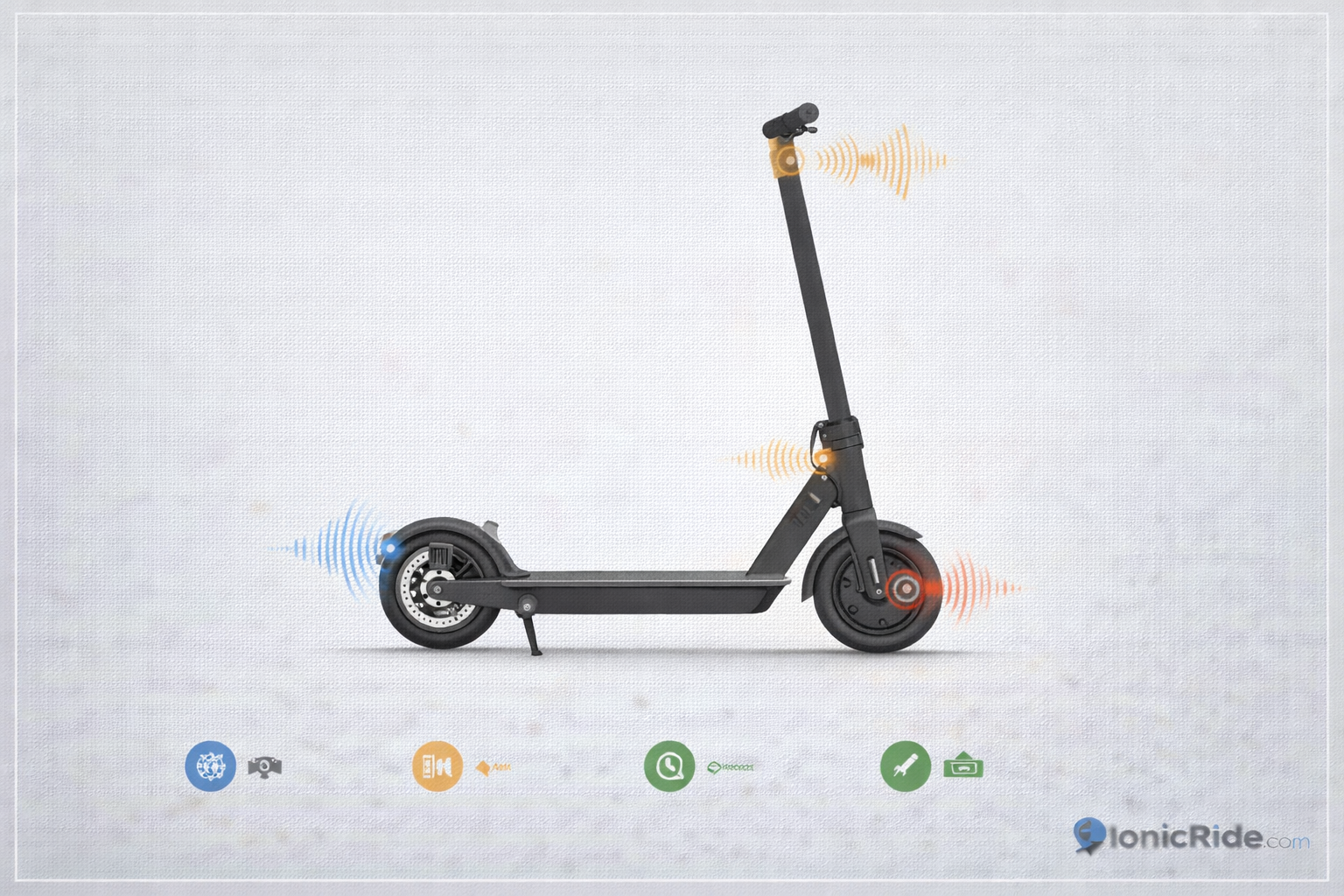
Start here. Match the sound your scooter is making to the descriptions below. Each sound type has typical causes. Once you’ve matched the sound, move to the location-specific sections to narrow it down further.
E-Scooter Noises: What Each Sound Means
Sound Type Guide| Sound | Most Likely Cause | Severity |
|---|---|---|
| High-pitched squeak (when braking) | Brake pads contaminated with dust or oil. Worn pads. Glazed rotor surface. | Low — annoying but safe |
| Rattle (from stem or handlebars) | Loose bolts. Loose folding mechanism. Worn stem bearing. Loose display or cables. | Medium — can lead to failure if ignored |
| Grinding (metal-on-metal) | Bearing failure. Brake pads completely worn. Motor internal damage. Disc rubbing on caliper. | High — stop riding, diagnose immediately |
| Clicking (every wheel rotation) | Spoke loose or broken. Tyre rubbing on frame or mudguard. Debris stuck in tyre tread. | Medium — check before next ride |
| Creaking (when turning or going over bumps) | Dry or loose folding hinge. Worn suspension bushings. Loose handlebar clamp. Frame flexing at weld points. | Medium — lubricate and tighten |
| Whining or whirring (motor noise) | Normal motor operation at high RPM. Or: bearing inside motor failing. Or: motor magnets coming loose. | Variable — normal or serious depending on pitch and volume |
| Buzzing or vibration (handlebar or deck) | Loose bolt somewhere. Cable rubbing against frame. Motor mount loose. Display not seated properly. | Low — usually just needs tightening |
Brake Squealing: The Most Common Noise
Here’s the thing…
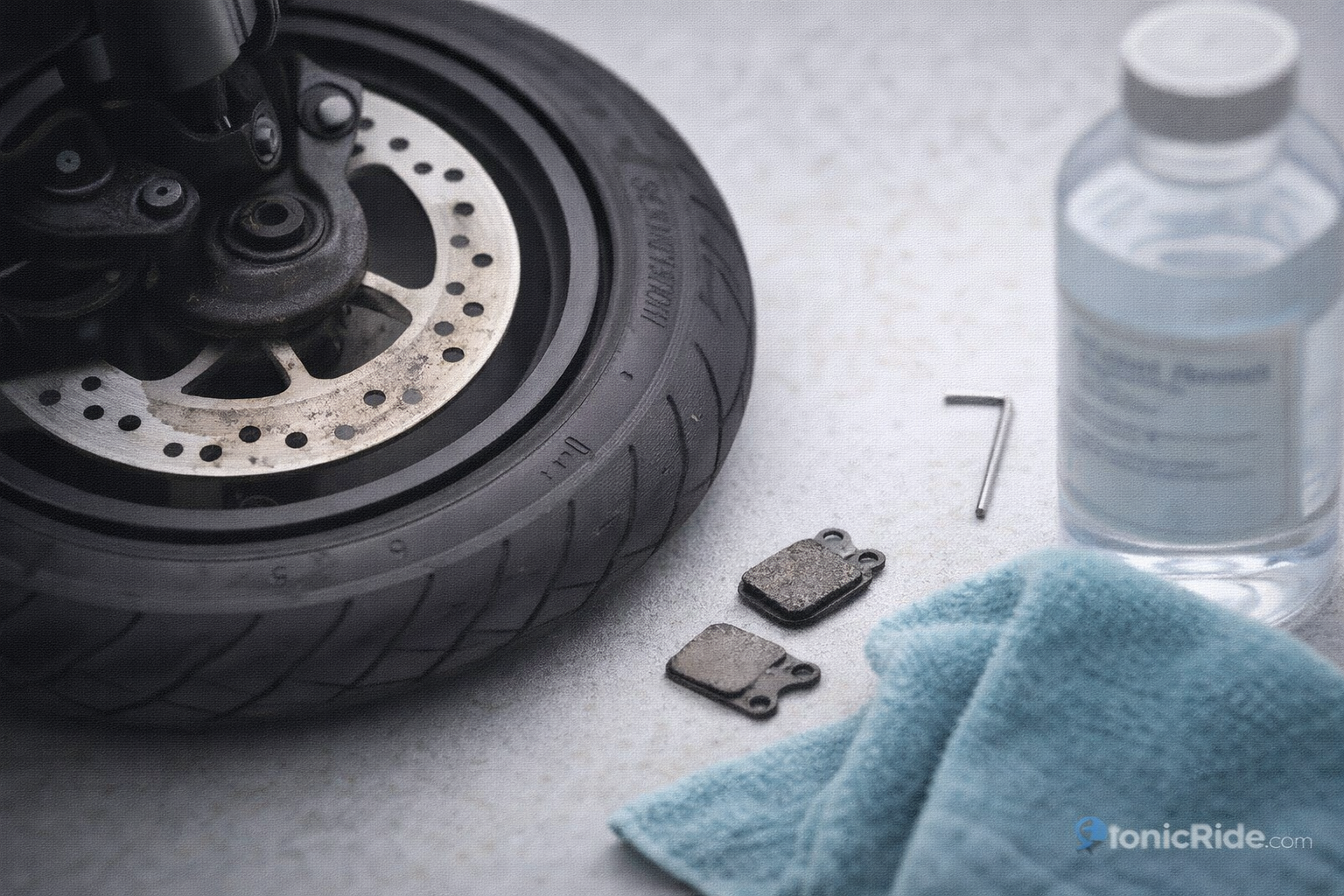
Brake squeal is by far the most common noise complaint. It’s also the easiest to fix in most cases. Dubai dust and sand are abrasive — they get between the brake pad and the rotor and cause squealing as the two surfaces grind against each other.
Clean the Rotor and Pads
Use isopropyl alcohol (IPA) — AED 30–50 at any pharmacy or electronics shop. Spray it on a clean cloth and wipe down the rotor surface on both sides. Wipe the brake pad surface too. Let it dry for 2 minutes. Test the brakes. If the squeal is gone, it was dust contamination. If it’s still there, move to the next fix.
Roughen the Pad Surface
If the pads are glazed — smooth and shiny instead of slightly rough — they need to be roughened up. Use fine-grit sandpaper (200–400 grit). Lightly sand the pad surface in a crosshatch pattern. This removes the glaze and restores grip. Wipe off the dust, clean the rotor again with IPA, and test. Squeal should be gone.
Replace the Pads
If the pads are worn down to less than 2mm of friction material, or if they’re contaminated with oil (which can’t be cleaned off), they need replacing. New pads cost AED 60–120 per wheel. If you don’t want to do it yourself, a shop charges AED 50–80 labour on top of the part cost. Total: AED 110–200 per wheel.
Never use oil, WD-40, or any lubricant on brake pads or rotors. It soaks into the pad material permanently and destroys the braking surface. If you accidentally spray WD-40 on the rotor, clean it immediately with IPA. If it gets on the pads, the pads are done — replace them.
Rattling from the Stem or Handlebars
Rattling is the second most common noise complaint. It’s almost always a loose bolt, a loose folding mechanism, or cables that aren’t secured properly. Dubai roads — especially the older areas like Deira and Bur Dubai — are rough enough to loosen bolts over time even if they were tight when the scooter was new.
Rattle Sources and Fixes
Stem / Handlebar| Where It’s Coming From | Cause | Fix |
|---|---|---|
| Folding stem mechanism | The latch or hinge has play in it. Normal wear over time, accelerated by vibration. | Tighten the hinge bolt. Most scooters have an adjustment screw or nut that removes play. If it won’t tighten, the hinge is worn and needs replacing — shop job, AED 200–400. |
| Handlebar clamp | The bolts that hold the handlebars to the stem have loosened. | Tighten the clamp bolts with an Allen key. Torque them evenly — left and right sides should be equal. Don’t over-tighten — you’ll strip the threads. |
| Display unit | The display isn’t seated properly on its mount, or the mount itself is loose. | Remove the display, check the rubber gasket isn’t torn, reseat it firmly, and tighten the mounting screws if it has them. Some displays just clip on — make sure it’s fully clicked in. |
| Brake or throttle cables | Cables are rubbing against the frame or flopping around because the cable guides or zip ties have broken. | Re-secure the cables with new zip ties or replace the cable guides. AED 5–15 at any hardware shop. Route them so they don’t rub or catch on anything. |
| Bell, phone mount, or accessories | Aftermarket accessories weren’t installed tightly and have worked loose. | Remove and reinstall properly. If it won’t tighten, the mount is damaged or the wrong size for your handlebars. |
Check all bolts on your scooter monthly with an Allen key set. Dubai vibration and heat expansion/contraction loosen bolts faster than cooler climates. The most critical ones: stem clamp, handlebar clamp, folding hinge, brake caliper mounts, motor mount. Tighten them before they rattle — not after.
Grinding Noise: Stop Riding Immediately
But here’s where it gets serious…
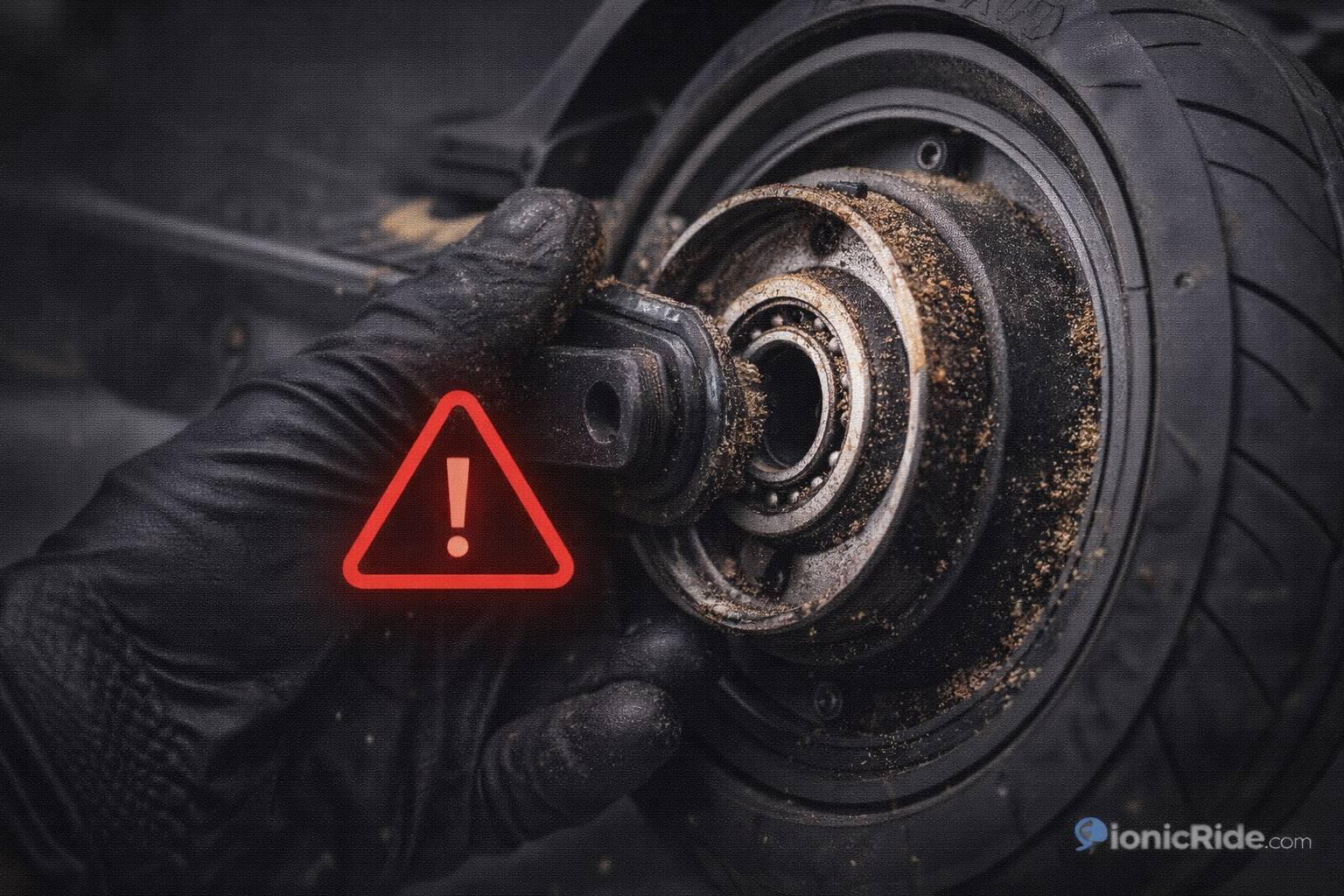
Grinding is metal-on-metal contact where there shouldn’t be any. It means a bearing has failed, brake pads are completely gone, or something internal has broken. A grinding noise that gets louder means the damage is getting worse every second you ride. Stop and diagnose before you turn a AED 200 repair into a AED 800 one.
Grinding from the Wheel
- Bearing failure: The wheel bearing has lost its balls or the race is damaged. The wheel will feel rough when you spin it by hand. Replace the bearing — AED 80–150 per wheel at a shop.
- Brake pads gone: The friction material is completely worn away and the metal backing plate is grinding on the rotor. Replace pads immediately — riding like this scores the rotor and you’ll need a new rotor too (AED 100–200 extra).
- Disc rubbing caliper: The rotor is bent or the caliper is misaligned and the disc is scraping the caliper body constantly. Straighten the rotor or realign the caliper.
Grinding from the Motor
- Motor bearing failure: The bearing inside the motor has failed. The motor will feel rough when you spin it by hand with the scooter off. Motor needs opening and bearing replacement — shop job, AED 300–600.
- Motor magnets loose: The magnets glued to the inside of the motor have come loose and are grinding against the stator. This is a write-off unless you want to rebuild the motor — usually cheaper to replace the whole motor.
- Gearbox damage (on geared motors): The internal gears have stripped or a tooth has broken. Motor replacement needed. AED 600–1,200 depending on model.
A customer from JLT rode his Xiaomi Mi Pro 2 for two weeks with a grinding noise from the front wheel — thought it was just the brakes. Turned out the wheel bearing had completely disintegrated. By the time he brought it in, the axle had worn a groove into the hub and the hub needed replacing too. What should have been a AED 100 bearing replacement became AED 350 — new bearing, new hub, labour. Grinding noises don’t fix themselves. They get worse. Stop riding and diagnose.
Clicking Noise from the Wheel
A clicking noise that repeats with every wheel rotation is usually something stuck in the tyre, a loose spoke, or the tyre rubbing on the mudguard or frame. It’s not dangerous in most cases but it’s annoying and it can indicate an alignment issue.
- Check the tyre tread for debris — stones, glass, screws, thorns. Remove anything stuck in there. Clean out the tread grooves with a small screwdriver.
- Spin the wheel and watch the gap between the tyre and the mudguard or frame. If they’re touching at any point, the wheel is out of alignment or the mudguard is bent. Realign the wheel or straighten the mudguard.
- Check for loose spokes (if your scooter has a spoked wheel). Press on each spoke — they should all be tight with no play. A loose spoke clicks as the wheel flexes. Tighten it with a spoke wrench — AED 20–40 at a bike shop.
- Check the axle nuts or quick-release lever. If the wheel isn’t seated properly on the axle, it can shift slightly and click. Reseat the wheel and tighten the axle.
Creaking When Turning or Going Over Bumps
Creaking is usually a dry joint somewhere — a hinge, a clamp, or a suspension bushing that needs lubrication. Dubai heat dries out grease faster than in cooler climates. Something that was lubricated six months ago might now be dry and creaking.
Folding Hinge
The hinge where the stem folds onto the deck creaks when you go over bumps. Apply a small amount of lithium grease or silicone spray to the hinge pin and pivot points. Work it in by folding and unfolding a few times. Wipe off excess. Creak should be gone. If it persists, the hinge is worn and has too much play — tighten the adjustment bolt or replace the hinge.
Handlebar Clamp
The clamp where the handlebars attach to the stem creaks when you turn. Remove the handlebars, clean the contact surfaces, apply a thin layer of grease, and reinstall. Tighten the bolts evenly. The grease reduces friction and stops the creak.
Suspension Bushings (If Applicable)
Scooters with front or rear suspension have rubber or polyurethane bushings. They dry out and creak over time. Remove the suspension bolts, inspect the bushings, and apply silicone grease. If the bushings are cracked or torn, replace them — AED 40–80 for a set.
Motor Whining: Normal or Problem?
All e-scooter motors make some noise. A slight whir or hum at speed is normal — that’s the motor doing its job. But a high-pitched whine that gets louder, or a grinding undertone, is not normal. Here’s how to tell the difference.
✓ Normal Motor Noise
- Steady hum or whir that’s consistent with speed — louder at higher RPM, quieter at lower RPM
- No grinding, clicking, or scraping undertones
- Motor feels smooth when you spin the wheel by hand with the power off
- Volume hasn’t increased over time
- No vibration through the deck or handlebars
✗ Problem Motor Noise
- High-pitched whine that’s getting louder over time
- Grinding or scraping sound mixed with the motor noise
- Motor feels rough or notchy when you spin it by hand
- Clicking or ticking sound every rotation
- Vibration that wasn’t there before
- Motor gets unusually hot after short rides
If the motor noise is in the “problem” category, take it to a shop. Motor internals aren’t DIY territory unless you’re very experienced. A motor rebuild costs AED 300–600. A replacement motor is AED 600–1,200 depending on the brand and model.
Motor noise won’t go away or getting worse? Shop directory with prices: E-Scooter Repair Dubai: 20 Shops with Prices, Reviews, Wait Times
Most e-scooter noises are either loose bolts, dry joints, or dust contamination. All three are fixable in under 15 minutes with basic tools. Brake squeal is dust on the rotor. Rattling is loose bolts. Creaking is a dry hinge. Check these first before you assume something expensive has broken.
Grinding is the only noise you should never ignore. It means metal-on-metal contact — a bearing failure, worn brake pads, or motor damage. Stop riding, diagnose, and fix it before the damage gets worse. Dubai dust and heat accelerate all these problems — noises develop faster here than in cooler, cleaner climates.
Do a monthly bolt check and grease the folding hinge every few months. Keep the brake rotors clean. Most noises never happen if you stay ahead of them.
Noise sorted but the scooter feels sluggish going uphill?
Power loss on inclines is one of the most common performance issues in Dubai. Here’s why it happens and what you can do about it.