Had an E-Scooter Accident in Dubai? Here’s What to Do Next
Customer came in last week. Arm in a sling. Face scraped.
“Car hit me in JLT. I called the police. They said I’m at fault because I was riding outside the designated zone.”
“Insurance won’t pay. I have to pay for the car damage myself. 4,500 AED.”
He thought the car driver would be responsible. He was wrong.
E-scooter accidents in Dubai follow different rules than car accidents. If you don’t know what to do in the first 10 minutes, you’ll make expensive mistakes.
First 60 seconds: stop and assess
You crashed. Now what?
Don’t move yet.
First 60 seconds determines everything that happens next. Do this:
- Check yourself for injuries — Can you stand? Any bleeding? Sharp pain anywhere?
- Check others — If you hit someone, check if they’re injured
- Turn on hazard lights (if it’s a car collision) — Alert other drivers
- Move to safety if possible — If minor accident, move to side of road
- Don’t ride away — Leaving = hit and run = criminal charge
If there’s serious injury (bleeding, broken bones, unconsciousness), call 999 immediately. Request ambulance.
If minor (scratches, small dents, no injury), move to the reporting process.
- Riding away because “it’s just a scratch” — This makes you liable for hit and run
- Admitting fault (“Sorry, my fault”) — Police determine fault, not you
- Arguing with the other party — Save it for the police
- Not checking for injuries until later — Adrenaline hides pain
The insurance reality you need to understand NOW
div class=”wp-block-image”>
Here’s what no one tells you about e-scooter accidents in Dubai:
E-scooters have NO mandatory insurance in the UAE.
Cars? Required by law to have third-party insurance minimum.
E-scooters? Nothing.
This creates massive problems when accidents happen.
If you hit a car (and you’re at fault)
You pay for everything:
- Car damage repair costs (average: 3,000-8,000 AED for minor accidents)
- Your own medical bills
- Your scooter repair (no one else pays)
- Any fines issued (200-500 AED)
The car driver’s insurance won’t cover you. You have no insurance to cover the car.
You pay out of pocket. All of it.
Customer was riding in Dubai Marina. Swerved to avoid pedestrian. Hit parked BMW.
Police report: Rider at fault (riding outside designated zone).
He paid:
- BMW rear bumper repair: 6,200 AED
- Fine for wrong zone: 200 AED
- His own scooter broken deck: 450 AED
- Total: 6,850 AED
His scooter cost 1,800 AED. The accident cost him almost 4x the scooter price.
If a car hits you (and car is at fault)
The car driver’s insurance covers:
- Your medical bills
- Compensation for injuries
- Your scooter damage (if comprehensive insurance)
But this only works if:
- You were riding legally (in designated zone, with permit, following rules)
- Police report says car driver is at fault
- You have proper documentation
Even if the car hit you, you might be found at fault. This means:
- Car driver’s insurance won’t pay you
- You pay for your own injuries
- You might even pay for car damage
- You get fined on top of everything else
Riding illegally = No protection even when you’re the victim.
How to report the accident (step-by-step)
In Dubai, every accident must be reported. Even minor ones.
No police report = No insurance claim = You can’t get repairs done.
Here’s the exact process:
Option 1: Call Dubai Police (999)
Use this for:
- Any injuries
- Serious damage
- Other party is aggressive or refusing to cooperate
- You’re unsure who’s at fault
- Police assess the scene
- They check for injuries
- They take statements from both parties
- They determine fault
- They issue accident report with colored forms:
- Pink form → You’re at fault
- Green form → Other party at fault
- White form → No one at fault
- They may issue fines on the spot
Report arrives within 24 hours by email or SMS.
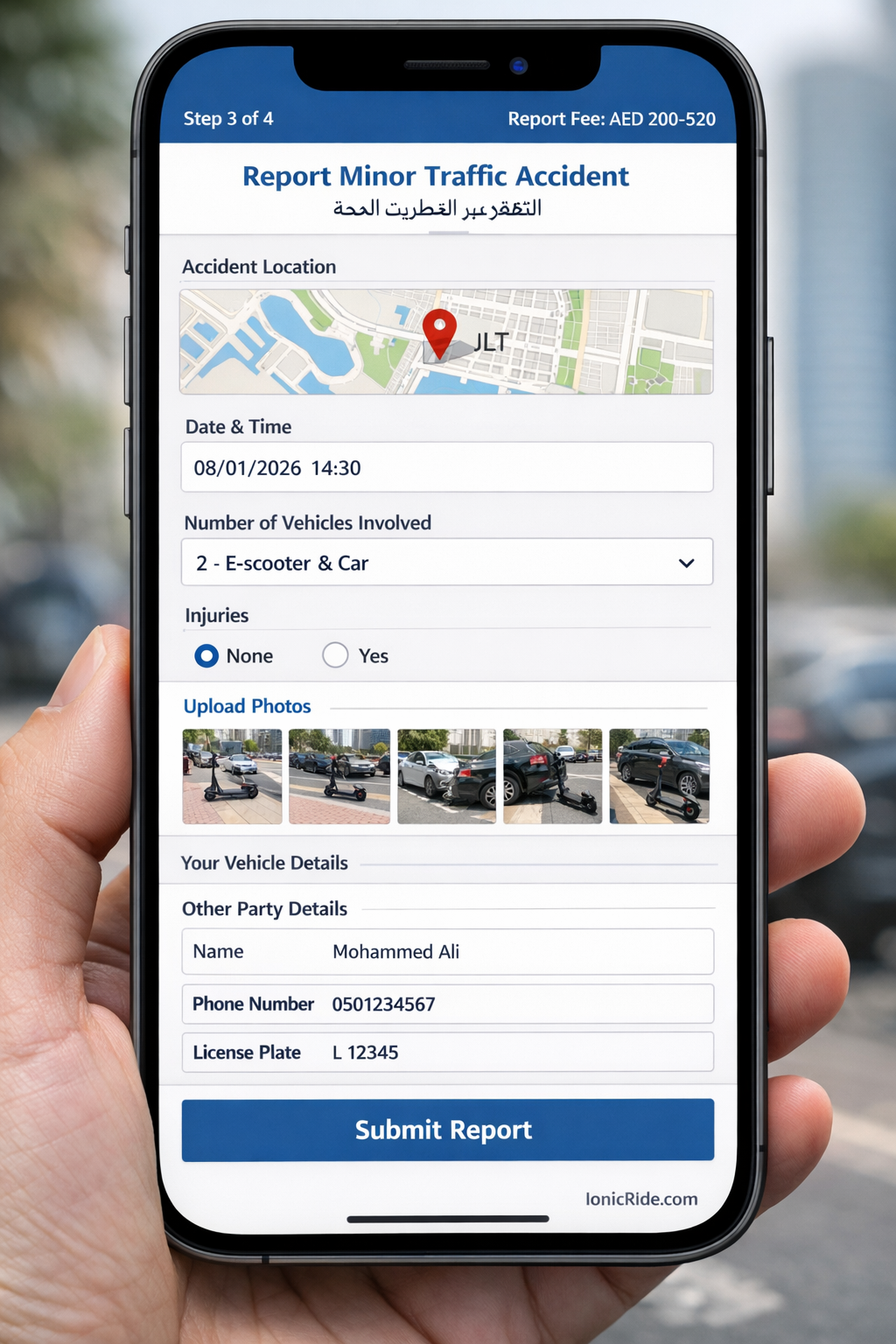
Option 2: Dubai Police App (for minor accidents only)
Use this if:
- No injuries
- Minor damage only
- Both parties agree on what happened
- Download Dubai Police app
- Go to Services → Minor Traffic Accident Report
- Enter accident location
- Enter both parties’ details (Emirates ID, plate numbers)
- Take 4-6 photos of damage (all angles)
- Submit report
- Get reference number immediately
- Official report emailed within 24 hours
App cost: 200-520 AED depending on accident type
Time: 3-5 minutes to file
If the other party disagrees about what happened, don’t use the app. Call 999. Let police decide fault at the scene.
What you need to have ready
Police (or app) will ask for:
- ✓ Emirates ID or passport
- ✓ E-scooter permit or driving license
- ✓ Other party’s details (name, phone, plate number)
- ✓ Photos of damage (scooter, car, scene)
- ✓ Location details (street name, nearest landmark)
If you don’t have permit, you’ll get fined for that too (200 AED) on top of the accident.
Critical: take photos immediately
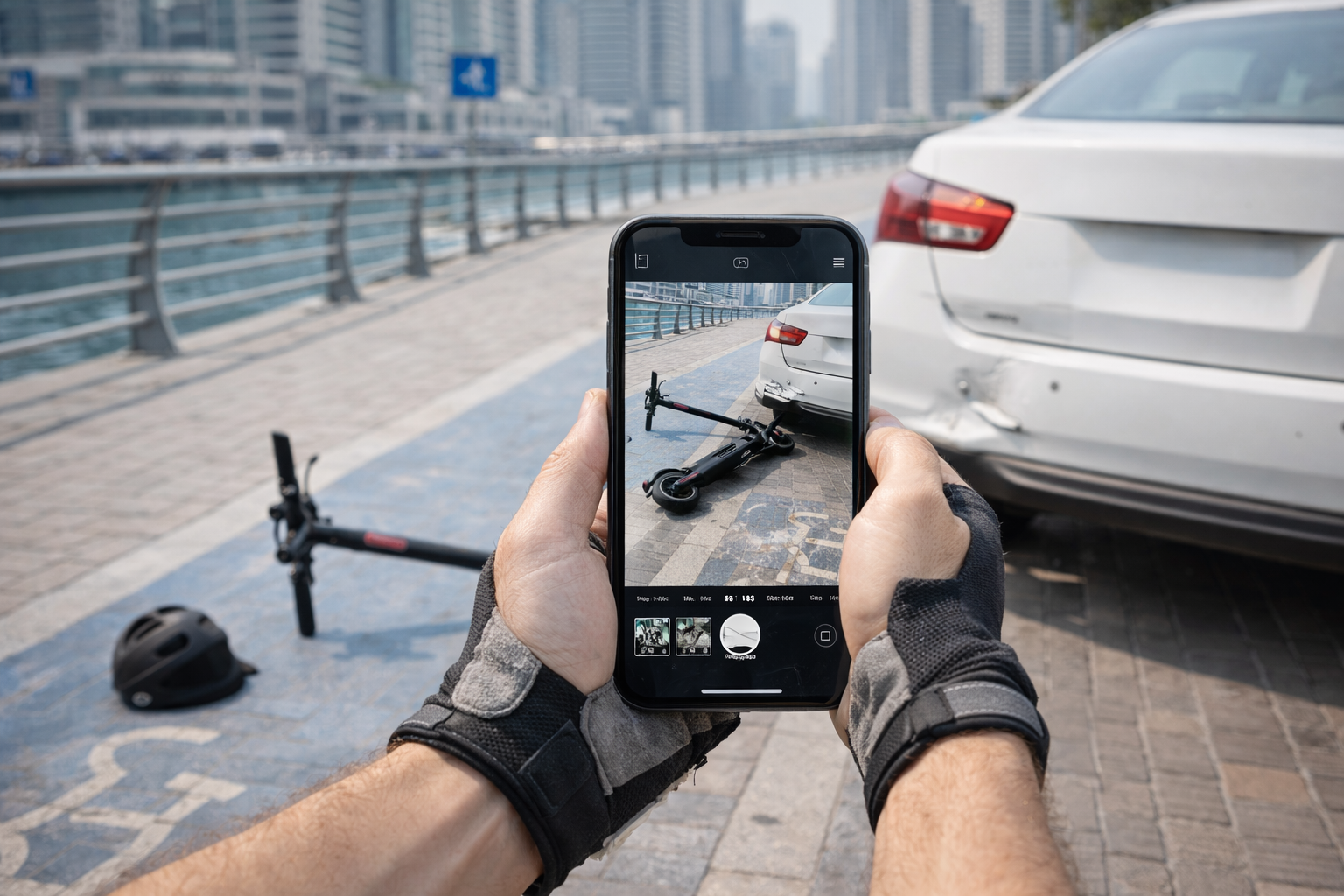
Before anything gets moved, take photos. This is evidence.
Take:
- Wide shot showing both vehicles/scooter and surroundings
- Close-up of all damage on your scooter
- Close-up of all damage on other vehicle
- License plate of other vehicle
- Road conditions (wet, dry, potholes)
- Traffic signs nearby
- Your scooter’s position relative to designated zone (if relevant)
Take 15-20 photos minimum. You can’t take too many.
Customer got hit by a car in Business Bay. Car driver claimed scooter rider was speeding and weaving.
Rider had photos showing he was in the bike lane, moving straight, car turned into him.
Police looked at photos. Found car at fault.
Without photos? He said / she said. Might have gone either way.
Exchange information (but don’t admit fault)
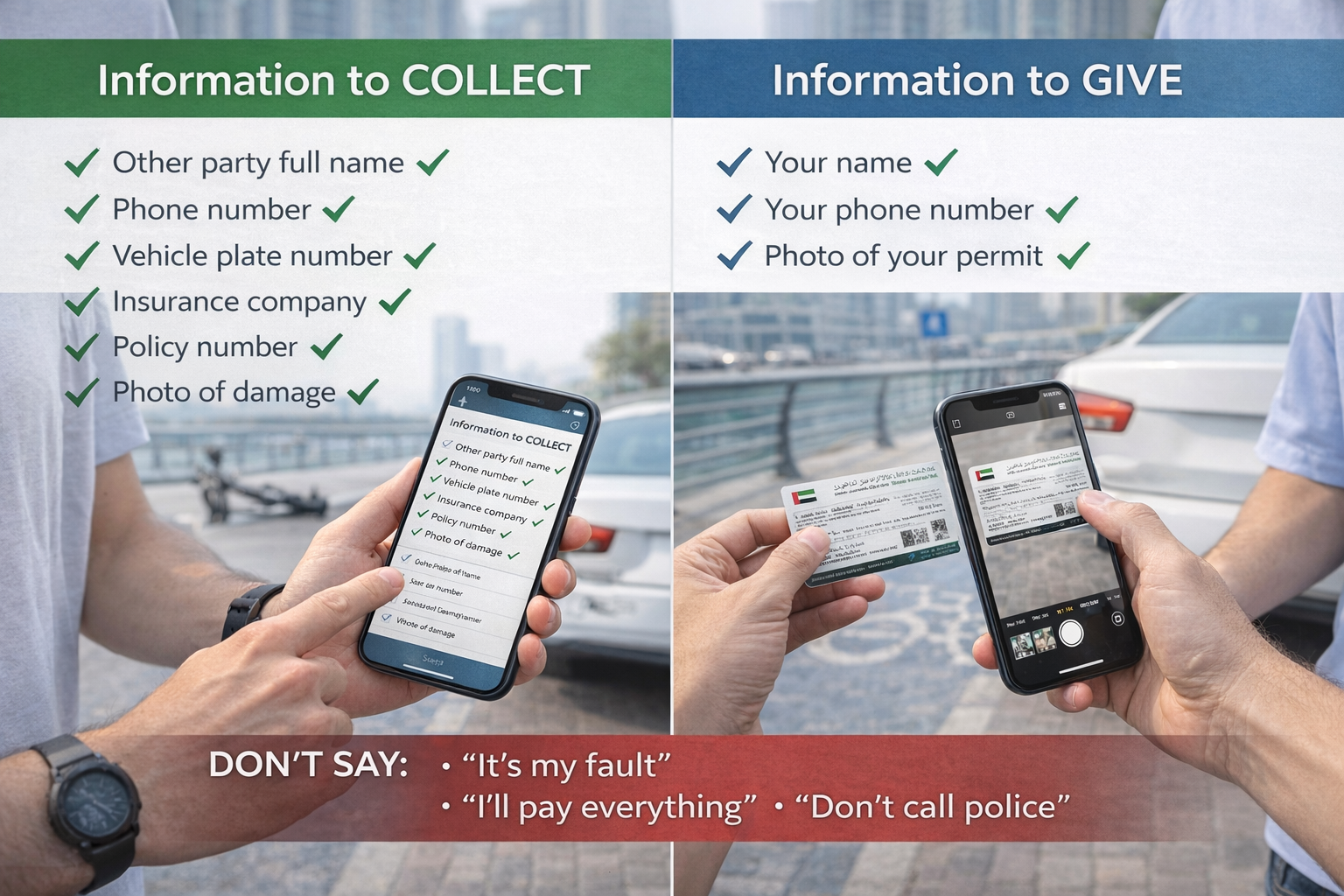
Get the other party’s:
- Full name
- Phone number
- Vehicle plate number
- Insurance company (if car)
- Insurance policy number (if car)
Give them yours:
- Name
- Phone number
- ✗ “It’s my fault”
- ✗ “I’m sorry” (can be interpreted as admission)
- ✗ “I’ll pay for everything”
- ✗ “Don’t call police, I’ll give you cash”
Be polite. Be factual. Don’t assign blame. Let the police report determine fault.
Who’s actually at fault? (How police decide)
Police determine fault based on:
- Were you in a designated zone? — If no, you’re likely at fault
- Did you have permit/license? — If no, counts against you
- Were you following traffic rules? — Signals, crossings, speed
- Were you wearing helmet? — Required by law
- Road conditions — Who had right of way?
- Witness statements — If any
- Traffic camera footage — If available
Common scenarios and who’s typically at fault
You’re likely at fault if:
- Riding outside designated zones
- No permit or license
- Ran red light or ignored traffic signal
- Riding on highway or road over 60 km/h
- Swerved suddenly into traffic
- Riding against traffic flow
- No helmet
Car likely at fault if:
- You were in designated zone, following rules
- Car turned into your path
- Car rear-ended you
- Car ran red light
- Car was speeding
- You had right of way at crossing
3 out of 4 accidents I hear about, the rider was outside the designated zone.
Doesn’t matter if the car hit you. Doesn’t matter if you had right of way on that road.
If you’re outside the 21 designated zones, police will often find you at least partially at fault.
This changes everything about liability and insurance.
After the police report: next steps
You got the police report. Now what?
If you’re at fault (pink form)
You’re responsible for:
- Other party’s repair costs (if car damage)
- Your own scooter repairs
- Your medical bills (unless you have health insurance)
- All fines issued
What to do:
- Contact the other party’s insurance company
- Provide police report
- They’ll send car for assessment
- You’ll get bill for repairs
- Pay or negotiate payment plan
Average car repair for minor accidents: 3,000-8,000 AED
Major accidents: 10,000-25,000 AED
If other party is at fault (green form)
Their insurance should cover:
- ✓ Your medical expenses
- ✓ Your scooter repair/replacement
- ✓ Compensation for injuries
- ✓ Lost wages (if applicable)
What to do:
- Get other party’s insurance details from police report
- Contact their insurance company
- Submit claim with police report + photos + medical reports
- Get scooter assessed for damage
- Wait for claim approval (7-30 days typical)
Insurance companies will try to minimize payouts. Expect:
- Questions about whether you were riding legally
- Requests for more documentation
- Offers lower than actual damage
- Delays (30-60 days sometimes)
Keep all receipts. Document everything. Be persistent.
If you were injured
Go to hospital immediately. Even if you feel fine.
Adrenaline hides injuries. Concussions, internal bleeding, fractures might not show symptoms for hours.
- Emergency room report
- Doctor’s assessment
- X-rays or scans (if done)
- Prescription for medication
- Follow-up appointment records
- Medical bills and receipts
This documentation proves injury for insurance claims.
Your health insurance (if you have it) covers emergency treatment.
If other party is at fault, their car insurance should reimburse your medical costs.
Can you sue for compensation?
Yes. If you were injured and the other party was at fault.
You can file civil claim for:
- Medical expenses
- Lost wages
- Pain and suffering
- Permanent disability (if applicable)
You’ll need:
- Police report showing other party at fault
- Medical reports proving injury
- Evidence of losses (pay stubs, medical bills)
- Lawyer (recommended for serious injuries)
Small claims (under 50,000 AED): 3-6 months
Larger claims: 6-18 months
Very serious injury cases: 1-3 years
Only worth pursuing if injuries are significant or you lost substantial income.
What if the accident was with a pedestrian?
This is serious.
If you hit a pedestrian:
- Police called immediately
- You’re likely at fault (pedestrians have right of way)
- You pay all medical costs
- Possible criminal charges if serious injury
- Fines 200-500 AED minimum
- Civil lawsuit for compensation likely
If pedestrian steps into your path suddenly (jaywalking), you might share fault.
But default assumption: rider should have been going slow enough to stop.
This is why designated zones exist. Mixing scooters with pedestrians = accidents.
The mistakes that make everything worse
Seen customers make these mistakes. All expensive:
1. Not reporting the accident
“It was just a scratch, we agreed to handle it ourselves.”
Then the car driver files police report 2 days later claiming you hit and ran.
Now you have no documentation of what actually happened. Police assume you’re guilty.
Always file report. Always.
2. Admitting fault at the scene
“Sorry, totally my fault, I’ll pay for everything.”
Later you realize you were actually in the right. Too late. You admitted fault.
Police report will reflect your admission. Can’t take it back.
3. Accepting cash settlement without documentation
Car driver offers you 1,000 AED cash “to forget about it.”
You take it. Later your scooter stops working (hidden damage from crash). Your shoulder still hurts (delayed injury).
You have no police report. No documentation. No recourse.
1,000 AED cash = giving up all legal rights.
4. Not checking if you were in designated zone
You think you’re in JLT (designated zone). Actually you crossed the boundary into neighboring area (not designated).
Police report: Violation of zone rules. You’re at fault regardless of circumstances.
Check zone boundaries on RTA map before riding. Know where the edges are.
5. Continuing to ride after crash
Scooter still works. Wheel wobbles a bit but you make it home.
Next day: wheel completely fails. You crash again. Now you’re injured.
After any crash, get the scooter inspected before riding again. Structural damage isn’t always visible.
How to protect yourself (before accidents happen)
Prevention is cheaper than paying for accidents.
- ✓ Verify you’re starting in designated zone
- ✓ Plan route that stays in designated zones entire way
- ✓ Helmet on (saves your life, saves you from 200 AED fine)
- ✓ Permit on phone (screenshot + app)
- ✓ Lights working (if evening ride)
- ✓ Check brakes work properly
- ✓ Stay visible — ride where cars can see you
- ✓ Assume cars don’t see you — always be defensive
- ✓ Slow down at intersections — even if you have right of way
- ✓ Don’t weave between cars — stay predictable
- ✓ Watch for car doors opening — people don’t check mirrors
- ✓ Never ride against traffic — this causes accidents constantly
One thing about rental scooters
If you’re on a rental (Tier, Lime, Arnab, Skurtt), the rental company has insurance.
But it only covers:
- Damage to third parties (if you hit someone/something)
- Liability for injuries you cause
It does NOT cover:
- Your own injuries
- Your medical costs
- Your lost wages
And the coverage only applies if you were riding legally.
Riding rental scooter outside designated zones = insurance void = you pay everything.
Bottom line on accidents
Accidents happen fast. Next steps happen faster.
First 10 minutes determine who pays, how much, and whether you face criminal charges.
- ✓ Stop. Don’t leave scene.
- ✓ Check for injuries (you and others).
- ✓ Call 999 if serious, or use app if minor.
- ✓ Take 15+ photos of everything.
- ✓ Exchange information with other party.
- ✓ Don’t admit fault.
- ✓ Wait for police / file app report.
- ✓ Get police report reference number.
- ✓ Go to hospital if any pain or injury.
- ✓ Contact insurance (theirs if they’re at fault).
- ✓ Keep all documentation.
Most accidents are preventable. Stay in designated zones. Wear your helmet. Follow traffic rules.
But if you crash, now you know what to do.