RTA Rules for Delivery E-Bikes 2026: Lane Restrictions You Need to Know
You’re doing deliveries. Cycling track is empty but ends in 200 meters. Car lane is right there.
Can you ride in the car lane? What about the sidewalk when there’s no bike lane? And why did that other rider just get a 500 AED fine for something you do every day?
RTA rules for e-bikes aren’t simple. There’s what’s written, what’s enforced, and what delivery riders actually do to survive in Dubai traffic.
Here’s the truth about lane restrictions—including the violations that actually get fined.
What RTA Actually Says: The Official Rules
First, the official position from RTA and UAE Federal Traffic Law:
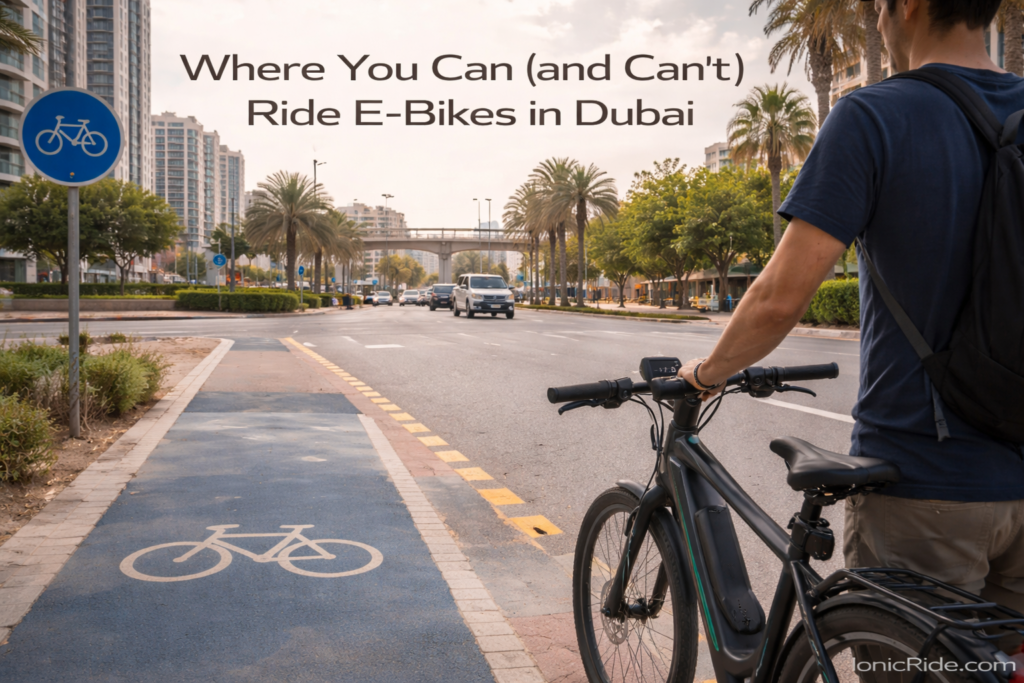
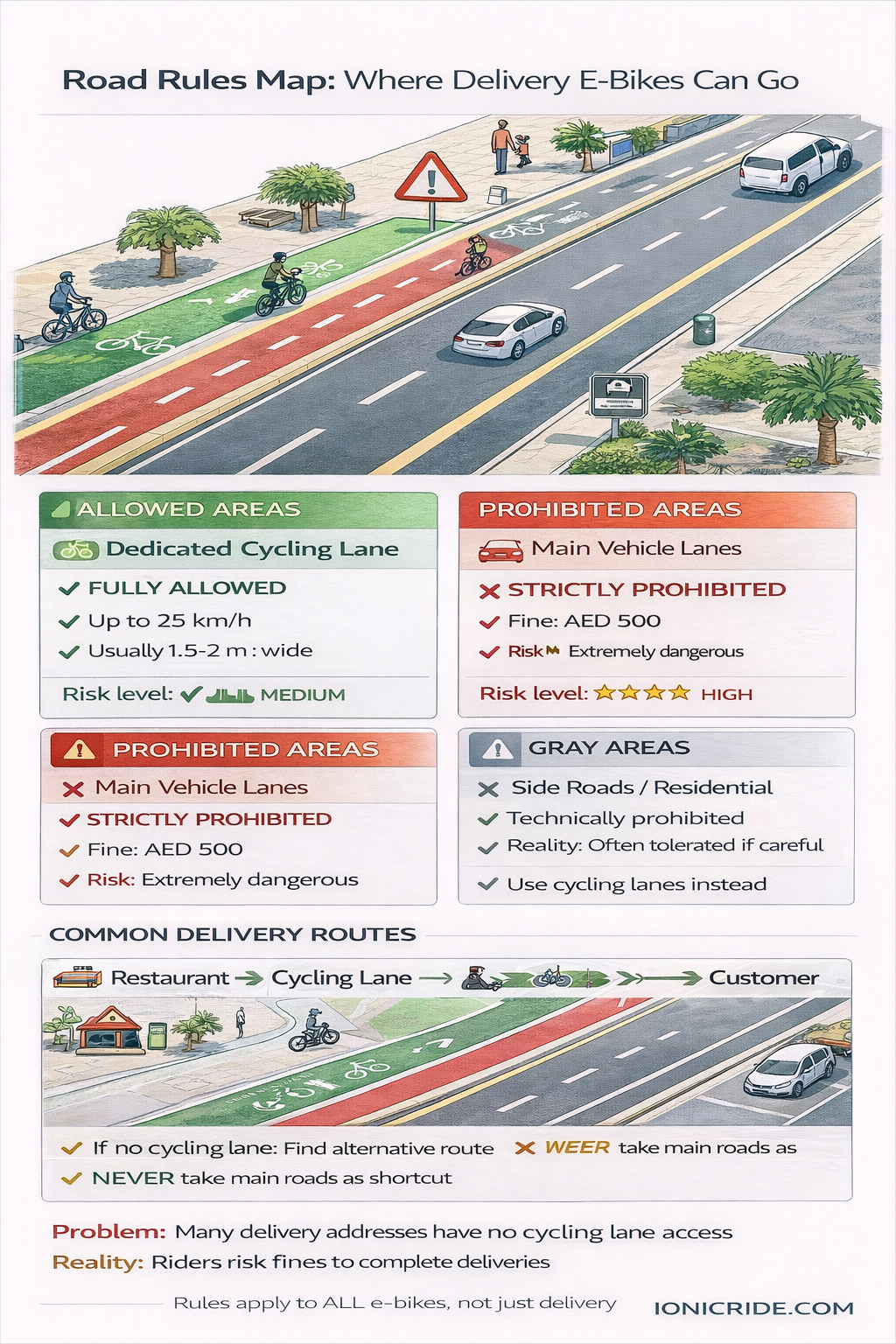
- Cycling tracks mandatory when available: If a cycling track or designated bike lane exists, you must use it
- Rightmost lane when no cycling track: Ride in the far-right lane of the road, not the middle or left lanes
- No highways: E-bikes banned on Sheikh Zayed Road, Emirates Road, and all highways/expressways (roads with 80+ km/h speed limits)
- Sidewalk use prohibited: Riding on pedestrian sidewalks is illegal (with some municipal exceptions)
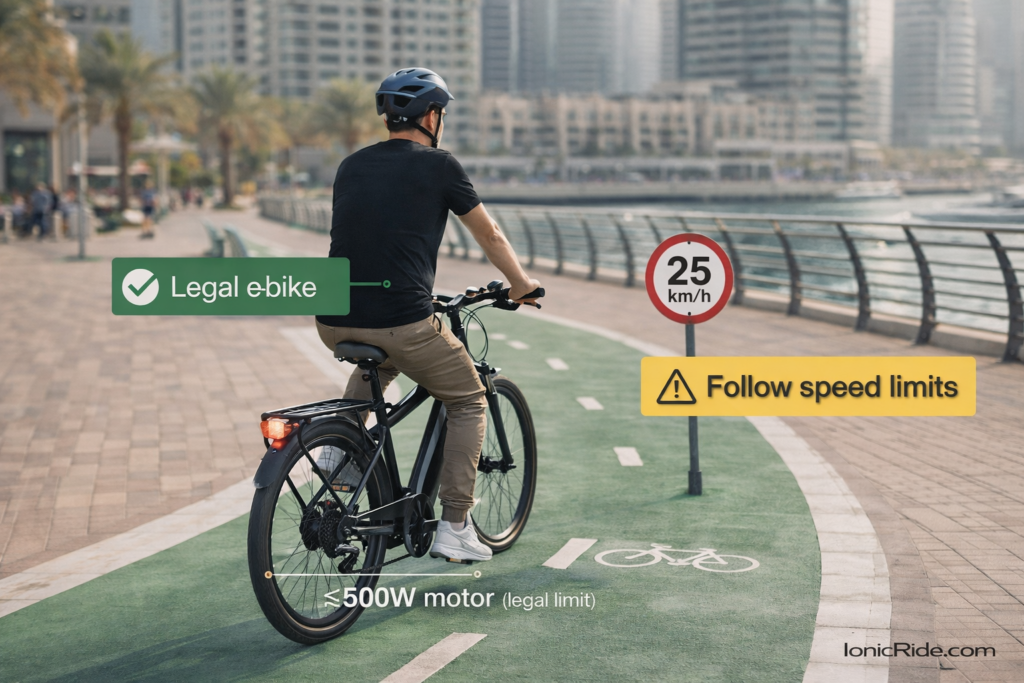
- Motor power limit: E-bikes with motors over 250W technically require registration (but enforcement is minimal)
That’s the official version. Now let’s talk about reality.
The Reality: What Actually Gets Enforced
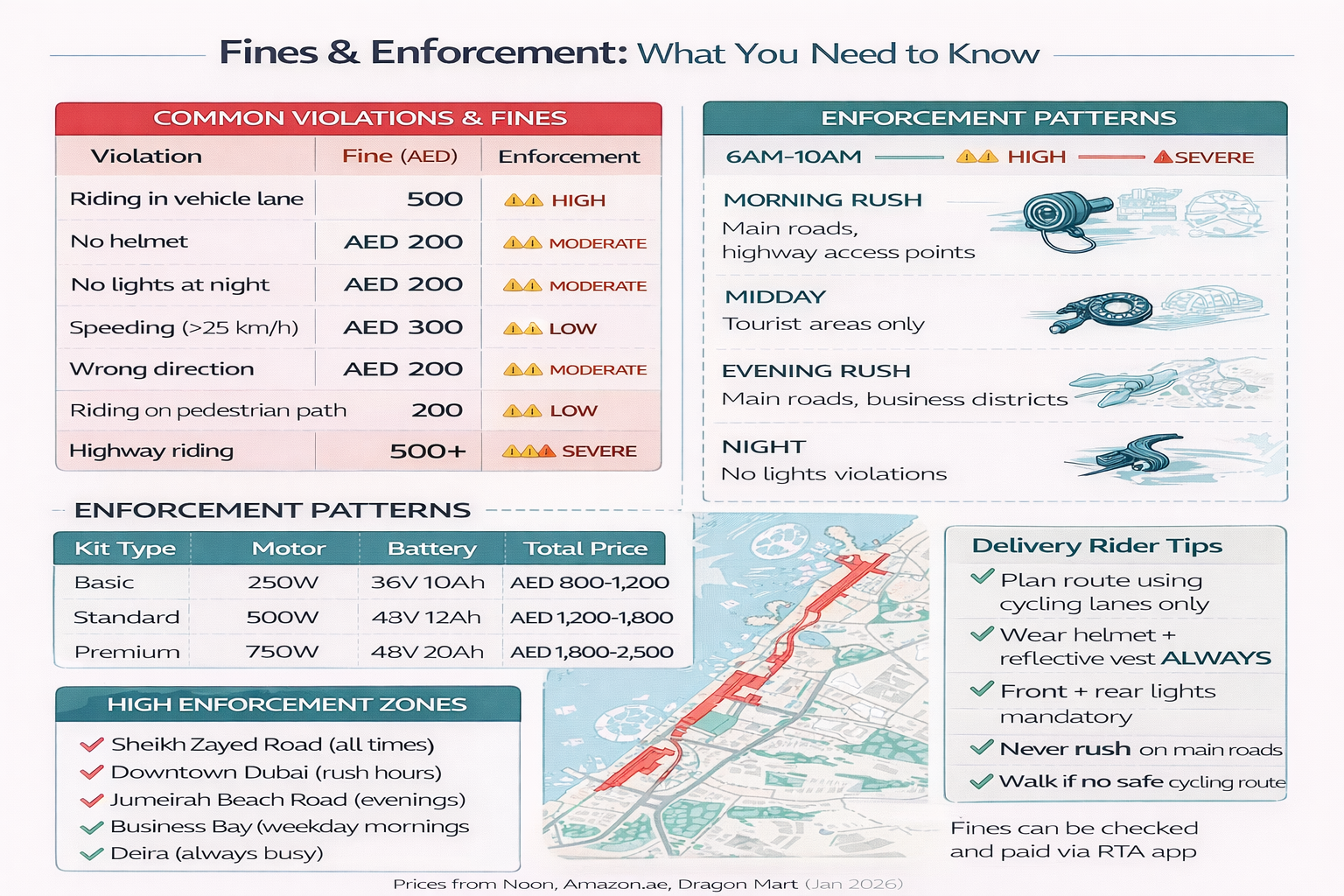
- Cycling tracks: Police DO stop riders who skip available cycling tracks to ride in car lanes. Fine: 200-300 AED.
- Highways: Strictly enforced. You will get fined (500 AED) or escorted off if caught on Sheikh Zayed Road/Emirates Road.
- Sidewalk riding: Enforced in high-pedestrian areas (JBR, Marina Walk, downtown). Fine: 200 AED. Ignored in low-traffic residential areas.
- Helmet requirement: Not consistently enforced for e-bikes (unlike motorcycles) but can be added to other violations.
- Motor power limits: Never checked in practice. Police don’t carry wattage meters.
The Cycling Track Problem
Here’s the issue delivery riders face daily:
- Cycling tracks end randomly: Track exists for 2 km, then just… stops. You’re forced into car lane anyway.
- Blocked by parked cars: Cars park in cycling lanes constantly. Do you stop? Ride around them into car lane? Use sidewalk?
- Wrong direction: You need to go west, cycling track only goes east. Legal answer: Find another route. Reality: Riders use car lane.
- Delivery timing pressure: Cycling track adds 5 minutes vs direct car lane route. Your Talabat order is late. What do you do?
RTA says “use cycling tracks when available.” Delivery riders say “available doesn’t mean practical.”
Where You CAN Ride (By Area)
Lane availability varies wildly by Dubai area:
| Area | Cycling Track | Car Lane (Rightmost) | Sidewalk | Notes |
|---|---|---|---|---|
| JBR/Marina | Yes | No (track mandatory) | No (heavy enforcement) | Use the beachfront cycling track. Sidewalk fines common. |
| JLT | Yes (partial) | Sometimes allowed | No | Internal roads okay, main roads have tracks. |
| Downtown Dubai | Yes (around Burj) | No (track mandatory) | No | Cycling track network extensive. Use it. |
| Deira/Bur Dubai | Rare | Yes (rightmost lane) | Tolerated in some areas | Old Dubai has minimal cycling infrastructure. |
| Business Bay | Partial | Yes (side roads) | No | Main roads have tracks, internal roads don’t. |
| International City | No | Yes | Ignored by police | No enforcement in practice. |
| Motor City/Sports City | Yes (extensive) | No (track mandatory) | No | Well-planned cycling infrastructure. Use tracks. |
| Al Quoz Industrial | No | Yes | No | Industrial area, minimal enforcement. |
The Highway Ban (Strictly Enforced)
- Sheikh Zayed Road (E11): Instant fine if caught. Police actively monitor.
- Emirates Road (E611): Same as SZR. No e-bikes, no exceptions.
- Al Khail Road (E44): Banned. Speed limit 100-120 km/h.
- Mohammed Bin Zayed Road (E311): Banned for e-bikes.
- Any road with 80+ km/h speed limit: If the sign says 80 or higher, e-bikes aren’t allowed.
Fine: 500 AED + bike impounded until fine paid
“I tried to cross SZR at Al Barsha. Police stopped me within 5 minutes, 500 AED fine. They said if I do it again, bike gets impounded for 30 days.” — Talabat rider, 2025
“The problem is GPS sometimes routes you onto highways. You have to manually avoid them or you’re screwed.” — Deliveroo rider, 2025
The Fines: What Actually Costs You Money
| Violation | Fine (AED) | How Often Enforced |
|---|---|---|
| Riding on highway/expressway | 500 | High (police actively monitor) |
| Ignoring cycling track when available | 200-300 | Medium (depends on area) |
| Riding on pedestrian sidewalk (high-traffic areas) | 200 | Medium (JBR, Marina, Downtown) |
| Riding against traffic flow | 300 | Medium (if police see it) |
| Running red light on e-bike | 500 | Low (but happens) |
| No lights at night | 200 | Low (rarely checked) |
| Riding between cars (lane splitting) | 400 | Low (unless you cause accident) |
| No helmet | 100-200 | Very Low (not required by law for e-bikes, but can be cited under “unsafe riding”) |
The Sidewalk Debate
This is where the rules get really murky:
Dubai:
- Strictly banned: JBR, Marina Walk, City Walk, La Mer, Downtown (high pedestrian areas)
- Tolerated: Residential areas with wide sidewalks, minimal pedestrian traffic
- Municipal discretion: Each area can set local rules
Sharjah:
- Generally stricter than Dubai
- Sidewalk riding rarely tolerated, even in residential areas
Abu Dhabi:
- Has designated “shared paths” (pedestrians + bikes) in some areas
- Clearer signage than Dubai about where bikes allowed
When Riders Use Sidewalks Anyway
- No cycling track AND 60+ km/h car traffic: Safety trumps legality for some riders
- Short distances (under 100m): To reach building entrance from car lane
- Construction blocking car lane: Temporary use to get around obstacle
- Late night (low pedestrian traffic): Less enforcement, lower risk to pedestrians
Riders who do this: Ride slowly (10-15 km/h), yield to all pedestrians, dismount if crowded. Minimizes risk of fine and actual danger to people.
What About Delivery Company Rules?
Talabat, Deliveroo, Noon, Careem don’t actually employ delivery riders—you’re independent contractors. But they have terms of service:
- Talabat: “Riders must follow all local traffic laws.” (No specific lane restrictions mentioned)
- Deliveroo: “Use designated cycling infrastructure where available.”
- Noon Food: “Comply with RTA regulations for e-bikes.”
- Careem: Similar general compliance language
- You pay the fine: Delivery apps don’t reimburse traffic fines
- Account suspension risk: Multiple violations reported to platform can get you deactivated
- No legal protection: You’re not an employee, so no company legal support
How Police Actually Enforce These Rules
Enforcement isn’t random. There are patterns:
High Enforcement Areas
- JBR Beach/The Walk: Dedicated bicycle patrols monitor sidewalk riding
- Downtown Dubai (Burj area): Tourist area, heavy police presence
- Dubai Marina Walk: Pedestrian safety focus, fines common
- Any highway on-ramp: Cameras + police presence
- Sheikh Zayed Road crossings: Traffic police specifically watch for this
Low Enforcement Areas
- International City (minimal police presence)
- Old Dubai residential areas (Satwa, Karama side streets)
- Industrial areas (Al Quoz, Jebel Ali)
- Late night (after 10 PM) in most areas
This doesn’t make it legal. Just less likely to result in immediate fine.
What Triggers Police Attention
- Riding recklessly: Weaving through traffic, cutting off cars
- Accidents: If you hit someone or something, police WILL check everything
- Complaints: Pedestrian calls police about aggressive sidewalk rider
- Checkpoints: Random traffic checks (rare for e-bikes but happen)
- Being the example: If police want to send a message, you might get stopped
Practical Routing Guide for Delivery Riders
How do you actually navigate Dubai legally while meeting delivery times?
Decision tree for choosing your lane:
Step 1: Is there a cycling track?
- Yes: Use it. This is non-negotiable if you want to avoid fines.
- No: Proceed to Step 2.
Step 2: What’s the speed limit?
- 80+ km/h: You can’t legally ride here. Find alternate route.
- 60 km/h or less: Use rightmost lane. Proceed to Step 3.
Step 3: Is the rightmost lane safe?
- Yes (cars giving space, low traffic): Ride in rightmost lane.
- No (cars aggressive, high-speed traffic): You have tough choice—risk safety in lane, or risk fine on sidewalk. Most riders choose safety.
Delivery Rider Tips from Those Who Haven’t Been Fined
- Learn your area’s cycling track network: First week, map out where tracks exist. Use them religiously.
- Pre-plan routes that avoid highways: Set Google Maps to avoid highways/toll roads. Adds time but avoids 500 AED fine.
- If you must use sidewalk, be invisible: Slow speed, yield to everyone, don’t block anyone. Police less likely to fine if you’re being considerate.
- Lights front and rear: Night riding with no lights gives police easy reason to stop you, then they check everything else.
- Stay right, signal turns: Hand signals for turns make you look compliant. Police less likely to assume you’re breaking rules.
The Insurance Question
If you’re hit by a car while in car lane, does insurance cover you?
- Car hits you while you’re in cycling track: Their insurance covers your injuries. Clear liability.
- Car hits you while you’re in car lane (legally, rightmost lane): Depends on circumstances. If you were following rules, their insurance should cover. If investigation shows you violated traffic rules, partial liability possible.
- Car hits you while you’re on sidewalk or highway: You were breaking law. Partial or full liability on you, even if car was also at fault.
Delivery riders have no commercial insurance: Platforms don’t provide it. Any injuries or bike damage comes out of your pocket.
Upcoming Changes (What We Know for 2026)
- Registration system planned: RTA considering mandatory registration for all e-bikes/scooters. No timeline yet.
- Cycling track expansion: Dubai 2040 plan includes 1,000+ km of cycling tracks. In progress.
- E-bike delivery licensing: Discussed but not implemented. Would require delivery riders to have commercial license.
- Geofencing technology: Some discussion of requiring e-bikes to have speed limiters in certain zones. Not implemented.
None of these are law yet. As of January 2026, rules remain as described above.
The Bottom Line for Delivery Riders
Here’s what you need to remember:
Critical rules to avoid fines:
- Use cycling tracks when they exist. Even if it’s slower. 200-300 AED fine isn’t worth saving 2 minutes.
- Never ride on highways. 500 AED fine + impound. GPS will try to route you there—ignore it.
- Stay in rightmost lane when no cycling track. Don’t ride in middle or left lanes.
- Be smart about sidewalks. High-pedestrian areas = high enforcement. Residential/industrial = low enforcement. If you do it, ride slow and yield.
- Don’t be the example. Ride predictably, follow basic rules, don’t give police a reason to make you the case study.
Most delivery riders go months without fines by following these basic principles.
The riders who get fined are usually:
- New riders who don’t know the highway restrictions (one 500 AED fine teaches this fast)
- Riders taking risky shortcuts daily until they finally get caught
- Riders causing near-accidents, which brings police attention
You don’t need perfect compliance. You need enough compliance to stay off police radar.
RTA rules aren’t designed for delivery riders. They’re designed for recreational cycling. You’re trying to make money in a system that wasn’t built for your use case.
Understand the rules. Understand what’s actually enforced. Make informed decisions about risk vs. reward.
Just don’t be surprised when the 500 AED highway fine hits your bank account.