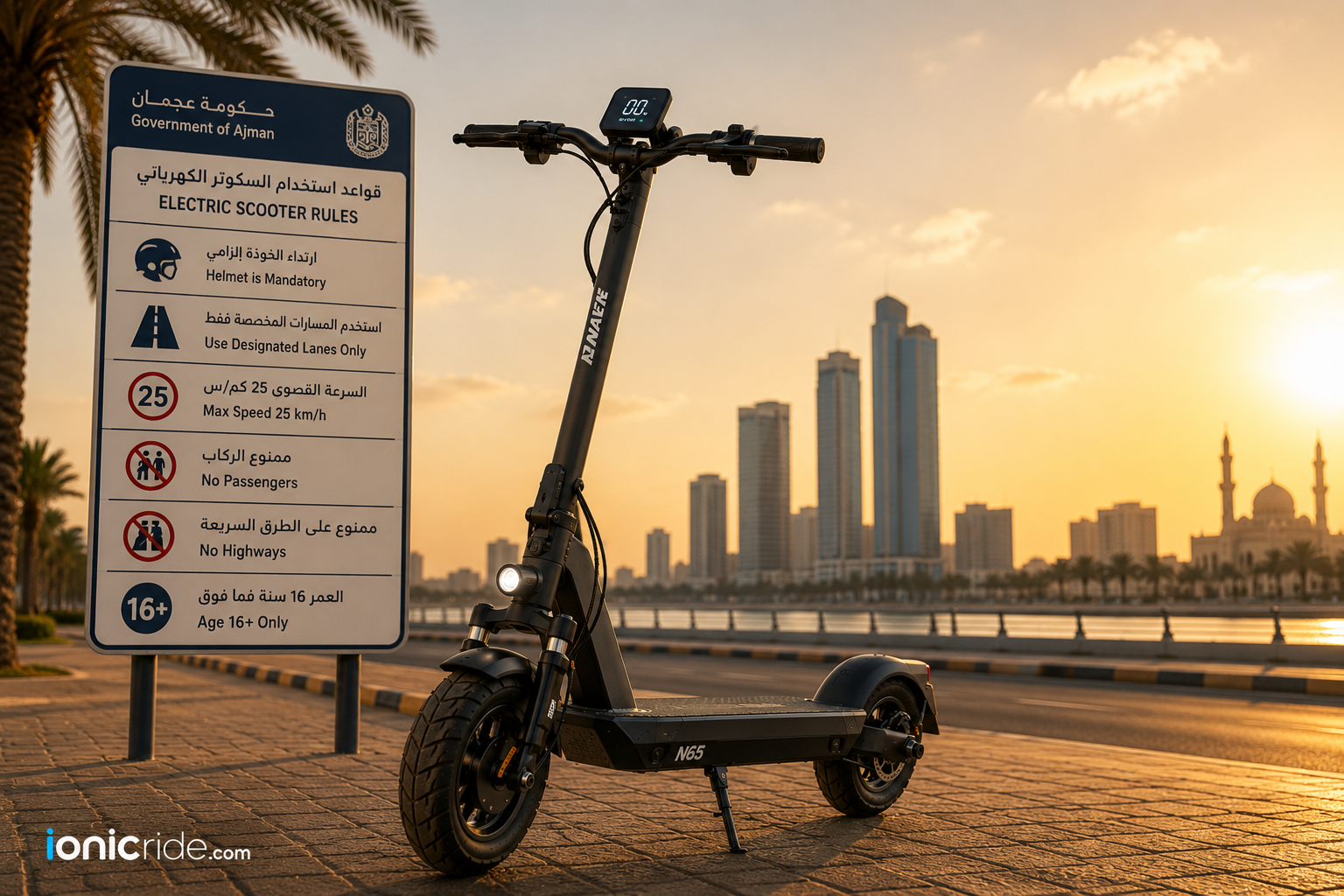
Electric Scooter Rules in Ajman 2026
Electric Scooter Rules in Ajman 2026 — Why They’re Stricter Than Dubai (And What You Can Actually Do)
A lot of scooter riders in the UAE assume the rules are the same across all seven emirates. They’re not. And nowhere is the difference more stark than Ajman.
While Dubai built out 21 designated riding zones, an RTA permit system, and a whole monitoring unit for e-scooters, Ajman went in the opposite direction. In August 2025, Ajman Police announced a full ban — no public roads, no streets, no footpaths, no exceptions. Privately owned or rental, it doesn’t matter. If it’s electric and it’s two wheels, it’s off the public roads in Ajman.
This guide covers exactly what’s banned, what happens if you get caught, where you can still ride (hint: it’s limited), and how to handle the commute if you live in Ajman but ride in Dubai.
Ajman vs Dubai vs Sharjah — How the Rules Compare
People who moved to Ajman from Dubai are often surprised when they find out. The assumption is that UAE rules are UAE rules. They’re not — each emirate sets its own approach to e-scooters, and the gap between Dubai and Ajman is basically as wide as it gets.
- All public roads banned
- No designated zones
- Immediate confiscation
- Both private + rental banned
- No permit system
- Main roads: banned
- Parks + waterfront: permitted
- Immediate confiscation on roads
- No formal permit system
- Stricter than Dubai
- 21 designated zones
- Free RTA permit required
- Helmet mandatory
- 25 km/h max speed
- Active monitoring unit
The pattern is clear. Dubai treats e-scooters as transport to be regulated. Sharjah tolerates them in recreational zones but not on roads. Ajman decided the risk wasn’t worth the regulatory effort and banned the lot.
Each UAE emirate has its own police force and transport authority. There is no single federal e-scooter law that overrides local decisions. Dubai’s Roads and Transport Authority (RTA) built its framework over years. Ajman doesn’t have the same scale of cycling infrastructure — no dedicated tracks, narrower roads in older residential areas, mixed pedestrian and vehicle traffic. When violations started piling up and accidents followed, a full ban was the path of least resistance. It’s blunt, but it’s enforceable without building new infrastructure.
Why Did Ajman Actually Do This
The ban didn’t come out of nowhere. Ajman Police had been watching the same pattern that was playing out across the UAE — scooters becoming popular fast, riders not understanding or not caring about the rules, near-misses and actual accidents following. But Ajman’s road environment made the problem worse than it was in Dubai.
Ajman has more mixed-use roads — streets where pedestrians, cyclists, and cars share space without dedicated lanes for any of them. In Dubai Marina or JBR, there’s a proper cycling track. In central Ajman, there often isn’t. Scooter riders were filling that gap by using the road shoulder, the pavement, or just the main carriageway. None of those options are safe.
- Riding the wrong way on one-way streets — directly into oncoming traffic. Common in Ajman’s older residential grid where one-way systems are not well signed.
- No safety gear — riding without a helmet on main roads at speed. Police documented this repeatedly before the ban.
- Entering roads from exit points — cutting through roundabout exits and one-way entry/exit points on foot and scooter paths.
- Riding on pavements at speed — near-misses with pedestrians. Ajman’s pavements are narrower than Dubai’s dedicated cycling infrastructure and were never built for 20+ km/h scooter traffic.
- Multiple riders — carrying a second person on a single scooter, which is prohibited everywhere in the UAE.
A warning went out from Ajman Police about a month before the formal ban, with video footage of specific violations. The warning was largely ignored. The ban was the follow-through.
“For some it feels like losing an affordable way to get around. For others it brings peace of mind — their evening walks and school runs feel safer now. Either way, the ban has stirred up plenty of conversation across the city.” — Times of Dubai, August 2025
What Exactly Is Banned in Ajman
The Ajman ban is broader than people realise. It’s not just “no riding on main roads” — that’s Dubai and Sharjah’s approach. Ajman’s ban covers everything public.
Ajman E-Scooter Ban — What’s Covered
Effective August 2025| Location / Activity | Status |
|---|---|
| Public roads and streets | 🚫 Banned |
| Public footpaths and pavements | 🚫 Banned |
| Public parks and open spaces | 🚫 Banned |
| Ajman highways and main roads | 🚫 Banned |
| Rental scooters (Arnab, Lime, etc.) | 🚫 Banned |
| Private compound paths (gated) | ✓ Permitted |
| Villa garden / private land | ✓ Permitted |
| Private indoor spaces | ✓ Permitted |
| E-bikes (throttle or pedal assist) | 🚫 Banned |
| Commercial delivery (specific cases) | ⚠️ Unclear |
Private gated compounds with internal paths that are not public roads are generally not covered by the public road ban. However, “not covered” is not the same as “officially approved.” If your compound’s internal paths lead directly onto a public road — as most do — the moment you exit that compound gate onto a public surface, the ban applies. The compound interior is your permitted space. The second the wheel hits the public road, you’re in violation.
What Happens If Ajman Police Stop You
Ajman Police confirmed officers are authorised to stop riders, issue fines, and confiscate scooters on the spot. The specific fine amount hasn’t been officially published — which is unusual compared to Dubai’s clear AED 200–500 structure, but consistent with Ajman’s approach to enforcement where the deterrent is the confiscation more than the fine.
Here’s what the process looks like in practice based on how Ajman handles similar vehicle violations:
- 1Stop and confiscation: Officer stops you on any public road. Scooter is taken on the spot. No warning system — the ban was already the warning. Riders stopped post-August 2025 have no grace period argument.
- 2Fine issued: A fine is issued. Specific amount not published but likely in line with similar vehicle violations — potentially AED 500+. Unlike Dubai, Ajman abolished its fine discount scheme, meaning no 50% reduction campaigns apply.
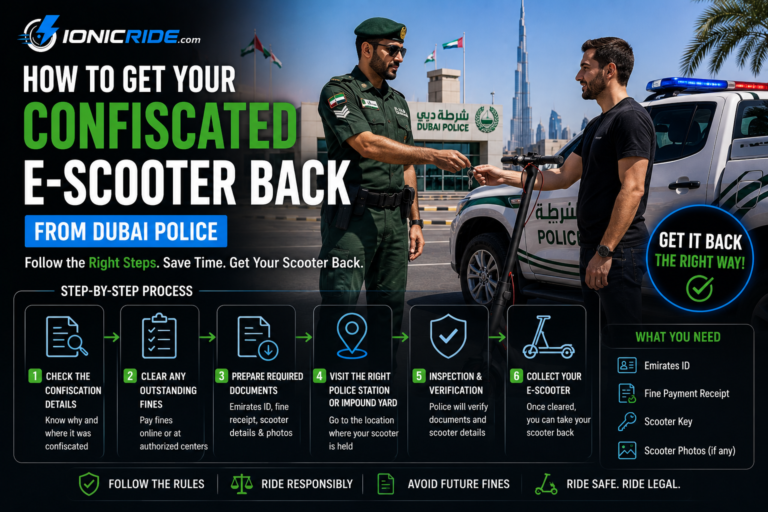
- 3To retrieve your scooter: Visit Ajman Police headquarters with Emirates ID, proof of ownership, and the fine payment receipt. The release process is handled directly through Ajman Police customer service — there is no online confiscation release equivalent to Dubai’s system.
- 4Repeat violations: Ajman’s traffic enforcement has zero discount tolerance — they scrapped the discount scheme specifically because violations weren’t deterred by fines alone. A second confiscation means starting the retrieval process again, with no leniency.
Ajman Police announced the ban publicly, with media coverage across Gulf News, Khaleej Times, and local outlets. The prior warning month means there was a documented public notification before enforcement. “I didn’t know about the ban” is not a defence that will help you retrieve a confiscated scooter or avoid a fine. If you ride in Ajman in 2026, assume you will be stopped.
What You Can Actually Do If You Live in Ajman
Living in Ajman with a scooter doesn’t have to mean the scooter sits unused. It does mean adjusting how you use it.
- ✓Compound riding: If you live in a large gated community — Al Nakheel, Al Rawda, Ajman Uptown, Emirates City — the internal compound paths are your riding space. Use lowest speed mode, always wear a helmet, stay on internal paths. This is the main practical option for daily fun riding.
- ✓Drive to Dubai, ride in Dubai: Load the scooter in your car, drive to a designated Dubai zone — JLT, Dubai Marina, Downtown, Al Rigga — park the car, and ride from there. A lot of Ajman residents who work in Dubai do exactly this. It’s not convenient, but it’s legal.
- ✓Use the scooter for last-mile in Dubai only: If you commute to Dubai by car, your scooter becomes your Dubai last-mile tool from the car park. You never ride it in Ajman. This is the cleanest workaround for commuters.
- ⚠️Wait and watch for any Ajman zone announcements: There is no official timeline for Ajman to establish designated zones. However, the ban is a safety-response measure, not a permanent ideological position. If Ajman builds cycling infrastructure and formal tracks, designated zones could follow. Check Ajman Police and Ajman Municipality announcements for any updates.
Living near the Dubai border? Get your free RTA permit before you ride in Dubai: RTA E-Scooter Permit Guide — 15 Minutes Online
Why Dubai Managed to Regulate It and Ajman Didn’t
The honest answer is infrastructure and resources. Dubai built dedicated cycling tracks over years, mapped 21 specific zones where scooter speeds and pedestrian interactions could be managed, trained a monitoring unit, and created a digital permit system. None of that is cheap or quick to build.
Ajman is a smaller emirate with less dedicated transport infrastructure. The cycling tracks that make Dubai’s system work — the ones that keep scooters separated from main road traffic — largely don’t exist in Ajman’s urban areas. Without that infrastructure, a permit system that allows public riding creates unmanageable enforcement problems.
This isn’t a criticism of Ajman’s approach — it’s a realistic reading of the situation. A ban is enforceable without infrastructure. A regulated system requires the infrastructure first.
- Ajman address on your Emirates ID? Your scooter is a Dubai tool, not an Ajman one. Plan accordingly.
- Visiting Ajman from Dubai? Leave the scooter in the car or at home. Do not ride it once you cross into Ajman — not even “just this one road.”
- Got a scooter as a gift and live in Ajman? Compound use only until the rules change. Don’t test it on the public road “just quickly.”
- Delivery work in Ajman? The commercial delivery e-bike situation is less clearly defined, but the safest position is to treat the ban as covering all electric two-wheelers unless you have specific authorisation from your employer and Ajman authorities.
Got Your Scooter Confiscated in Ajman? Here’s What to Do
First: don’t argue with the officer at the roadside. The ban is in effect, the confiscation is lawful, and anything said at the scene doesn’t change the outcome.
The retrieval process:
- Go to Ajman Police headquarters — Sheikh Humaid bin Rashid Al Nuaimi Street, Ajman. Bring your Emirates ID and any proof of scooter ownership (receipt, box, or the scooter’s serial number registered to you).
- Pay the fine — amount determined at the time of violation. Payment by card or cash at the customer happiness centre.
- Collect the release paperwork — the scooter is held at the police impound until the fine is paid and release is processed.
- Check Ajman Police website or app — ajmanpolice.ae — for current waiting times and any updated procedures. Log in with UAE Pass for the most accurate information.
Ajman Police may charge a storage fee for each day your scooter is held in impound after confiscation. The longer you wait to retrieve it, the more the total cost grows. Go to the police headquarters as soon as possible after a confiscation — don’t leave it for a week.
Got a scooter confiscated in another emirate? Read our full guide: E-Scooter Confiscation in Dubai — Documents, Fees & How to Avoid It
Ajman E-Scooter Rules — Complete FAQ
Yes — fully. Ajman Police issued a blanket ban on all electric scooters on public roads, streets, and footpaths in August 2025, effective immediately. Both private and rental scooters are banned. Only private compound areas and villa gardens are outside the ban’s scope. There is no designated public riding zone in Ajman as of May 2026.
Ajman Police has not published a specific AED amount for e-scooter violations. What is confirmed: officers can issue fines and confiscate scooters on the spot. Ajman abolished its traffic fine discount scheme, meaning no periodic 50% reductions apply. Treat the financial consequence as significant and the confiscation as near-certain — that’s the realistic deterrent.
Only in private areas — gated compound paths, villa gardens, private parking areas. There are no public zones, no designated tracks, and no permit system for public riding. If the path connects to a public road, the ban applies the moment you reach that connection point.
No. The RTA permit covers riding in Dubai’s designated zones only. It gives you zero riding rights in Ajman. Each emirate sets its own rules — a Dubai permit is a Dubai document.
Rising accidents, documented violations (wrong-way riding, no safety gear, entering roads from exits), and a road environment that lacks the dedicated cycling infrastructure needed to manage scooter traffic safely. After a warning period was largely ignored, Ajman Police moved to a full ban. It is both a safety response and an infrastructure reality — you cannot regulate riding zones you haven’t built yet.
Yes. The Ajman ban covers electric scooters, e-bikes, and all similar two-wheeled electric vehicles. It is not limited to standing scooters — electric bicycles with throttle or pedal assist are included. See our UAE e-bike rules guide for the broader picture.
Drive to Dubai, use the scooter as your last-mile from the car park within a designated Dubai zone. Many Ajman residents do exactly this. Get the free RTA e-scooter permit if you don’t already have one — it’s free and takes 15 minutes. Your scooter is a Dubai commute tool, not an Ajman one.
The Ajman ban explicitly includes rental scooters — both Arnab and any other rental service. Rental services cannot legally operate on public roads in Ajman under the current ban. Any rental scooter spotted in Ajman is operating in violation of the ban.
Sharjah restricts scooters to parks and designated waterfront tracks — it is a partial restriction, not a full ban. Riding on main roads in Sharjah leads to immediate confiscation, but there are permitted recreational spaces. Ajman has no permitted public spaces at all, making it the most restrictive emirate in the UAE for e-scooter use. See our Sharjah e-scooter rules guide for the comparison.
Go to Ajman Police headquarters with your Emirates ID and proof of ownership. Pay the fine at the customer happiness centre. Collect the release paperwork. Check ajmanpolice.ae or the Ajman Police app (log in with UAE Pass) for current procedures and waiting times. Go as soon as possible — storage fees may accumulate daily.
No official announcement of any change in Ajman’s position as of May 2026. The ban is a deliberate policy response, not a temporary measure. Whether Ajman eventually establishes designated zones depends on future infrastructure investment and policy decisions. For 2026, treat it as permanent.
Dubai’s nearest designated zones include Al Rigga, Deira City Centre area, and parts of Sharjah’s waterfront for recreational riding. If you live near the Dubai-Ajman border, check the full list of Dubai’s 21 designated zones for the closest legal riding location to your address.
Ajman has the strictest e-scooter rules in the UAE — a full ban on all public roads, with no exceptions and no designated zones. This isn’t a misunderstanding or a grey area. Ajman Police made the announcement publicly, enforced it immediately, and haven’t signalled any change in direction for 2026.
If you live in Ajman: compound or villa garden use only. For anything beyond that, drive to Dubai and ride in a designated zone with your free RTA permit.
If you’re visiting Ajman: leave the scooter where you’re staying or in the car boot. One road, one officer, one confiscation — it’s not worth it.
If you got caught already: Ajman Police headquarters, Emirates ID, ownership proof, pay the fine, collect the scooter. Go soon — storage fees don’t stop accumulating.
The ban exists because Ajman’s road infrastructure wasn’t built for scooters. Until that changes, the rules won’t.