Electric scooter laws qatar 2026
Electric Scooter Laws in Qatar 2026: Fines, Helmet Rules & Where You Can Ride
Short answer: yes, electric scooters are legal in Qatar. You can buy one and ride one. But there’s a catch that surprises a lot of riders — Qatar doesn’t have a separate “e-scooter law.” It treats your scooter like a bicycle under the national traffic law.
That one fact explains almost everything: why a helmet is mandatory, why you need lights and a reflective vest, why you can’t ride in car lanes, and why getting on a highway lands you a QR 1,500 fine and black points on your record. Once you understand that scooters follow the bicycle rules, the whole framework makes sense.
This guide lays it all out for 2026: the helmet and safety-gear rules, the fines and black points, exactly where you can and can’t ride in Doha and Lusail, and the bits the law leaves genuinely unclear — which I’ll flag honestly instead of inventing a tidy number.

How Qatar Regulates E-Scooters (The Bicycle Rule)
If you’ve ridden in Dubai, you know that emirate has one clear e-scooter resolution with a permit, a 20 km/h cap and a published fine list. Qatar works differently.
In Qatar, there’s no bespoke e-scooter statute. Scooters fall under Traffic Law No. 19 of 2007, enforced by the Ministry of Interior’s General Directorate of Traffic — and the authorities have been explicit that the requirements for e-scooters are the same as for bicycles. Here’s who does what:
There is no standalone e-scooter law in Qatar — and that’s the single most useful thing to understand. If you’d need it on a bicycle, you need it on your scooter: helmet, lights, reflective vest, designated paths, no car lanes, no highways. Ride it like a bicycle and you’ll stay on the right side of the law.
Helmet & Safety Gear Rules
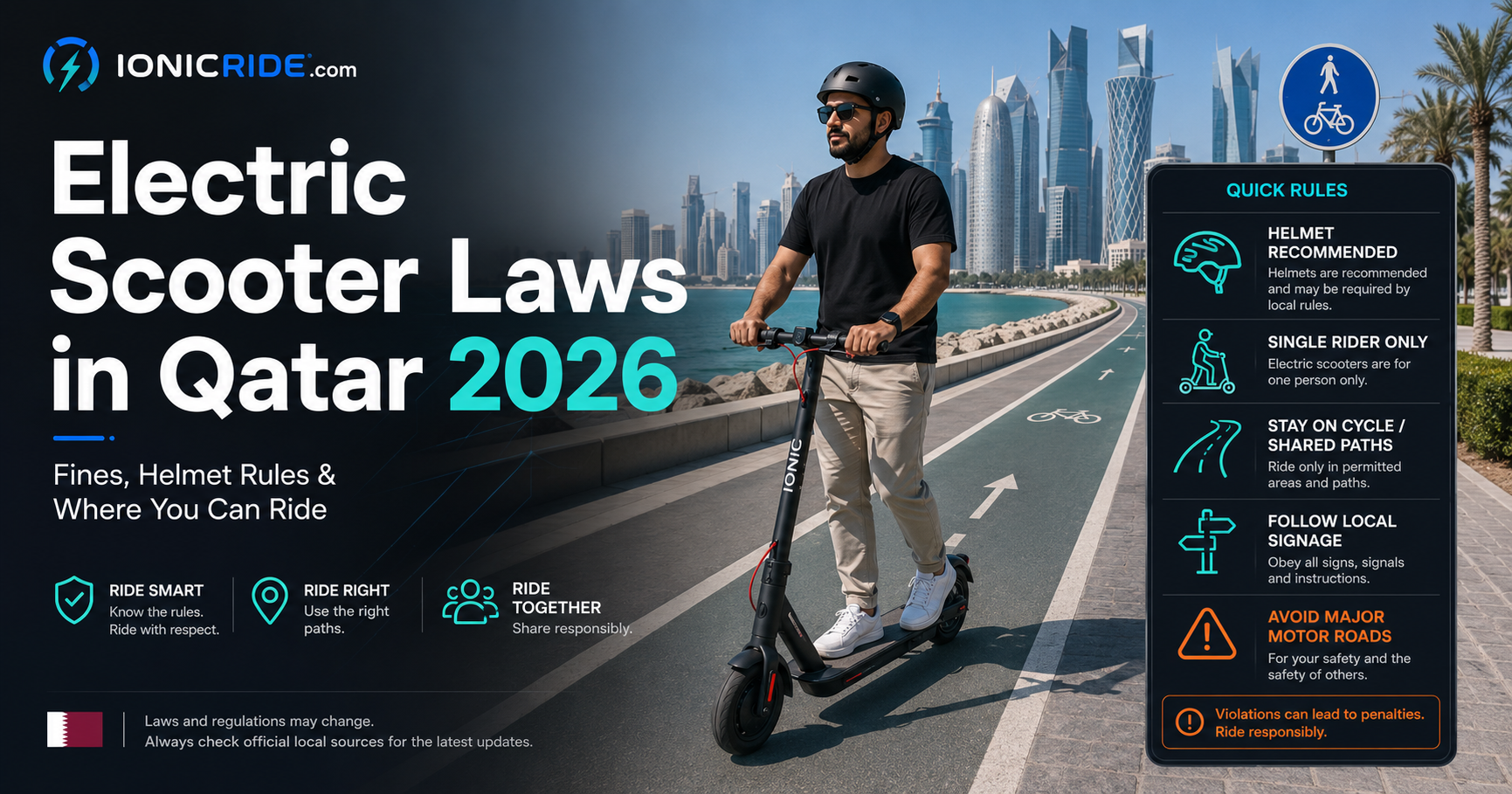
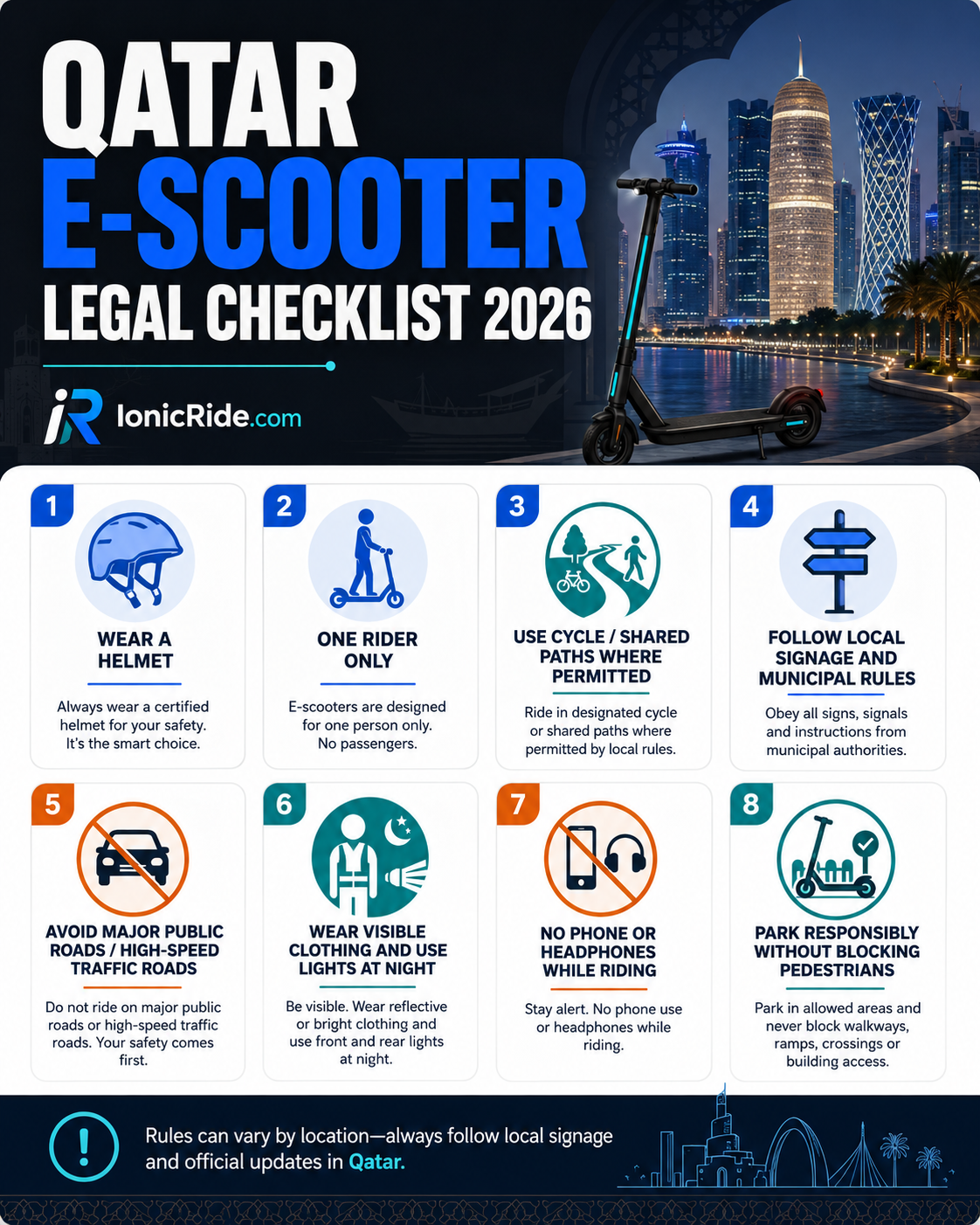
This is the part the Ministry of Interior has been most vocal about, so it’s where enforcement is most likely. The headline: a helmet is mandatory, even for short trips. The MOI has said this directly. Don’t treat the five-minute ride to the shop as an exception — that’s exactly the trip people get caught on.
- Helmet — mandatory on every ride, no exceptions for short trips.
- Front and rear lights — required, especially at night, exactly as for a bicycle.
- Reflective vest — so other road users can see you clearly.
- Both hands on the handlebar — and no phone use or scrolling while riding.
- No passengers — one rider per scooter.
One thing worth knowing: because scooters are handled like bicycles, if you cause an accident, you’re liable for the damage to the other party — the same way a cyclist would be. That’s a good reason to ride defensively and consider personal liability cover if you ride often.
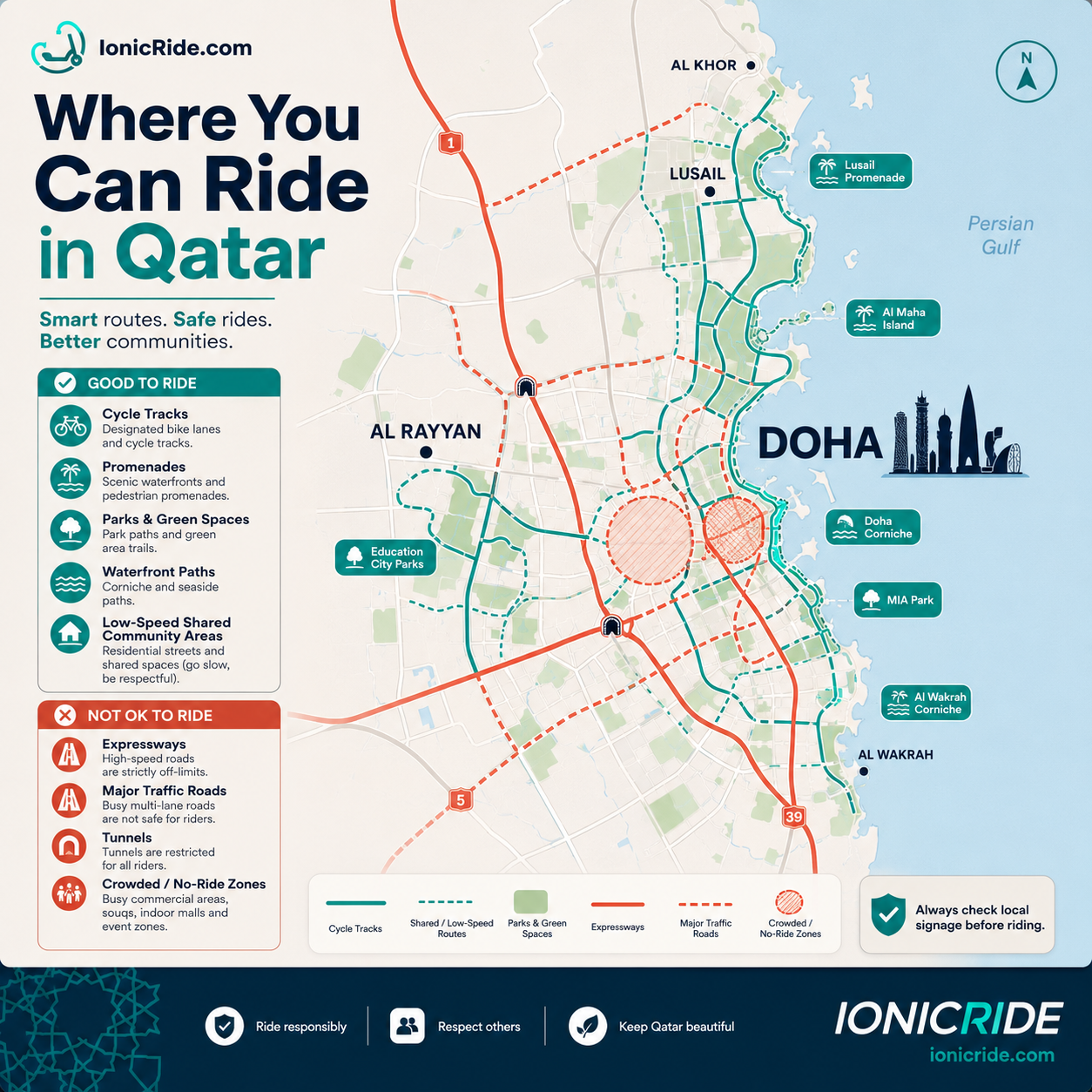
Where You Can — and Can’t — Ride
This is where almost all the trouble happens, so read it carefully. Qatar wants scooters on the infrastructure built for non-motor traffic, not mixed in with cars.
- Designated cycle tracks — the natural home for a scooter.
- Pedestrian and crossing areas set aside for non-motor traffic — the same spaces cyclists use, including designated sidewalk paths and crossings.
- Shared paths in newer districts — Doha’s Corniche, Aspire, Lusail and similar developments have growing cycle and shared-path networks.
- Vehicle lanes — the MOI has been explicit: stay out of car lanes.
- Highways / expressways — a specific offence: QR 1,500 fine + 2 black points, with possible confiscation.
- Against the flow of traffic, or ignoring signs and signals.
- Anywhere you’d block pedestrians — slow down and give way in foot areas.
Doha and Lusail specifically
Doha, Lusail and Al Rayyan are where most riding happens, and they’re also where the camera and patrol enforcement is heaviest. Shared rental scooters operate in parts of Doha within approved zones, and the cleanest, safest riding is on the dedicated cycle and waterfront paths rather than weaving through city streets. The exact approved network keeps expanding, so if you’re unsure whether a stretch counts as a designated area, the bicycle test is your friend: if you wouldn’t ride a pushbike there legally, don’t ride your scooter there either.
Fines, Black Points & Enforcement
Here’s where I have to be straight with you, because a lot of sites publish a neat “e-scooter fine table” that doesn’t really exist in Qatar. There is no single dedicated standalone e-scooter fine schedule. Scooter offences are handled under the bicycle and traffic-law provisions.
What is clearly published is the big one:
Known E-Scooter Penalties in Qatar (2026)
| Offence | Penalty | Notes |
|---|---|---|
| Riding on a highway | QR 1,500 + 2 points | Scooter can be confiscated |
| No helmet / unsafe riding | Under bicycle rules | No fixed standalone figure published |
| Riding in vehicle lanes | Enforced | MOI directive; treat as a violation |
| Causing an accident | Rider liable | Responsible for the other party’s damage |
- Tied to your Qatar ID (QID). Fines and black points are recorded against your record — even if your employer holds your QID.
- Black points add up. Accumulating points can lead to licence suspension.
- Unpaid fines can trigger a travel ban — you may be blocked from leaving Qatar until they’re cleared.
- Check and pay via the MOI portal (moi.gov.qa) or the Metrash2 app.
Fine amounts in Qatar can change by Ministerial Decision, and the e-scooter framework is still maturing. The QR 1,500 highway penalty is the clearest published scooter-specific figure; beyond that, the safest approach isn’t memorising amounts — it’s simple: helmet on, lights and vest, designated areas only, never a highway or car lane. Do that and the fine list stops being your problem. Confirm current values on the MOI portal before relying on any number.
Speed Limit & Minimum Age — What’s Actually Set
Speed: no single published private cap
Unlike Dubai (20 km/h) or Saudi Arabia (around 20 km/h), Qatar has not published one official speed limit for privately owned e-scooters. Because scooters are treated as bicycles, the expectation is that you ride at a safe, controlled pace on shared paths and obey any posted limits on cycle tracks. Rental operators set their own caps. My practical advice: keep to walking-to-jogging pace around people, and never assume your scooter’s top speed is a permitted speed.
Age: 18 for rentals, unstated for private
Shared rental operators in Doha require riders to be 18 or older. For privately owned scooters, Qatar hasn’t published an explicit minimum age — again, because of the bicycle framing. The sensible benchmark is to treat 18 as the minimum for road and shared-path riding, and keep younger children on quiet private property only.
Qatar vs UAE — Quick Comparison
Plenty of our readers ride in more than one Gulf country, so here’s how Qatar lines up against the more formalised UAE framework.
E-Scooter Rules — Qatar vs UAE (2026)
| Rule | Qatar | UAE (Dubai) |
|---|---|---|
| Legal to ride? | Yes | Yes |
| Dedicated e-scooter law? | No — bicycle rules | Yes (Res. 13/2022) |
| Helmet | Mandatory | Mandatory (AED 200 fine) |
| Lights + reflective vest | Required | Required |
| Speed cap (private) | Not published | 20 km/h |
| Minimum age | 18 (rentals) | 16 |
| Permit / licence | Not required | RTA permit or licence |
| Highway riding | QR 1,500 + 2 pts | Prohibited |
Riding in Saudi Arabia too? Here’s that breakdown: Are E-Scooters Legal in Saudi Arabia — Laws, Speed Limits & Fines 2026
The Factor No Law Covers: Qatar’s Heat
You can follow every rule perfectly and still have a miserable, costly time if you ignore the heat. Doha summers regularly push past 45°C, and that hits both you and your scooter.
- Battery range drops. Lithium batteries lose noticeable range in extreme heat, and sustained high temperatures shorten their lifespan. Knock a good chunk off the range printed on the box for a Qatari summer afternoon.
- Don’t charge a hot battery. Let it cool first, and never leave a scooter charging in direct sun or a parked car.
- Rider safety comes first. Mid-afternoon summer riding carries real heat-stress risk. Ride early morning or after sunset, carry water, and keep rides short in peak heat.
It’s the same advice we give riders across the Gulf — the machines and the bodies riding them don’t care which country’s law applies.
Full hot-climate riding and battery-care guide: Gulf Summer Survival Guide for E-Scooters
Common Mistakes & Things People Forget
- Skipping the helmet on a “quick” trip — it’s mandatory every time, and it’s where riders get caught.
- Forgetting lights and a reflective vest — both are required, just like on a bicycle.
- Drifting into a vehicle lane because there’s no obvious cycle path — that’s a violation; find the designated area.
- Getting onto a highway or expressway — QR 1,500, 2 black points, and possible confiscation.
- Assuming your scooter’s top speed is a legal speed — ride at safe, bicycle-like pace.
- Ignoring a fine — it’s tied to your QID, adds black points, and unpaid fines can block you from leaving Qatar.
- Letting an under-18 ride a rental — operators require 18+.
- Treating one article (including this one) as the final word — rules are evolving, so verify on the MOI portal before a big trip.
Yes, e-scooters are legal in Qatar — to own and to ride, with no special permit for ordinary scooters.
Ride it like a bicycle. Helmet on (always), lights and reflective vest fitted, and stay in designated cycle and pedestrian areas.
Never a highway or a car lane. Highway riding is QR 1,500 plus 2 black points, and the scooter can be taken.
The framework is still maturing — there’s no standalone e-scooter law, no single published private speed cap, and no fixed age for private use. Expect the rules to tighten as Doha and Lusail expand their micromobility networks. Ride conservatively and you’ll stay well within the law as it stands in 2026.
Qatar E-Scooter Law — Full FAQ
Yes — legal to own and ride, and not banned. They’re regulated under Traffic Law No. 19 of 2007 and treated like bicycles: helmet, lights, reflective vest, designated areas only, no vehicle lanes or highways. Qatar has no separate stand-alone e-scooter law; the rules come from the bicycle and traffic-law provisions plus MOI safety directives.
Yes — a helmet is mandatory, even for short trips, as stated directly by the Ministry of Interior. You also need front and rear lights and a reflective vest, must keep both hands on the handlebar, and must not use a phone while riding. The requirements mirror the rules for bicycles.
In designated areas only — cycle tracks, the pedestrian and crossing areas used by cyclists, and shared paths in districts like the Corniche, Aspire and Lusail. You must not ride in vehicle lanes, and riding on a highway is a specific offence (QR 1,500 + 2 black points). If you wouldn’t legally ride a pushbike there, don’t ride your scooter there either.
The clearest published penalty is for highway riding: QR 1,500 plus 2 black points, with possible confiscation. Other conduct (no helmet, car-lane riding, unsafe riding) is handled under the bicycle and traffic-law provisions, and there’s no single dedicated e-scooter fine schedule. Fines tie to your QID, can carry black points, and unpaid fines can trigger a travel ban. Amounts can change by Ministerial Decision — confirm on the MOI portal or Metrash2.
Qatar doesn’t publish a single official speed limit for private e-scooters the way Dubai does (20 km/h). Because scooters are treated as bicycles, ride at a safe, controlled pace and obey posted cycle-track limits. Rental operators set their own caps. Keep to walking-to-jogging pace around pedestrians.
Rental operators in Doha require riders to be 18 or older. Qatar hasn’t published an explicit minimum age for privately owned scooters, so 18 is the sensible benchmark for road and shared-path use. Keep younger children on quiet private property only.
Not on highways — that’s a specific offence (QR 1,500 + 2 black points, possible confiscation). On ordinary roads you also must not ride in vehicle lanes; the MOI has made clear scooters belong in designated areas, not mixed with car traffic. Use cycle tracks and pedestrian/crossing areas instead.
Through the MOI portal (moi.gov.qa) or the Metrash2 app — fines and black points are tied to your Qatar ID. You can view camera evidence for some violations in the app before paying or appealing. Note that unpaid fines can result in a travel ban, and fines stay on your record even if your QID is held by an employer.