Segway F3 vs Xiaomi 4 Ultra: Which Fits UAE Riders?
By Alex at IonicRide · Updated 24 October 2026
Affiliate disclosure: IonicRide may earn a commission from qualifying purchases through affiliate links in our guides, at no extra cost to you.
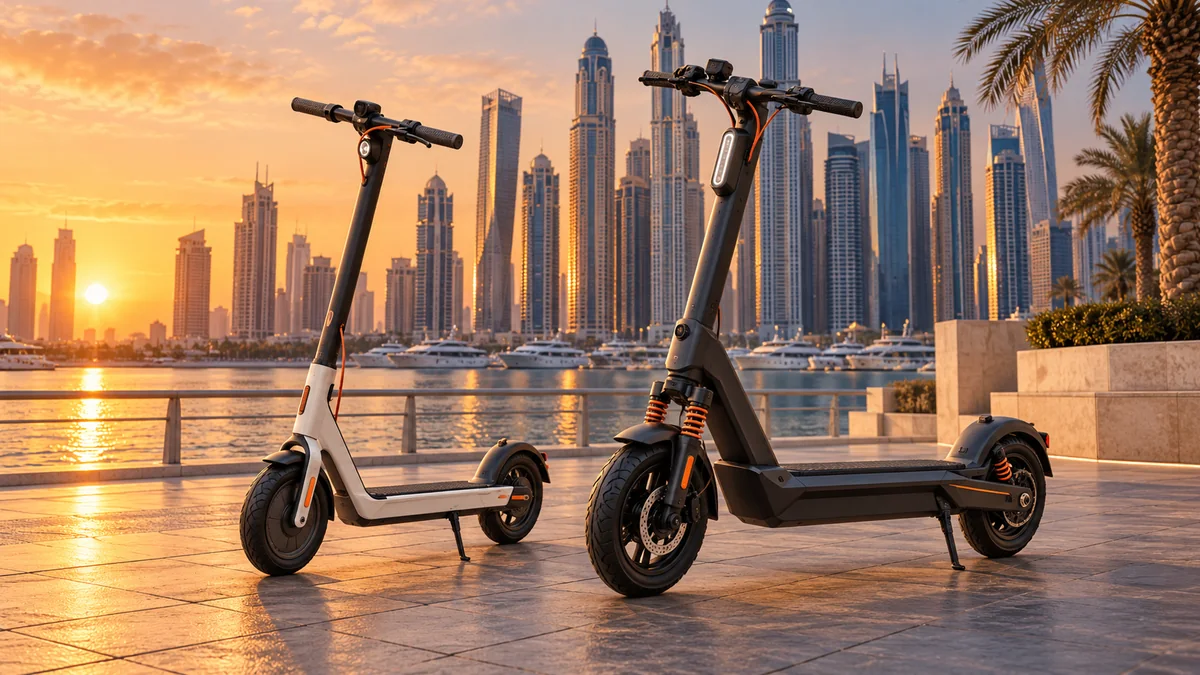
This guide compares published specifications and buying considerations. It does not report hands-on testing. Cover: AI-generated illustration of generic designs.
Quick answer
The Segway F3 E is the more manageable starting point if lifting weight matters: its published weight is 18.6 kg versus 24.5 kg for the Xiaomi 4 Ultra. The Ultra has the larger published battery. Neither is a default Metro choice, and neither global specification establishes Dubai compliance. Start with the exact regional version, carrying requirements and local service support.
Choosing between the Segway F3 and Xiaomi 4 Ultra is a decision about everyday compromises. A scooter can look excellent in a specification table and still be awkward in your lift, difficult to store or unsuitable for your legal route. This guide separates published facts from the judgments you need to make yourself.
There are no claimed braking tests, heat trials, measured ranges or invented winner scores here. For alternatives based on your priorities, use the scooter comparison Ride Finder.
First identify which Segway F3 you are comparing
This comparison uses the Segway Ninebot F3 E, model 051701E, and the global Xiaomi Electric Scooter 4 Ultra specification. “F3” alone is not enough to identify the regional model. The F3 Pro is also a different product. A listing advertising only a peak wattage does not resolve these differences.
Ask the seller for a photograph of the model label and the manual supplied in the box. Match those details to the invoice, warranty and app activation requirements. If the version differs from the one below, compare its own documentation before treating any figure here as applicable.
Segway F3 E vs Xiaomi 4 Ultra: published specifications
| Specification | Segway F3 E | Xiaomi 4 Ultra |
|---|---|---|
| Weight | 18.6 kg | 24.5 kg |
| Battery capacity | 477 Wh | 561.5 Wh |
| Advertised range | Up to 70 km at 15 km/h; 50 km at 25 km/h | Up to 70 km under manufacturer test conditions |
| Rated / maximum motor power | 450 / 1,000 W | 500 / 940 W |
| Brakes | Front disc + rear electronic | Drum + E-ABS |
| Tyres | 10-inch self-sealing | 10-inch DuraGel |
| Suspension | Front hydraulic + rear elastomer | Dual suspension |
| Maximum rider load | 120 kg | 120 kg |
| Approximate full-charge time | 8 hours | 6.5 hours |
| Published global maximum speed | 25 km/h | 25 km/h |
Check the Segway F3 E manufacturer specification and Xiaomi 4 Ultra specifications against the supplied version. Do not compare one scooter’s peak power with another’s rated power, or assume matching headline ranges were measured in the same way.
Carrying and storage: the clearest practical difference
The published weight difference is 5.9 kg. That is meaningful if you must lift a scooter over a threshold, into a vehicle or up stairs. It does not make the F3 E lightweight: test the carrying method and your actual lifting task before ordering. A comfortable handle position can matter as much as the scale reading.
The Ultra makes more sense to consider when your route between home, parking and charging involves little lifting. Measure the lift entrance and storage space rather than assuming a folding mechanism solves every obstacle. Leave room to move around the parked scooter without blocking an exit.
Metro warning: check every condition
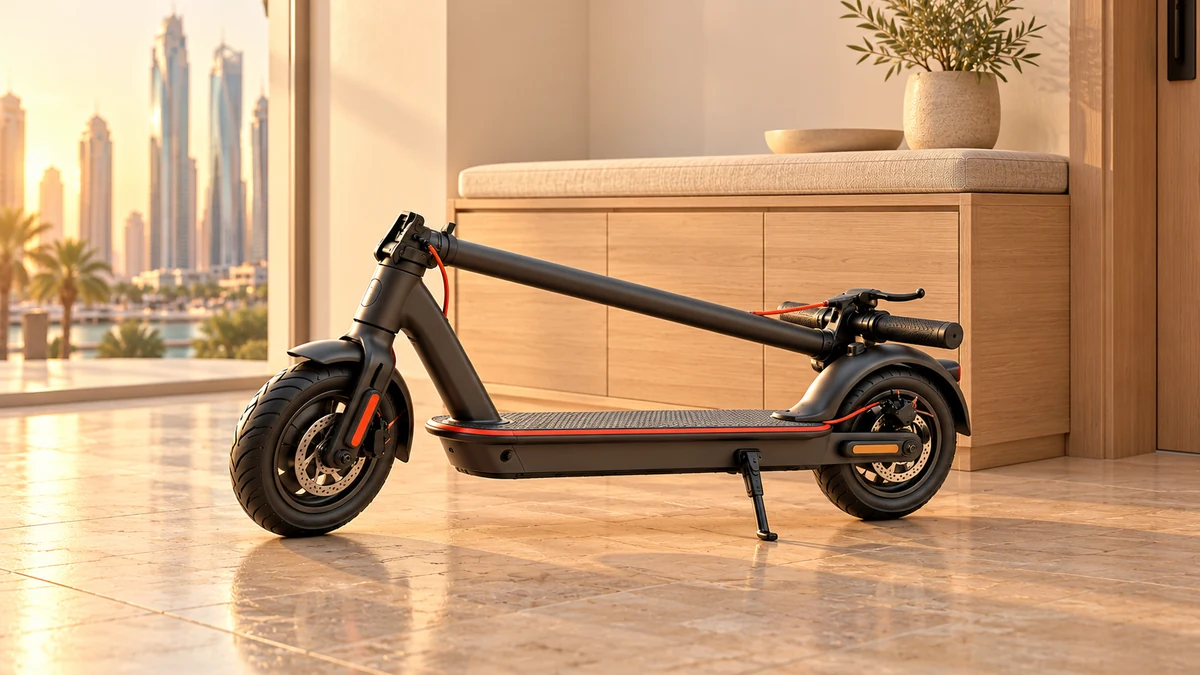
RTA’s carriage envelope is 120 × 70 × 40 cm with a 20 kg maximum weight, alongside other requirements. The F3 E’s published folded dimensions, 115.2 × 59 × 61.3 cm, exceed that envelope despite its lower weight. The Ultra exceeds the weight limit. Neither should be sold to you as an automatic Metro-compatible choice.
Read the official RTA carriage requirements and our guide to taking a scooter on Dubai Metro before basing a commute on train access. A seller saying “foldable” or “under 20 kg” has answered only part of the question.
Range: battery capacity helps, but the headline is not your commute
The Ultra’s published battery capacity is 84.5 Wh larger. That is a useful specification difference; it does not prove that the Ultra will travel farther on every route. Vehicle efficiency, rider and luggage load, speed, stops, tyre pressure and gradients all affect energy use. We cannot convert those capacities into a trustworthy Dubai range without comparable measurements.
Segway publishes different F3 E range figures at different speeds, which illustrates why the conditions matter. Xiaomi’s 70 km figure must be read with its own testing conditions. Treat those numbers as reference points for shortlisting, not a target to use up completely on a planned journey.
- Map the full permitted round trip, including the route around areas where riding is not allowed.
- Allow room for a realistic diversion and an ageing battery rather than planning to arrive empty.
- Establish where charging is allowed; do not assume a workplace or café will provide it.
- If your normal journey is close to a claimed maximum, choose a different charging plan or shortlist.
Brakes, tyres and suspension: what the differences mean
Brakes need support, not just a winner label
The F3 E uses a front disc and rear electronic brake. The Ultra combines a drum brake with E-ABS. Those are different systems, but this comparison has no measured stopping-distance evidence to rank them. Ask a service provider which adjustments and parts the exact unit requires, and check the brakes according to its manual before each ride.
Do not describe the F3 E as having two mechanical disc brakes, or the Ultra as relying on electronic braking alone. If a retailer’s specification disagrees with the manufacturer page, resolve the model identity before buying. Brake feel and lever reach are worth checking in person when a seller offers a safe demonstration.
Self-sealing tyres still need attention
Both descriptions include puncture-mitigation technology. That does not mean they cannot puncture, lose pressure or need replacement. Check pressure using the value in the supplied manual and inspect the tread and sidewalls. Do not add a second sealant or replace the tyre construction without manufacturer guidance.
Ask for a quote for the exact replacement tyre and fitting, rather than a generic promise that repairs are cheap. Confirm whether a local workshop can handle the particular wheel and sealing system. A lower purchase price can become less attractive when suitable parts are difficult to obtain.
Suspension is not permission to ignore the surface
The F3 E’s front hydraulic and rear elastomer arrangement differs from the Ultra’s dual-suspension setup. Published descriptions do not establish which feels better for your body and route. A supported demonstration, correct tyre pressure and inspection for looseness are more useful than an unsupported comfort score. Slow down for rough surfaces and avoid treating either commuter as an off-road machine.
Charging and UAE heat: plan the storage location first
The published full-charge times favour the Ultra on paper, but they are approximate rather than a promise for every temperature or battery state. Decide whether your usual charging window is long enough and whether you have a place that meets the supplied manual’s temperature and ventilation instructions.
After a hot journey, allow the scooter to reach its permitted charging temperature before plugging it in. Keep the original or manufacturer-approved charger with the correct model. Avoid leaving the scooter or charger in a parked car, and do not charge where it blocks an exit. Our UAE summer scooter guide covers the planning questions in more detail.
Water-resistance ratings also have limits. The published F3 E body rating is IPX6; Xiaomi lists IP55 for the Ultra. Neither is a blanket “waterproof” claim, permission to ride through standing water or proof of warranty cover for water damage. Keep the charging port dry and follow the model’s cleaning and wet-weather instructions.
Which scooter fits which rider?
Shortlist the F3 E if lifting is a frequent concern
Its lower published weight makes it the more plausible starting point for occasional carrying. Confirm that the actual F3 offered matches the E specification before relying on that advantage.
- Pros: lower mass in this comparison; published front-and-rear suspension; separate range claims help expose the role of speed.
- Cons: still a substantial lift; folded dimensions do not meet the cited Metro envelope; local version and app features need confirmation.
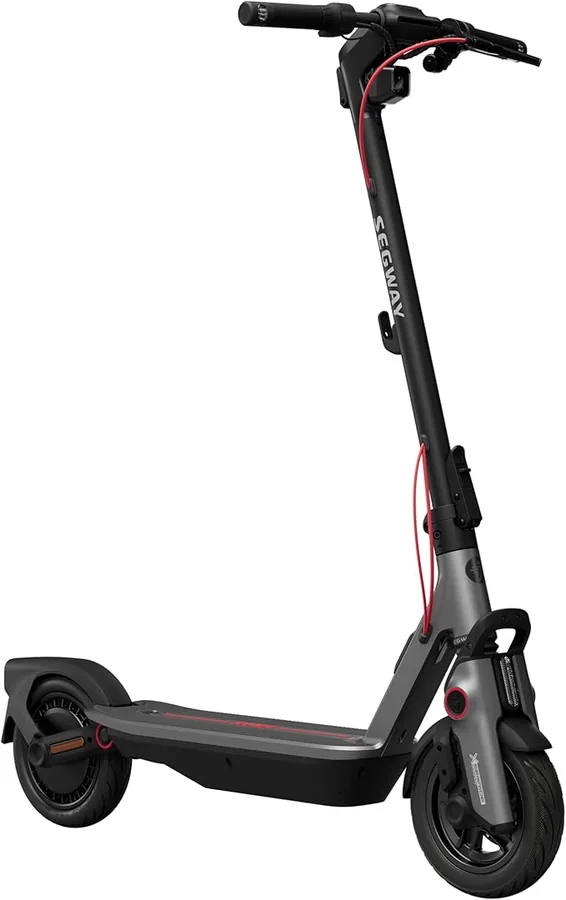
Ask about the precise model code, brake parts, tyre fitting and warranty provider before comparing an offer.
Shortlist the 4 Ultra if carrying is rare
Its larger battery is worth considering for riders who can roll it between storage and charging. Choose it only if its size and mass fit that routine; do not buy on a 70 km headline alone.
- Pros: larger published battery in this comparison; dual suspension; shorter published full-charge time.
- Cons: 24.5 kg is demanding to lift; exceeds the cited Metro weight limit; real range and comfort are not established by this comparison.
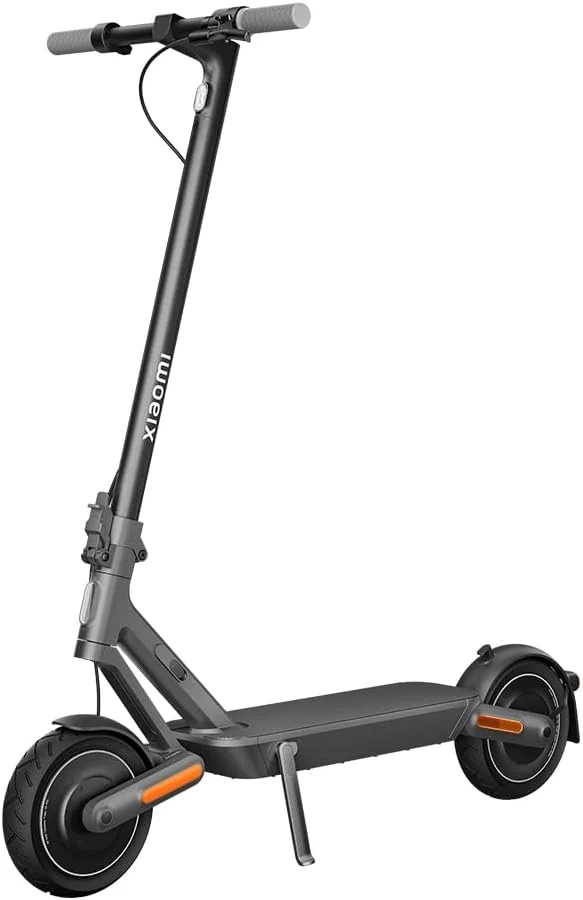
Ask about the supplied regional configuration, DuraGel tyre support, warranty exclusions and the delivered total.
Before buying either scooter in Dubai
Configuration before checkout
RTA specifies a maximum scooter speed set at 20 km/h. Both published versions above reach 25 km/h. A low-speed riding mode alone does not prove the delivered scooter meets the requirement. Confirm the supplied configuration and permitted route before purchasing; this guide does not present either as automatically Dubai compliant.
Use RTA’s current scooter guidance for Dubai requirements. Other emirates have their own rules. A regional product name, an app lock or a retailer’s “UAE version” badge is not a substitute for checking the exact unit and your intended use.
- Compare total offers. Include delivery, taxes, included equipment and the actual seller; do not assume a fixed price gap between the two models.
- Check support. Identify who handles a warranty claim, where the scooter goes and which wear items are excluded.
- Verify app features. Check phone compatibility, region, account requirements and any advertised tracking features for the supplied model. An electronic lock does not replace physical security.
- Read return conditions. Understand what activation, assembly or use does to your return options before setting the scooter up.
Frequently asked questions
Is the Segway F3 the same as the F3 E or F3 Pro?
Do not assume so. This article uses the F3 E model 051701E specification. Regional variants and the F3 Pro can differ. Match the model label and supplied manual before using the table.
Which scooter has better real-world range in Dubai?
This guide cannot establish that from the published figures alone. The Ultra has a larger stated battery, but comparable route, load, speed and environmental measurements would be needed to make a measured range claim.
Which one is better on hills?
We have no comparable hill test on which to name a winner. Manufacturer gradient claims use particular conditions and do not prove how either scooter will perform on your route with your load. Avoid treating peak watts as a guarantee.
Can the Ultra’s slower mode make it Dubai legal?
A slower mode alone does not establish compliance. Confirm that the supplied configuration meets the applicable requirements and that your planned route permits use.
Should I pay more for either model?
Only for a difference you will use, with acceptable support. Battery headroom may matter to one rider; carrying weight may matter more to another. Compare current delivered offers and likely maintenance rather than an assumed price gap.
Bottom Line
Start with the F3 E if carrying weight is the main compromise you need to reduce. Consider the Ultra if lifting is rare and its larger battery suits your routine. For either, settle the regional version, legal configuration, storage and local support before deciding that an offer is good value.