Worst Electric Scooters to Buy in Dubai 2026
Worst Electric Scooters to Buy in Dubai 2026 — The What to Avoid
Every decent guide tells you what to buy. Nobody tells you what to avoid — because warning people away from bad products earns little affiliate income. This guide does it anyway.
The Dubai market has a specific problem that doesn’t exist in Europe or the US: a flood of unbranded and obscure-brand scooters from unverified sellers, making bold claims about range and quality, with zero after-sales infrastructure anywhere in the UAE. When something goes wrong — and in Dubai’s heat, something always eventually goes wrong — there’s nobody to call, no parts to order, and a workshop that can’t help you because the parts simply don’t exist locally.
Before paying, compare where to buy an electric scooter in Dubai and verify local warranty and parts support.
It covers the categories to avoid, the specific red flags to check before handing over any money, and the brands that consistently cause problems in UAE conditions.
None of the scooters recommended at the end of this article appear on this blacklist. That’s the point.
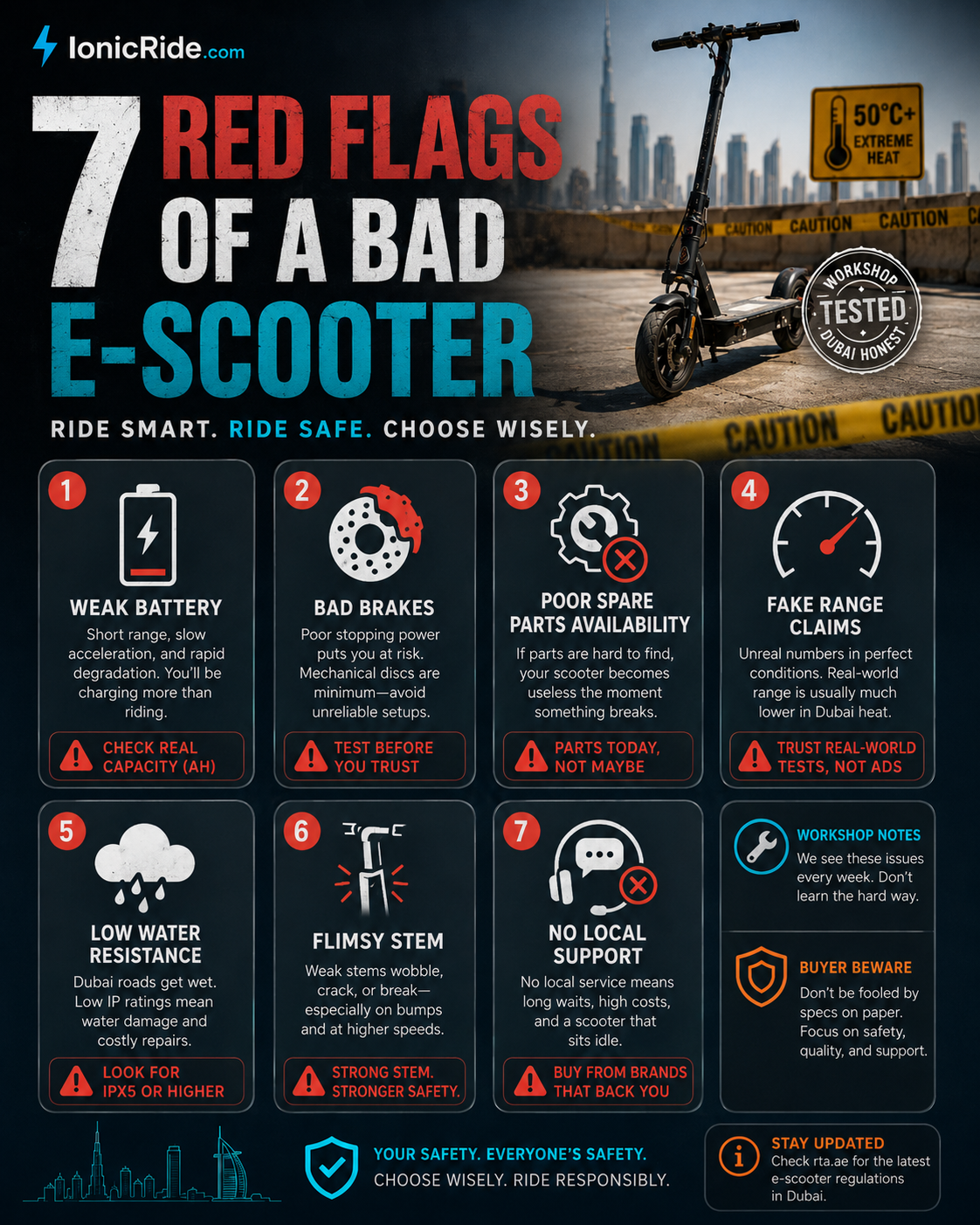
The Blacklist — 7 Categories to Avoid
This is the single most common buying mistake in Dubai. Walk through Dragon Mart’s electronics section or browse certain UAE online stores and you’ll find electric scooters under names that don’t exist anywhere outside that one shop. No reviews online. No brand website. No service centre address. Prices between AED 300–700 claiming performance that would cost AED 1,500+ from a legitimate brand.
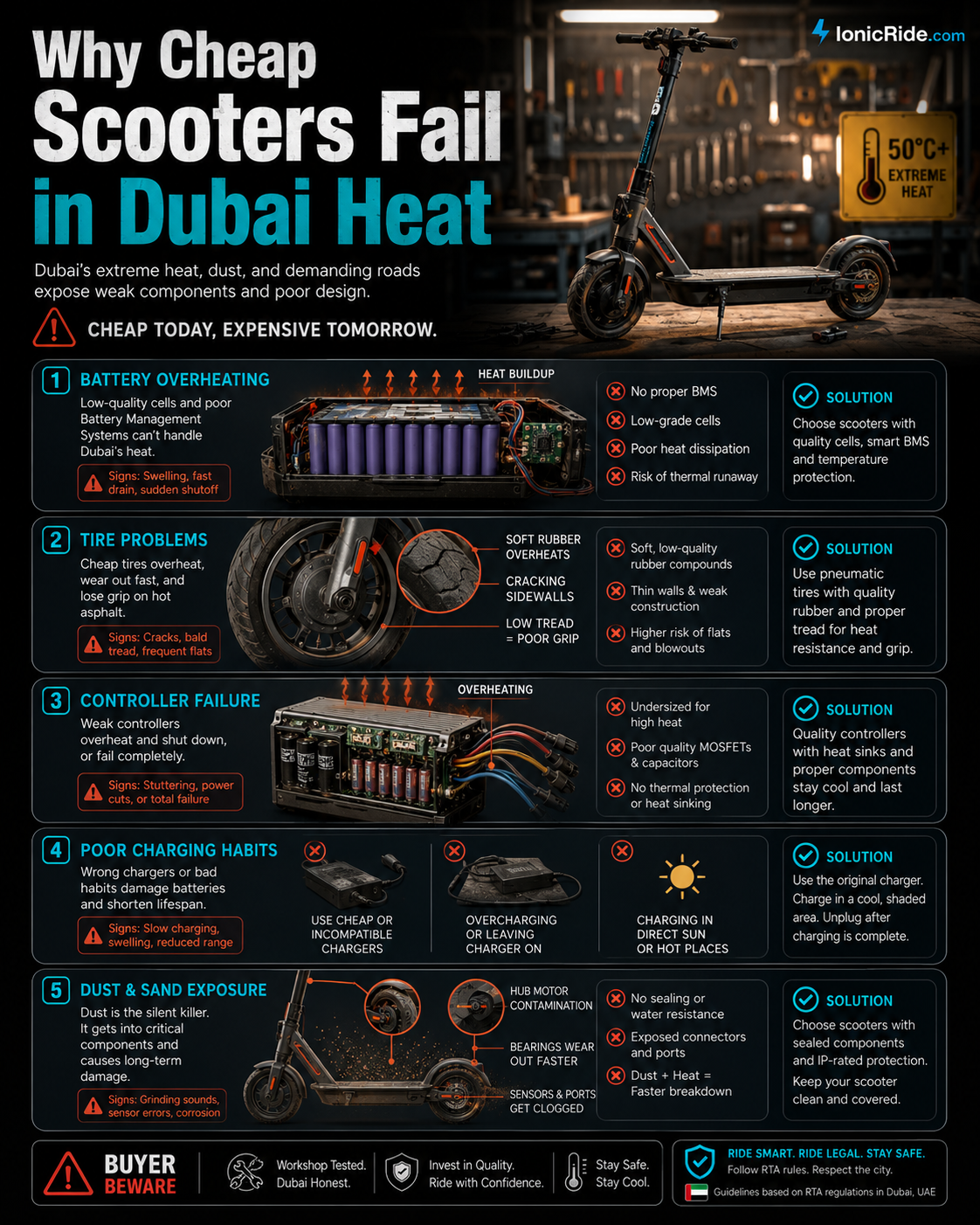
The battery in these scooters is the critical issue. Uncertified lithium-ion cells from unknown manufacturers, no UL2272 or CE safety testing, no Battery Management System worth the name. In Dubai’s 45°C heat, these cells are being stressed to failure from day one. Dubai apartment buildings have banned e-scooters from being charged indoors specifically because of fire incidents from exactly these batteries.
When these come into a workshop: we can’t help. No parts exist. No battery replacement is available. No controller swap is possible. The scooter is landfill after the first major failure — which typically comes within 2–3 months of Dubai summer riding.
What happens when it breaks: The seller’s WhatsApp stops responding. The “1-year warranty” turns out to be a number that rings out. You have an AED 400 ornament. The repair cost — if it were even possible — would exceed the purchase price.
- Brand name does not appear in any independent review or search result
- No physical UAE service address listed — only a WhatsApp number
- Price under AED 700 from an unknown brand claiming 40+ km range
- No UL2272 or CE certification visible in listing or on product
- Seller cannot tell you where to go for warranty repairs
Crony is one of the most visible electric scooter sellers in Dragon Mart and is worth naming specifically because of the documented pattern of failures. Consumer reviews describe batteries failing within 2 weeks of purchase, multiple repair attempts that failed to resolve the issue, and warranty support that became progressively harder to reach until it disappeared entirely.
The specific pattern: buyer purchases scooter, battery shows fault within days to weeks, scooter is sent for repair, returns with same fault, process repeats until warranty period expires and the seller declares the product out of warranty. Each time the scooter comes back “repaired” — it wasn’t.
One documented Dubai buyer case: bought 2 Crony scooters from Dragon Mart, both batteries failed within 2 weeks, sent for repair 3 times each over 2 months, third repair came back with original fault unchanged, seller declared warranty expired. Total money lost: full purchase price × 2. Zero functional scooters.
The problem is not unique to Crony — it’s a pattern common to Dragon Mart scooter shops generally. We use Crony as the named example because the evidence trail is public and documented.
- No independent reviews from UAE riders on third-party platforms
- Warranty service requires returning the product to the same shop that sold it
- No manufacturer website or global brand presence to appeal to if shop-level warranty fails
This one requires nuance. Kugoo’s hardware — particularly the Kirin G3 Pro — is mechanically reasonable for the price. The problem in the UAE is not the scooter itself. It’s what happens when something goes wrong.
Kugoo has no UAE-based service centre with physical premises and stocked spare parts as of 2026. When parts fail, the options are: (1) ship the scooter to an EU service centre, (2) wait for parts from China, or (3) find an Al Quoz workshop that will fabricate a generic replacement. None of these options is fast or cheap in Dubai.
Internationally, Kugoo’s customer service is rated 1.5/5 on Trustpilot across hundreds of reviews. Documented failure patterns: battery defects after 400 km, handlebar wobble under warranty being refused because the product was bought through a third party, rusting within months, spare parts simply not existing for older models.
In Dubai specifically: a Kugoo battery replacement requires sourcing parts internationally. A Xiaomi 4 Pro battery replacement is same-day at any Al Quoz workshop. The question isn’t just “is this scooter good?” — it’s “what happens when this scooter needs a repair in Dubai?” For Kugoo, the answer is significantly worse than for Xiaomi, Segway, or Navee.
- No Kugoo UAE service centre with physical address and stocked spare parts
- International customer service rated 1.5/5 — warranty claims routinely delayed or refused
- Battery failure documented from 400 km — common for UAE daily commuters within 3–4 months
- Parts unavailable locally — any major repair requires international shipping
This is a specific, calculable fraud that appears constantly in UAE online listings. Understanding it protects you from being deceived by a number on a spec sheet.
Battery capacity (measured in Wh) determines range. A reasonably efficient scooter uses approximately 15–20 Wh per km under realistic conditions. Do the maths — and compare it to the listing:
🔢 Range Reality Check Calculator
Formula: Battery (Wh) ÷ 20 = realistic range (km). If the listing claims more than this, the specs are inflated.
The most outrageous example in the current UAE market: scooters selling for AED 450–600 claiming 60 km range. The physics are impossible. A battery capable of delivering 60 km of real range costs more than AED 450 by itself. The actual range delivered by these scooters is typically 8–15 km — and much less in Dubai summer heat.
- Range claim more than 2× what Wh ÷ 20 formula suggests
- Battery capacity not listed in the product specs (they’re hiding it)
- Price under AED 700 claiming 40+ km range
- Motor wattage stated as “peak” without a rated figure — 1000W peak on a budget scooter means 150W rated
The Xiaomi Mi 1S and Mi Pro 1 (sometimes listed as “Pro 1st Gen”) still appear in UAE shops and on platforms like Dubizzle, occasionally sold as new-in-box from old stock. These are not current models — they are discontinued products that Xiaomi no longer manufactures spare parts for.
Buying a new Mi 1S in 2026 means buying a scooter with no official parts supply chain. If the battery fails — which it will, in Dubai heat, within 18–24 months of daily use — a genuine Xiaomi replacement battery for the Mi 1S is not available in UAE stock. Generic replacements are available but carry the same risks as the uncertified batteries discussed above.
The give-away: Mi 1S and Mi Pro 1 are still occasionally priced competitively (AED 700–900 for “new” units). If a Xiaomi is that price and it’s “new”, it’s old stock. The current supported Xiaomi range starts at the 4 series — 4 Lite (AED 899), 4 Base (AED 1,201), 4 Pro (AED 1,849). Any Xiaomi below that price point marketed as new deserves a model number check before purchase.
- Model number is M365, Mi 1S, or Pro (1st Gen) — not the 4 series
- Listed as “new” at significantly below 4 Lite pricing
- No Xiaomi UAE warranty card included or seller cannot confirm UAE warranty registration
This one is a legal trap rather than a quality problem. Seated electric scooters — scooters with a built-in seat or saddle — are not covered by the RTA’s standard e-scooter framework for designated zones. They cannot be taken on the Dubai Metro under the October 2024 rules. Yet some UAE sellers market them with phrases like “RTA approved”, “street legal in Dubai”, or “legal for Dubai roads”.
None of these claims are accurate for a seated scooter used on public infrastructure in Dubai’s standard designated zones. At best, a seated scooter falls into an ambiguous vehicle category. At worst, it’s a product being misrepresented to buyers who will discover they can’t legally use it the way they thought they could.
If you specifically want a seated scooter for private compound use only, the legal issue is less relevant. But if the reason you’re buying it is for public road or Metro use in Dubai, a seated scooter is not the right product — regardless of what the listing claims.
- Listing says “RTA approved” or “street legal Dubai” for a scooter with a built-in seat
- Seller cannot produce the specific RTA approval document when asked
- Marketed as Metro-compatible — seated scooters are explicitly excluded from Metro rules
At the other end of the price spectrum: scooters that take a mid-range Chinese platform, add a famous fashion or automotive brand name to the sticker, and charge AED 3,000–8,000+ for what is mechanically a AED 1,500 scooter underneath. The UAE market has seen several of these — “Lamborghini”, “Bugatti”, and similar fashion-house branded scooters sold through premium retailers.
The hardware inside these scooters is not developed by Lamborghini or Bugatti’s engineering teams. It is a licensed brand application to an existing scooter platform. The performance and durability characteristics are determined by the underlying manufacturer — not the badge. And the spare parts situation follows the underlying manufacturer’s supply chain, not the luxury brand’s reputation.
A Bugatti-branded scooter at AED 6,000 and a Segway MAX G2 at AED 2,750 will both get you to work. The Segway has a UAE service network, genuine parts availability, an established repair community in Dubai, and the hardware backing of Segway’s actual engineering. The Bugatti-branded one has a badge. For a daily commuter tool in Dubai’s heat — the badge matters less than the parts supply chain.
- Fashion or automotive brand name on a scooter at 2–4× the price of comparable spec models
- Underlying manufacturer or OEM is not disclosed — only the brand name
- Spare parts need to be sourced through the boutique retailer, not a UAE parts network
The Battery Fire Risk — Why It’s a Dubai-Specific Problem
This section exists because it’s not theoretical. Dubai apartment buildings have banned e-scooters from being charged indoors — a policy that came from actual incidents, not from abstract risk assessment.
Uncertified lithium-ion cells in cheap scooters lack proper Battery Management Systems. Without a proper BMS, the cells have no protection against overcharging, thermal runaway, or cell-level failures. In Dubai summer — where ambient temperatures already push cells towards their stress limits — a cheap uncertified battery being charged indoors overnight in a warm apartment is a fire risk that insurance companies, building management, and the Civil Defence are all taking seriously.
Safety experts quoted in Khaleej Times specifically warned against “substandard e-scooters and chargers that are easily available online.” Some Dubai apartment building administrators have confirmed “instances of e-scooter battery sparking and catching fire.” These are cheap, uncertified products — not branded scooters from established manufacturers.
UL2272 certification means the electrical system has been independently tested for fire and shock risk. CE marking indicates European safety conformity. Both are visible on legitimate products. Neither appears on the batteries in AED 400 Dragon Mart scooters.
Battery swollen or hot to touch? Read this immediately: Swollen E-Scooter Battery in Dubai — Do This in the Next 30 Minutes
Ask These 5 Questions Before Buying Any Scooter in Dubai
Before paying for any electric scooter in Dubai — from any seller, at any price — these five questions will tell you everything you need to know about whether you’re buying something worth owning:
What to Buy Instead — The Safe List
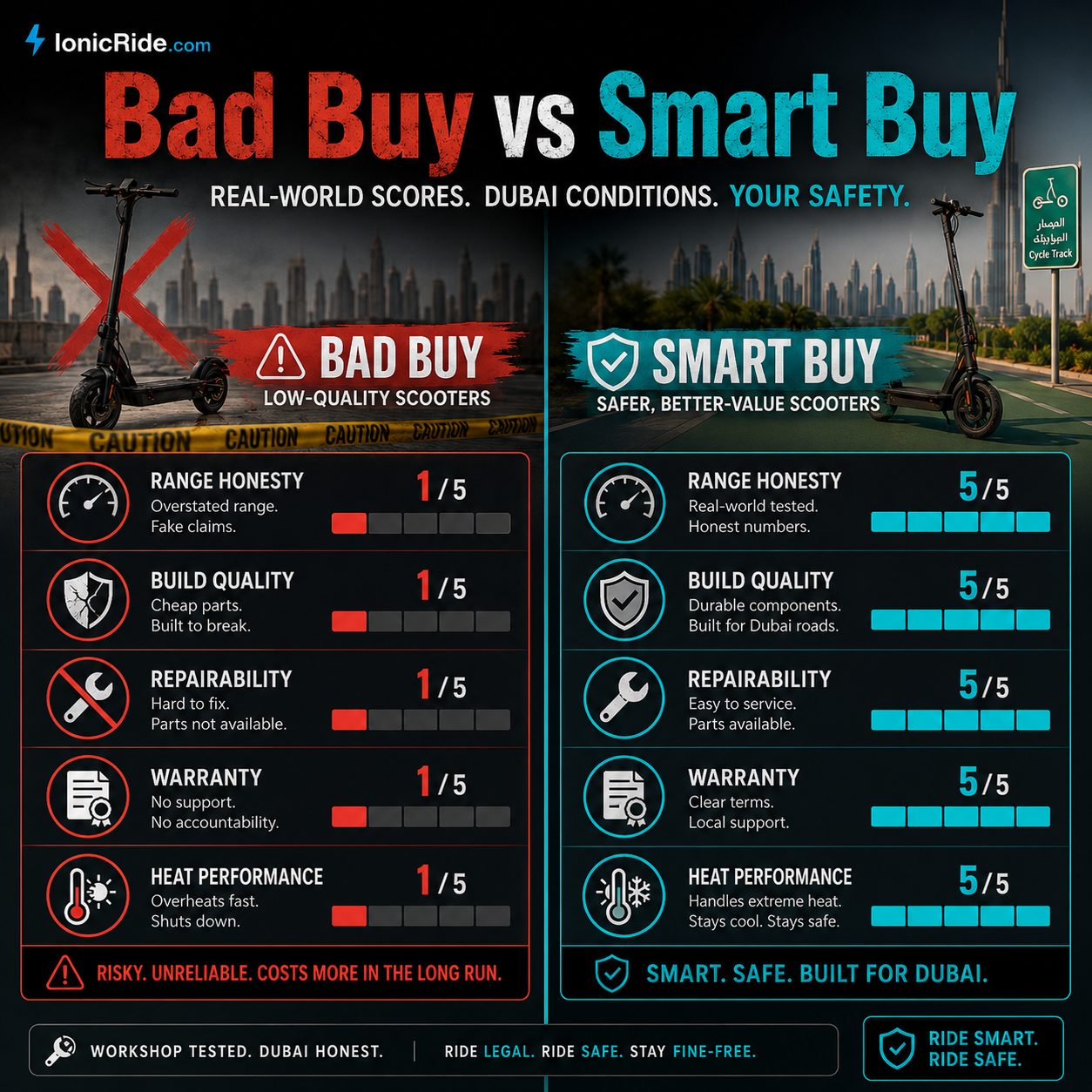
Every scooter on this list has an established UAE parts supply chain, real-world Dubai owner data, and no place on the blacklist above.
Safe Buys in Dubai 2026 — Parts, Warranty & Dubai Data Available
May 2026| Model | Price Range | Best For | Parts in Dubai |
|---|---|---|---|
| Xiaomi 4 Lite | AED 899–996 | Short commutes, Metro carry | Same-day |
| Xiaomi 4 Base | AED 1,201 | Budget commuter, 22 km real range | Same-day |
| Xiaomi 4 Pro | AED 1,849 | Daily Metro commuter, 32 km real range | Same-day |
| Xiaomi 5 Max | AED 1,943 | Ride-and-lock, rough roads, suspension | Available |
| Segway MAX G2 | ~AED 2,750 | Long range, IPX5, self-healing tyres | Available |
| Navee GT3 Pro | AED 1,859 | Suspension, tubeless, IPX5 | Limited |
| Inokim Light 2 Max | ~AED 1,600 | Metro carry, lightweight premium | Available |
Buy from a brand where you can answer yes to: “If this battery fails in 18 months, can I get a genuine replacement same-day or within a week in Dubai?” For Xiaomi and Segway — yes, definitively. For Navee and Inokim — yes, with some lead time. For Kugoo, Dragon Mart brands, and no-name imports — no.
Ready to buy? See the full ranked guide: Best Electric Scooters for Dubai 2026 — By Price Range
Worst Scooters Dubai — Complete FAQ
The worst buys fall into five categories: unbranded no-name scooters from Dragon Mart and unverified online sellers, specific Dragon Mart shop brands with documented failure patterns, scooters without UL2272 or CE certification, models with mathematically impossible range claims (Wh ÷ 20 formula), and discontinued older Xiaomi models sold as new from old stock. The common thread: no UAE parts supply chain when something goes wrong.
Generally no. Documented failure patterns: batteries failing within 2 weeks, repair attempts that don’t resolve the issue, warranty support disappearing before the warranty expires. More importantly: no spare parts exist for these scooters anywhere in Dubai. When the battery dies — and it will — the scooter is finished. Dubai apartment buildings have banned e-scooter charging indoors specifically citing fire incidents from the type of uncertified batteries these scooters use.
The hardware is mechanically reasonable on some models. The UAE-specific problem is after-sales: no Kugoo service centre with physical premises and stocked parts in UAE as of 2026. International Trustpilot rating: 1.5/5. Documented battery failures from 400 km — which is a typical Dubai commuter’s 2–3 month usage. When it needs repair in Dubai, you’re sourcing parts internationally. Compare that to Xiaomi’s same-day parts availability across Al Quoz.
Use the formula: battery capacity (Wh) ÷ 20 = realistic range in km. A 150Wh battery cannot deliver 60 km. A scooter priced under AED 700 claiming 40+ km range is either lying about the range or lying about the battery capacity. Both are common. If the battery Wh is not listed in the specs, that’s the first red flag — they’re hiding it because the number would expose the range claim as false.
Yes — and this is documented, not theoretical. Dubai apartment buildings have banned e-scooter charging indoors after fire incidents from defective batteries. Uncertified lithium-ion cells in cheap scooters have no proper thermal protection. Charging them overnight in a warm Dubai apartment is a genuine fire risk. Only buy scooters with UL2272 or CE certification, and follow Dubai apartment charging safety guidelines.
Five questions: (1) Physical UAE service centre address? (2) UL2272 or CE certification? (3) Actual battery capacity in Wh? (4) Can you find independent third-party reviews of this specific model? (5) What is the rated (not peak) motor wattage? If the seller can’t answer all five clearly, walk away.
Yes — Xiaomi, Segway-Ninebot, Navee, and Inokim all have established UAE parts networks, real-world Dubai owner data, and no blacklist-level issues. The Xiaomi 4 series (4 Lite to 4 Pro) is the most parts-available range in Dubai. The Segway MAX G2 is the strongest long-range option with proven UAE durability. See the full safe list with prices.
Not as a commuter. At AED 500 from an unknown brand, you are buying: uncertified batteries, no parts supply, no warranty support, and inflated specs. In Dubai summer, these scooters typically fail within 3–6 months. The total cost of ownership — purchase + failure + replacement — is higher than buying a Xiaomi 4 Lite at AED 899 once and maintaining it properly for 3+ years. Buy cheap, buy twice.
UL2272 (independently tested for e-scooter electrical safety — fire and shock risk) and/or CE marking (European conformity). UL2272 is the more rigorous test specifically for e-scooter electrical systems. Both should be visible on the product unit and in the listing specs. If neither is mentioned anywhere, treat the product as uncertified and avoid using it for indoor charging in a Dubai apartment.
Dubai’s e-scooter market has a specific problem: the volume of unverified sellers, inflated specs, and uncertified products is higher than almost any equivalent market globally, because the demand is high and the consumer protection infrastructure has not kept pace with it.
The seven categories to avoid: unbranded no-name imports, Dragon Mart brands with documented failure patterns, Kugoo in the specific UAE after-sales context, mathematically impossible range claims, outdated Xiaomi stock, seated scooters misrepresented as RTA-legal, and overpriced fashion-brand rebrands.
The simple filter: before buying anything, ask “if this battery fails in 18 months, can I get it replaced same-day in Dubai?” If the answer is no — you’re about to buy a ticking clock, not a commuter scooter.
Buy brands with UAE parts networks. Buy certified products. Avoid everything on this list.