Are E-Scooters Legal in Dubai? Here’s What the Law Actually Says
Someone asked me this last week: “Can I get fined for riding my e-scooter to work?”
Short answer: It depends where you’re riding.
Long answer: The rules exist, but they’re confusing — and enforcement varies depending on where you are in Dubai.
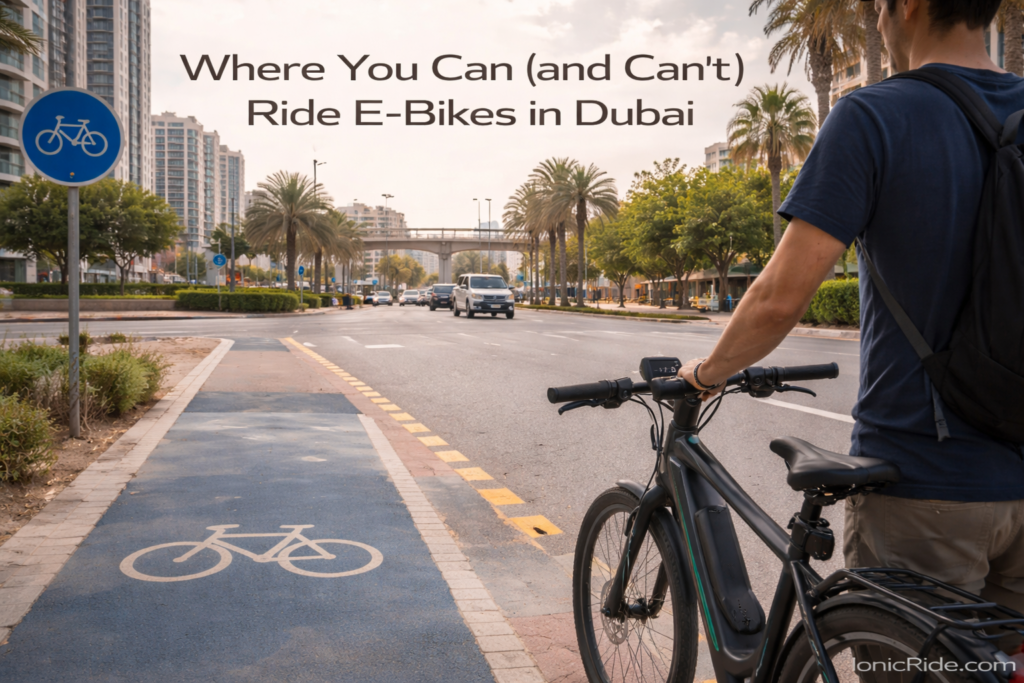
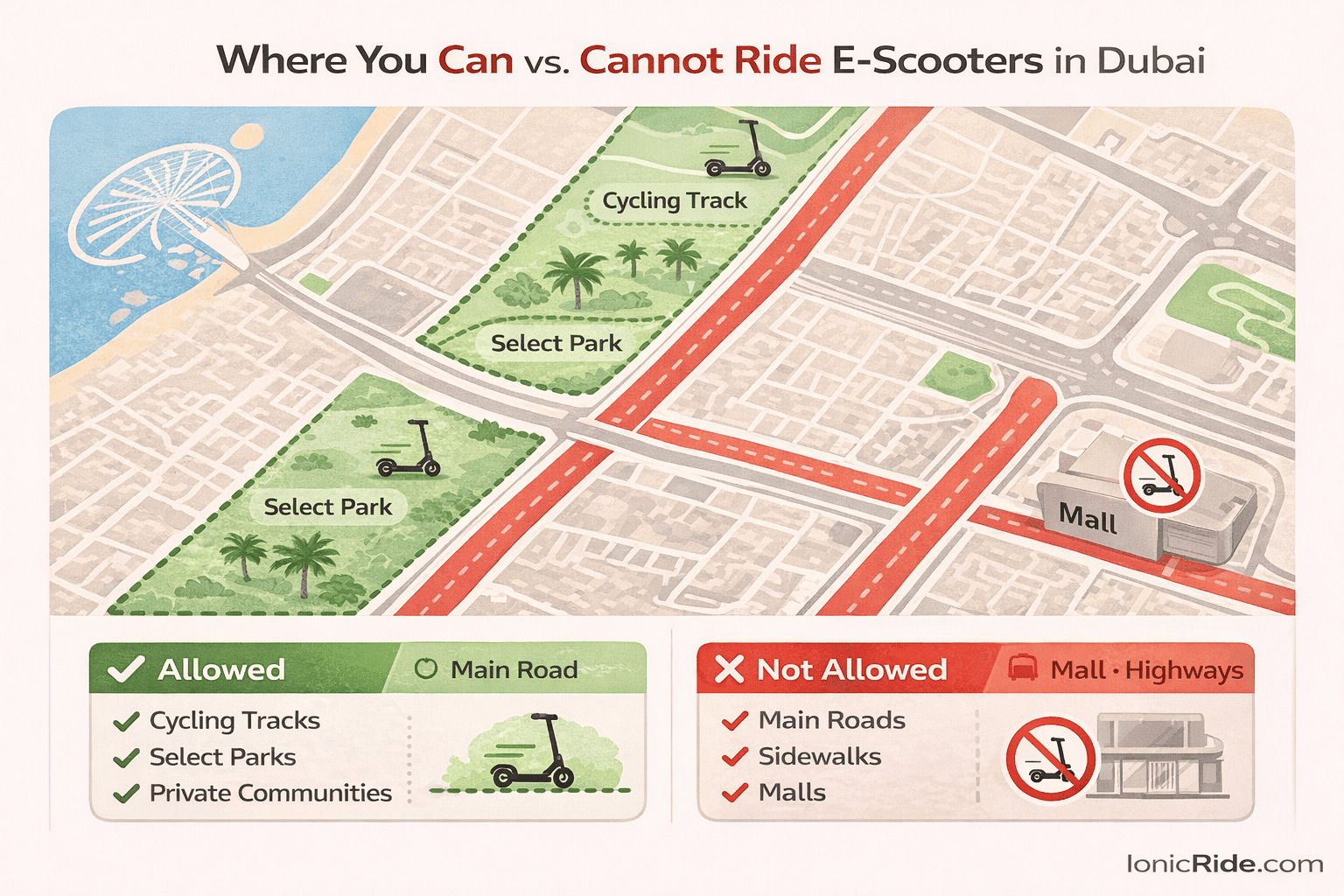
Here’s what you actually need to know. For a visual breakdown by area, see where you can (and can’t) ride in Dubai. .
Yes, e-scooters are legal in Dubai — with restrictions
E-scooters aren’t banned in Dubai. You can own one. You can ride one. But you can’t ride it everywhere, and there are rules about how and where you use it.
The confusion comes from the fact that different areas have different rules — and the RTA (Roads and Transport Authority) updates regulations periodically without making huge public announcements.
So let’s break it down clearly.
Where you CAN ride an e-scooter in Dubai
These are the officially permitted areas as of 2025:
Dedicated cycling tracks and paths
If there’s a designated cycling track — usually marked with painted lines or separate from the road — you’re allowed to ride there.
Examples: Dubai Marina, JBR beachfront, Al Qudra cycle track, Nad Al Sheba cycle track, parts of Jumeirah Beach Road.
These are your safest bet. The rules are clear, and you’re unlikely to get stopped.
Parks and recreational areas (where permitted)
Some parks allow e-scooters on internal paths. Zabeel Park and Al Barsha Pond Park, for example, have sections where you can ride.
But not all parks allow them. Check the signs at the entrance or ask security. If there’s no clear “no e-scooter” sign and you see others riding, you’re probably fine.
Private property and communities
If you live in a gated community — Arabian Ranches, The Springs, Dubai Marina residential areas — you can usually ride within the community.
But that’s up to the community management, not the RTA. Some allow it. Some don’t. Check with your building or community security.
If you’re riding in a new area and not sure if it’s allowed, look around. Do you see others on e-scooters or e-bikes? Are there bike lanes or shared paths? That’s usually a good indicator you’re in a safe zone.
Where you CANNOT ride an e-scooter in Dubai
This is where people get into trouble.
Main roads and highways
You cannot ride an e-scooter on Sheikh Zayed Road, Al Khail Road, or any major highway. This should be obvious, but I’ve seen people try.
It’s dangerous. It’s illegal. Don’t do it.
Most public roads without dedicated cycle lanes
This is the gray area that causes confusion.
If you’re on a regular street in a residential neighborhood — no bike lane, just cars and sidewalks — technically you’re not supposed to ride an e-scooter there.
The rule is: e-scooters must use dedicated cycling infrastructure. If there’s no cycling track, you’re supposed to walk or use another mode of transport.
Do people ride e-scooters on neighborhood streets anyway? Yes. Do they always get stopped? No. But if a police officer sees you, they can issue a fine. Whether they do depends on the area, the time of day, and how you’re riding.
Sidewalks (mostly)
Sidewalks are technically for pedestrians. E-scooters are supposed to use bike lanes, not sidewalks.
That said — enforcement on sidewalks is inconsistent. In busy areas like JBR or Dubai Marina, riding on the sidewalk is more likely to get you stopped. In quieter residential streets, less so.
But the official rule is: don’t ride on sidewalks unless there’s a shared pedestrian/cycle path clearly marked.
Inside malls and indoor spaces
You can’t ride inside Dubai Mall, Mall of the Emirates, or any other shopping center. Some malls won’t even let you bring the e-scooter inside — you have to leave it at the entrance or in your car.
This varies by mall. Dubai Mall is strict. Smaller neighborhood malls are more relaxed. But assume you can’t ride indoors unless you see others doing it.
The technical requirements (what the RTA says)
Even in areas where e-scooters are allowed, there are rules about the scooter itself.
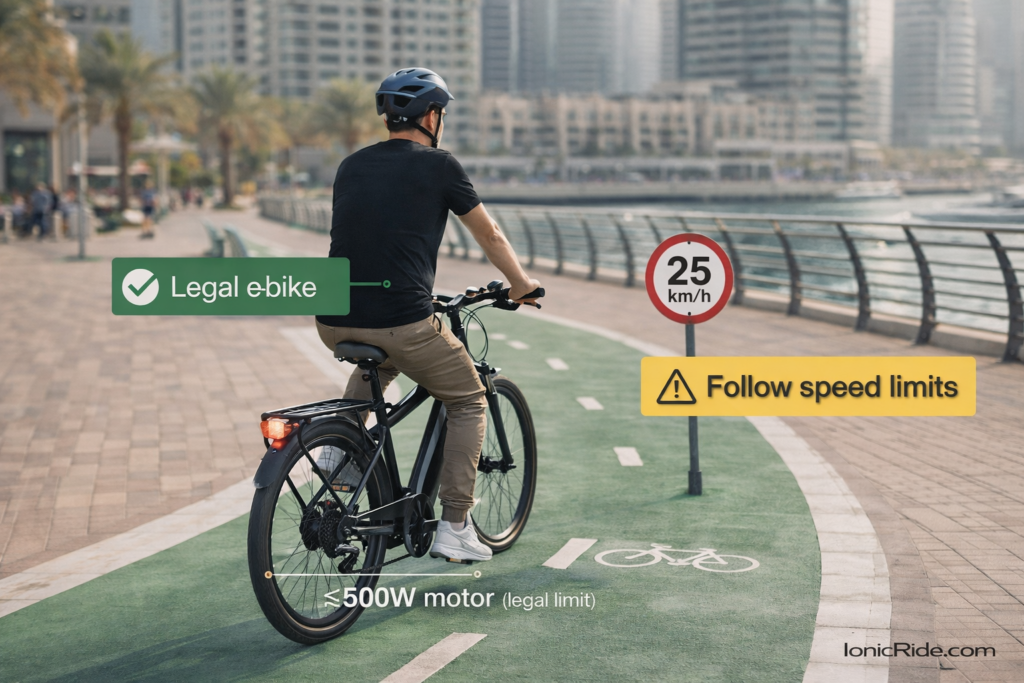
- Maximum speed: 20 km/h in permitted areas
- Age limit: Must be 16+ to ride (some sources say 14+, enforcement is unclear)
- Safety gear: Helmets recommended, not legally required (but this could change)
- Lights: Front white light and rear red light if riding after dark
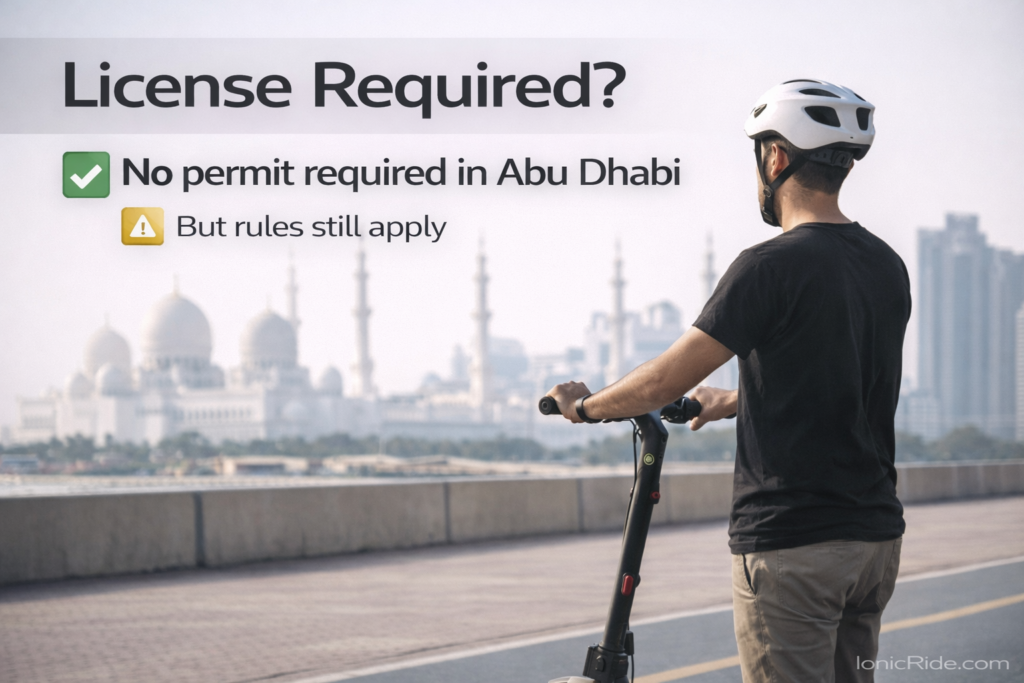
- Registration: Not required for personal e-scooters under 20 km/h
Most consumer e-scooters sold in Dubai are capped at 20–25 km/h, so you’re probably fine on speed. But if you’ve modified yours to go faster, that’s technically illegal — and more likely to get you fined if stopped.
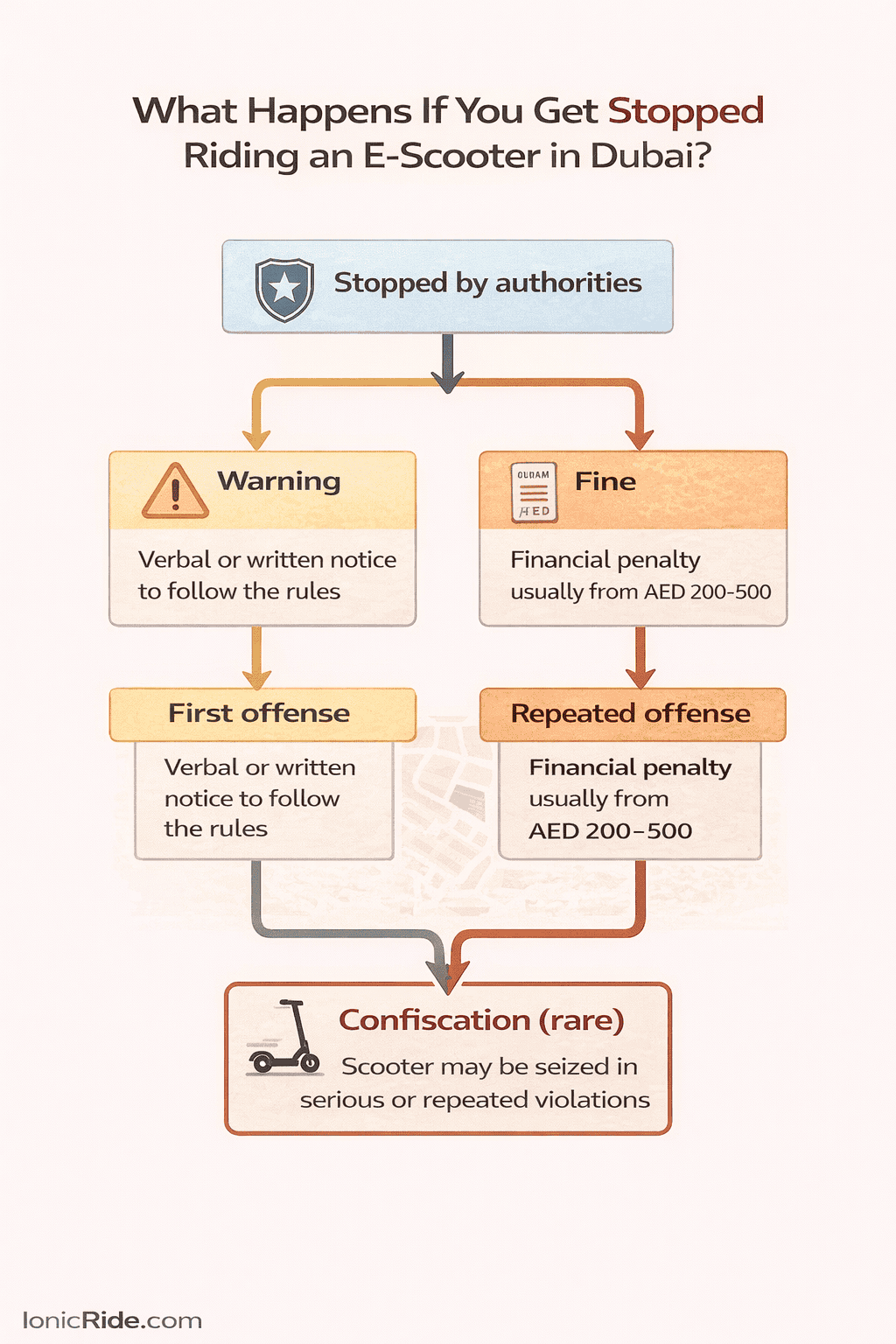
What happens if you get stopped?
I’ve had customers get stopped. Here’s what usually happens.
Scenario 1: Warning
If you’re in a borderline area — neighborhood street, not causing problems, riding safely — the officer might just tell you to walk the scooter to a permitted area or go home.
No fine. Just a warning. This is common in less busy areas.
Scenario 2: Fine
If you’re riding on a main road, being reckless, or in a high-traffic area where enforcement is strict, you’ll get fined.
The fine for riding an e-scooter in a prohibited area is typically AED 200–500, depending on the violation.
If you’re under 16 (or 14, depending on interpretation), the fine could be higher — and your parents might get called.
Scenario 3: Confiscation (rare)
In extreme cases — riding on a highway, repeated violations, causing an accident — the police can confiscate the scooter.
You’ll have to go to a police station to retrieve it, pay fines, and possibly sign paperwork saying you won’t do it again.
This is rare. But it happens.
If you cause an accident while riding in a prohibited area, you could be held liable for damages. Insurance typically doesn’t cover e-scooter accidents on public roads, so any medical or property damage costs fall on you.
The difference between e-scooters and e-bikes
This confuses people, so let’s clarify.
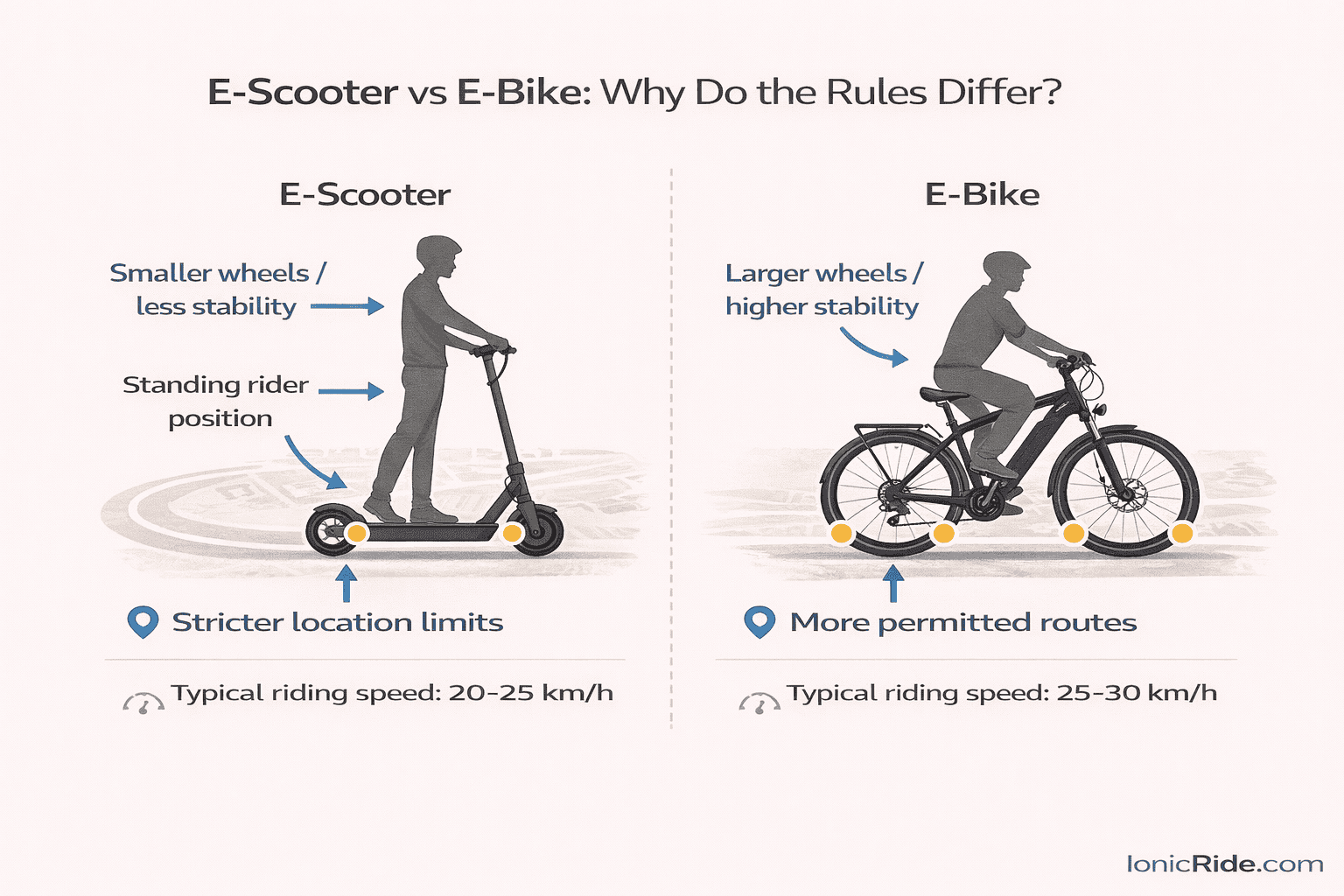
E-scooters (stand-up scooters): More restricted. Must stay on cycling tracks and permitted areas. Not allowed on most public roads.
E-bikes (electric bicycles): More freedom. Can use bike lanes and some roads, depending on motor power and speed. Rules are slightly more lenient because e-bikes are closer to traditional bicycles.
If you’re deciding between the two and plan to commute on roads, an e-bike gives you more flexibility legally. This comparison breaks it down honestly: e-bike vs e-scooter in the UAE.
Where can you actually commute in Dubai on an e-scooter?
If you’re thinking about using an e-scooter to get to work or run errands, here’s the reality:
✓ Realistic for commuting:
- Dubai Marina → JBR (cycle paths)
- Within Business Bay on community roads
- Around Downtown Dubai internal roads
- Within large residential communities
- Short distances with cycle track access
✗ Not realistic for commuting:
- Crossing Sheikh Zayed Road
- Deira ↔ Bur Dubai routes
- Most Sharjah → Dubai routes
- Areas with no cycling infrastructure
- Long distances on main roads
If your commute requires crossing major roads or traveling long distances without bike lanes, an e-scooter probably isn’t the right tool. You’ll spend more time walking it or risking fines than actually riding.
Will the rules get stricter or more relaxed?
Hard to say. The RTA has been slowly expanding cycling infrastructure — more bike lanes, more dedicated paths, better connectivity between areas.
As that infrastructure grows, e-scooters will become more practical. But the rules might also get stricter about where you can and can’t ride.
Right now, enforcement is inconsistent. That could change if accidents increase or if complaints from pedestrians go up.
My guess? Over the next few years, Dubai will get more e-scooter-friendly in designated areas, but stricter about keeping them off sidewalks and main roads.
So — should you ride an e-scooter in Dubai?
If you live or work near cycling tracks, parks, or well-connected communities with bike infrastructure — yes. This becomes especially practical when combined with Metro rules covered here: Dubai Metro + e-scooter rules. E-scooters are great for short trips in those areas.
If your route requires riding on main roads, sidewalks, or areas with no cycling paths — probably not. You’ll be in a legal gray area at best, and at worst you’ll get fined or cause an accident.
The rule of thumb: if you see dedicated bike lanes or other riders using them, you’re probably safe. If you’re the only one on a scooter and everyone else is in cars, you’re probably in the wrong place.