E-Scooter Loses Power Going Uphill: Why and How to Fix It Dubai
E-Scooter Loses Power Going Uphill: Why and How to Fix It Dubai
You’re riding your e-scooter up a bridge, a ramp, or the slightest incline and the scooter slows down dramatically. Sometimes it stutters. Sometimes it cuts out completely and you have to walk it to the top. On flat ground it’s fine — but the moment there’s a grade, the power drops.
This is one of the most frustrating issues because it’s not always clear whether it’s a problem with your scooter or just a limitation of the model. Dubai has pedestrian bridges over Sheikh Zayed Road, ramps in parking structures, and the Business Bay Canal bridge. None of them are steep by Dubai standards — but your scooter struggles with all of them. You don’t know if the battery is dying, the motor is weak, or if this is just how the scooter performs under load.
Here’s the full breakdown: why e-scooters lose power on inclines, which causes are normal vs fixable, and what you can actually do about it in Dubai heat.
Is It Normal or Is It a Problem?
First thing: some power loss on hills is completely normal and expected. E-scooters are not cars. A 300W motor pulling 90kg up a 10° incline is working harder than it was ever designed to work for sustained periods. Here’s how to tell if what you’re experiencing is normal performance vs a fixable fault.
Normal vs Problem: Power Loss on Hills
Diagnosis| Situation | Normal | Problem |
|---|---|---|
| Scooter slows from 25 km/h to 15–18 km/h on a moderate incline | Yes — expected | No issue |
| Scooter slows from 25 km/h to under 10 km/h on a gentle incline | Maybe — depends on rider weight and motor power | Check battery and motor |
| Scooter cuts out completely mid-hill and won’t restart until you’re on flat ground | No — thermal cutoff or battery sag | Yes — diagnose now |
| Power loss is worse when battery is below 50% | Yes — voltage sag under load | Battery may be degraded if it happens above 50% too |
| Scooter handled the same hill fine a month ago but struggles now | No — something changed | Battery degradation or motor issue |
Take your scooter to the same hill at different battery levels — 100%, 70%, 40%, 20%. If performance is consistent until you hit 20–30%, that’s normal voltage sag. If performance drops significantly above 50% charge, the battery is degraded. If it struggles even at 100%, it’s either a weak motor for your weight or a controller/motor fault.
The Real Reason: Battery Voltage Sag
Here’s the thing…
Battery voltage sag is the number one reason e-scooters lose power uphill — and it’s physics, not a fault. When you ask the motor for maximum power (which is what uphill riding demands), the battery voltage drops temporarily under the high current draw. A 36V battery at 80% charge might drop to 32V or even 30V under heavy load. The controller reads that voltage drop and limits power to protect the battery from damage.
This is why the scooter slows down on hills but recovers on flat ground — the load decreases, the voltage comes back up, and the controller allows full power again. In Dubai heat, this effect is worse because hot batteries have higher internal resistance, which causes more voltage sag for the same current draw.
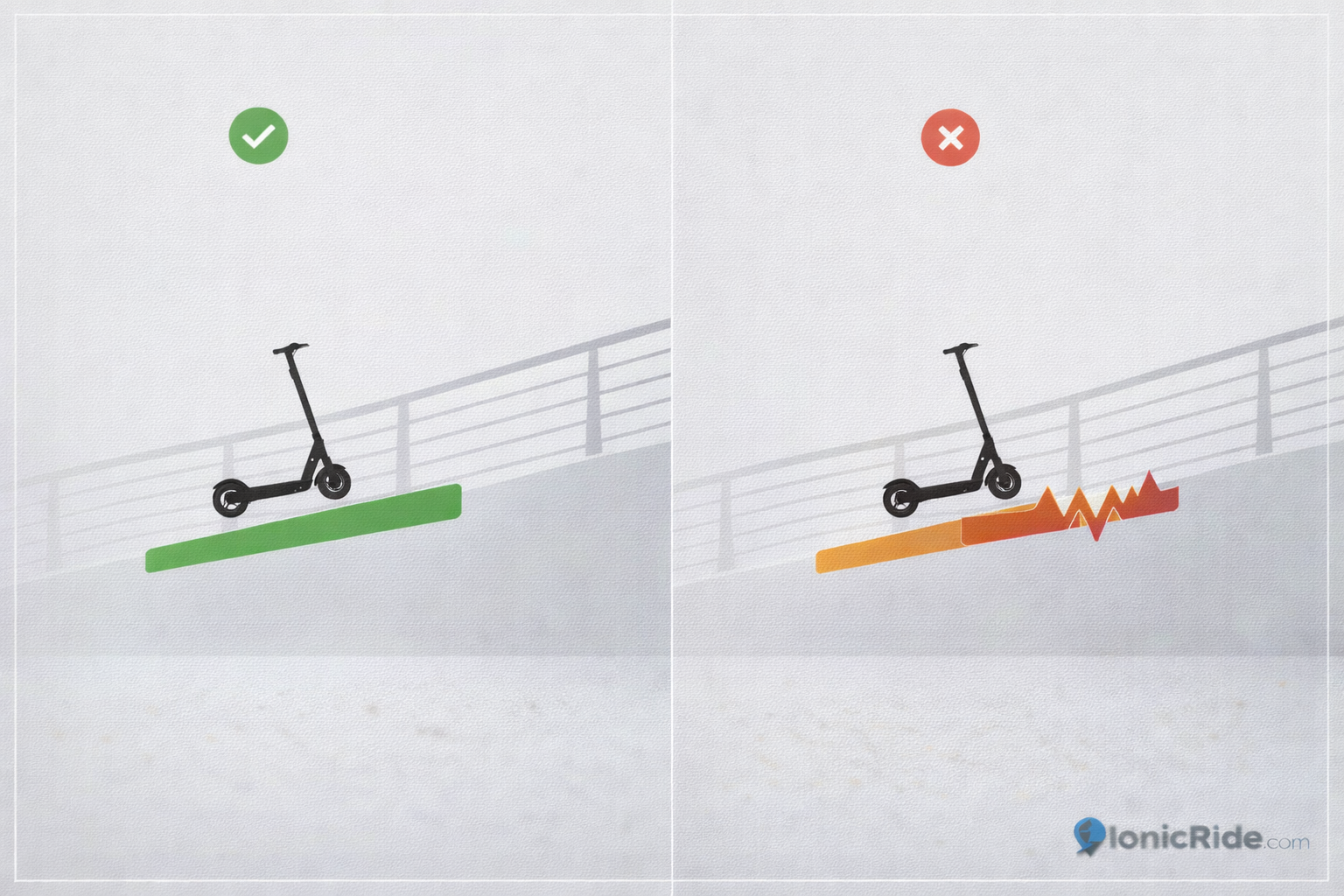
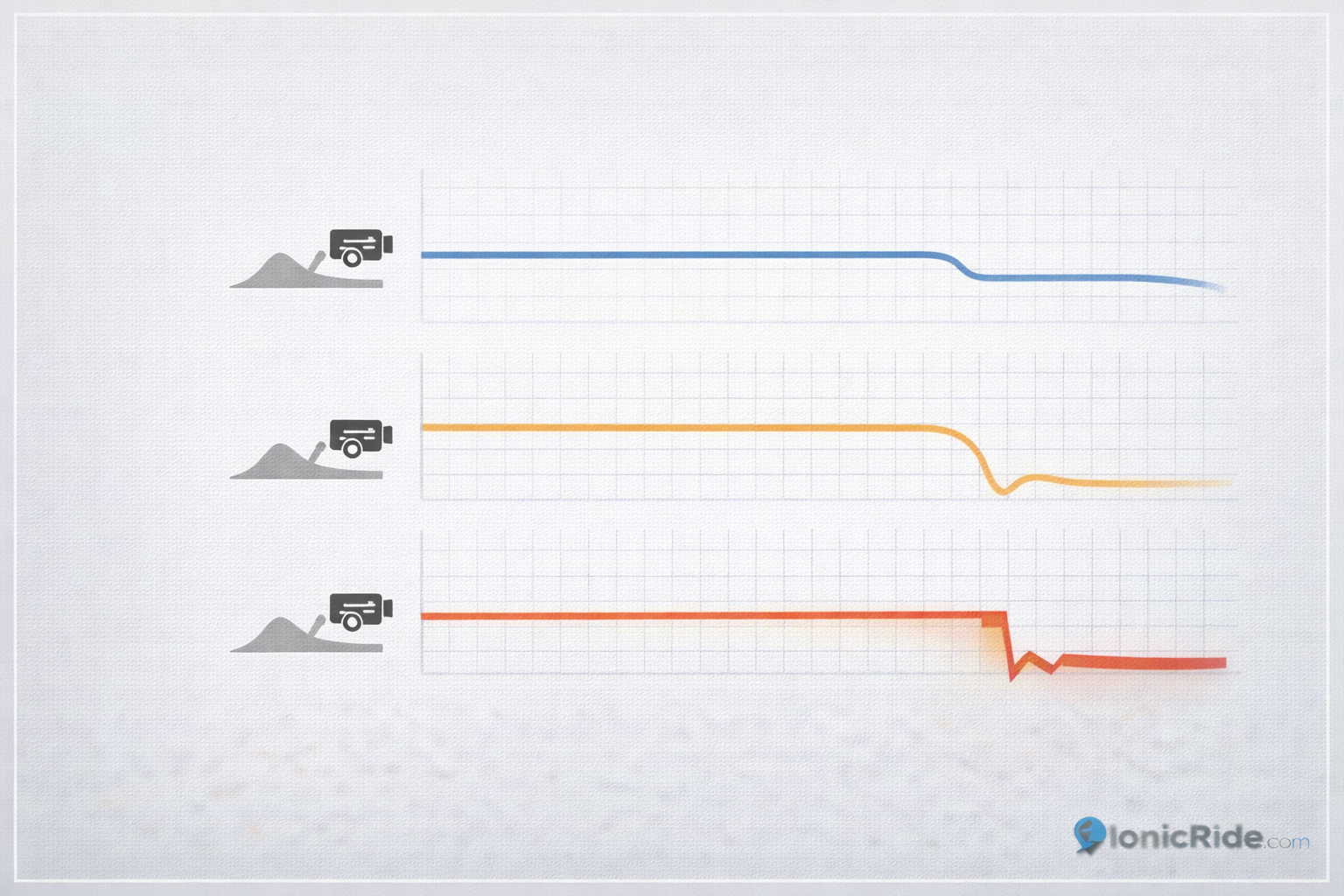
Minimal Voltage Sag — Good Hill Performance
A new or well-maintained battery holds voltage better under load. You’ll see a 2–4V drop on a steep hill but it recovers quickly and the scooter maintains decent speed. This is the best-case scenario and how the scooter performed when it was new.
Moderate Voltage Sag — Poor Hill Performance
A battery that’s been through 6–12 months in Dubai heat has higher internal resistance. The voltage drop under load is 6–8V or more. The controller cuts power significantly to protect the battery. You slow to a crawl on moderate hills. This is battery degradation, not a motor problem.
Severe Voltage Sag — Scooter Cuts Out
The battery voltage drops so low under load that the controller shuts down completely to prevent damage. The scooter cuts out mid-hill. You have to wait 30 seconds for the voltage to recover before it will restart. This battery is done — it needs replacing. Riding it like this risks complete failure and potential fire if the BMS fails.
Battery showing signs of degradation? Full replacement guide with costs: E-Scooter Battery Replacement Dubai: Cost, Lifespan & Which Batteries Actually Last
Motor Power vs Rider Weight vs Hill Grade
The second factor is simply whether your scooter has enough motor power for your weight and the grade you’re trying to climb. E-scooter marketing spec sheets are optimistic at best and misleading at worst. “Climbs 15° hills” doesn’t tell you at what speed or with what rider weight.
Motor Power vs Hill Climbing Ability (Dubai Reality)
Real Performance| Motor Power | Rider Weight Under 70kg | Rider Weight 70–90kg | Rider Weight Over 90kg |
|---|---|---|---|
| 250W (budget scooters) | 5–8° at reduced speed | Struggle on anything over 5° | Walk it |
| 300–350W (Xiaomi Mi Pro 2, most mid-range) | 10° comfortable | 8–10° at 12–15 km/h | 6–8° slowly |
| 500W (Segway G30 Max, higher-end) | 15° comfortable | 12–15° at decent speed | 10–12° manageable |
| 800W+ (Segway P100S, performance models) | 20°+ easily | 18–20° strong | 15° no issue |
Dubai’s bridges and ramps are typically 5–10° — not steep by global standards. But if you’re 85kg on a 300W scooter with a battery at 40% charge, a 10° ramp in 42°C heat is going to slow you down significantly. That’s not a fault — it’s physics.
Typical scenario: a heavier rider on a small-motor commuter scooter (around 300W) slows to walking pace on a steep pedestrian bridge. Nothing is broken. The motor is simply too small for that weight on that slope, and no repair or adjustment will change the power-to-weight ratio.
Dubai Heat Makes It Worse
Now here’s what most people miss…
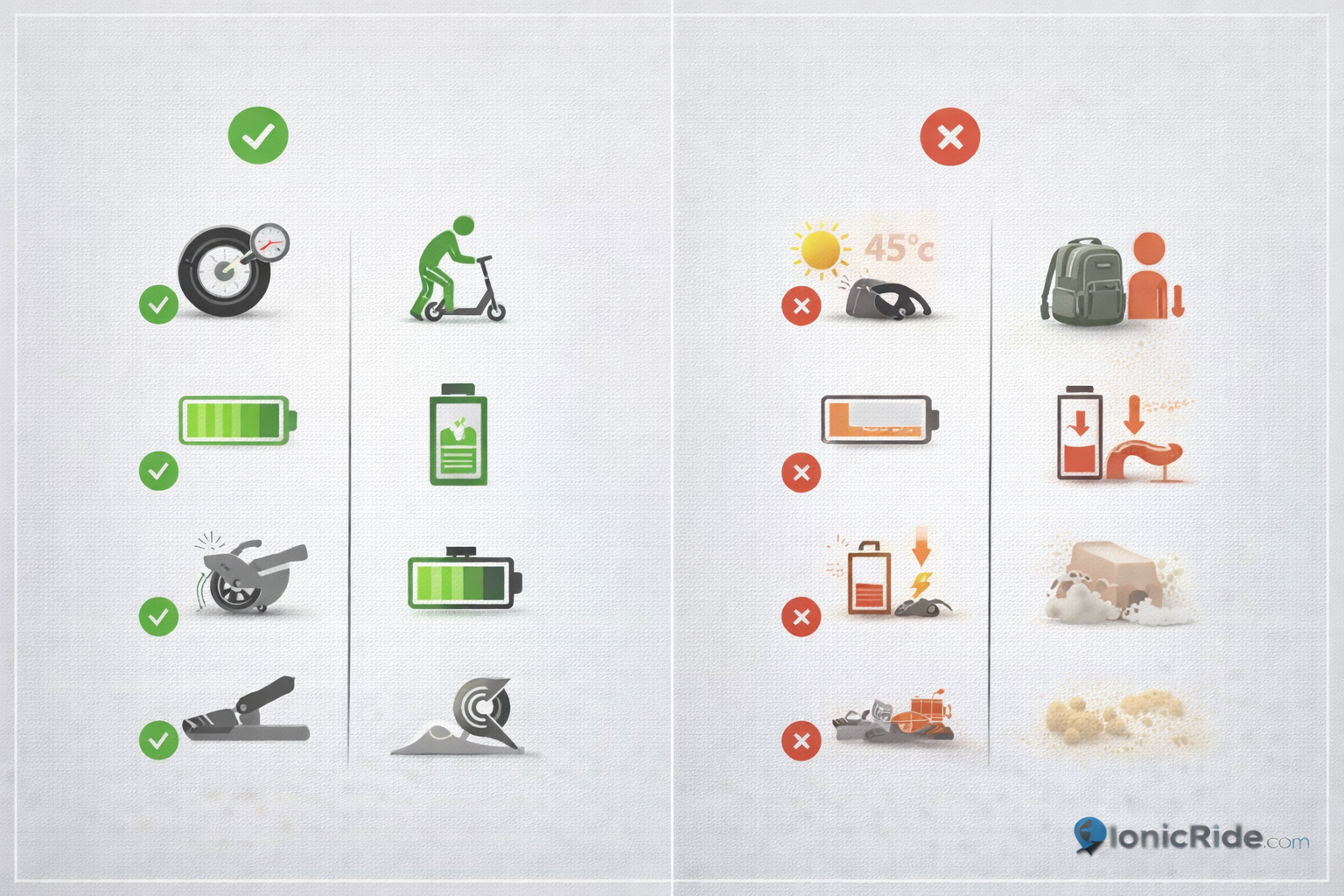
Dubai heat affects uphill performance in three ways. First, hot batteries have higher internal resistance — more voltage sag for the same load. Second, hot motors hit their thermal limit faster and the controller reduces power to prevent overheating. Third, you’re likely heavier in the afternoon (water retention, full stomach after lunch) than in the morning — even a 2–3kg difference changes the power demand.
✓ Maximise Hill Performance in Dubai
- Ride in the morning or evening — cooler temperatures mean better battery performance
- Keep battery above 50% if you know you’ll hit hills — voltage sag is worse when battery is low
- Reduce backpack weight — every kg counts on an incline
- Get a running start if safe — momentum helps carry you up the first part of the hill
- Use the lowest gear/mode if your scooter has multiple power modes — better torque at lower speeds
✗ What Makes It Worse
- Riding in peak heat (12pm–3pm) — battery and motor both suffer
- Starting the hill from a standstill — no momentum to help
- Using high-speed mode on a steep grade — the motor is optimised for speed, not torque
- Carrying heavy loads in a backpack — adds significant weight
- Tyres under-inflated — more rolling resistance
What You Can Actually Fix
If your scooter used to handle hills fine and now struggles, or if the power loss seems excessive for the grade and your weight, here’s what to check and fix.
- Check tyre pressure. Under-inflated tyres add rolling resistance. Inflate to the max PSI listed on the tyre sidewall. In Dubai heat, check pressure weekly — air expands and tyres can be over-inflated in the afternoon.
- Check for brake drag. If the brakes are rubbing slightly, they create constant resistance that’s barely noticeable on flat ground but kills you on hills. Spin each wheel by hand — it should spin freely for several rotations. If it stops quickly or you hear rubbing, adjust the brakes.
- Test the battery at different charge levels. If performance is terrible even at 80–100% charge, the battery is degraded. A healthy battery should give strong hill performance above 60% charge. Below that, some power loss is normal.
- Check motor temperature after a hill climb. If the motor is too hot to touch (over 60°C), it’s hitting thermal limits and the controller is cutting power to protect it. This is normal on long sustained climbs in Dubai heat but shouldn’t happen on short bridge crossings.
- Check the controller settings (if accessible). Some scooters let you adjust power delivery through the app or display. If it’s set to “Eco” mode, switch to “Sport” or “Turbo” for hills. Eco mode limits current draw which kills hill performance.
- Reduce weight. Every kg you’re carrying matters. Empty your backpack of non-essentials. If you’re carrying a laptop, water bottle, and lunch, that’s an extra 3–5kg the motor has to pull uphill.
If you commute daily and your route includes hills, invest in a scooter with at least 500W of motor power. The price difference between a 300W and a 500W scooter is AED 500–800 but the hill performance difference is night and day. You can’t upgrade the motor on an existing scooter — it’s designed as a complete system with the controller and battery. The only real fix for weak hill performance is a more powerful scooter.
When It’s Not Fixable
Sometimes the power loss on hills is just a limitation of the scooter you have. If you’ve checked everything and the scooter is working correctly but still struggles, you have three options.
Accept It and Plan Routes Around Hills
Dubai is mostly flat. If you can avoid the bridges and ramps, you avoid the problem. Use Google Maps cycling directions and look for routes that stay on flat ground. It adds time but it works.
Walk the Hills
Get off and walk the scooter up steep sections. It’s slower but it’s less frustrating than crawling at 5 km/h while riding. And it saves battery for the rest of the ride. Most Dubai bridges are short — 50–100 metres — so it’s not a massive detour in time.
Upgrade to a More Powerful Scooter
If hills are unavoidable on your commute and walking them every day isn’t viable, you need a scooter with more motor power. A 500W or 800W scooter will handle Dubai’s inclines without issue. That’s a AED 2,500–4,500 investment but it solves the problem permanently.
Need help diagnosing whether it’s battery, motor, or just normal performance? Shop directory: E-Scooter Repair Dubai: 20 Shops with Prices, Reviews, Wait Times
Power loss on hills is mostly normal and physics-based. Battery voltage sag under load is the main cause — hot batteries in Dubai heat make it worse. If your scooter used to climb fine and now struggles, the battery is degraded. If it never climbed well, the motor is too weak for your weight.
You can’t add more power to a weak motor. You can’t make a degraded battery perform like new without replacing it. What you can do: keep tyres inflated, ensure brakes aren’t dragging, ride when it’s cooler, and keep battery above 50% if you know hills are coming.
Dubai’s bridges and ramps are 5–10° typically. A 300W scooter with a 70–80kg rider should handle them at 12–15 km/h. If you’re slower than that at 80% battery charge, either the scooter is underpowered for your weight or something is broken. Test it when it’s new so you know what normal performance looks like — then you’ll know when degradation starts.
Hills aren’t the issue but range is dying faster than it used to?
Battery degradation shows up as both power loss and range loss. Here’s how to tell if your battery needs replacing.
Similar Posts
Xiaomi Scooter Repair Dubai: Official Service vs Local Shops (Cost Compare)
Xiaomi Scooter Repair Dubai: Official Service vs Local Shops (Cost Compare) Troubleshooting & Repair Xiaomi Scooter Repair Dubai: Official Service vs Local Shops (Cost Compare) 9 min read January 2026 By Alex at IonicRide Your Xiaomi scooter broke down. You googled “Xiaomi scooter repair near me” in Dubai and got two options: go to an…
E-Scooter Beeping Continuously: 15 Beep Codes Decoded (All Brands Dubai)
E-Scooter Beeping Continuously: 15 Beep Codes Decoded (All Brands Dubai) Troubleshooting & Repair E-Scooter Beeping Continuously: 15 Beep Codes Decoded (All Brands Dubai) 10 min read January 2026 By Alex at IonicRide Your e-scooter won’t stop beeping. It’s been going since you turned it on — or it started mid-ride and now it’s driving you…
What Is BMS in E-Scooter? (Battery Management Explained for Dubai Heat 2026)
What Is BMS in E-Scooter? (Battery Management Explained for Dubai Heat 2026) What Is BMS in E-Scooter? (Battery Management Explained for Dubai Heat 2026) The four core jobs of a BMS — protection, temperature control, cell balancing, and safe charging — especially critical in Dubai’s heat. Your e-scooter battery stopped charging. You take it to…
Why Your E-Bike Feels Sluggish After 6 Months
Why Your E-Bike Feels Sluggish After 6 Months Why Your E-Bike Feels Sluggish After 6 Months Six months ago, your e-bike was fast. Responsive. Fun to ride. Now? It feels… tired. Acceleration is slower. Top speed isn’t what it used to be. The battery drains faster. Nothing broke. Nothing failed. It just doesn’t feel the…
E-Scooter Battery Not Charging Dubai 2026: 12 Reasons & Solutions (Heat Issues)
E-Scooter Battery Not Charging Dubai 2026: 12 Reasons & Fixes (Heat Issues) E-Scooter Battery Not Charging Dubai 2026: 12 Reasons & Fixes (Heat Issues) Troubleshooting & Repair E-Scooter Battery Not Charging Dubai 2026: 12 Reasons & Solutions (Heat Issues) 11 min read February 2026 By Alex at IonicRide Your e-scooter plugs in… and nothing happens….
E-Scooter Making Noise: Squeaking, Rattling, Grinding
E-Scooter Making Noise: Squeaking, Rattling, Grinding — What Each Sound Means Dubai Troubleshooting & Repair E-Scooter Making Noise: Squeaking, Rattling, Grinding — What Each Sound Means Dubai 9 min read January 2026 By Alex at IonicRide Your e-scooter is making a noise it didn’t make before. A squeak when you brake. A rattle from the…