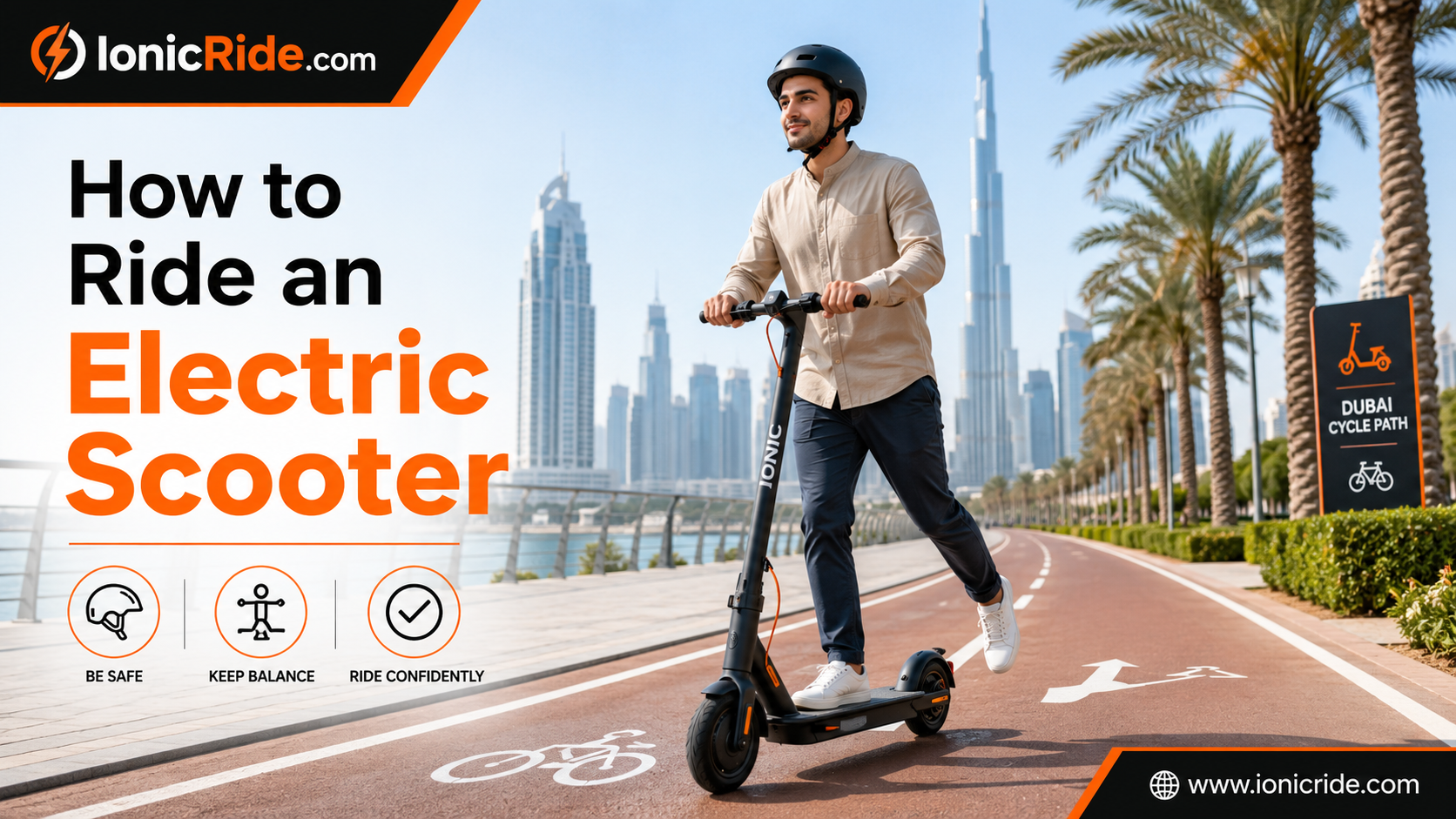
How to Ride an Electric Scooter
How to Ride an Electric Scooter: Complete Beginner’s Guide (Step by Step)
Riding an electric scooter comes down to five things: a staggered stance, a kick-off to rolling speed, a gentle press of the throttle, braking with your weight shifted back, and turning by leaning — not yanking the handlebars.
Most beginners are riding comfortably within 10–30 minutes. E-scooters are genuinely easier to learn than bicycles — there’s no pedalling, and the deck is low. What separates a smooth first ride from a bruised one isn’t balance; it’s knowing three or four things before you press the throttle.
This guide is those things: the pre-ride check, the 7-step first ride, throttle and brake technique, turning properly, and the beginner mistakes I watch happen outside my workshop every single week.
⚡ Quick Answer — Riding an E-Scooter in 5 Moves
Before You Ride: Gear and the 60-Second Check
The Gear That’s Actually Non-Negotiable
You don’t need a racing suit for a first ride at walking pace. You do need:
- A certified helmet. Roughly a third of e-scooter injuries are head injuries, and most riders in accident statistics weren’t wearing one. A bicycle helmet is fine up to ~20 km/h. It’s also mandatory in Dubai — our helmet guide covers what to buy.
- Flat, closed-toe shoes. You need to feel the deck and grip it. No sandals, no flip-flops — I’ve seen the toe injuries.
- Optional but smart for the first sessions: gloves (your hands hit the ground first in any fall) and knee pads if you’re nervous.
The 60-Second Pre-Ride Check
Do this before your first ride and, honestly, before every ride — it becomes automatic within a week:
- Tyres — firm pinch test, or a gauge if pneumatic. Soft tyres are the hidden cause of wobbly steering, poor braking and drained batteries.
- Brakes — squeeze both levers; the wheel should stop firmly when you push the scooter forward.
- Folding stem locked — listen for the click and physically tug the stem. A stem that folds mid-ride is a genuinely nasty crash.
- Battery level — enough for your route plus margin; performance drops as charge falls.
- Mode set to slowest — Eco or Pedestrian mode for every learning session.
Before your first powered ride, push around on the scooter with the power off, like a plain kick scooter, for two or three minutes. You’ll learn the balance, the steering feel and the brake pull with zero risk — it’s the single best confidence trick for nervous beginners.
Know Your Controls (2 Minutes That Prevent Most Falls)
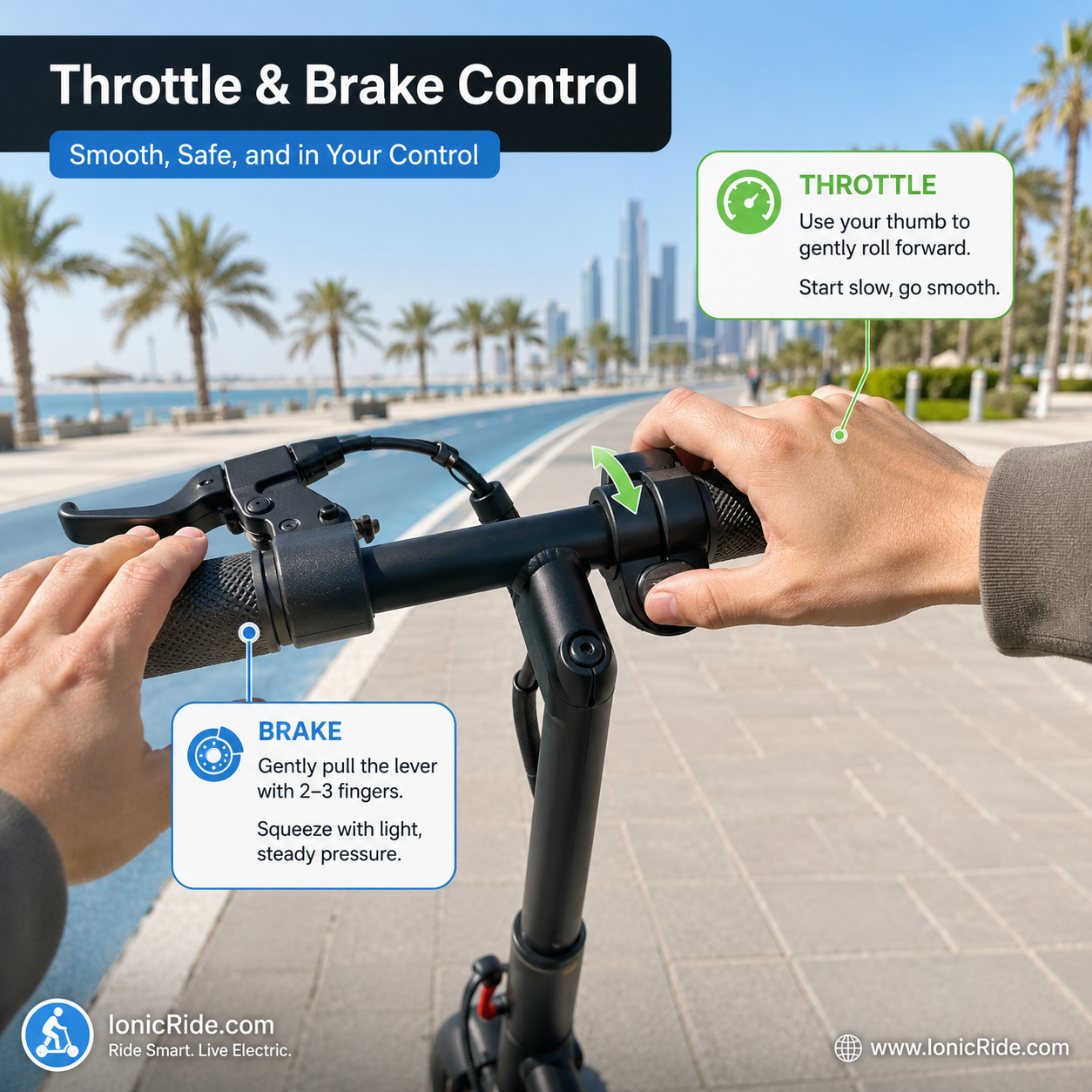
- Throttle — usually a thumb lever or twist grip on the right. This is the control beginners abuse; treat it like a dimmer switch, not an on/off button.
- Brakes — typically a hand lever (front or rear disc/drum), sometimes plus a rear fender you press with your foot, and often regenerative braking that slows you when you release the throttle. Learn which lever does what before moving.
- Zero-start vs kick-to-start — most modern scooters won’t engage the motor from a standstill; you must be rolling at ~3–5 km/h first. This is a safety feature, not a fault. If your throttle “doesn’t work” while stationary, this is why.
- Riding modes — Eco/Drive/Sport on most models. Learn in the slowest; it caps your speed while your instincts catch up.
- Bell, lights, display — find them now, not while moving.
Your First Ride: The 7-Step Method
Find an empty car park or quiet paved area — smooth surface, no traffic, no pedestrians, ideally early morning. Then work through these in order:
- Do the 60-second check — tyres, brakes, stem lock, battery, slowest mode. Helmet on.
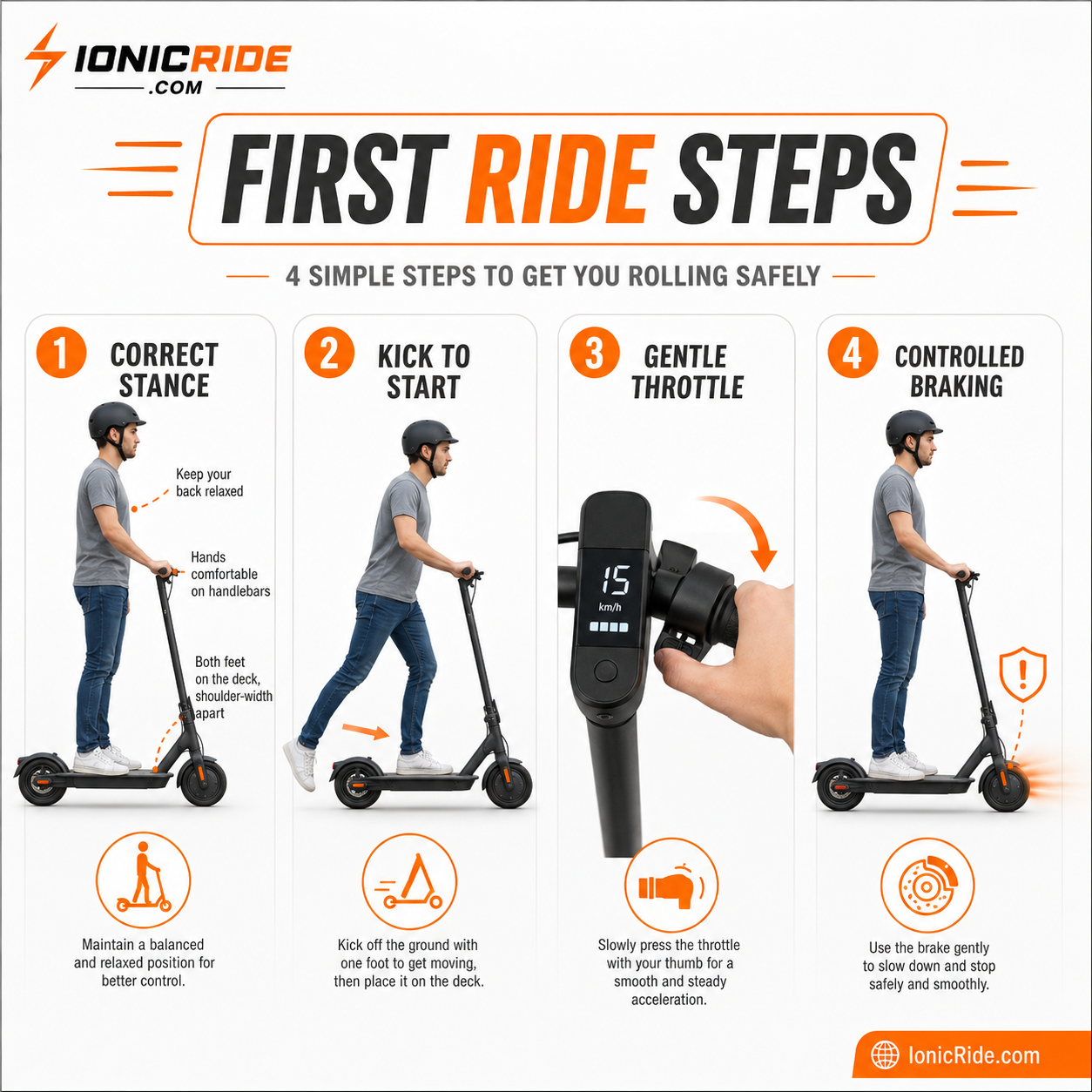
- Take the staggered stance. Stronger foot forward on the deck pointing ahead, rear foot behind it at a slight angle — a relaxed skateboard stance. Knees soft, elbows loose, both hands on the bars. Feet side by side facing forward is the classic beginner mistake — it leaves you nowhere to go when the scooter accelerates or brakes.
- Kick off to a slow roll. Push off the ground with your rear foot exactly like a kick scooter, to about walking pace. On zero-start scooters this is required before the throttle will respond.
- Feather the throttle. Bring your rear foot onto the deck and press the throttle slowly — you’re asking the motor to take over from your kick, not launch you. Hold a steady 10–15 km/h and just ride straight lines until it feels boring.
- Practise stopping — early and often. Ease off the throttle, shift your hips slightly back, squeeze the rear brake first, then add front brake progressively. Repeat gentle stops until your stopping distance is instinctive. E-scooters stop slower than beginners expect.
- Learn the lean. At riding speed, initiate turns by leaning your body slightly into the curve with the bars nearly straight. Save actual handlebar steering for walking pace. And always: slow down before the turn, not during it.
- Add the real world gradually. Figure-8s, slalom around imaginary cones, emergency stops, looking over your shoulder while riding straight (harder than it sounds — and essential for traffic). Only when all of that is comfortable do you graduate to shared paths.
Throttle & Brake Control: The Skill That Actually Matters
Balance isn’t what beginners struggle with — control inputs are. Small wheels and instant electric torque punish sudden movements. Two habits fix almost everything:
Throttle: Less Is More
Electric motors deliver their power instantly — there’s no engine spooling up to warn you. A jab on the throttle lurches the scooter out from under your feet; that’s the classic first-ride fall. Apply pressure the way you’d turn up music at midnight: gradually, listening for the response. Smooth throttle also noticeably extends your range — spiky acceleration is the fastest way to drain a battery, something we cover in why real-world range is lower than claimed.
Braking: Weight Back, Rear First
Physics is against you here: short wheelbase, small wheels, your weight up high. Grab the front brake hard at speed and the scooter stops while you continue — over the handlebars. The sequence that works: off the throttle → hips slightly back → rear brake → front brake added progressively. Practise it at low speed until it’s muscle memory, because in a real emergency you’ll do whatever you practised. If your brakes feel weak or grabby, sort them before riding further — our guide to e-scooter brake problems and adjustment walks through it.
At 20 km/h a typical e-scooter needs several metres to stop cleanly — more on dusty or sandy patches, which act like marbles under small wheels. Ride at a speed where you could stop within the distance you can clearly see. That one rule quietly prevents most beginner accidents.
Riding in Dubai? The 60-Second Legal Version
Technique is universal; the rules aren’t. If you’re learning here in the UAE, the short version:
- UAE e-scooter age limit: 16+, helmet mandatory, 20 km/h max in designated areas, one rider per scooter.
- You need the free RTA permit — or a valid driving licence — before riding in public areas. It’s a 20-minute online course: our step-by-step permit guide shows every screen.
- Ride only in designated zones and tracks — the 21 legal zones map shows where. Enforcement patrols are active in 2026, and the fines run AED 200–500.
- Practising: a quiet corner of a designated track early morning, or genuinely private property, is your legal “empty car park.”
- Summer riders: learn at dawn or after sunset from June to September — our Dubai summer survival guide explains the heat rules that protect both you and the battery.
The 8 Beginner Mistakes I See Every Week
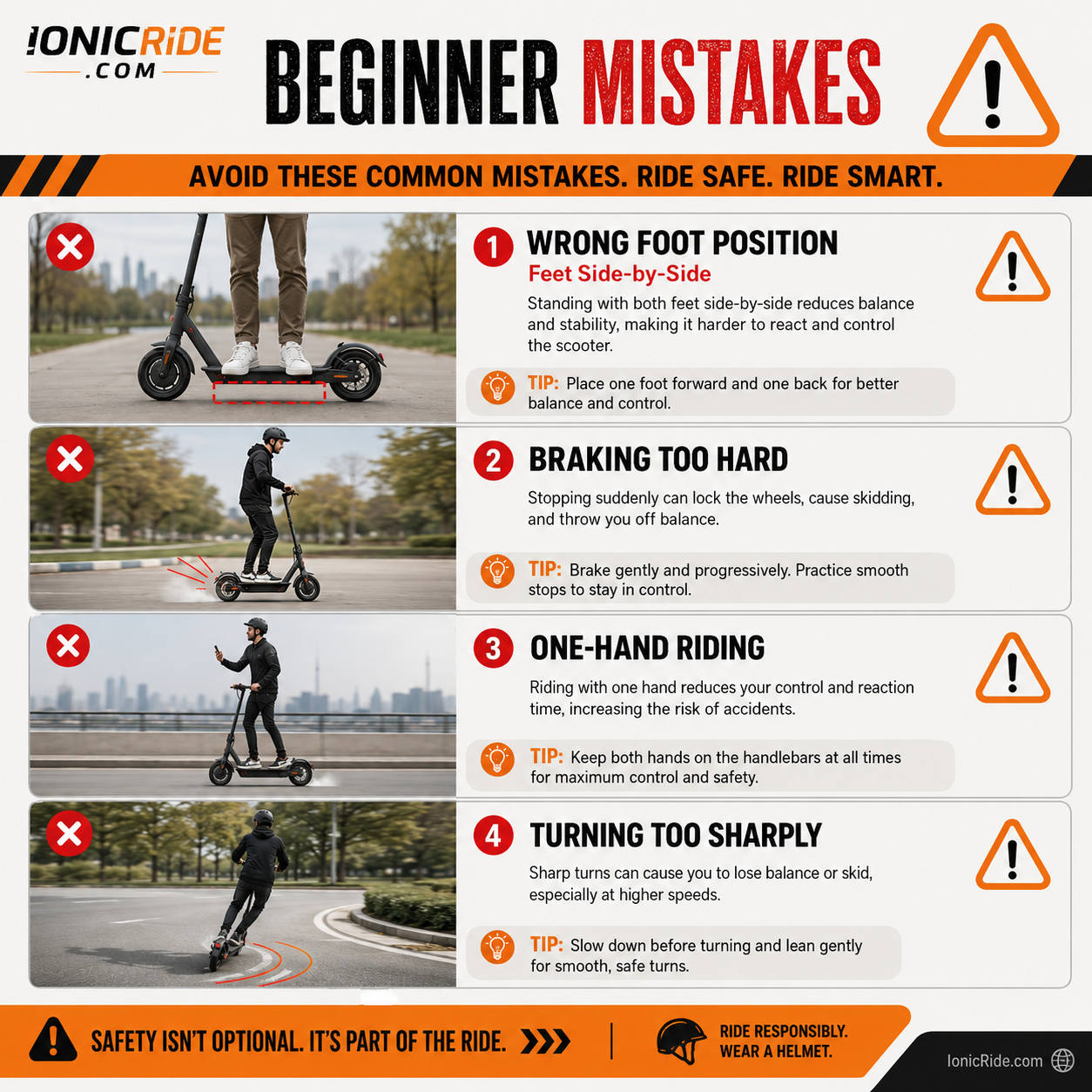
Feet side by side. The stance mistake behind most wobbles — stagger your feet, always.
Jabbing the throttle. Instant torque + sudden input = scooter leaves without you.
Grabbing the front brake. The over-the-handlebars special. Rear first, front gently.
Steering like a bicycle at speed. Small wheels react violently to handlebar input — lean instead.
Riding at full speed on day one. Speed you can’t stop from isn’t confidence, it’s a countdown.
Ignoring tyre pressure. Soft tyres cause more handling complaints in my workshop than any actual fault.
Kerbs, sand and paint lines at speed. Small wheels hate all three — slow down, cross at an angle, or dismount.
Phone in one hand. Both hands on the bars, every ride. No exceptions, and in Dubai it’s also a fine.
From First Ride to Traffic-Ready: A Simple Practice Plan
The Two-Week Beginner Plan
Go At Your Pace| Session | Where | Focus |
|---|---|---|
| 1–2 | Empty car park | Stance, kick-off, straight lines, gentle stops in slowest mode |
| 3–4 | Empty car park | Figure-8s, slalom, emergency stops, shoulder checks |
| 5–6 | Quiet track, off-peak | Riding around others, passing etiquette, bell use, predictable lines |
| 7+ | Your real routes | Short commutes at quiet times, building up to normal conditions |
Most people compress this into a week or two of short sessions. The graduation test: can you do an emergency stop, a tight U-turn, and a shoulder check without wobbling? Then you’re ready for the real world.
Still choosing your first scooter? Start with our best e-scooters by price range — beginner-friendly picks flagged in every tier — and kit up with the 10 must-have accessories.
The Bottom Line
Riding an e-scooter is easy — riding one well takes about two weeks of short, deliberate practice. Staggered stance, kick-off, feathered throttle, weight-back braking, lean-to-turn: that’s the whole skill.
The throttle and the front brake cause almost every beginner fall. Treat both like dimmer switches, practise emergency stops until they’re boring, and keep the speed inside your stopping distance.
Helmet on, slowest mode, empty space, then graduate gradually. Do it in that order and your first month will be all enjoyment and zero workshop visits — which, coming from the guy who runs the workshop, is honest advice against my own interest.
Riding Sorted? Make It Legal
In Dubai, the free RTA permit takes 20 minutes — get it before your first public ride.
Frequently Asked Questions
No — most people ride comfortably within 10–30 minutes, and it’s generally easier than a bicycle: no pedalling, low deck. The skills that need practice are smooth throttle control and confident braking, which is why the first session belongs in an empty car park, not traffic.
Power on, slowest mode, front foot on the deck, then push off with your rear foot like a kick scooter. Most scooters are zero-start — the throttle engages only once you’re rolling at roughly 3–5 km/h. Once rolling, bring your rear foot up and press the throttle gently so the motor takes over smoothly.
Both, by speed: steer with the bars at walking pace, lean at riding speed with the bars nearly straight. Small wheels react sharply to handlebar input at speed — over-steering is a common beginner fall. Slow down before the turn, not during it.
Off the throttle, weight slightly back, rear brake first, front brake added progressively. Grabbing the front hard at speed can send you over the bars. Practise smooth stops from low speed until braking distance is instinctive — e-scooters stop slower than beginners expect.
Basic riding: 10–30 minutes in a safe open area. Genuinely traffic-ready: a week or two of regular short rides. Give yourself two or three practice sessions before commuting on busy routes.
You need the free RTA e-scooter permit or a valid recognised driving licence, plus you must be 16+, wear a helmet, keep to 20 km/h and stay in designated areas. The permit is a short online course and test — about 20 minutes.
10–15 km/h in the slowest mode for your first sessions — fast enough to balance easily, slow enough to stop safely while instincts develop. In Dubai’s designated areas the legal limit is 20 km/h regardless of experience.
Depends on the scooter’s IP rating — and even then, wet surfaces sharply reduce small-wheel grip and braking. In the UAE, rare rain mixes with accumulated dust and oil to make roads especially slick. Beginners should simply avoid riding in or right after rain.
Staggered — front foot forward, rear foot angled behind, like a relaxed skateboard stance. Side-by-side feet is the most common stance mistake: it leaves you unstable under braking and acceleration. Staggered lets you shift weight naturally.
Almost certainly a zero-start scooter: the motor stays disengaged until you’re rolling at ~3–5 km/h. Kick off first, then throttle. If it still won’t respond while rolling, check the mode, battery level, and that a brake lever isn’t slightly engaged — then see our throttle troubleshooting guide.